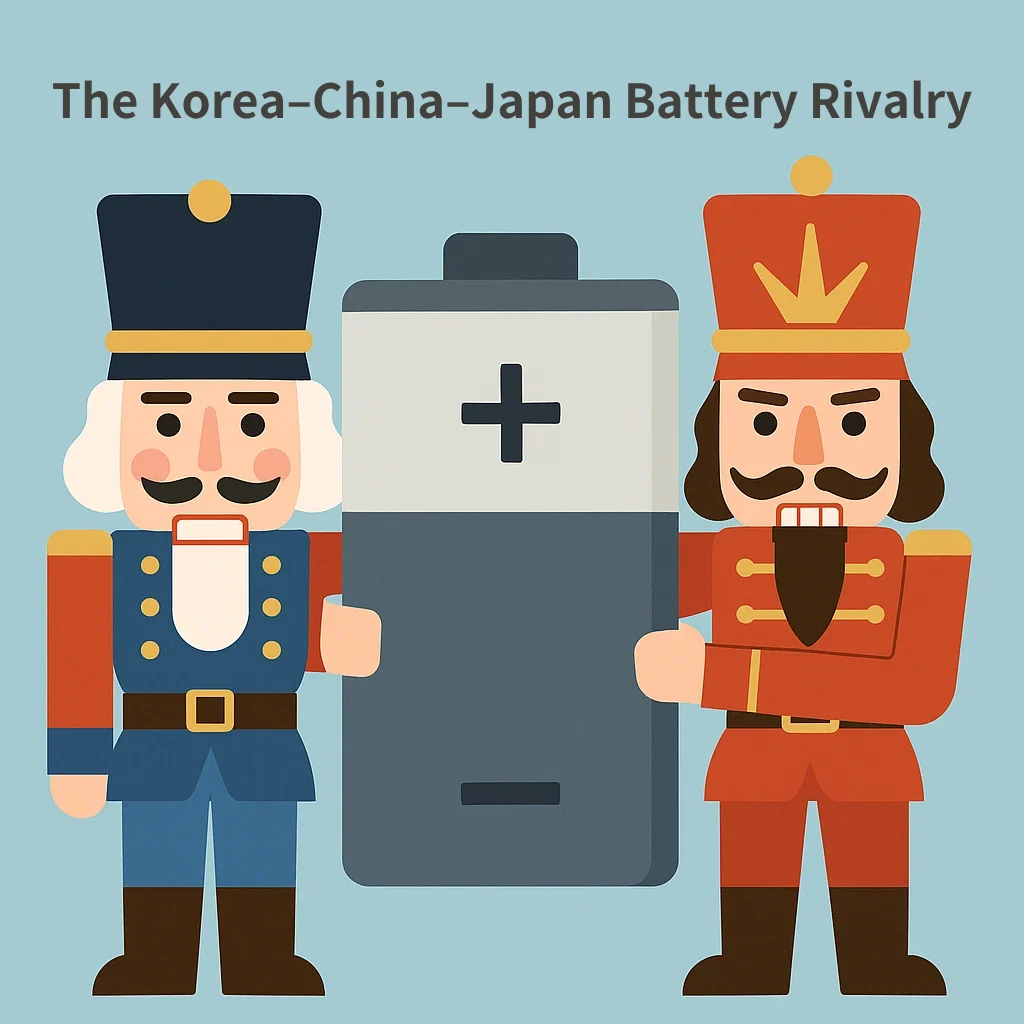
📌 What is a nutcracker? The trap Korea's battery industry has fallen into
📖 Economic term explained: "nutcracker"
A "nutcracker" is originally a tool that cracks walnuts by pressing them from both sides, but as an economic term it means a state of losing competitiveness while caught between advanced countries with superior technology and developing countries competing on low prices.
The term was often used after the Asian financial crisis to describe how Korea's export industries struggled between Japan and China, and after Abenomics the expression "new nutcracker" also appeared.
🔍 A recent case: the battery industry's "nutcracker"
According to a Maeil Business Newspaper article of June 19, 2025, there are warnings that even Korea's battery industry, once a global leader, has fallen into the "nutcracker".
👉 See the original article: Maeil Business Newspaper
⚡ Why is Korea's battery industry caught in the middle?
Korean companies have mainly produced ternary (NCM) batteries. Recently, however, global carmakers such as Tesla and Mercedes-Benz have announced a switch to Chinese LFP (lithium iron phosphate) batteries.
This ties in with the following trends:
- 🔸 Ternary batteries: high energy density, but expensive because they use costly raw materials such as nickel, cobalt and manganese.
- 🔸 LFP batteries: lower energy density, but cheap and highly stable. China's CATL, BYD and others lead the market.
🔥 Especially in 2024–2025, fires in NCM-battery vehicles and soaring raw material prices drove up LFP demand, and price-competitive Chinese batteries have been rapidly gaining share in the EV market.
🧪 Korea is falling behind in solid-state batteries too
Korea is not yet in the lead even in solid-state batteries, which have emerged as the answer for the future.
- US startups (Solid Power, SES and others): plan commercialization in 2025–2026
- Japan's Toyota: unveiled an EV model with a solid-state battery
- Korea's Samsung SDI: targets commercialization after 2027
Korean companies are also focused on development, but they are judged to be a step behind in commercialization timing and technology.
💡 Wrapping up: without technology leadership, even survival is hard
The nutcracker situation is not just a matter of price competition.
It is a warning that if Korea fails to lead in technology competition, its entire industrial structure could be shaken. Falling behind at the core of future industries such as EV batteries could leave it with an industrial structure that relies only on past glory, like memory chips.
Technology is hard to catch up on overnight. It is time for government, business and academia to work on long-term investment and a collaborative ecosystem.