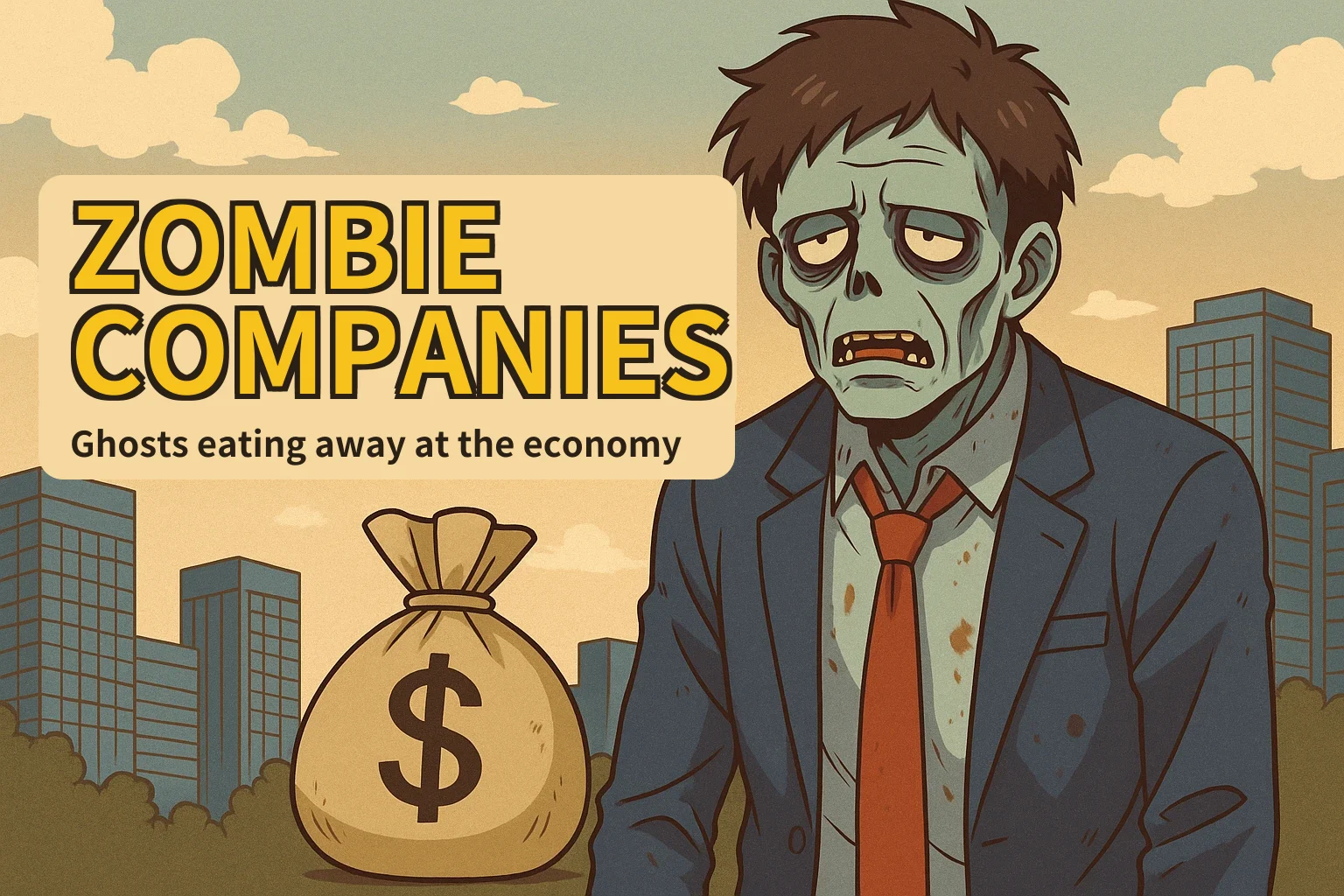
🧟 Zombie companies, the silent ghosts eating away at the economy
📚 What is a zombie company?
What comes to mind when you hear "zombie"? 🧟♀️ Something dead yet still walking around, right?
In economics, a zombie company means a company that is "alive as if dead." It is an ailing company that cannot even properly pay its interest, but it barely stays alive thanks to government support or bank loan extensions. It may look fine on the outside, but in reality these are companies with almost no chance of returning to normal management.
🔍 Example: operating profit < interest expense → likelihood of being a zombie company ↑
📈 Zombie companies in recent news
🗞️ On July 24, 2025, the Korea Exchange lined up 3 KOSPI and 14 KOSDAQ ailing companies for delisting.
👉 Companies like these are exactly what "zombie companies" are!
🧾 Why have there come to be so many?
Zombie companies didn't appear out of nowhere. There are several reasons behind them.
💊 1. Prolonged low interest rates and policy funds
- As low-rate policies and loan deferrals were repeated after COVID-19,
- an environment was created where even underperforming companies could keep themselves alive.
🏦 2. Half-hearted restructuring by financial institutions
- Banks, too, focused on "buying time" rather than recalling loans.
- Instead of pushing ailing companies out, they consistently chose to extend support.
🛑 3. Political and regional economic factors
- There were also many cases where exits were put off out of concern for regional economies and jobs.
🔍 What do the actual statistics say?
📊 As of 2023, a whopping 40.9% of companies subject to external audits were classified as "zombie companies" unable to cover even their interest.
- There are also reports that 42.4% of small and medium-sized enterprises are in this state.
- The number of companies recording operating losses for two years in a row is also rising every year.
📉 The strange phenomenon of rising SME loan delinquency rates while the number of bankrupt companies falls…
The cause? None other than the zombie companies that haven't been pushed out!
❗ The problems with zombie companies
Are zombie companies just "pitiful companies"? No. 😓
⚙️ 1. Inefficiency across the economy
- Low-productivity companies stay in the market and hinder the growth of healthy companies.
- Talented people and capital get tied up in the wrong places.
🚧 2. Barriers to entry for new companies
- When inefficient companies hold market share,
- startups have no room to stand.
💸 3. Waste of policy resources
- Government finances and financial-sector resources are not used efficiently.
🧠 How is this being addressed?
💼 The government and financial authorities have recently been taking the following measures.
✅ Tougher delisting criteria
- Companies whose market capitalization falls below a certain level, or
- companies that receive an "adverse" audit opinion two years in a row, now find it hard to stay listed.
✅ Encouraging restructuring
- Companies with little chance of recovery are wound up by steering them into workouts or debt-to-equity swaps.
- Meanwhile, tailored support is being strengthened for companies that can recover.
✅ Overhauling policy funds
- Zombie companies are excluded from the outset,
- and funds are being reallocated with a focus on innovative growth companies.
💡 Clues to a solution
| Direction | Strategy | Explanation |
|---|---|---|
| 🎯 Selective support | Select companies based on financial indicators | Use the interest coverage ratio, ROE, etc. |
| 🔄 Reallocation of resources | Reorganize facilities and personnel | Move idle resources to innovative companies |
| 🏗 Industrial restructuring | Wind down low-productivity industries | Focus on nurturing new growth industries |
| 🤝 Public-private cooperation | Link government + finance + business | Build a joint restructuring platform |
✨ Wrapping up…
The zombie company problem is not just a problem of one or two companies.
It weakens the constitution of the entire industrial ecosystem,
and is also a structural crisis eating away at the future of the Korean economy. 😥
But if, as now,
✔️ cleaning up ailing companies,
✔️ stronger support for innovative companies,
✔️ and industrial transition policies all work together,
our economy will be able to climb out of the zombie swamp! 💪