📌 Keywords
What is an indirect tax, what is a direct tax, indirect vs direct tax comparison, value-added tax, income tax, tax burden, tax system
🧾 The two faces of taxation: indirect tax vs direct tax
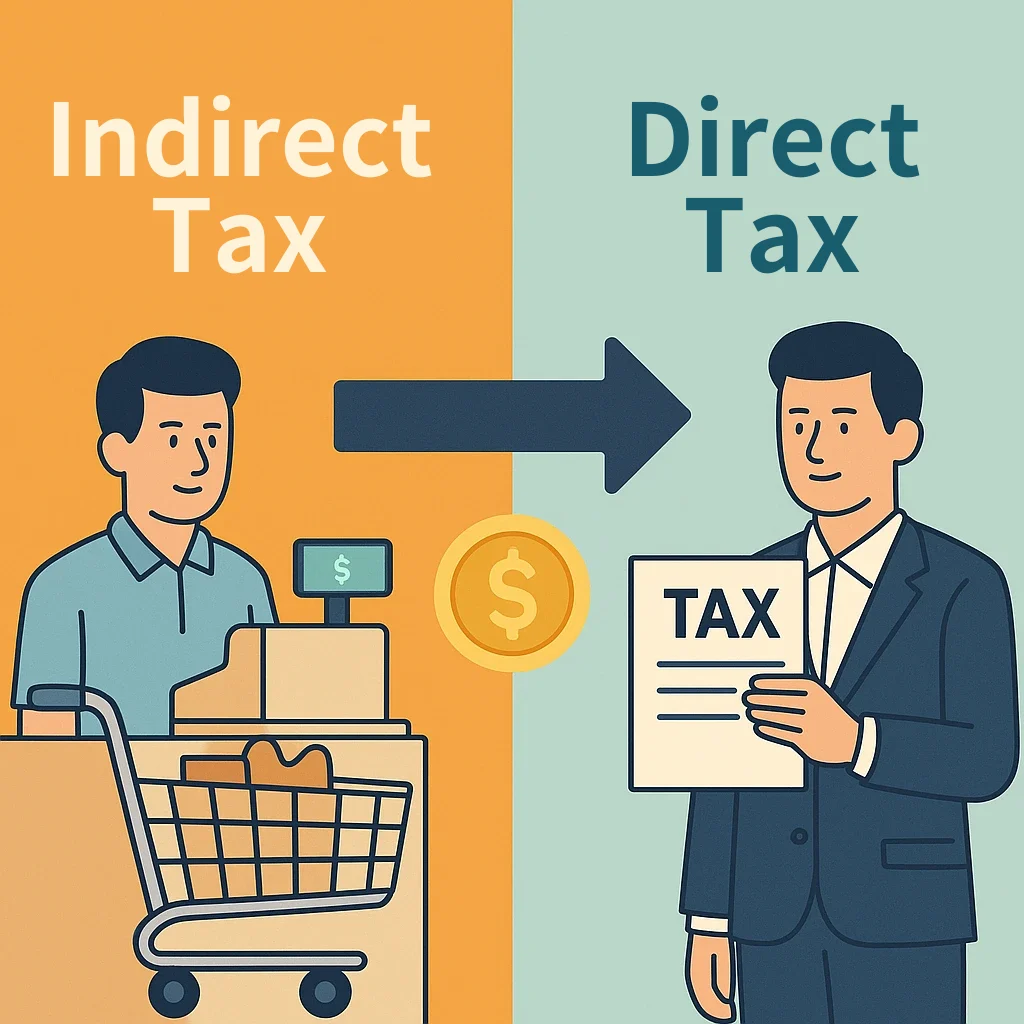
We pay taxes in daily life, knowingly or not. When buying things at the supermarket, when receiving a salary, even when receiving an inheritance, taxes follow. But depending on who pays a tax and who actually bears it, taxes are divided into "indirect taxes" and "direct taxes."
These two don't just differ as types of tax; they are linked to various issues such as tax policy, income redistribution and economic equity, so it's worth understanding them properly at least once.
✅ What is a direct tax?
A tax whose taxpayer and bearer of the tax burden are the same
A direct tax is a tax where the person who pays it and the person who actually bears it are the same. Simply put, it is a tax levied directly on people who have income or own assets. Representative examples are as follows.
- 👨💼 Income tax: levied on earned income, business income, interest and dividend income, etc.
- 🏢 Corporate tax: levied on companies' corporate income
- 🏠 Comprehensive real estate holding tax: levied on real estate assets above a certain threshold
- 🧾 Inheritance tax/gift tax: levied when property is received free of charge
📌 A feature of direct taxes is that they are levied at different rates according to the taxpayer's economic capacity (progressive tax rates). In other words, it is a structure in which the more income you have, the more tax you pay. That's why they are considered desirable in terms of tax equity.
✅ What is an indirect tax?
A tax whose taxpayer and bearer of the tax burden are different
An indirect tax is a tax where the person who pays it and the person who actually bears it are not the same. When you buy goods, the seller pays the tax on your behalf, but the actual burden falls on the consumer. Representative examples are as follows.
- 🛒 Value-added tax (VAT): included in almost all transactions of goods and services
- 🚬 Individual consumption tax: levied on alcohol, tobacco, luxury cars, etc.
- 🍷 Liquor tax: levied on alcoholic beverages
- 📄 Stamp tax: levied when certain documents such as contracts are drawn up
- 📈 Securities transaction tax: arises when trading stocks
📌 Because the consumer bears the burden of indirect taxes, most of them use proportional tax rates applied uniformly regardless of income.
⚖️ The economic differences between the two taxes
| Item | Direct tax | Indirect tax |
|---|---|---|
| Bearer of the tax | Taxpayer = bearer | Taxpayer ≠ bearer |
| Representative taxes | Income tax, corporate tax, etc. | Value-added tax, liquor tax, etc. |
| Rate structure | Progressive rates possible | Mainly proportional rates |
| Advantages | Strong income redistribution function | Easy to collect, little resistance |
| Disadvantages | Unstable tax revenue, strong resistance | Regressive, low equity |
👉 Direct taxes face strong tax resistance but are highly fair,
👉 while indirect taxes are easy to collect but disadvantageous to people with low incomes.
In this way, the two taxes are complementary, and most countries run their public finances with an appropriate mix of both.
📉 Why is regressivity controversial?
Indirect taxes look simple, but they have a problem called "regressivity." For example, if a person earning 1 million won a month and a person earning 10 million won buy the same item, they bear the same value-added tax, but in practice the low-income person bears a heavier burden.
For this reason, critics argue that the higher the share of indirect taxes, the more tax equity can be undermined.
📊 How does the System of National Accounts (SNA) classify them?
Meanwhile, the international economic statistics framework, the System of National Accounts (SNA), classifies taxes into the following three categories instead of "direct/indirect", on the grounds that the distinction between taxpayer and bearer is not clear-cut.
- Taxes on production and imports
- Current taxes on income and wealth
- Capital taxes
This is a method of classifying taxes by type of economic activity, taking their actual effects into account.
🔚 Final summary
- A direct tax is a structure in which you bear the tax yourself (income tax, corporate tax, etc.)
- An indirect tax is a structure in which the tax is passed on to consumers (value-added tax, etc.)
- Direct taxes excel at equity, indirect taxes at efficiency
- Balancing the two is the key to tax policy!
💡 CTA – Which taxes are you more exposed to?
💬 Curious which taxes make up more of your spending?
💸 Take a look at your pay slip and your shopping receipts!
📈 Or you can also use online tools such as a "tax burden ratio calculator."