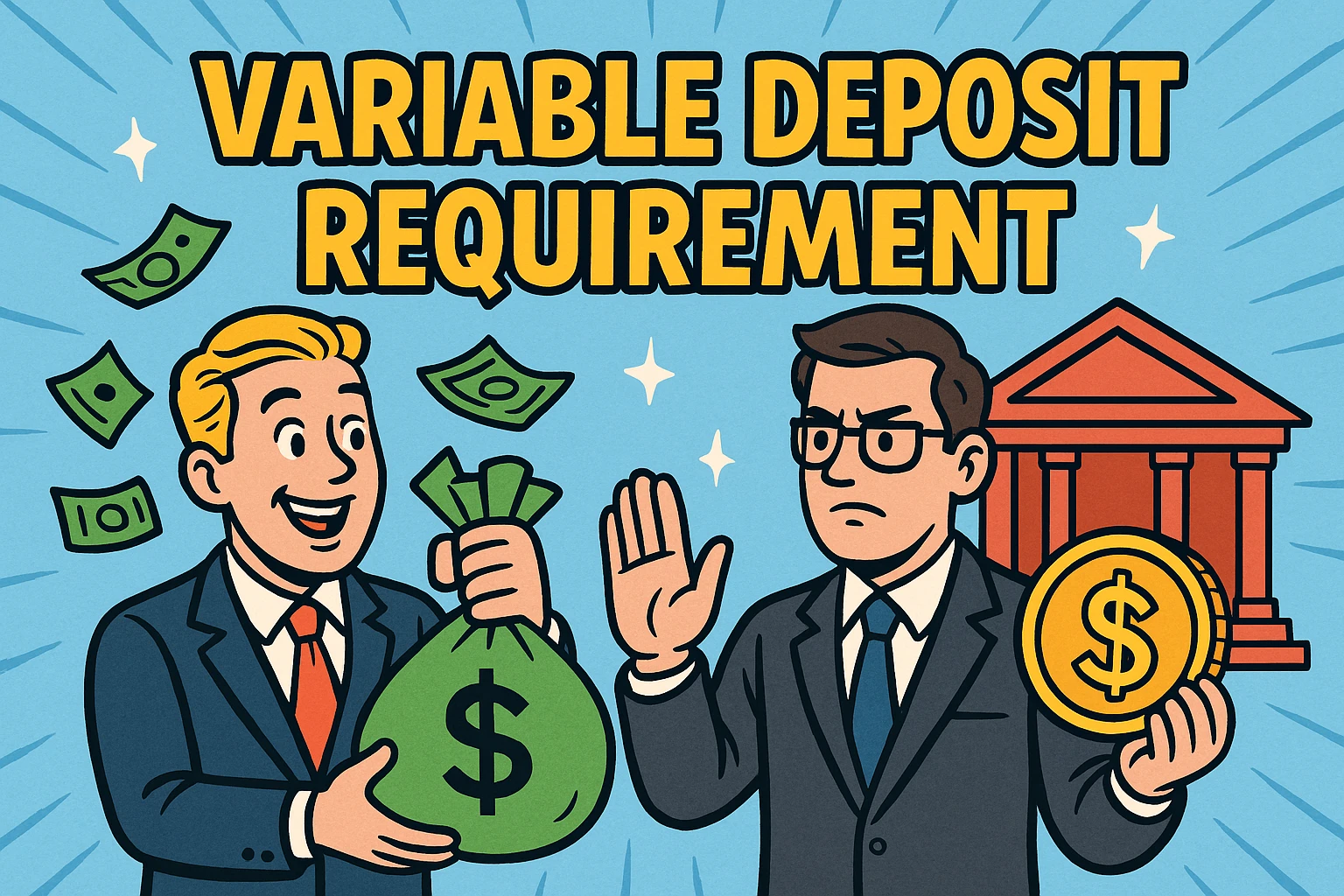
International financial markets are becoming ever faster and more organically connected.
In this environment, cross-border capital flows often become a double-edged sword
that broadens companies' investment opportunities while also threatening the stability of a country's economy.
So today, let's look at one of the systems that mitigates this risk:
the variable deposit requirement (VDR). 😊
📌 Money flowing across borders: why does it need to be managed?
Phrases like "foreign investment surges" and "short-term foreign capital inflows soar" often appear in the news we see.
This is common in countries with open capital markets.
Such capital inflows have positive sides as well.
✅ When foreign currency comes in, the exchange rate stabilizes,
✅ companies raise funds at low cost,
✅ and investment across the economy picks up.
However, the problem is "speed" and "scale."
🔻 If too much money flows in over a short period
🔻 or flows back out quickly,
👉 sudden exchange rate swings,
👉 sharp rises and falls in the stock market,
👉 instability in financial markets and more can result.
🧷 The system that emerged: the variable deposit requirement
So what is the variable deposit requirement?
Simply put,
it is a system that requires a certain share of capital coming in from abroad to be deposited.
That is, when a foreign investor brings funds into Korea,
part of them must be deposited with the Bank of Korea or a financial company for a set period.
This way,
☑️ the speed of foreign currency inflows can be controlled,
☑️ and inflows of speculative capital seeking only short-term gains can be curbed.
📚 What is the legal basis in Korea?
Korea bases this system on the Foreign Exchange Transactions Act.
When a situation arises that could seriously affect the macroeconomy,
such as a deterioration in the balance of payments or financial market instability,
the Minister of Economy and Finance can order that part of the foreign currency related to the capital transaction
be deposited with the Bank of Korea's Foreign Exchange Equalization Fund or with a financial company.
But! Important conditions are also specified.
🔹 It can be applied only for up to six months
🔹 It is lifted immediately once the cause disappears
🔹 It cannot be applied to foreign direct investment (FDI)
In other words, since it can be used only as an urgent, temporary measure,
this system can be seen as similar to "firefighting equipment used in an emergency." 🚒
🪙 The link with the Foreign Exchange Equalization Fund
One of the places where funds are deposited under the variable deposit requirement is
the Foreign Exchange Equalization Fund.
This fund is
✅ government money used to prevent sharp swings in the exchange rate
✅ and to stabilize the foreign exchange market.
In other words, through this fund
the variable deposit requirement serves as a buffer for capital inflows and outflows. 🔁
📊 Are there examples of it being applied globally?
This system is not unique to Korea.
After the IMF crisis, several emerging economies such as Malaysia, Brazil and Chile
operated similar systems as a means of stopping sudden foreign capital inflows.
✨ Wrapping up: a safety line for the economy in the rapids
International capital markets sometimes move like huge rapids.
Within them, we need to put in place institutional safeguards that can protect economic stability.
The variable deposit requirement is an important policy tool that controls reckless inflows of short-term speculative capital
and stabilizes financial markets and the exchange rate.
By understanding this system,
we can think more wisely about the balance
between opening capital markets and maintaining stability. 🤔💼
🔖 Related terms worth reading together
- Foreign Exchange Transactions Act
- Foreign Exchange Equalization Fund
- Foreign direct investment (FDI)
- Monetary policy
- Capital flow regulation