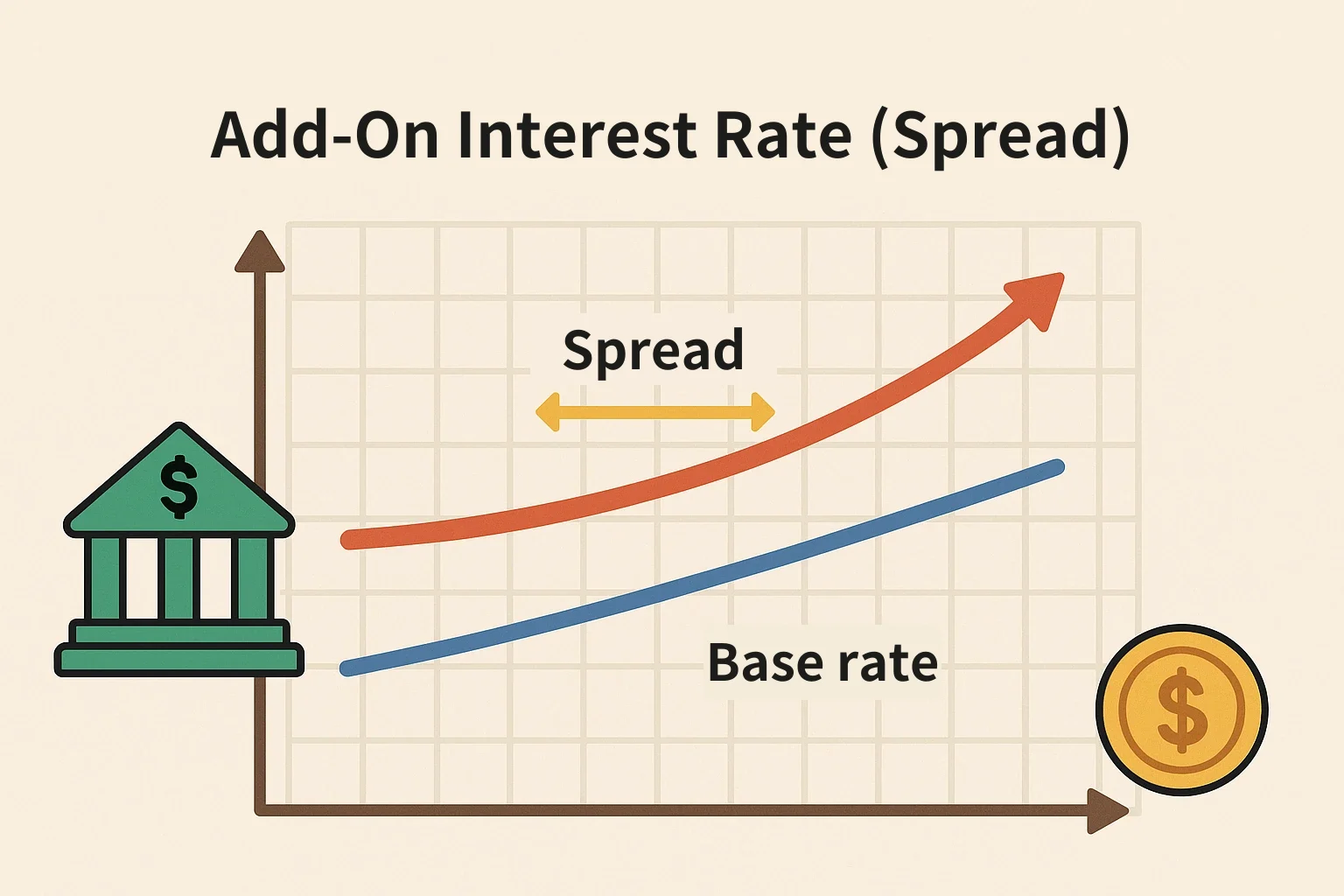
Why do loan interest rates differ from person to person? The key lies in the "add-on interest rate"!
=> The rate applied to you is a function of "credit" and "term."
📌 What is an add-on interest rate?
When you take out a loan from a financial institution, it's not just the base rate that applies.
On top of it, there is an additional rate that reflects many factors such as credit rating, loan term, market conditions and liquidity risk,
and it is called the add-on interest rate (spread).
Base rate + add-on interest rate = actual applied rate (loan interest rate)
This add-on rate corresponds to the risk premium the financial institution takes on.
In other words, you can think of it as converting into a number risks that can arise when lending money, such as the possibility of default or the risk of delayed repayment.
📊 Add-on rates that vary with credit
For example, a customer with an AAA credit rating has a very low risk of default, so almost no add-on rate, or a very low one, is applied.
On the other hand, a C-grade customer has a high chance of default, so a high add-on rate is set.
| Customer | Credit rating | Base rate | Add-on rate | Applied rate |
|---|---|---|---|---|
| Mr. A | AAA | 3.5% | 0.3% | 3.8% |
| Mr. B | BB | 3.5% | 1.8% | 5.3% |
📌 The better your credit, the lower the interest you pay,
which translates directly into lower financing costs.
⏳ Understanding the term spread
Besides credit, the add-on rate can also vary with the term of the loan.
For example, short-term loans carry a low repayment risk, so their add-on rate is low,
but long-term loans of 10 years or more carry correspondingly greater risk, so a higher add-on rate is attached.
This is called the "term add-on rate," or term spread,
and this structure is commonly seen in the government bond yield curve as well.
📈 Example:
1-year government bond yield: 3.0%
10-year government bond yield: 4.0%
👉 Term spread = 1.0% = 100bp
🌍 Spreads in international financial markets
The add-on rate is also a key indicator when issuing bonds overseas.
In international bond markets, rates such as US Treasuries or LIBOR and SOFR serve as the base rate,
and an add-on rate reflecting the credit risk of each government or company is added on top.
📌 A real case:
During the 1997 foreign exchange crisis, the Korean government had to pay in international financial markets
an add-on rate of several hundred bp (several % over the base rate) over US Treasuries.
This was the cost of the decline in the country's credibility.
👉 Therefore, the higher a country's credit rating, the lower its overseas funding costs,
and conversely, when it is low, the spread widens, creating an enormous interest burden.
🧠 How to read add-on rates as an investor
From an investor's point of view, the spread is an indicator that visualizes risk.
- A widening spread between government and corporate bonds
→ suggests rising credit risk → bond market instability - Spreads spiking during a financial crisis
→ a signal that investors are flocking to safe assets
📌 In other words, spread trends are used as a useful indicator that indirectly reveals market sentiment and economic conditions.
🔢 How is the add-on rate calculated?
Add-on rates are set internally by very complex algorithms,
but they generally include the following factors:
- 🔸 Credit rating
- 🔸 LTV (loan-to-value ratio)
- 🔸 Loan term
- 🔸 The financial institution's funding rate
- 🔸 Industry risk and market risk
What financial consumers can do is ask "Why is my rate high?"
and devise strategies to lower the rate by improving their credit, adjusting collateral terms and so on.
✍ Final summary
✅ What is an add-on interest rate? A rate that adds a "risk premium" to the base rate
✅ The higher your creditworthiness, the lower your loan rate
✅ The spread is the language of risk in global financial markets
✅ For investors, it becomes a signal for gauging market sentiment
📌 Related concepts
- Base rate
- Credit rating
- LIBOR / SOFR
- Basis point (bp)
- Bond yield curve
- Spread trading