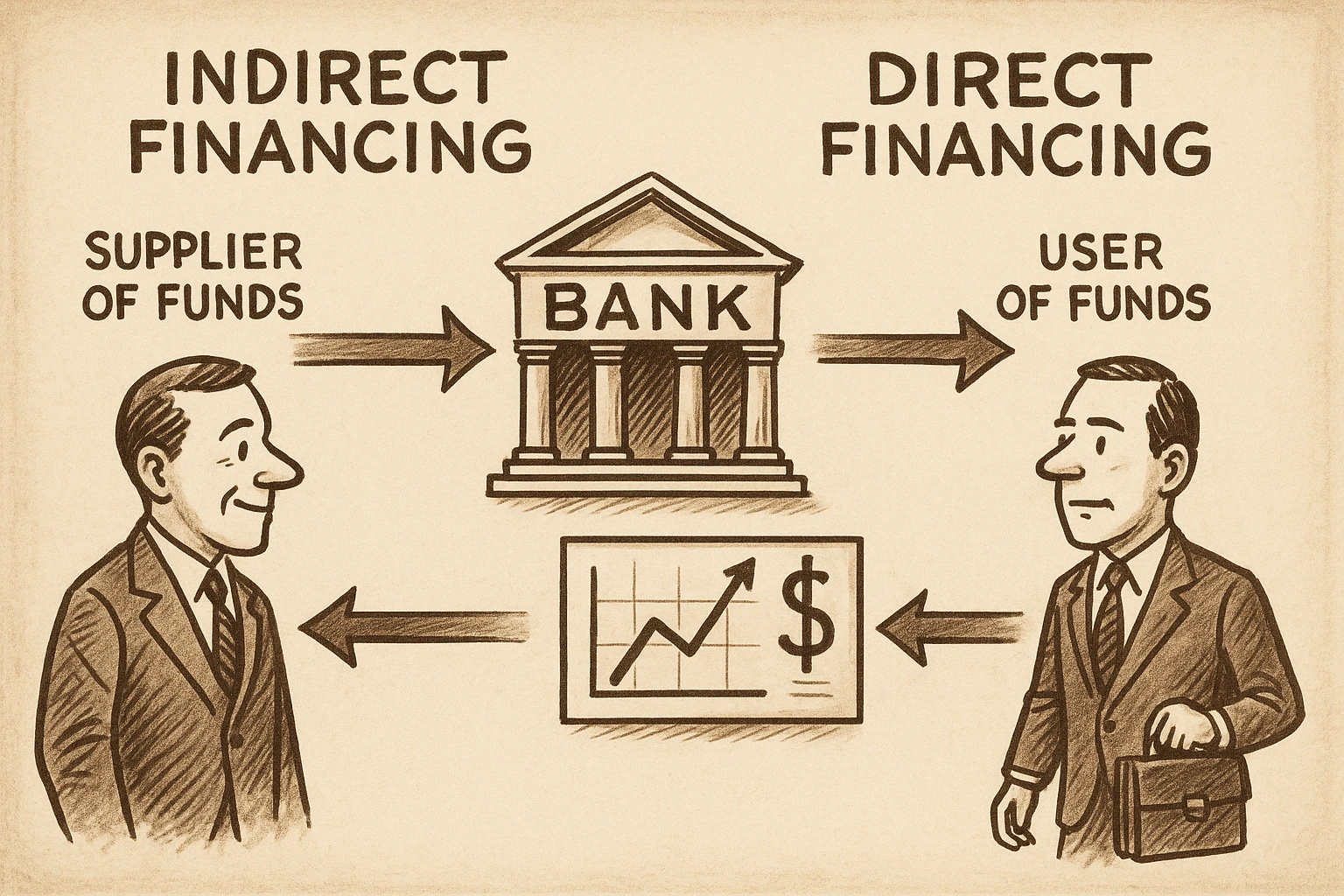
Money is the lifeblood of the economy. For this blood to circulate smoothly, funds need to flow smoothly between those with surplus funds (households, the government, some companies) and those who need funds (most companies, startups, etc.).
Depending on how this flow of funds is connected, there are two approaches: indirect financing and direct financing.
Indirect financing 🏦
"The bank sits in the middle and lends on your behalf"
In indirect financing, financial institutions such as banks, savings banks and credit unions act as intermediaries.
For example, when I deposit money in a bank, the bank uses those funds to make loans to companies. In this case, the person who lent the money (the depositor) and the one who borrowed it (the company) don't know each other, and the bank takes on all the risk.
📌 Key features
- The bank regulates the flow of funds
- Resolves information asymmetry
- Favorable to small and medium-sized enterprises and parties with lower creditworthiness
- Depositor protection mechanisms exist
Direct financing 📈
"Those who need funds meet investors directly in the market"
Direct financing is a structure for raising funds by issuing stocks or bonds.
For example, when a startup needs business funds, it issues stocks or bonds on the market without going through a financial institution and sells them directly to general investors.
In this case, investors have to assess the issuer's financial condition, growth potential and so on themselves and make their investment decisions.
📌 Key features
- Direct connection between fundraisers and investors
- Requires transparency in how funds are managed
- The better the access to information, the more favorable
- Favorable to large companies and innovative companies
Which is more ideal? ⚖️
In truth, there is no right answer. The appropriate mix differs depending on the economic structure and stage of development.
🇰🇷 In an economy like Korea's, where small and medium-sized enterprises make up a large share and information asymmetry is high, indirect financing is more stable.
On the other hand, in places like 🇺🇸 the United States, where capital markets are developed and the venture investment culture is active, the share of direct financing is high.
The two compete, but at the same time they are complementary.
For instance, during a recession bank lending may shrink while capital markets remain alive, and conversely, when capital markets contract, indirect financing can serve as a support.
What do financially advanced countries have in common?
🔍 Developed financial markets = a growing share of direct financing
Ultimately, the stronger the capital market infrastructure (stock exchanges, audit systems, disclosure systems, etc.), the bigger the role of direct financing becomes.
For venture ecosystems, ESG investment, green finance and the like to flourish, strengthening the direct financing system is essential.
Wrapping up ✍️
Direct and indirect financing are the two wings of the economy.
Growing both the stability of banks and the innovativeness of capital markets in balance is the key to financial advancement.
Which side is our economy leaning toward right now? And what kind of balance should we pursue going forward?
📌 Recommended posts on related concepts
- 👉 Go to: the difference between capital markets and financial markets
- 👉 Comparing stocks and bonds from an investor's perspective
- 👉 In the age of venture investment, how far has direct financing come?
🔍 Related keywords
Difference between direct and indirect financing / ways to raise funds / understanding the financial system / comparing banks and capital markets / financial market structure