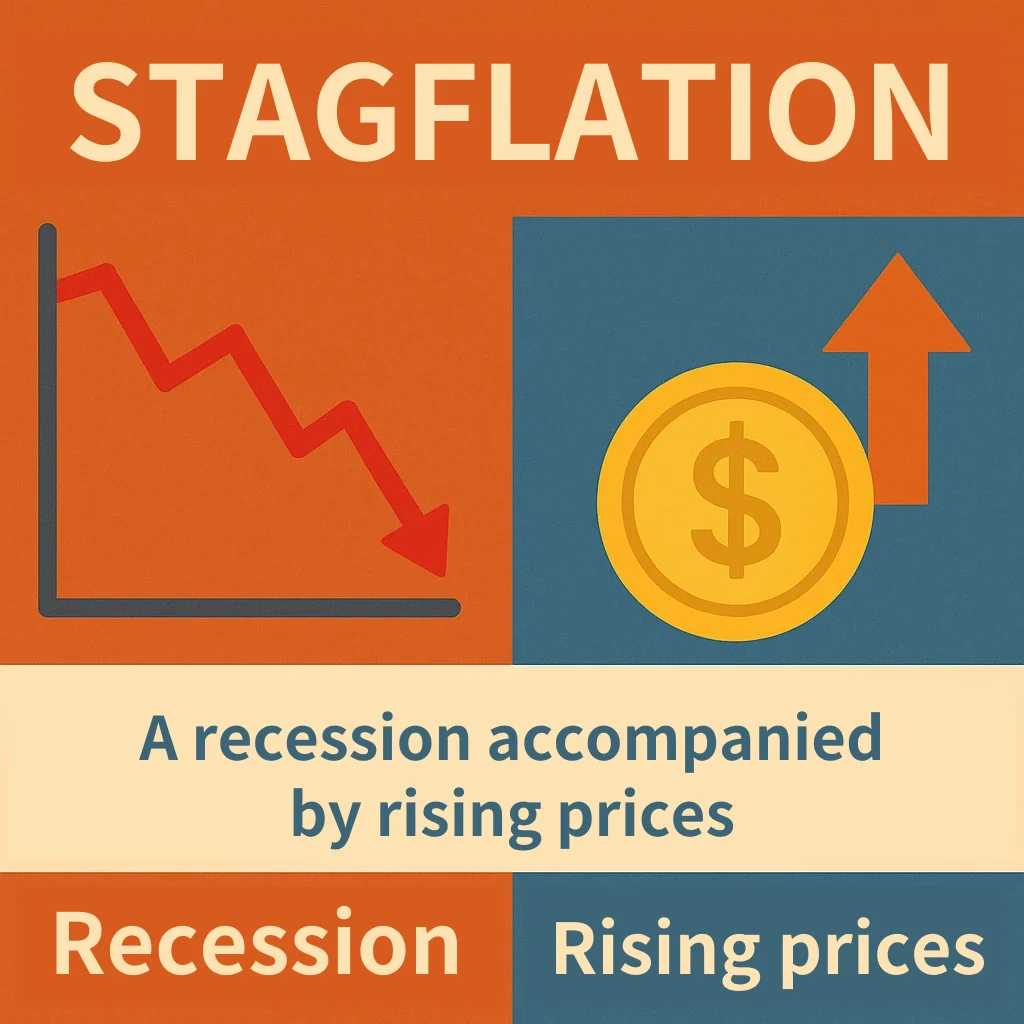
🧩 Today's economic term: stagflation
Stagflation is an economic phenomenon in which stagnation (an economic slump) and inflation (rising prices) appear at the same time. According to the traditional Phillips curve theory, prices should also fall during a recession, but that rule began to break down starting in the US in the late 1960s. The 1970s oil shocks are the classic example.
Why is it a hot issue again?
Looking at the global economy as of June 20, 2025,
- the US Federal Reserve held its policy rate at 4.25–4.50% for the fourth meeting in a row at the June FOMC and signaled two rate cuts by the end of the year. But it lowered its GDP growth forecast from 1.7% to 1.4% while raising its inflation (PCE) forecast from 2.8% to 3.1%, voicing concern about stagflation (donga.com).
- The Bank of Korea also cut its base rate for the fourth time, from 2.75% to 2.50%, in May, but it is proceeding cautiously as the rate gap with the US has widened to as much as 2 percentage points.
In the end, a typical sign of stagflation is emerging: "the economy is weak, but prices won't come down."
🇰🇷 The situation in Korea
1. Inflation at 1.9%, the lowest in five months
The May consumer price index (CPI) rose 1.9%, the lowest since December, but still close to the Bank of Korea's 2% target (hankyung.com, bloomberg.com). This can be read both as price stability and as a sign of an economic slowdown.
2. The second supplementary budget
On June 19, the Lee Jae-myung government finalized a second supplementary budget of 30.5 trillion won, aimed at boosting domestic demand through consumption, construction, AI investment and support for small business owners. About 19.8 trillion won of it will be funded by issuing deficit-covering government bonds (reuters.com).
It is a policy to stimulate the economy, but under stagflation the side effect of adding to price pressure must also be considered.
Summary 🔍
| Factor | Current state |
|---|---|
| Economy | Korea's first-quarter GDP turned negative; growth forecasts cut in both the US and Korea |
| Prices | US PCE up; Korea's CPI holding around 1.9% |
| Policy response | Bank of Korea rate cuts and a larger government supplementary budget; the Fed holding rates with cuts expected later |
Once stagflation takes hold, traditional policy tools hit their limits, because policymakers must balance goals that are hard to reconcile: raising rates → price stability, cutting rates → economic stimulus.
✍️ Wrapping up: how we respond to stagflation
The difficulty of stagflation is the dilemma of which policy to prioritize.
- Stimulus through fiscal expansion → short-term boost to the economy
- Stable or lower rates to revive domestic demand → but raises inflation concerns
- Keeping monetary policy focused on price stability → risks a prolonged recession
Rather than a single direction, a policy mix and structural reform are what matter.
For example, improving supply-side efficiency, linking wages to productivity, responding to energy and food price shocks, and stabilizing global supply chains all need to go together for a sustainable solution.
✅ Today's conclusion
Stagflation is a complex crisis unlike what past economic theory described.
As of June 2025, with both the US and Korea showing signs of stagflation, the policy mix of governments and central banks has become even more important.