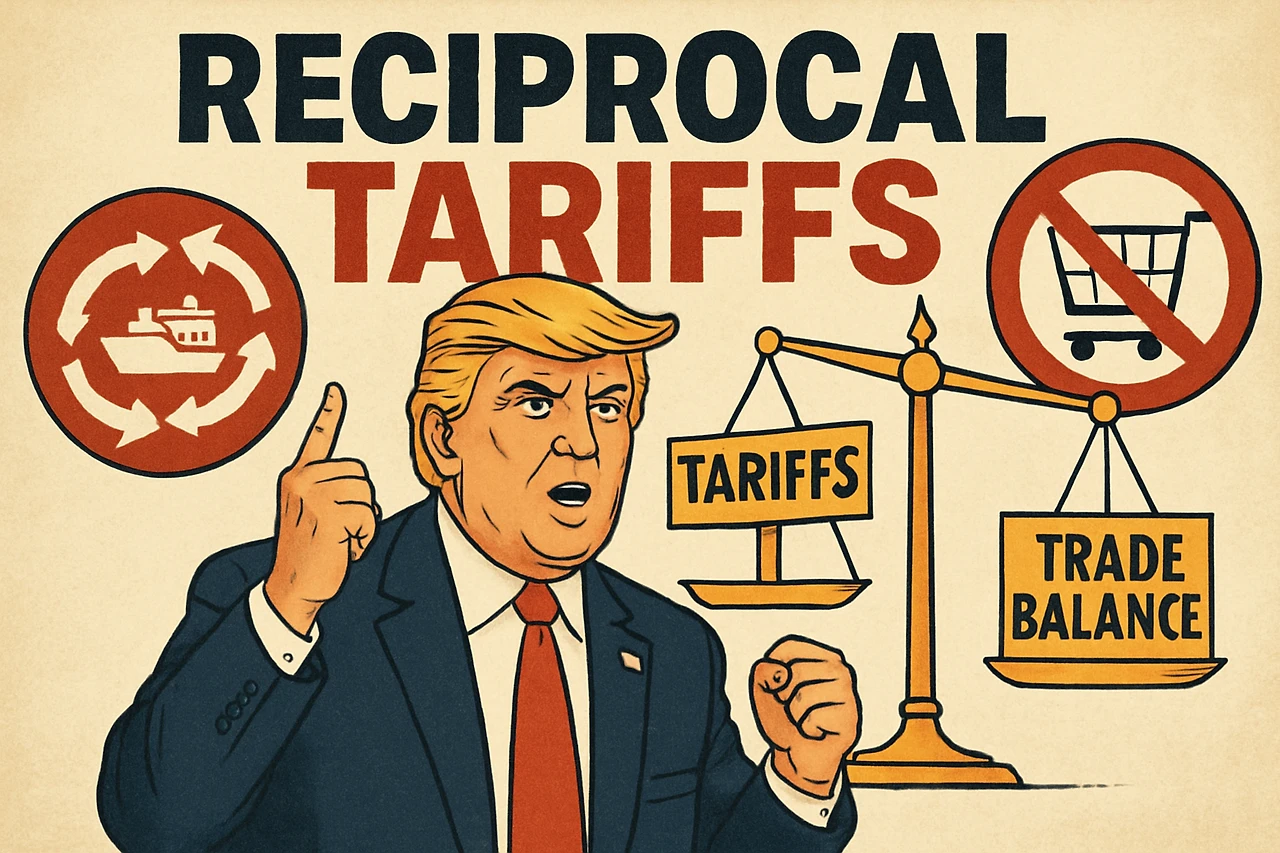
✅ What is a reciprocal tariff?
A reciprocal tariff is, just as the name says, a policy of "if you put a tax (tariff) on our goods, we will put the same tax on your goods."
In other words, by imposing on the other country's imports a tax at the same level as the tariff rate that country imposes on your own products, you set up a fierce mechanism for retaliatory trade (news.einfomax.co.kr).
🧭 Why is it in the spotlight?
On April 2, 2025, US President Trump issued Executive Order 14257, imposing a 10% baseline reciprocal tariff on all imports.
Then, from April 9, high-intensity differentiated reciprocal tariffs of up to 49% were set to apply to some 50 major countries (including Korea), but they were suspended for 90 days (m.kati.net).
In particular, Korea faces a 25% reciprocal tariff rate, heightening the sense of crisis over exports (haesanews.com).
🇰🇷 How are Korean companies and the government responding?
- The Korean government is preparing to respond with customs consulting for exporters, briefings on the trade environment, and the injection of export-support policy funds (worth 9 trillion won) (m.kati.net).
- Court brakes: At the end of May, a US federal court ruled that "unilaterally imposing reciprocal tariffs based on the IEEPA (International Emergency Economic Powers Act) is unlawful" and issued a ruling halting their enforcement (tongilnews.com).
🌍 Impact on the global trade order
- EU: With a differentiated tariff of around 20% announced, it is preparing countermeasures and getting ready for bilateral negotiations, including reviewing a "retaliatory tariff list worth 95 billion euros" (kiep.go.kr).
- China: Layered on top of existing US tariffs, it faces a stacked tariff regime totaling 104%, and is stressing the need for a strong response (magazine.hankyung.com).
- Global trade tensions: As a hostile "an eye for an eye, a tariff for a tariff" mood spreads, the burden on consumers and the possibility of international disputes are also growing (khan.co.kr).
🧾 Summary & implications
| Key item | Description |
|---|---|
| Definition | A retaliatory tariff that pays back the other country at exactly the same rate as the tariff it imposes |
| US measures | Baseline 10% + differentiated rates of up to 49% for specific countries; Korea is subject to 25% |
| Implications | ▪︎ High likelihood of damage to Korean exporters ▪︎ Bilateral negotiations and international cooperation needed ▪︎ Possible international legal issues involving the WTO, the IEEPA and more |