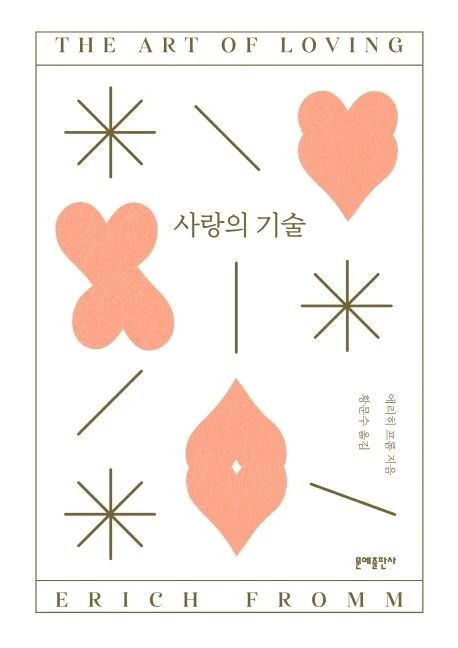
The essence of relationships, read through a developer's eyes
1️⃣ Love, a "skill"?
Living as a programmer means "solving problems structurally." But human relationships, and the subject of "love" in particular, have always been dismissed as a matter of emotion.
After reading The Art of Loving, though, I came to accept that this world of emotion, too, is something you ultimately have to learn, practice and internalize like a skill.
📘 Erich Fromm puts it this way:
"Love is not a feeling but a skill. A skill requires knowledge, effort and practice."
2️⃣ Love is an active "act"
In a system, if data goes missing, the whole flow breaks. Human relationships are the same. Fromm says love is not a mere emotional reaction but an active, intentional "act of giving."
He defined love through four core elements:
- Care
- Responsibility
- Respect
- Knowledge
These four do not apply only to lovers. They apply just the same when I deal with clients, when I give feedback to colleagues and when I collaborate with a project team. In the end, love is a question of the attitude you bring to every human relationship.
3️⃣ The "misunderstanding of love" created by capitalism
The part of this book that impressed me most is its analysis of how modern capitalism has contaminated love.
To become a "marketable person," we build up credentials, manage our image and promote ourselves on social media. In the process, even love has been turned into something measured by "conditions" and "success."
I stopped short at this passage:
"Modern people treat love like an 'object of success,' forgetting that what matters is not being loved but knowing how to love."
💻 At work, if you do a project well, you get recognition and even awards. But between people, there are no such clear metrics. Isn't that exactly why it is harder, and why it needs even more skill?
4️⃣ Lovers, family, and even yourself
The book introduces various forms of love.
- Brotherly love (love of humanity, fellowship)
- Motherly love (unconditional protection)
- Eros (passionate love)
- Self-love
- Love of God
What stood out to me here in particular was the emphasis on self-love.
Fromm says that no love is possible without healthy self-love.
📌 It means that if I am not generous with myself and do not respect myself, I cannot give true love to anyone.
Systems are like that too, right? If the internal logic is broken, no matter how nicely you package the outside, it eventually collapses. Human relationships also start from inner stability.
5️⃣ A life of "learning" love
As I closed this book, I engraved the sentence "love is not an emotion but a habit and an attitude" in my mind.
Whether I am doing a code review at work, communicating with a client company or talking with my family, I find myself asking whether I am someone who knows how to love.
So these days I am training myself:
- When giving feedback, with consideration rather than attack
- The busier I am, the more I think once more from the other person's point of view
- Building routines that give me some breathing room too
Love is a routine, and a skill. If connection with people is still the essence even in the era of digital transformation, this book deserves to remain "a textbook of humanity for the digital age."
🔚 Closing
Fromm says:
"Learning to love is learning how to be human."
Love is not "the peak of a relationship" but "a way of life." Even for someone like me who works with systems, this book helped me understand people in a new way. After all, the economy, systems and organizations all exist for people.
Becoming "a developer who knows how to love" is the biggest lesson I took from this book.