In chapter 45 of Of Human Bondage, when Philip asks what life means, the poet Cronshaw only says that if he studies some Persian rugs the answer will occur to him one day. The riddle is solved in the novel's second volume, number 12 in Minumsa's World Literature series. The answer comes in chapter 106: life has no fixed meaning, which leaves Philip free to choose his life's pattern himself. After reading this guide you will be able to trace, chapter by chapter, where the rug turns up again, and see how the answer of chapter 106 leads to the choice Philip makes in chapter 122. The ending is discussed.
The guide to volume 1 suggested folding down chapters 14, 28 and 45, because they come back later. This guide follows the rug from chapter 45 and also notes where the other two scenes return.
What kind of book is volume 2?
Minumsa publishes the novel in two volumes translated by Song Mu. Volume 2 came out on 30 September 1998, runs to 596 pages, and ends with the translator's commentary and a chronology of the author's life. The original is a 122-chapter novel by W. Somerset Maugham (1874–1965), published in 1915. The publisher presents it as a Bildungsroman, a novel about a young man waking up to the world, and explains that at twenty-four Maugham drew on the same memories for a manuscript it calls The Artistic Temperament of Stephen Carey; when that went unpublished, he took the material up again in this novel.
Neither the publisher's page nor the bookshop page says at which chapter volume 2 begins. Splitting the Project Gutenberg text into chapters and counting words puts the end of chapter 64 at 50.2 percent of the whole. So this guide calls chapter 65 onward "the second half" and gives chapter numbers from the English original; the actual first chapter of volume 2 may be a few chapters off. Most of the second half is set in London, and after fighting begins with the Transvaal in chapter 95, the war reaches into Philip's livelihood.
The question Cronshaw put off
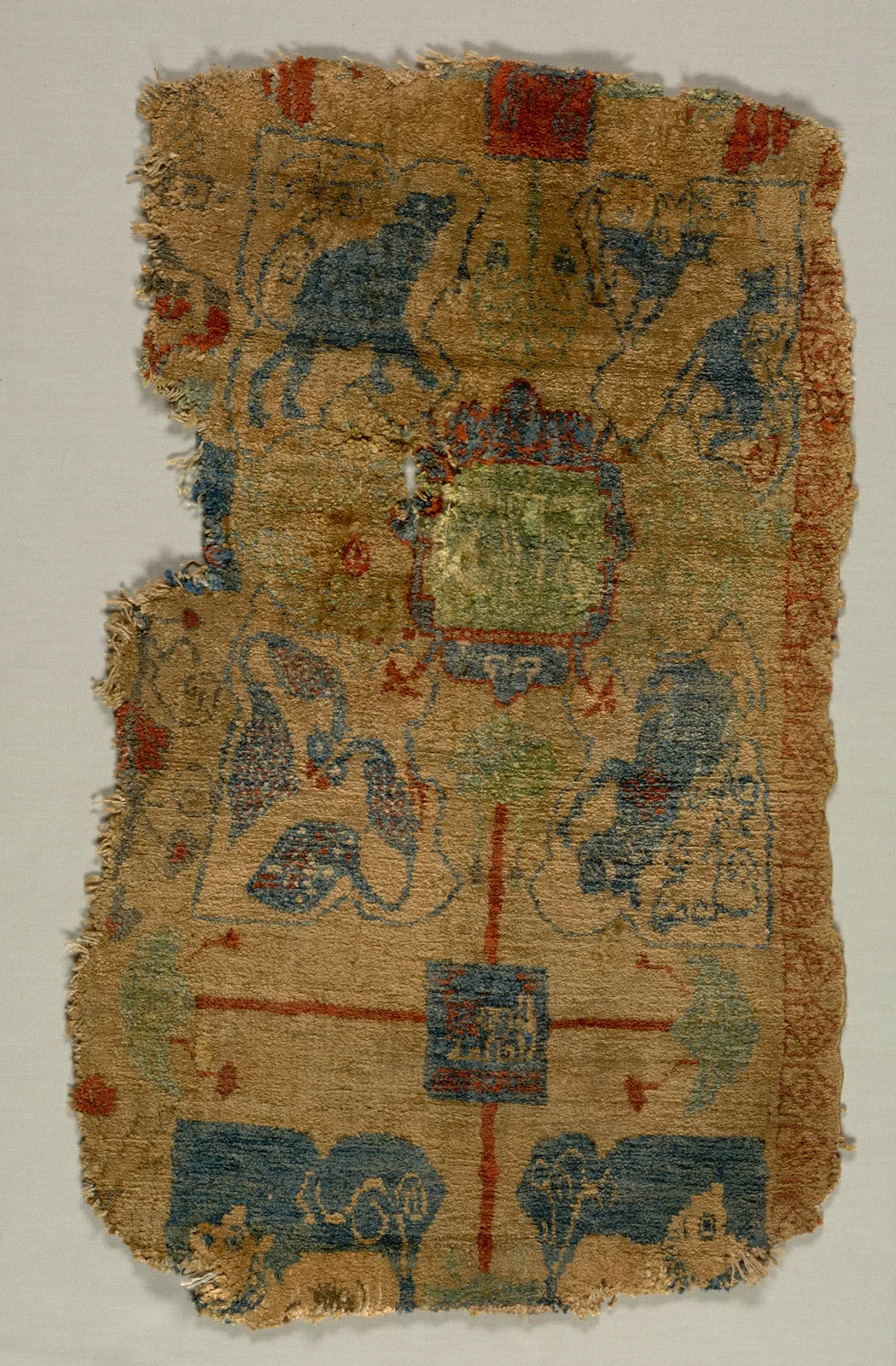
Chapter 45 is a Sunday evening in a Paris café. Philip is demanding to know what anyone is born for if duty, goodness and beauty are all taken away, when pedlars of cheap rugs come in. Cronshaw makes a show of haggling over a table-cloth, sends the pedlar packing once the price has come down to fifteen francs, and then simply directs Philip to the Persian carpets in the Cluny museum. Philip thinks of the comparison again in chapters 50 and 53, but Cronshaw has kept repeating that an answer Philip has not worked out for himself is worthless.
Where the rug goes
In chapter 65 the painter Lawson, who has moved to London, mentions a present from Cronshaw. Just after Philip left Paris, Cronshaw sent round a worn scrap of Persian rug he had picked up for fifteen francs in a shop on the Rue de Rennes, calling it the answer about the meaning of life. It is the same sum at which the pedlar was sent away in chapter 45.
In chapter 79 Philip takes rooms in Kennington and puts the rug in them. In chapter 82 he meets Cronshaw again, ill, in a shabby little restaurant in Dean Street, and asks whether he remembers the rug; Cronshaw only asks back whether Philip has found the answer, and still will not tell him. At the end of chapter 83 Philip moves him into his own lodgings, and in chapter 85 he finds Cronshaw dead in that room. What troubles Philip that night is the thought that the life just ended has left nothing behind.
In chapter 97 the rug is ruined. Mildred, who has been living in Philip's rooms with her baby, wrecks the place with a kitchen knife and a coal-hammer before she leaves, and the rug on the wall above his desk is left in rags by three long cuts. She had always hated the thing, and Philip's claim that it held the answer to a riddle had made her furious; she took it as mockery.
READING NOTES
Where the rug goes
From the riddle in ch. 45 to the answer in ch. 106
Ch. 45 · A café in Paris
- Philip asks what life is for.
- Cronshaw points to the Cluny rugs.
Ch. 65 · A fifteen-franc scrap
- Cronshaw sent it after Philip left Paris.
- It comes to London with Lawson.
Ch. 82 · Work it out alone
- Ill, Cronshaw still won't explain.
- He dies in Philip's rooms (ch. 85).
Ch. 97 · Three knife strokes
- Mildred wrecks the rooms and leaves.
- The rug on the wall is slashed.
Ch. 106 · The rug remembered
- He recalls it at the British Museum.
- Life has no meaning, but he can weave a pattern.
Chapter numbers follow the English text on Project Gutenberg
Chapter 106: an answer among the gravestones
In chapter 98 Philip trusts a tip from the stockbroker Macalister that the war will soon be over, buys shares in a South African mine, loses heavily and has to give up the hospital. After some nights on benches by the river, from chapter 102 he works as a shop-walker at a draper's in Regent Street, a job Athelny finds for him.
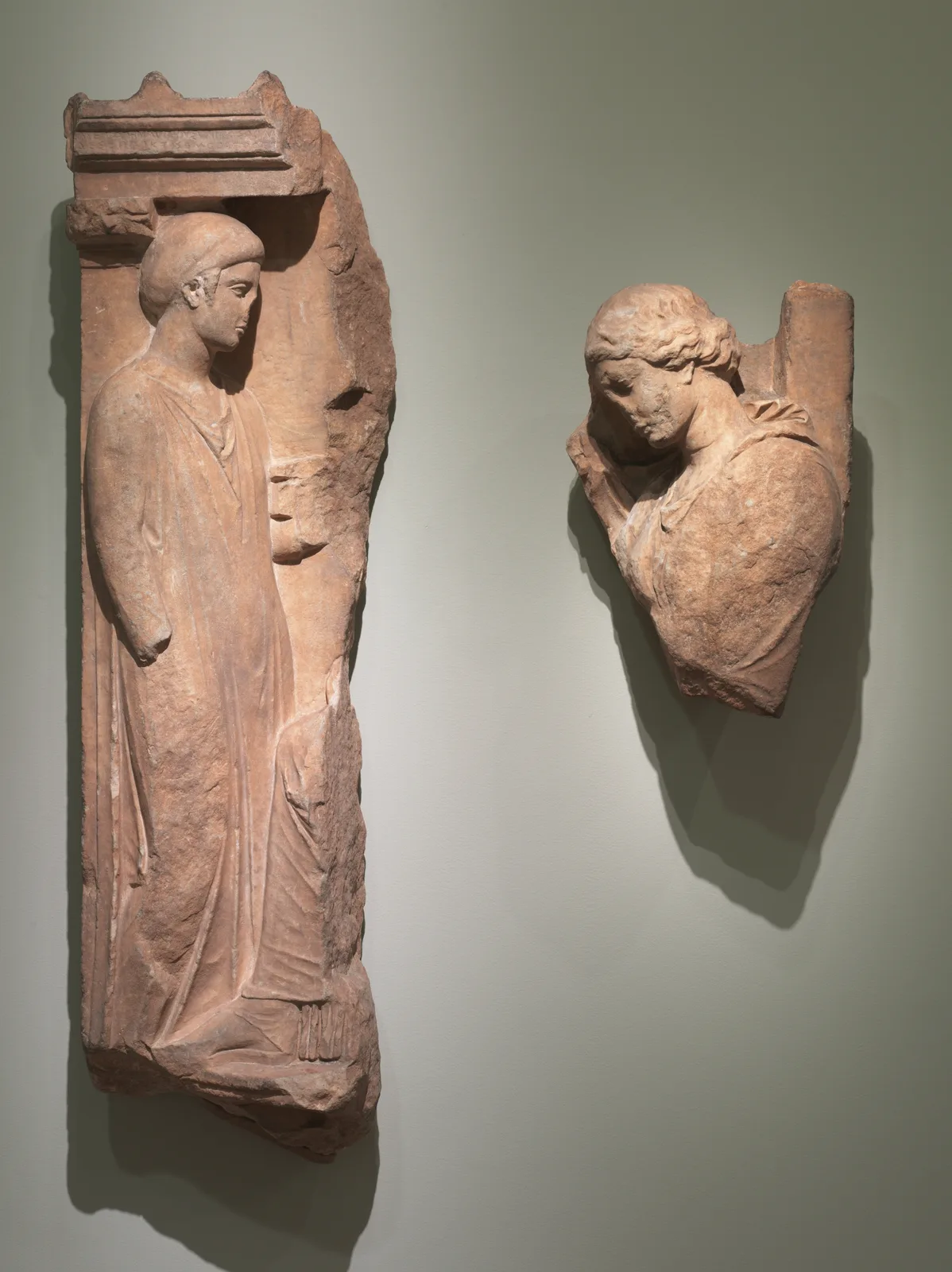
One Saturday in chapter 106 Philip hears that Hayward, the friend he first met in Heidelberg, caught enteric fever and died not long after reaching the Cape. He goes to the British Museum and sits in a room lined with gravestones carved by Athenian masons in the fifth and fourth centuries BC. The novel describes marble that time has turned honey-coloured, and a farewell on every stone. A friend who once seemed bound for great things had achieved nothing and died pointlessly of an illness, and to Philip, Cronshaw's life seems no different.
Then he remembers Cronshaw's rug, and the answer comes to him. The English text gives it in one sentence: "Life had no meaning." Philip does not despair; he is delighted. Just as when he gave up his faith as a boy, he feels for the first time entirely free. The release of chapter 28, folded down in volume 1, comes back here.
The weaver's pattern
A second thought follows in the same chapter, and Philip guesses this is why Cronshaw gave him the rug. A weaver works a pattern purely because it pleases his eye; in the same way a person can take what he has done, felt and thought as threads and look at his life as a pattern. Life need not serve any purpose for a pattern to be made of it.
There is more than one pattern. The novel ranks the plainest, which runs from birth through growing up, marriage, children and work to death, as the clearest, most perfect and loveliest, and adds intricate ones that make no room for happiness and do not aim at success. Hayward's was cut short by chance before it was finished; Cronshaw's only shows its worth once you change where you stand to look at it. In chapter 106 Philip lets go of the wish to be happy and resolves to treat joy and pain alike as material for the pattern.
One detail is worth noticing. Cronshaw pointed to a museum in chapter 45, and the answer also arrives in a museum. Yet what sits in front of Philip in chapter 106 is a row of gravestones, not a rug, which was cut to pieces back in chapter 97. The answer does not come from looking hard at the object. It comes when a friend's death sends Philip back to the memory of it.
What Philip does with the idea
Besides chapter 106, the second half likens a life to a pattern in chapters 112, 116, 121 and 122. In chapter 112, after his uncle's funeral, Philip walks through Tercanbury and is overwhelmed by loneliness, so he tells himself firmly that past unhappiness is only ornament in the design. In chapter 116, in his last year at medical school, he finds paint and words trivial beside the work of shaping a pattern, and when he spots Lawson in Piccadilly he slips into a side street, deciding that their friendship was a thread already woven in. The image that once consoled him now helps him keep a friend at a distance.
In chapter 117 Doctor South, an old doctor at Farnley in Dorset for whom Philip is working a month as a locum, offers him a partnership, and Philip refuses because he plans to see Spain and then head east. In chapter 121 Sally, the Athelnys' eldest daughter, whom he grew close to during the hop-picking at Ferne, tells him she may be pregnant. Philip first argues to himself that an accident must not knock his life's pattern out of shape, then soon knows he cannot act on that, and chooses marriage and South's offer.
READING NOTES
Five places Philip uses the pattern idea
What Philip does with the idea from ch. 106
Ch. 106 · More than one pattern
- The plainest: birth, growing up, marriage, children, work, death.
- Intricate ones leave happiness out.
- Philip gives up wanting happiness.
Ch. 112 · Comfort
- Lonely after his uncle's funeral,
- he tells himself firmly that past pain is ornament.
Ch. 116 · Keeping away
- Paint and writing seem trivial now.
- Lawson is a thread already woven in.
Ch. 121 · An excuse
- No mishap may spoil his pattern, he vows,
- but soon he chooses to marry Sally.
Ch. 122 · The simplest pattern
- A false alarm brings dismay, not joy.
- The simplest is the most perfect.
In the second half only these five chapters liken a life to a pattern
Chapter 122: the simplest pattern
In the last chapter Philip waits for Sally at the National Gallery. On the way a stranger who walks like Mildred makes his heart lurch, and he knows he will never be wholly rid of that passion. Sally says the scare was groundless. His plans are safe again, yet what he feels is not joy but dismay. Only now does he see that he had fooled himself: it was not self-sacrifice that had turned his mind to marriage but the wish for a wife, a home and love. He recalls what he had already seen in chapter 106, that the simplest pattern is also the most perfect, and asks Sally to marry him.
The rug's answer has two layers. Life has no meaning set in advance, and for that very reason a person can choose the pattern of his own life. In chapter 106 the answer led Philip to drop the wish for happiness first of all; in chapter 122, holding the same answer, he picks the simplest pattern, the one with happiness in it. The answer has not changed. What has changed is how he uses it.
Reading volume 2
The second half falls into six stretches, broken where Philip's home or work changes. The main new figures are Norah Nesbit (chapter 66), Macalister (67), Dr Tyrell (81), the surgeon Jacobs (84), Athelny (86) and his eldest daughter Sally (87), and Doctor South (116).
READING NOTES
The second half in six stretches
Chapters 65–122, split by where Philip lives and works
Ch. 65–78 · Norah and Mildred
- Norah Nesbit becomes his lover.
- Mildred comes back, and then she goes off with Griffiths.
Ch. 79–90 · Hospital and the Athelnys
- He trains in outpatients and on wards.
- Cronshaw dies in ch. 85.
- Philip meets a patient, Athelny,
- and his family.
Ch. 91–97 · Mildred in Kennington
- Mildred and her baby move in.
- His foot is operated on in ch. 94.
- The rooms are wrecked in ch. 97.
Ch. 98–111 · Shares, poverty, a draper's
- Wartime shares sink him in ch. 98.
- He becomes a shop-walker in ch. 102.
- He designs costumes from ch. 107.
Ch. 112–117 · Legacy and diploma
- With his uncle's legacy,
- he goes back to hospital.
- He spends a month as a locum at Farnley, Dorset.
- He turns down a partnership in ch. 117.
Ch. 118–122 · Ferne, then London
- He picks hops with the Athelnys.
- In ch. 122 he meets Sally at the National Gallery.
Minumsa does not say where volume 2 starts · from ch. 65 is the second half by a word-count estimate
The other two folded scenes come back as well. In chapter 14 Philip prayed for his foot to be healed; in chapter 94 he has Jacobs operate on it. Told that it can never be like the other foot, he remembers praying to a God who could move mountains, smiles wryly, and says he has no hope of a miracle. The release of chapter 28 returns in chapter 106, as shown above. Note the settings too: the question is put off with a museum named, the answer arrives in the British Museum, and the decision is made in the National Gallery.
The Minumsa edition is Song Mu's translation, and the commentary and chronology at the end of volume 2 can be read alongside it. The Korean version of this guide spells names of people and places close to their English pronunciation, so its spellings may differ from the translation's.
When you open volume 2, mark the chapters where the rug appears (65, 79, 82, 97 and 106; chapter 65 may fall at the end of volume 1) and those that liken a life to a pattern (106, 112, 116, 121 and 122). Each time the pattern comes up, write one line on what Philip is trying to do with it. You will watch the same image serve as comfort, then as an excuse, and in the last chapter as the ground for a decision.
Add your perspective.
Share a question, another approach, or something you have tried.
Checking sign-in…
Loading comments…