Volume 7 of Minumsa's World Literature series is Joseph Conrad's Heart of Darkness. On a boat anchored in the Thames, a seaman named Marlow tells of a journey he once made up a great African river to bring back Kurtz, an ivory agent. Partway through, Marlow says he hates, detests and cannot bear a lie. Yet in the last scene of the book he tells a plain one. After this guide you will be able to follow where that lie is announced and which scenes it rests on. It also sets out the book's nested frame, the course of its three parts, and the argument that surrounds it.
Translated by Lee Sang-ok, 212 pages
The Minumsa edition, translated by the English literature scholar Lee Sang-ok, came out in 1998 and runs to 212 pages. Like the original it has three parts, listed as Chapters 1, 2 and 3, followed by the translator's commentary and a chronology of the author's life. The publisher presents it as the source of Francis Ford Coppola's film Apocalypse Now (1979).
Conrad was born in Poland in 1857 as Józef Teodor Konrad Korzeniowski. He left Poland in 1874 to sail on French merchant ships and learned English only after moving to British ships. He became a British subject in 1886, left the sea in 1894 and published his first novel the following year. In 1890, at thirty-two, he was hired by a Belgian trading company to serve on a Congo River steamer and briefly took command when the captain fell ill. Georges-Antoine Klein, a company agent who fell ill and died on board, is one of several people suggested as a model for Kurtz. Heart of Darkness appeared in three instalments in Blackwood's Magazine from February to April 1899 and was collected in the book Youth in 1902. Conrad died in 1924.
A story that begins on the Thames
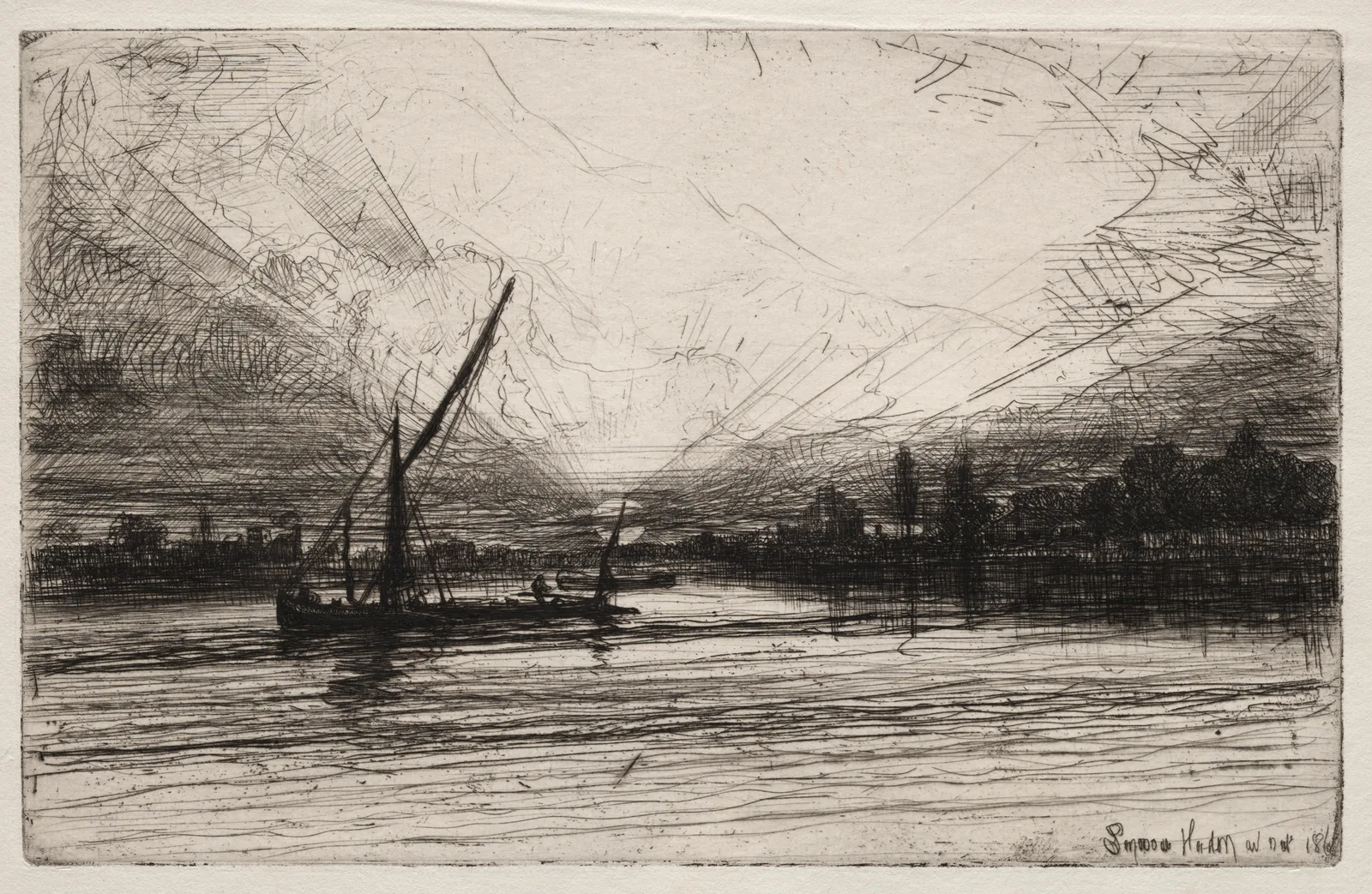
The novella opens not in Africa but on the Thames below London. The yawl Nellie has dropped anchor to wait for the tide, and on deck are a Director of Companies, a Lawyer, an Accountant, Marlow and an unnamed narrator, “I.” As the sun goes down Marlow suddenly says that this, too, has been one of the dark places of the earth. He imagines what the land was like for the Romans who first came up the river nineteen hundred years earlier, and only then begins his own story.
So what we read is Marlow's tale as told by “I,” with Kurtz at its very centre. The narrator remarks that for Marlow the meaning of a story is not inside it like the kernel of a nut but outside, enveloping it like a misty halo. As the story goes on it grows so dark on the river that the listeners can hardly see one another.
READING NOTES
A story inside a story
It opens at sunset on the Thames and ends there after dark
Outer frame · the Nellie on the Thames
- Five men on a yawl wait for the tide.
- An unnamed 'I' reports the evening.
Inner tale · Marlow's river journey
- Marlow recounts a journey he once made.
- As night falls, the listeners lose sight of him.
Innermost · Kurtz
- Known first by rumour, a report and a voice.
- Last words: "The horror! The horror!"
Back to the frame · the ebb is missed
- Marlow stops; they have lost the ebb.
- The Thames, too, seems to lead into darkness.
Almost all of Marlow's words sit inside quotation marks: we read Kurtz as told by Marlow as told by 'I'.
Three parts, one journey upriver
In Part I Marlow gets command of a trading company's river steamer through his aunt's connections. In a European city that reminds him of a whited sepulchre, two women in the company's outer office knit black wool, and a doctor measures the heads of those going out. After more than thirty days along the coast he reaches the Outer Station a little way up from the river mouth: men with iron collars joined by a chain, people dying in the shade, and in the middle of it all a chief accountant in spotless whites keeping his books in order. Marlow walks two hundred miles with a caravan of sixty men to the Central Station, only to find his steamer at the bottom of the river and the rivets needed to repair it never arriving.
In Part II Marlow overhears the manager and his uncle talking about Kurtz. As the chief accountant said in Part I, Kurtz sends in as much ivory as all the other stations put together, and the manager resents him for it. The steamer passes through thick fog, comes under attack with arrows, and the helmsman is killed by a spear. At the Inner Station a young Russian in patched clothes greets the boat. In Part III Marlow looks through his glass and realises that the round knobs on the posts of the station's fence are human heads. Kurtz, now ill, is carried aboard and dies on the way downriver.
READING NOTES
Three parts, one journey upriver
The Minumsa edition keeps the three parts as Chapters 1–3
Part I · from Europe to the Central Station
- Two women knitting black wool; a doctor measures heads.
- Men in chains; an immaculate chief accountant.
- A steamer sunk in the river; rivets that never come.
Part II · towards the Inner Station
- Overhears the manager and his uncle.
- Fog, an attack with arrows, the helmsman killed.
- Greeted by a young Russian in patched clothes.
Part III · Kurtz, then Europe
- Heads on stakes; the sick Kurtz carried aboard.
- Kurtz dies on the way downriver.
- Over a year later, Marlow visits his Intended.
Neither the Congo nor the European city of the Company is named in the text. Scene order follows the English text.
A man who cannot bear a lie
In Part I Marlow says he hates, detests and cannot bear a lie, because there is a taint of death, a flavour of mortality in lies. Yet in the same passage he lets the brickmaker at the Central Station believe he has powerful friends in Europe, and admits he went near enough to a lie.
In the middle of Part II Marlow breaks off and tells his listeners the ending in advance: “I laid the ghost of his gifts at last with a lie.” He adds at once that women should be out of it, and that men must help them stay in that beautiful world of their own. Before the reader reaches the last scene of Part III, the lie is already on its way.
In Part III, just before he dies on the boat, Kurtz cries out twice in a whisper: “The horror! The horror!” Back in Europe Marlow receives a series of visitors who want Kurtz's papers. He gives the Company man Kurtz's report for the Suppression of Savage Customs, but with the postscript torn off. That postscript read “Exterminate all the brutes!” Then, more than a year after Kurtz's death, he visits Kurtz's Intended. Dressed in mourning, she asks for his last words, saying she wants something to live with, and Marlow answers: “The last word he pronounced was—your name.”
Marlow says he felt as if the heavens would fall on his head, but nothing happened. He ends by saying the truth would have been too dark, too dark altogether. The lie can be read in two ways. It can be read as mercy shown to someone in grief, or as complicity in protecting the “beautiful world” of women he spoke of earlier, and beyond it the lofty “idea” that Europe used to justify conquest. In Part I Marlow had already said that what redeems conquest is the idea only. The torn-off postscript and the lie to the Intended do the same work: what reaches Europe is only the fine words.
READING NOTES
Marlow and the lie
What a man who cannot bear a lie does at the end
Part I · with the brickmaker
- "I hate, detest, and can't bear a lie."
- Yet he lets the man believe he has powerful friends.
Part II · the ending told in advance
- "I laid the ghost of his gifts at last with a lie."
- He tells his listeners how it ends before it ends.
Part III · visitors in Europe
- The Company man gets the report, postscript torn off.
- The Intended hears: "The last word was your name."
Kurtz's actual last words were "The horror! The horror!" Marlow says it would have been "too dark" to tell her.
The argument around the book
Heart of Darkness has long been read as a classic critique of imperialism, but it has also met strong objections from Africa. In his 1975 lecture “An Image of Africa: Racism in Conrad's Heart of Darkness,” the Nigerian novelist Chinua Achebe argued that the novella uses Africa only as a backdrop for a European crisis of the mind and strips Africans of their humanity. From the other side, the historian Adam Hochschild wrote in King Leopold's Ghost (1998) that literary scholars had dwelt on the book's psychology and paid too little attention to how accurately Conrad recorded the colonial violence of the Congo Free State. When Conrad wrote the novella, the Congo Free State was the private colony of King Leopold II of Belgium.
There is no need to settle the question one way or the other. But once you know Achebe's critique, you notice how little the Africans in the novella speak. The manager's boy who announces Kurtz's death, the helmsman and the fireman have no names, and the African woman beside Kurtz is never heard speaking in her own words. T. S. Eliot took that boy's words, “Mistah Kurtz—he dead,” as the first epigraph of his 1925 poem “The Hollow Men.”
What to mark as you read
First, the quotation marks. Almost all of Marlow's words sit inside quotation marks, and the words of the people in his story sit inside another set within them. Mark the places where the story breaks off and the narrator “I” cuts in, and you will see how Marlow's tale was being heard on the Thames.
Second, white and black. The European city like a whited sepulchre, the white of ivory, the accountant in white, the women knitting black wool. Through colour the novella keeps showing that darkness is not only in Africa.
Third, Kurtz's voice. Even before meeting Kurtz, Marlow thinks of him as a voice, and he admires the eloquence of his report. Mark the scenes where what Kurtz said comes before what he did, and they lead straight to why Marlow covers him with words in the final scene.
If you do just one thing
When you have finished the book, read the first few pages and the last page one after the other. At sunset on the Thames Marlow says this too was one of the dark places, and on the night his story ends the narrator says the river seemed to lead into the heart of an immense darkness. The “heart of darkness” you took to mean Africa at the start turns out, at the end, to point back towards London, and that is the reason to open the book again.
Add your perspective.
Share a question, another approach, or something you have tried.
Checking sign-in…
Loading comments…