Number 13 in Minumsa's World Literature series, One Day in the Life of Ivan Denisovich, opens with reveille at five in the morning and closes as its hero falls asleep. Having followed a day in a labour camp, the reader meets a last remark that the day was almost a happy one. Why end like that? This guide's answer is that the words read less as praise of a day that went well than as the result of a night-time reckoning of things avoided and things gained. After reading it you will be able to walk through the day in order, mark which scene each item in that reckoning came from, and work out the final number, 3,653, yourself. The ending is discussed.
What kind of book is it?
The Minumsa edition is translated into Korean by Lee Young-eui (this guide's romanization) and came out on 30 September 1998 at 260 pages. Its contents list the title work, the translator's commentary and a chronology of the author's life. The original was the first published work of Aleksandr Solzhenitsyn (1918–2008) and appeared in the November 1962 issue of the Soviet magazine Novy Mir. Its editor, Tvardovsky, is reported to have passed the manuscript up to the Party, and Khrushchev to have overruled some objections and allowed publication of a censored text.
English-language study guides often place the story in Siberia. Yet in his Nobel autobiography Solzhenitsyn writes that in 1950 he was sent to the new Special Camps for political prisoners and worked as a miner, bricklayer and foundryman in one at Ekibastuz in Kazakhstan, and he sets this novel's title beside that sentence. One commentary also says the novel does not name the camp's location, so this guide does not pin the setting to one place. That the author was a bricklayer is worth recalling at the wall scene below.
There are at least six English translations; the first five are said to come from the censored Soviet text, and H. T. Willetts's of 1991 from the canonical one. The publisher's and bookshop's pages do not say which text the Minumsa edition follows. Names in this guide follow English summaries and may differ from the Korean translation's spellings.
How does the day go?
Ivan Denisovich Shukhov has been given ten years on a charge of spying because the Germans briefly held him prisoner during the war. The title uses his first name and patronymic; inside the novel he is mostly called by his surname, Shukhov. Woken by the banging on an iron rail, he feels ill and lies on a moment longer, is caught by a guard and sent to mop a floor, and then fails to get excused at the sick bay. At the morning search Buynovsky, caught wearing extra layers, is given ten days in the cells.
His squad, the 104th, goes out to a power station under construction. They cover windows and fix a stove; at lunch he swipes extra kasha; on the way back to work he picks a scrap of metal out of the snow and conceals it. In the evening a man who fell asleep on site holds up the count, the metal gets through the search on re-entering the camp, and Shukhov stands in line for Tsezar, who has a parcel coming. At night he talks about prayer with Alyoshka, a Baptist. As the summaries tell it, this is close to an ordinary day, built more on routine than on major events.
READING NOTES
The day in order
Six stretches, from reveille to sleep
Dawn · Reveille at five
- Ill and slow to rise, he mops a floor as punishment.
- The sick bay does not excuse him from work.
Morning · Search and march
- The men are searched out in the cold.
- Buynovsky is given ten days in the cells.
Midday · The power station
- They cover windows and fix a stove.
- He swipes an extra bowl of kasha at lunch.
- He picks up a scrap of metal on the way back to work.
Afternoon · The brick wall
- They lay bricks before the mortar freezes.
- He stays on to see the work is solid.
Evening · Count and parcels
- A man asleep on site holds up the count.
- The metal gets through the search.
- He saves Tsezar a place in the parcel line.
Night · Before sleep
- He and Alyoshka talk about prayer.
- The day is reckoned almost happy.
Pieced together from English guides · not checked against the Minumsa text
An afternoon at the wall
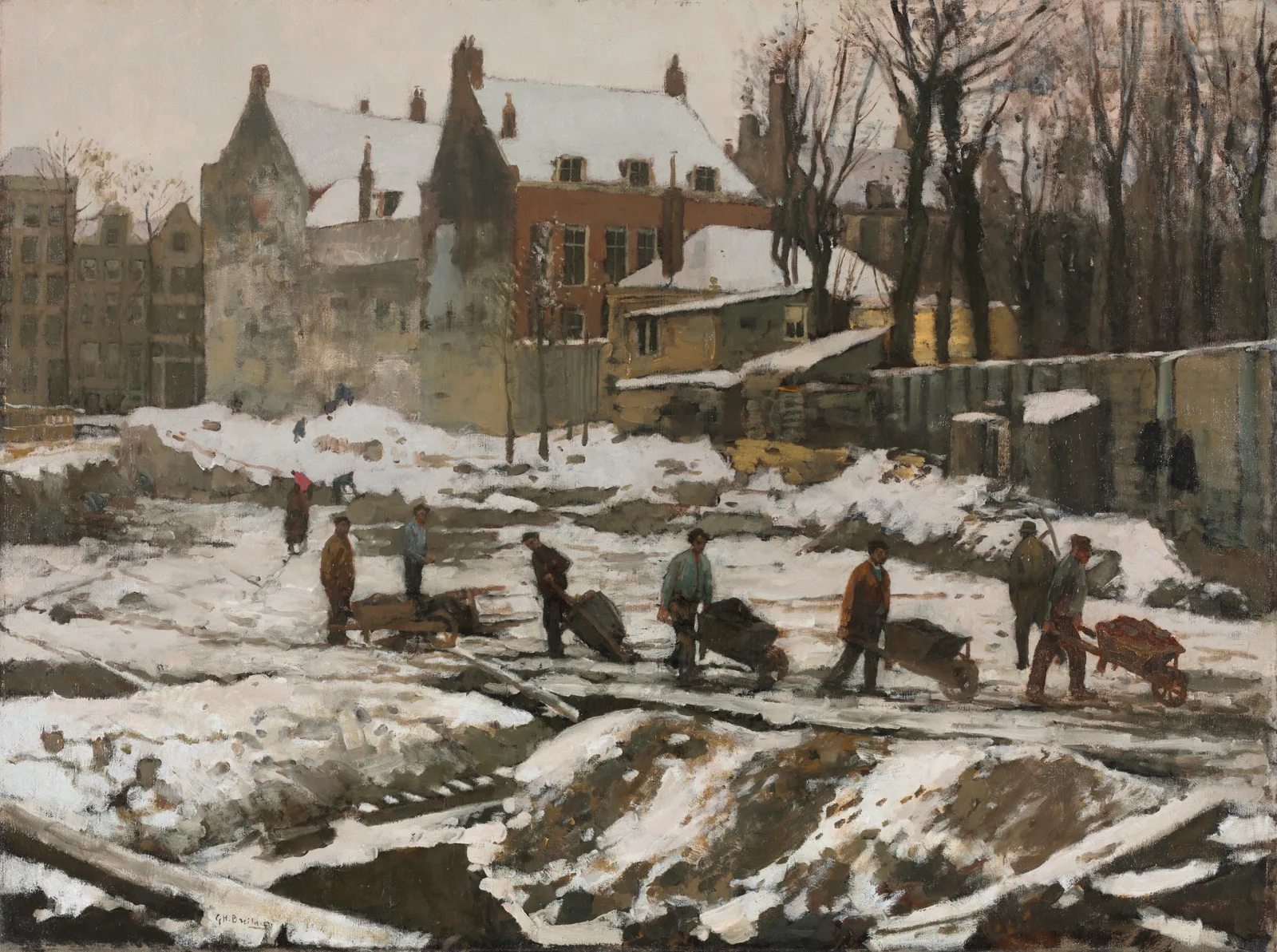
The afternoon at the centre of the book is a brick wall. The cold freezes the mortar if it is not used quickly, so the squad has to move fast. When work has ended, Shukhov stays to see that the wall is solid and to hide his trowel, at the risk of being late for the count. One commentary points out that he could simply throw away the spare mortar and stop, and does not.
The reckoning before sleep
In the translation quoted by the study guide LitCharts, the end of the novel calls the day this: “Almost a happy one.” The phrase “almost happy day” in this guide comes from there; the Minumsa wording has not been checked against it. Before those words comes a list of the day's “strokes of luck.” Counting from an excerpt of Ralph Parker's English translation on Encyclopedia.com gives nine items. They are not in the original order here and have not been checked against the Minumsa text, so check them against a translation yourself.
By this guide's grouping, four are things avoided (the cells, the settlement site, discovery of the metal, illness), four are things gained (kasha, favourable work rates, a favour from Tsezar, tobacco) and one is something he made (the wall). One commentary says the squad leader, Tyurin, bribed an official with salt pork to spare his men a work detail on the open steppe, and that appears to be the settlement site on the list. So although the list speaks of luck, it can be read as containing human contrivance too.
READING NOTES
The tally before sleep
The closing list's nine items, in three groups
Four things avoided
- He was not put in the cells.
- The squad was not sent to the settlement.
- The metal was not found.
- He did not fall ill.
Four things gained
- A bowl of kasha at lunch.
- Good work rates fixed by the squad leader.
- A favour earned from Tsezar.
- Tobacco.
One thing he made
- He put up a wall and liked the work.
Items from an English translation excerpt · not the novel's order · the groups are this guide's
Sources also differ on who is speaking. The EBSCO commentary says the narrator makes the remark; LitCharts and Shmoop give it as Shukhov's thought. And on that same day Buynovsky is given ten days in the cells. Read alongside this, the word happy plainly refers to Shukhov's day and not to the camp as a whole. Shmoop takes the ending as showing how far his idea of happiness has sunk, and this guide's reading is close to that. Shmoop adds that it also shows him as a survivor.
The number 3,653
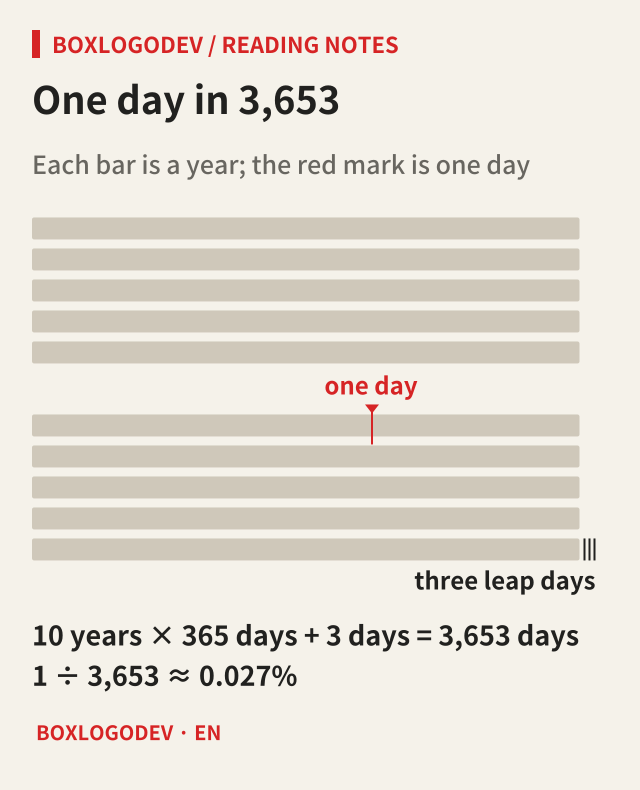
The novel does not stop there. It adds that there were 3,653 days like this in his sentence, three of them for leap years. The sum is simple: 10 years × 365 days = 3,650 days, and three leap days make 3,653. One day is 1 ÷ 3,653 of that, about 0.027 percent.
There seems no need to take “days like this” to mean that all were lucky. The novel has just singled out this day's luck, and the quoted translation measures those days by the clanging of the rail, first to last. So this guide reads them as days locked in the same frame; that is an interpretation. Nor is the end of the sentence certain. One commentary notes that Shukhov has no real assurance of release after ten years. Solzhenitsyn writes in his autobiography that a month after he had served his full eight years, an administrative decision without any new judgement exiled him for life.
What to watch for
First, mark the eating scenes. Where Shukhov takes out his spoon and secures his kasha, you can see how food becomes a unit of exchange. Second, look in the wall scene for what no one orders him to do. Third, read the others' stories alongside his: the squad leader Tyurin, Buynovsky, Tsezar and Alyoshka each bear these conditions differently. Minumsa presents them as a miniature of society in Stalin's time.
When you have finished, mark each of the nine items in the tally against its earlier scene. Seeing which group fills up most lets you judge for yourself what this novel's almost happy day is made of.
Add your perspective.
Share a question, another approach, or something you have tried.
Checking sign-in…
Loading comments…