How should we prepare for an era of writing together with AI?
📌 SEO keywords
Claude AI, Claude 3, AI writing, how to use generative AI, prompt engineering, writing aids, work automation, AI collaboration
📖 Opening the book: why Claude?
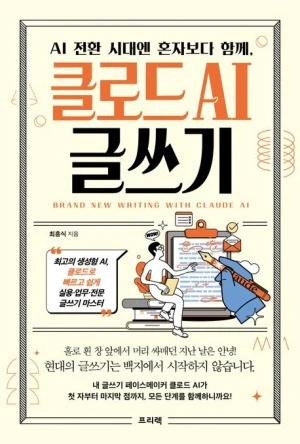
This is a Korean book, and its author, Choi Heung-sik, is a prompt designer and a Google Workspace instructor. The AI he turned his attention to is neither OpenAI's ChatGPT nor Google's Gemini, but Anthropic's Claude.
As the book's title suggests, his view is that what matters in the age of AI transformation is "together rather than alone," and he stresses that, especially in writing, AI is a colleague you work with.
"Don't rack your brain alone; start your writing by talking with Claude."
This line is the book's starting point.
🤖 What are Claude AI's strengths?
The Claude 3 series is strong in language comprehension, long-form summarization, smooth sentence generation and logical flow. Building on these traits, the book explains how to use Claude as a writing assistant.
- 📌 Can summarize even long documents: reads and summarizes reports tens of thousands of words long
- 📌 Memory of earlier context: the flow of conversation feels natural
- 📌 Control over writing style: freely switches from official documents to diary style
- 📌 Ethics and safety by design: it even has the nickname "constitutional AI"
If ChatGPT is the byword for conversational AI, Claude feels like "a quiet but elegant professional."
✍️ Structure and real usage examples
The book is organized around two main parts:
1️⃣ Basics
- Understanding generative AI
- Claude vs. other AIs
- The basic structure of a prompt: role, instruction, conditions, expected output
- Templates for beginners
- Practicing how to "ask AI well"
2️⃣ In practice
- Blog writing: keyword-based posts, summaries, SEO sentence generation
- Reports/proposals: designing tables of contents, organizing key points, adjusting style
- Cover letters/emails: refining expressions, suggesting structure
- Professional documents: advanced examples for HR, finance, law and more
- Creative writing and emotional expression: diaries, book reviews, essays
The author presents a collaborative method in which, before starting to write, you ask Claude for ideas, generate a draft, and then have a person revise it, repeating the cycle.
🌟 Why I recommend it
✔️ Offers a way out of "writing anxiety"
✔️ Full of examples that working professionals and students can use right away
✔️ Conveys the philosophy that "AI is not a tool but a colleague"
✔️ Encourages intuitive understanding by comparing example prompts with their results
Above all, this book proves the point that "people who make good use of AI gain a competitive edge." Its message is that a person who uses a tool well is stronger than the tool.
😅 What I found lacking
- Because it centers on Claude, comparisons with GPT, Gemini and others are thin
- Limits in keeping up with the latest versions → as fast as technology changes, the book's content can quickly become outdated
Given that it is about how to use AI, what matters is not just reading the book and stopping there, but actually opening Claude and following along.
🧩 Insights I gained as a reader
As someone who runs a blog and writes meeting minutes and reports at work, the most useful thing was "how to throw AI the first line." For example:
"Summarize just the key points of this report in 3 lines."
"Rewrite it in simple sentences that even a middle school student can understand."
"Explain it like an expert, but keep the tone gentle."
This process of asking clearly, adjusting again, and finishing with a human touch is exactly the "AI writing collaboration method" this book presents.
📌 Overall verdict
Writing with Claude AI: Better Together Than Alone in the Age of AI Transformation is a book that combines a technical book and a practical guide. It is fine if you don't know much about AI or lack confidence in writing. What matters is the courage to start a sentence together with Claude instead of struggling alone.
This book guides the way for readers who find that courage.
🏷️ Recommended readers
- Office workers who feel "I have no idea how to write this"
- Team leaders considering adopting AI
- Beginning writers
- Practitioners who often write blog posts and reports