When a child standing at a dinosaur footprint asks how fast it walked, the natural thing is to look for a figure in kilometres per hour. That figure is not measured from the fossil; it is calculated from what was measured plus an estimate. By the end you will be able to work the calculation yourself from a footprint length and a stride, read the 37.8 km/h attached to 1 cm tracks from Jinju in Korea, and explain how far such numbers can be trusted.
What you can actually measure
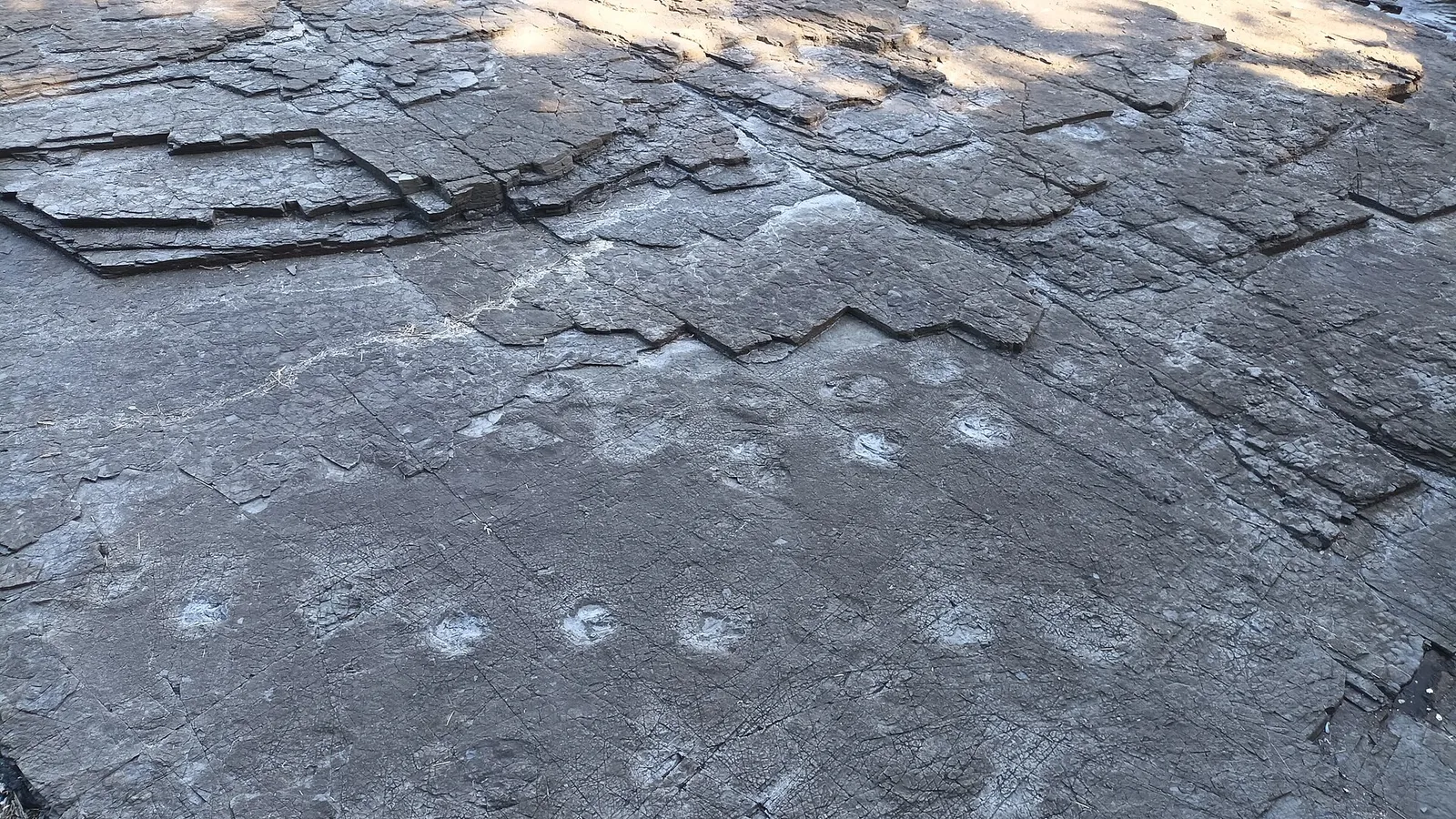
A ruler on a fossil gives you footprint length and the distances between footprints. Left foot to right foot is one pace; left foot to the next left foot is a stride. People often say stride when they mean a single step, which is an easy slip, but the speed formula takes the full stride. The stride carries an exponent of 1.67, so putting in half the stride by mistake cuts the result to about a third (0.5 to the power 1.67 is about 0.31).

The formula needs an estimated hip height
The most widely used equation comes from R. McNeill Alexander in 1976. Speed (m/s) = 0.25 × 9.81 to the power 0.5 × stride (m) to the power 1.67 × hip height (m) to the power −1.17. The relationship came mainly from mammal data: a longer stride gives a higher speed, and for the same stride a bigger body gives a lower one. Alexander himself was unsure the pattern from four-legged mammals would carry over to dinosaurs.
Hip height leaves no mark in a footprint. Alexander estimated it, working from mounted dinosaur skeletons, as four times the footprint length, and a teaching resource from the UC Museum of Paleontology (UCMP), noting that the ratio differs between dinosaur groups, also takes roughly four times for a two-legged dinosaur. So what the fossil shows stops at lengths and gaps; hip height and speed are inferred.
Here is the calculation. A 30 cm footprint and a 2.0 m stride are made-up values chosen for illustration. Hip height is 0.30 m × 4 = 1.2 m. 0.25 × √9.81 = 0.783, 2.0 to the power 1.67 = 3.18, and 1.2 to the power −1.17 = 0.808; multiplied together they give 2.01 m/s, about 7.2 km/h. You can also estimate the gait. By UCMP’s thresholds, stride ÷ hip height under 2 is a walk, 2 to 2.9 a trot and over 2.9 a run. This example comes to about 1.67, a walk.
DINO NOTES
Working through a made-up footprint
Say the footprint is 30 cm and the stride 2.0 m
First, measure
L → R → L- Left (L) to right (R): one pace
- Left to next left: one stride
- Using a pace instead cuts the result to about a third
Estimate hip height
h = 1.2 m- Footprint length × 4
- 0.30 m × 4
Work out the two terms
- Stride: 2.0 to the power 1.67 = 3.18
- Hip height: 1.2 to the power −1.17 = 0.808
Multiply with the constant
2.01 m/s ≈ 7.2 km/h- 0.25 × √9.81 = 0.783
- 0.783 × 3.18 × 0.808
Stride ÷ hip height = 2.0 ÷ 1.2 ≈ 1.67, under UCMP's 2.0, so a walk. Every value here is made up and no real specimen is involved.
The 1 cm tracks from Jinju: one slab, two numbers
For a Korean example, take the Jinju Chungmugong-dong pterosaur, bird and dinosaur footprint fossil site (called Hotan-dong until 2021). In 2018 Kim Kyung Soo and colleagues reported in Scientific Reports two-toed tracks about 1 cm long from the Lower Cretaceous Jinju Formation and gave them the track name Dromaeosauriformipes rarus. One slab, specimen CUE JI-2E Dr001, holds 18 tracks.
Trackway 1 has seven tracks, a mean length of 1.03 cm and a mean stride of 10.00 cm, and the paper gives 0.6 m/s (2.16 km/h). Trackway 2 has three tracks, a mean length of 1.05 cm and a stride of 55.63 cm, and the paper gives 10.5 m/s (37.8 km/h). The 2018 paper treated this as within published estimates for other dinosaurs and set it beside top-speed estimates for an adult Velociraptor. The maker has not been identified to species. The paper’s title points to microraptorines, a group of small dromaeosaurids, and the authors write that it may be a very small dromaeosaurid species or a juvenile of a larger one, and they estimate the 18 tracks as 6 to 10 trackways, possibly made by a similar number of individuals.
The paper says it used Alexander’s formula but does not state a hip height multiple. Putting the same measurements back into the formula gives 0.70 m/s for trackway 1 and 12.0 m/s for trackway 2 at four times; 0.61 m/s and 10.5 m/s at 4.5 times, which matches the paper; and 0.54 m/s and 9.2 m/s at five times. That recalculation is this note’s own. The 2018 paper and its supplement print no hip height, but a 2024 follow-up gives that paper’s estimate as 4.75 cm, about 4.5 times the 1.05 cm track.
One thing is worth noticing. Trackway 2 has three tracks and so only one stride, and its two paces differ, at 25.16 cm and 31.28 cm. Its stride ÷ hip height is about 12 to 13 at four to 4.5 times, far outside the range in the 2025 experiment below (0.6 to 2.5 times leg length).
DINO NOTES
Two trackways on one Jinju slab
Dromaeosauriformipes rarus, Kim and colleagues (2018)
Trackway 1: seven tracks
- Track 1.03 cm, stride 10.00 cm
- Paper: 0.6 m/s (2.16 km/h)
Trackway 2: three tracks
- Track 1.05 cm, stride 55.63 cm
- Paper: 10.5 m/s (37.8 km/h)
Change the multiple: trackway 1
- Hip height = track × multiple
- ×4 0.70, ×4.5 0.61, ×5 0.54 m/s
Change the multiple: trackway 2
- Hip height = track × multiple
- ×4 12.0, ×4.5 10.5, ×5 9.2 m/s
Reading trackway 2
- Just one stride
- Stride ÷ hip height is about 12 to 13 (at ×4 to ×4.5)
- Whether the three prints form one line is disputed (2025)
The values for each multiple are this note's own calculation. The paper does not state a multiple; ×4.5 matches its figures.
Trackway 2’s 37.8 km/h has since become contested. A 2024 paper in PNAS by Dececchi and colleagues, with Kim among the authors, takes a hip height of 4.75 cm and calculates that reaching 10.5 m/s on leg power alone would mean a speed for its size (a Froude number of 238) far above an ostrich or a cheetah. They read the long stride as stretched with help from the wings, at a lower real speed. In 2025, in the same journal, Falkingham and Lallensack, co-authors of the guineafowl experiment below, replied that the evidence for these three prints forming one line is weak, and that separate prints or missing prints between them are more likely. Dececchi and colleagues answered that their conclusion holds even if prints are missing. As of that 2025 reply the two readings still stand against each other, but neither side treats 37.8 km/h as a speed the animal really ran.
Testing it on living birds
An experiment by Prescott and colleagues, published in Biology Letters in 2025, compared high-speed video of two helmeted guineafowl crossing trays of mud with 3D models of their tracks. Over 20 trials in three grades of mud, speed measured from video averaged 0.29 m/s, while speed calculated from the same tracks averaged 0.61 m/s. Calculated speed was 1.17 to 4.74 times the measured speed, and still about 1.2 to 2.5 times above roughly 0.3 to 0.4 m/s. Variants of Alexander’s equation also came out above the measured speeds. In one case a 0.37 m stride at 0.17 m/s was followed by a 0.36 m stride at 0.48 m/s.
This does not make the formula simply wrong. Earlier treadmill data fitted it, at least at higher speeds, and the authors attribute the gap to soft ground and unsteady walking. But footprints form only on soft ground, so fossils cannot avoid that condition. The authors warn that a single figure may be badly wrong, and advise giving speeds only in broad terms. They also note that only one species was tested and allow that the formula may fit better for much larger dinosaurs or in sand. Earlier work summarised in the same paper includes Alexander’s own warning that speeds could be off by a factor of at least 1.5, and a possible factor of 2 from the hip height estimate alone.
DINO NOTES
Testing the formula on living birds
Two guineafowl crossing mud (Prescott and colleagues, 2025)
Mean speed
- Measured on video: 0.29 m/s
- From the formula: 0.61 m/s
The formula gave
- 1.17 to 4.74 times the measured speed
- About 1.2 to 2.5 times above roughly 0.3 to 0.4 m/s
Similar stride, different speed
- 0.37 m at 0.17 m/s
- Next stride: 0.36 m at 0.48 m/s
On a hard surface
- Earlier treadmill data fitted the formula, at least at higher speeds
- It went wrong on soft ground that takes prints
The experiment covers one species. The authors allow that the formula may fit better for much larger dinosaurs or in sand.
Answering at the site
The Uiseong Jeo-ri dinosaur footprint fossil site is a slope exposed by road widening in 1989. The Korea Heritage Service record gives more than 300 footprints from about 110 million years ago. A 2013 survey sorted them into 12 sauropod, 10 ornithopod and 1 theropod trackways. At a site like this, deciding which prints belong in a line is itself a judgement.
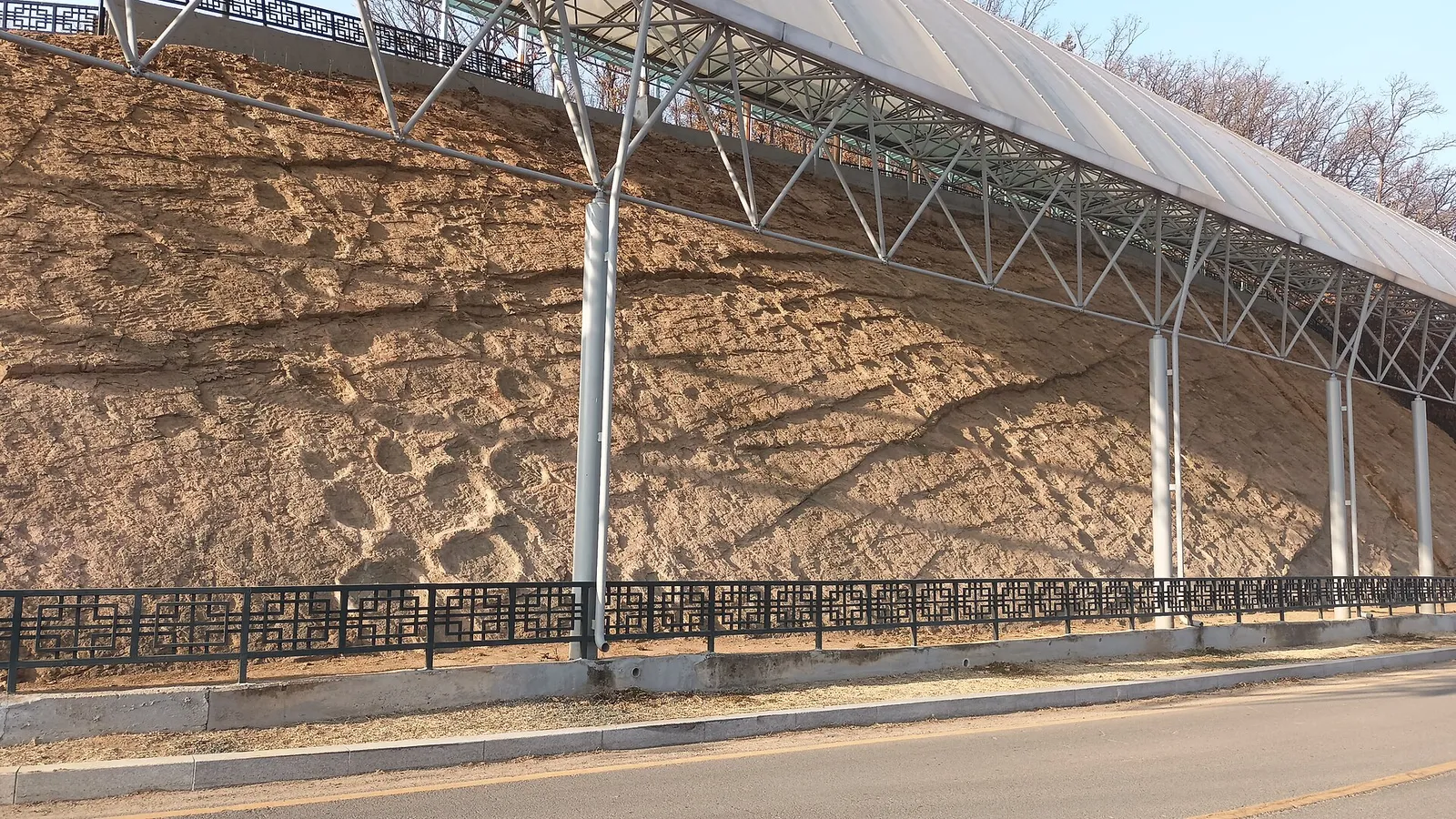

There is an estimate you can make without a ruler. If hip height is four times footprint length, UCMP’s 2 and 2.9 become 8 and about 11.6 footprint lengths. Pick a line, count roughly how many footprint lengths it takes to reach the next print of the same foot, and if it is under 8 you can say UCMP’s thresholds put it on the walking side. The made-up example above is 2.0 ÷ 0.30 ≈ 6.7. This note did not confirm that the same thresholds hold for four-legged dinosaurs, so it is safer on two-legged tracks. Keep off the fossil surface and count by eye from where visitors are directed to stand. If you go to Jinju, the Jinju Pterosaur Tracks Museum says it closes on Mondays (or the next day if Monday is a public holiday), Lunar New Year, Chuseok and 1 January (checked 1 November 2026). The slab in this note is listed in the paper as a Chinju National University of Education (CUE) specimen; whether it can be seen at the museum could not be confirmed.
So here is what to tell the child. The length and spacing of the footprints were really measured; a figure in km/h is a calculation with an estimate in it; and what the fossil supports with confidence stops at a comparison, provided the prints were grouped correctly: that this line took longer strides than that one.
Add your perspective.
Share a question, another approach, or something you have tried.
Checking sign-in…
Loading comments…