Suppose 1,000,000 won is left for one year at 3%. Interest is added once, at maturity, and there is no tax or fee. The balance is then 1,030,000 won. The amount of won has grown by 3%. That does not mean the quantity it can buy has grown by 3%.
Under the same assumption, one basket costs 10,000 won today. The 1,000,000 won buys 100 baskets. If only the basket price rises 2%, to 10,200 won, the 1,030,000 won buys 100.980 baskets. The quantity has grown by 0.980%. A 3% rise in the balance and a 0.980% rise in quantity are different numbers.
The 1,000,000 won, the 3% rate, the 10,000 won basket, and the 2% price rise are a worked example. They are not a bank product, and they are not a price index from the national data office. No deposit was opened and no basket was bought while writing this.
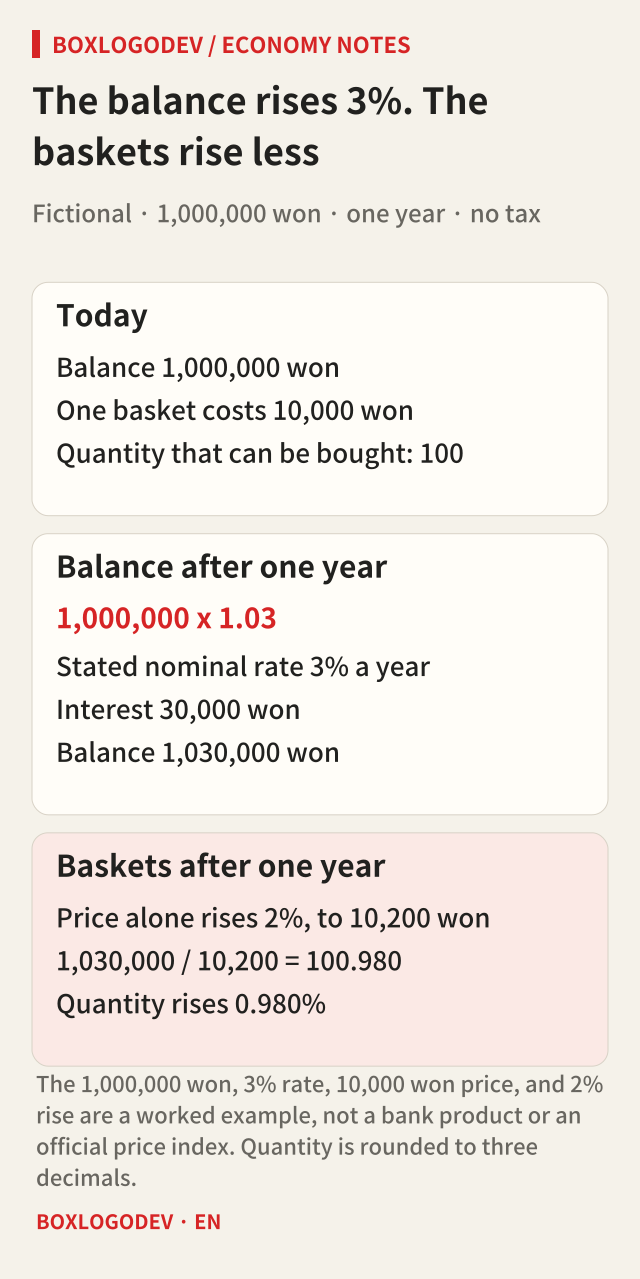
The rate on the screen and the amount you can buy
The interest rate on a deposit or loan notice is a nominal rate. Principal and interest are both counted in won, and interest is divided by principal. In the example, (1,030,000 − 1,000,000) ÷ 1,000,000 = 3%.
The real change is how much that money can buy over the same period. The baskets go from 100 to 100.980, a rise of 0.980%. 100.980 rounds 1,030,000 ÷ 10,200 to three decimal places, and the change before rounding is 0.980392%.
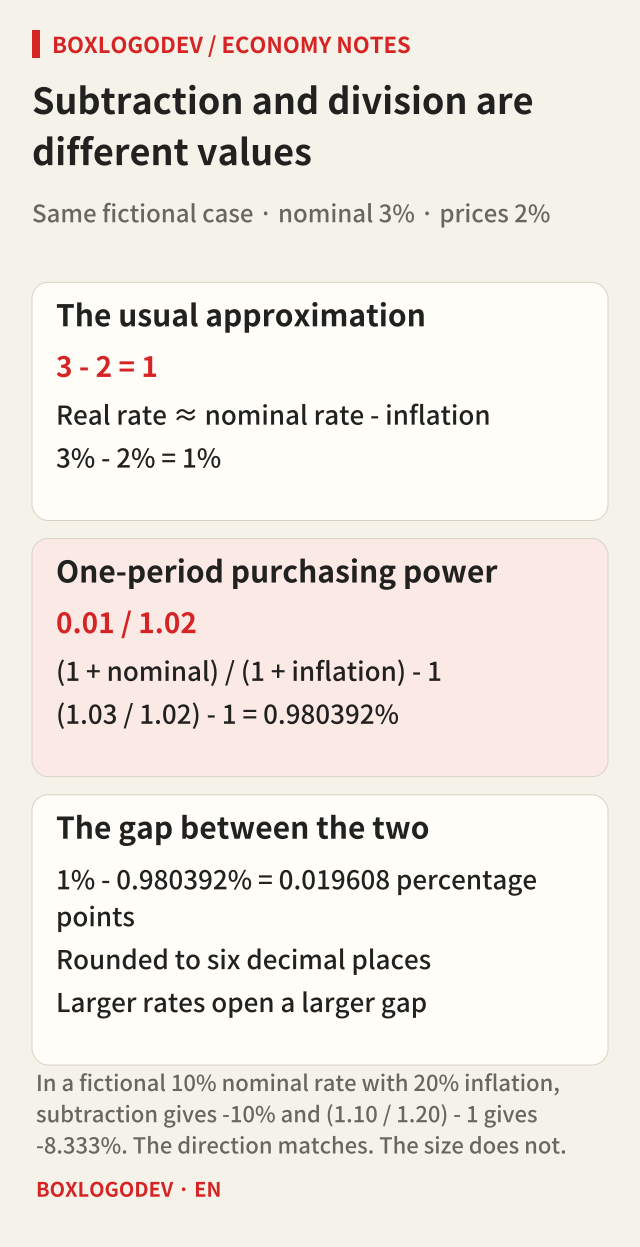
Purchasing power over one period is (1 + nominal rate) ÷ (1 + inflation) − 1. The example is (1.03 ÷ 1.02) − 1 = 0.980392%, rounded to six decimal places. Written as (nominal rate − inflation) ÷ (1 + inflation), it is 0.01 ÷ 1.02, and the result is the same 0.980392%.
Plain-language explanations often write real rate ≈ nominal rate − inflation. That gives 3% − 2% = 1%. The gap from the purchasing-power result, 0.980392%, is 0.019608 percentage points. The approximation drops the later division.
At small rates such as 3% and 2%, 1% and 0.980% sit close together. Larger rates open a larger gap. In a second fictional case, a 10% nominal rate and 20% inflation give an approximation of −10%, while (1.10 ÷ 1.20) − 1 = −8.333%. A reported size needs the formula that produced it. −8.333% is shown to three decimal places, and the 3 repeats.
The balance can rise while the quantity falls
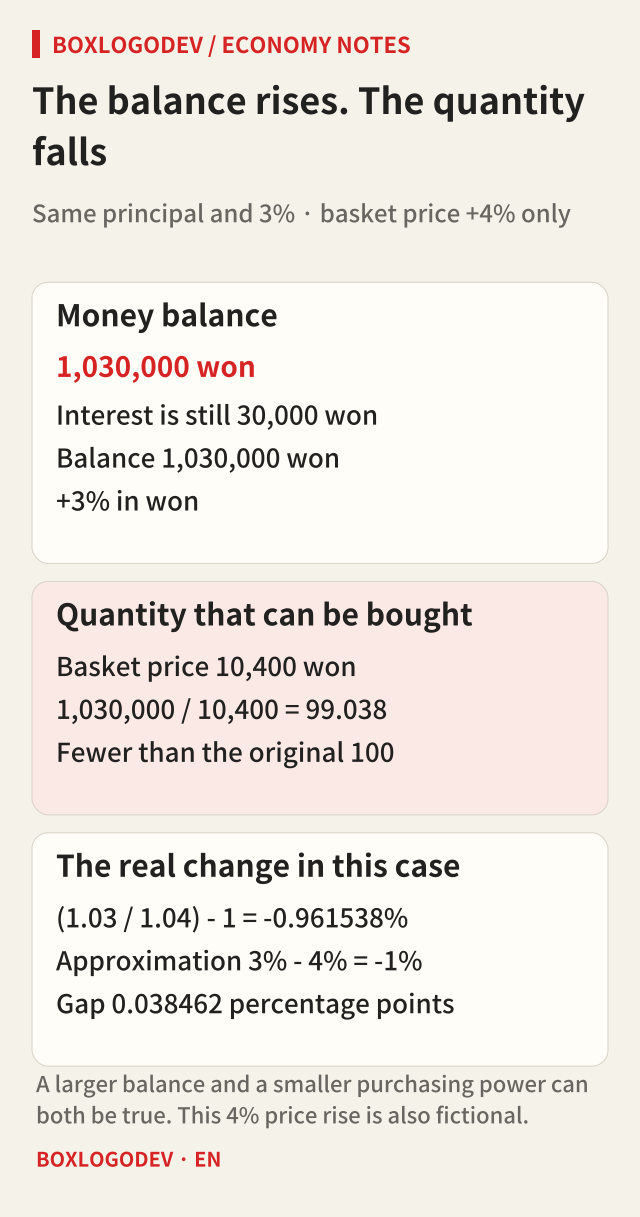
When prices rise by more than the interest rate, the balance grows and the quantity it buys shrinks. Keep the 1,000,000 won and the 3% rate, and change only the basket price to a 4% rise. A basket then costs 10,400 won. Rounded to three decimal places, 1,030,000 ÷ 10,400 is 99.038 baskets, fewer than the original 100.
The purchasing-power change is (1.03 ÷ 1.04) − 1 = −0.961538%. The approximation 3% − 4% = −1% differs by 0.038462 percentage points. Both say the amount you can buy fell. A sentence that only says the balance rose 3% hides that fall.
Inflation in this formula is the price change that actually happened during that year. On the day a contract is signed, that number is unknown. The figure used then is expected inflation. The figure calculated afterward from an index is inflation that has already occurred. Nothing requires the two results to match. The 2% and 4% above are prices chosen in advance so the two formulas can be compared.
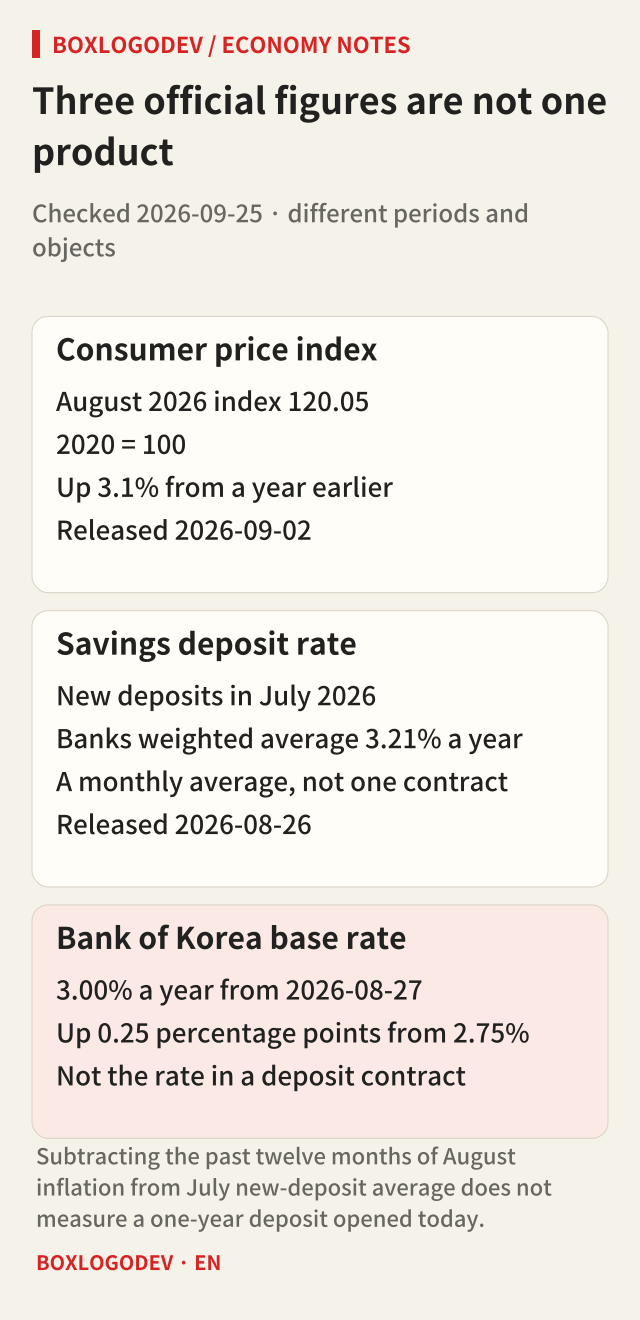
Three published numbers are not one deposit
Official statistics do not go into this fictional basket. The August 2026 consumer price index, released by the national data office on 2 September 2026, is 120.05 on a 2020 = 100 base. It was 3.1% higher than a year earlier and 0.2% higher than the previous month. The 3.1% is how far that index moved from August 2025 to August 2026, not the future inflation of a deposit opened today and not the price of one basket. The index excluding food and energy was 3.4% higher on the same year-before comparison. The inflation you subtract depends on which index you use.
The 0.2% change from the previous month and the 0.3 percentage point move in the year-before rate, from 2.8% to 3.1%, are different comparisons. The 0.2% is how far the index itself rose in a month. The 0.3 percentage point is how far the inflation rate rose from the previous month's inflation rate. It does not mean prices rose an extra 0.3% that month.
The index base is 2020, and the item weights use 2022. Multiplying item indexes by those weights and rebuilding a higher-level index can miss the published index. The index is not an absolute price level. The release says a 2025 rebase is scheduled for December 2026, and that figures published on the 2020 base may change.
On 26 August 2026 the Bank of Korea reported that the weighted-average rate on new savings deposits at deposit banks in July 2026 was 3.21% a year. That is the average of savings deposits newly taken that month. The same release put the end-July rate on outstanding deposits at 2.15% a year. The average alone does not say what any one-year contract paid. As checked on 25 September 2026, this July release was the latest weighted-average interest-rate release.
On 27 August 2026 the Monetary Policy Board raised the Bank of Korea base rate from 2.75% to 3.00% a year, an increase of 0.25 percentage points. The base-rate list showed no later change through 25 September 2026. The base rate is not the rate written in a deposit contract.
Subtracting 3.1% from 3.21% leaves 0.11 percentage points. That subtraction takes July's average rate on new deposits and removes the twelve-month inflation rate measured in August. The periods do not match, the inflation has already happened, and the interest rate is one month's average of new business. It does not measure the purchasing power of a one-year deposit opened today. Putting the same mismatched pair into the exact division still does not turn them into one deposit.
What the formula leaves out
Tax on interest, how often interest is added, early withdrawal, and bonus conditions change the interest received. The example sets tax to zero, so a taxed account has to recompute the growth left in the balance before comparing it with prices. The consumer price index is not one person's shopping. If rent or lesson fees move differently from the index, that person's purchasing power differs too.
This article does not recommend a deposit or a loan, and it does not forecast rates. It only separates the interest rate on the screen from the change in what that money can buy. The latest consumer prices cited here are in the August 2026 consumer price release. Bank deposit averages are in the July 2026 weighted-average interest rate release. The policy-rate decision is in the 27 August 2026 monetary policy statement. Choosing a product still means reading that product's rate, term, and tax, and deciding which price change the term should be compared with.
Add your perspective.
Share a question, another approach, or something you have tried.
Checking sign-in…
Loading comments…