The title of My Michael, number 15 in Minumsa's World Literature series, names the husband, but the person writing is his wife, Hannah. So the novel's Michael reaches the reader through Hannah's journal. How far can we trust it? This guide's answer is that it depends on the sentence. Dates and events are a reasonable place to start, but judgements and fantasy need to be read separately. One possible sign of this is that five English summaries give different accounts of what appears to be one episode involving Michael. After reading this guide you will be able to mark the journal's sentences in three layers. The ending is discussed.
What kind of book is it?
The Minumsa edition is translated into Korean by Choi Chang-mo and came out on 30 September 1998 at 356 pages. The publisher says it was translated from the Hebrew, and it ends with the translator's commentary, titled along the lines of “The Double Tale of Dream and Reality,” and a chronology of the author's life. The original is a 1968 novel by Amos Oz (1939–2018); the English edition appeared in 1972. Born in Jerusalem, Oz went to Kibbutz Hulda in his mid-teens.
Sources disagree on a few points worth flagging. One EBSCO commentary calls this his first novel, but other sources list Elsewhere, Perhaps (1966) as the first and this one as the second. English Wikipedia says he went to the kibbutz at fourteen; Minumsa's author note says fifteen. Minumsa's description spells the heroine's surname in a way that reads as Goren, while English sources give Gonen. Because this guide has not compared the translation, it uses Hannah and Michael and follows English spellings for other names, which may differ from the Korean edition's.
Who is writing?
The novel takes the form of the journal of Hannah Gonen, a thirty-year-old Jerusalem housewife. In its opening lines she says she is writing because people she loved have died. In 1950, while studying literature at the Hebrew University, she meets Michael, a geology student, and they soon marry. They meet in the Terra Sancta building, which the university was using as a stopgap because its main site on Mount Scopus was cut off. Their son Yair is born; Hannah suffers a serious collapse as the 1956 war, which Minumsa's description calls the Suez crisis, approaches, and Michael is called up for several weeks as a radio officer.
READING NOTES
Time in the journal, time outside it
The 1950s it covers, and the book's own dates
1950 · They meet
- Hannah studies literature; Michael, geology.
- They soon marry, and she gives up her studies.
1951–1955 · Child and home
- Their son Yair is born in 1951.
- Michael's father dies in 1955.
1956 · The Sinai war
- Hannah suffers a serious collapse.
- Michael is called up for several weeks.
1959–1960 · Thesis and journal
- Michael finishes his thesis.
- Hannah, now thirty, has been writing it all down.
1967 · Finished just before the war
- It is reported finished on the eve of the Six-Day War.
- The Hebrew edition appears in 1968.
1972, 1998 · Translations
- The English edition in 1972.
- Minumsa's Korean, by Choi Chang-mo, in 1998.
Dates in the story follow English reference works · not checked against the Minumsa text
Oz said in an interview that he tried not to write this narrator: he told her he was not a woman and that she should go to someone else, but she would not let him go. The Observer's 2011 review of a new edition, on the Guardian site, reports his account in its introduction: Hannah would “dictate” her story to him while he worked at night in a tiny lavatory at home on the kibbutz. Critics have seen his mother in Hannah; Oz rejected the comparison.
Five summaries of what looks like one event
Late in the book there is an episode involving Michael and a woman. English sources describe it differently. The New York Times review of 1972 says he starts seeing another woman; English Wikipedia says he is seduced; an article on Literary Theory and Criticism calls it a platonic relationship. The EBSCO character guide says Hannah senses his attraction, and Literature and Its Times says she suspects it but writes in her diary that she doesn't care, adding the caveat that this is what she says. Only EBSCO names her, and neither the New York Times review nor the Literary Theory and Criticism article mentions a thesis, so that all five mean the same episode is this guide's inference from comparing them.
READING NOTES
Five summaries, one event?
Michael and a woman
New York Times review (1972)
- Says he starts seeing another woman.
- Told as what happened.
English Wikipedia
- Says an old college friend seduced him.
- Told as what happened.
Literary Theory and Criticism
- Calls it a platonic relationship.
- Told as what happened.
EBSCO character guide
- Says Hannah senses his attraction.
- Told through what she senses.
Literature and Its Times
- Says she suspects it, and writes that she doesn't care.
- Told as her word in the journal.
Paraphrased from English sources · that this is one event is this guide's inference · it does not rule on which is right
This guide does not rule on which summary is right, because it has not been compared with the translation. It is possible to guess why they split, though. If what the reader has about that episode is mainly Hannah's word, each summariser must decide how much of it to pass on as fact. That is this guide's guess. Literature and Its Times calls Hannah a narrator who is “not always reliable” and says her present state of mind as she writes makes her memories less dependable.
Which sentences to trust, and how
One way to read such a novel is to divide the journal into three layers. The first is dates and events: marriage, birth, call-up and thesis, on which the summaries broadly agree. The summaries all draw on Hannah's journal, though, so their agreement does not confirm these events; starting from this layer is this guide's suggestion. The second is Hannah's judgements: her introduction of Michael as a good-natured man who is not witty, and the “my Michael” she keeps using. The EBSCO commentary reads those words as shifting from affection towards measuring the distance between them. It also picks out as irony that his surname, Gonen, means protector. Her suspicion about the woman above, and her saying she doesn't care, go in this layer too.
The third is fantasy: Jules Verne's heroes, a princess commanding armies, and Halil and Aziz, the Arab twins of her childhood games. At one point in the journal Hannah herself withdraws an earlier sentence as too high-flown. So the layers do not divide neatly. And as the New York Times review says, the voices of neighbours, relatives and a doctor come and go, so the novel is not shut up inside Hannah's head.
READING NOTES
Reading the journal in three layers
A way to mark which layer each sentence is in
Layer 1 · Dates and events
- Example: Yair's birth in 1951, the call-up in 1956.
- Accept it for now and read on.
- It comes from the journal, so it isn't confirmed.
Layer 2 · Hannah's judgements
- Example: Michael as not witty; “my Michael.”
- Her suspicion about the woman; saying she doesn't care.
- Reread it as “Hannah sees it this way.”
Layer 3 · Fantasy
- Example: fantasies about the twins, Halil and Aziz.
- The commando mission in the final pages.
- Read it as what goes on in Hannah's head, not as an event.
The three layers are this guide's suggestion · not the novel's own structure
The twins and the divided city
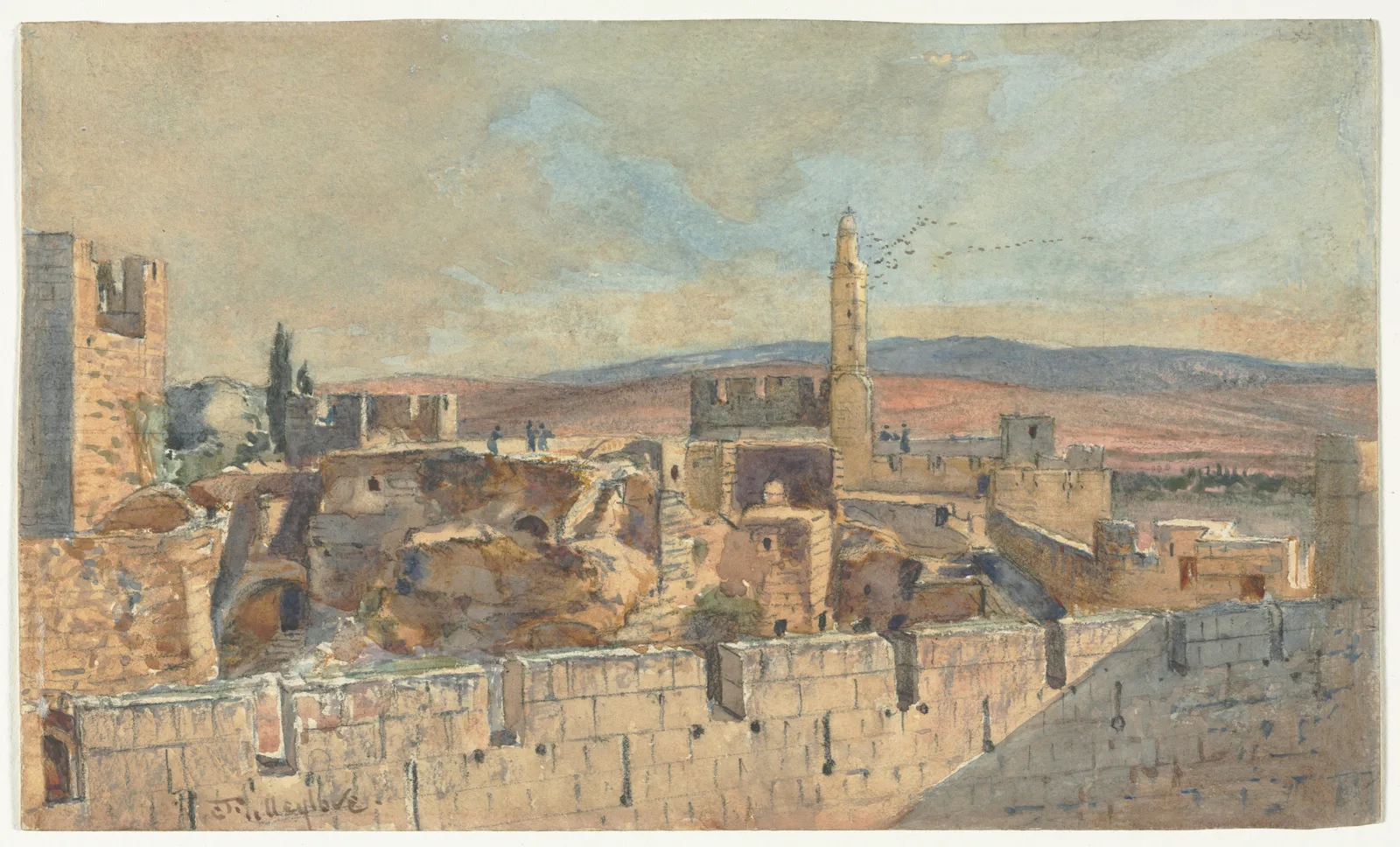
The novel's Jerusalem is a divided city. After the 1949 armistice Israel held the west and Jordan the east, including the Old City, and the one crossing point was reportedly the Mandelbaum Gate. From Hannah's West Jerusalem, her childhood friends the twins are now people beyond the line. She remarks in passing that they are probably in a refugee camp by now.
In the final pages Hannah, in fantasy, sends the twins on a commando mission. Literature and Its Times gives the target as Jerusalem's water tower; the New York Times review as Israeli supplies. What the scene and the twins mean also varies by reader. The New York Times reviewer Locke sees in the raid the inner mind of an outwardly numb society; Ehud Ben-Ezer, as Wikipedia reports him, reads the twins as a metaphor for Hannah's suffering. The publisher's description does not discuss the scene; it draws from the whole book a lesson about uniting dream and reality.
A confusion of dates is also worth watching. The EBSCO commentary says that after victory in the Six-Day War many took the novel as a strike at the country's new arrogance; Literature and Its Times says the manuscript was finished just before that war, and English Wikipedia, citing Amos Elon, gives May 1967. If so, readers' reactions after the war and the writing before it should be considered separately.
What to watch for
Try marking it up with three pencils. For each sentence about Michael, note whether it is a date or event, Hannah's judgement or fantasy, and where he speaks directly, ask who is passing it on. The Observer's review points out that Hannah repeats her husband's jokes and her own thoughts almost verbatim, so repeated sentences are worth marking too. Going through to the end that way, you can sort out separately what the journal lets you believe about Michael and what it lets you believe about Hannah.
Add your perspective.
Share a question, another approach, or something you have tried.
Checking sign-in…
Loading comments…