Because Chinese Myths and Legends carries numbers 16 and 17 in Minumsa's World Literature series, it is easy to take it for a book left by one ancient author, like Ovid's Metamorphoses. It is not. It was written by a twentieth-century scholar, Yuan Ke (1916–2001), out of short fragments scattered through old texts of many periods. Pangu, the god who opens the world, is a good example. In story time he stands at the very start of the world, yet he is widely said to appear in writing only in the third century. After reading this guide you will be able to tell when a story was written down from when it arose, and to read volume 1 with story order and record order kept apart.
This is a reading guide. It does not quote or compare the wording of the Minumsa edition; it rests on the publisher's description, published research and the ancient texts themselves. The renderings of the ancient texts are this guide's own.
What kind of book is it?
Minumsa publishes it in two volumes, written by Yuan Ke and translated into Korean by Jeon In-cho and Kim Seon-ja. By the publisher's listing, volume 1 came out on 15 February 1999 at 556 pages; the Chinese title is Zhongguo shenhua chuanshuo. The publisher says this translation first appeared in 1992 in a scholarly series, and that the 1999 World Literature reissue left out the introductory section and the detailed notes, among other things, for general readers. The annotated edition of 2002 follows the 1992 text, with research notes and quotations after each chapter. To follow which fragment came from which book, the annotated edition is probably the better fit.
According to a 2024 article in Chinese Social Sciences Today, there was no complete, systematic collection of Chinese myths before Yuan Ke, and the fragments lay scattered across old writings. In the short 1950 edition of Zhongguo gudai shenhua he melted them into one story running from Pangu's opening of the world to the end of the Xia dynasty, and he later widened it into the 600,000-character Zhongguo shenhua chuanshuo (1984).
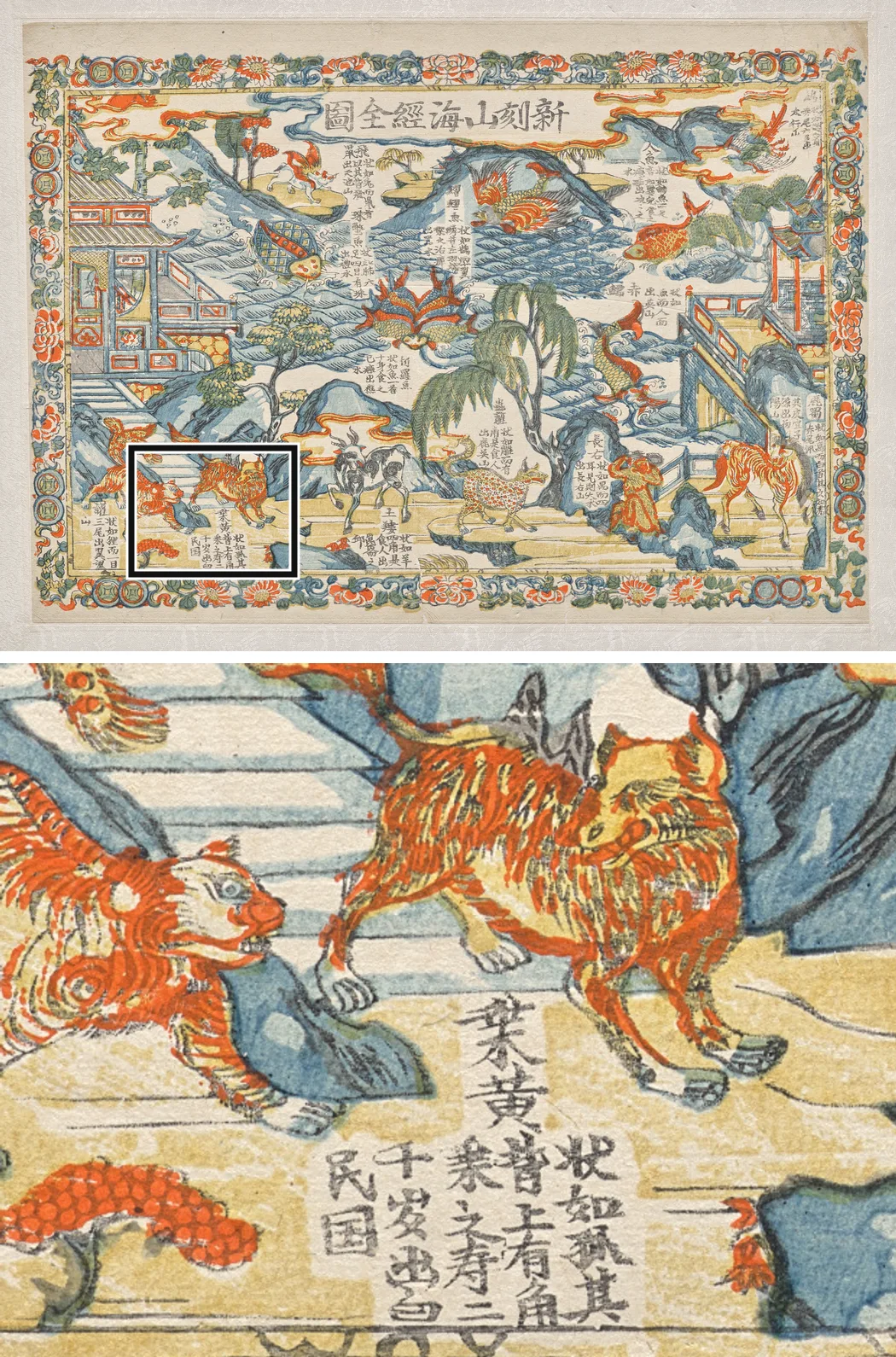
What the raw material looks like can be seen in the Shanhaijing, the Classic of Mountains and Seas. Its early versions are thought to go back to the fourth century BCE and its present form to the early Han dynasty. It lists beasts and gods along mountains and waterways, and many entries have no plot. The Chenghuang in the "Hai wai xi jing" section, for example, gets just this: it looks like a fox, has a horn on its back, and riding it gives you 2,000 years of life.
When does Pangu enter the record?
The frame of the familiar Pangu story is in the Sanwu liji by Xu Zheng, a man of the state of Wu in the Three Kingdoms period. The wording easiest to find is the quotation in chapter 1 of the Tang encyclopedia Yiwen leiju (624). Pangu is born in a chaos like a hen's egg; after 18,000 years sky and earth open, and each day the sky rises one zhang, the earth thickens one zhang and Pangu grows one zhang. The passage in which his dead body becomes sun and moon, mountains and rivers takes different shapes in different books. The Shuyi ji, transmitted under the name of Ren Fang, calls one of them a popular saying from between the Qin and Han.
A much older text also asks about the beginning. "Heavenly Questions" in the Chu ci opens, "Of the far beginning of things, who told the tale?", and goes on to ask who built the nine layers of the sky. It is traditionally credited to Qu Yuan, though some accounts see older material in it. The poem names Nüwa but does not use the name Pangu. Going by the order of the records alone, Nüwa comes centuries earlier.
READING NOTES
Story order and record order
The world opens first, but its god is named later
After c. 300s BCE · 'Heavenly Questions'
- It asks how the world began and names Nüwa.
- The name Pangu does not appear.
Before 139 BCE · Huainanzi
- Nüwa patches the broken sky.
c. 195 CE · Fengsu tongyi
- A popular saying: Nüwa shapes people from earth.
200s CE · Sanwu liji
- Xu Zheng writes of Pangu.
- After 18,000 years, sky and earth open.
'Heavenly Questions' is traditionally credited to Qu Yuan · dates are approximate · they date the writing, not the story
That does not prove the Pangu story was invented in the third century. When a story was written down and when it arose are different questions. Some read the giant embracing Fuxi and Nüwa on Eastern Han tomb carvings as Pangu, and another claim points to a painting of the late second century, but neither is settled. On origins, too, views divide: an old story from within China, a link to myths of southern peoples, or an Indian myth of a primordial giant that travelled east. This guide does not choose among them.
Why does Nüwa read like one person?
Nüwa shows the fragments and the seams clearly. "Heavenly Questions" asks who made Nüwa's body and gives no answer. One line of the Shanhaijing's "Da huang xi jing" says ten gods called "Nüwa's bowels" live on a plain. In "Lan ming" in the Huainanzi, from before 139 BCE, the sky collapses and Nüwa patches it with five-colored stones and props up the corners with a turtle's legs. The Taiping yulan, quoting the Fengsu tongyi of about 195 CE, gives a saying that she shaped people from yellow earth until the work was too much for her, then dipped a rope in mud and lifted it out. So the rich are people of yellow earth and the poor are people of rope.
READING NOTES
Four fragments called Nüwa
Short passages scattered across separate texts
'Heavenly Questions' · one question
- Who made Nüwa's body?
- The poem gives no answer.
Shanhaijing · one line
- Ten gods called 'Nüwa's bowels'
- live on a plain.
Huainanzi · disaster repair
- Five-colored stones patch the sky;
- a turtle's legs prop up the corners.
Fengsu tongyi, quoted · folk saying
- Molding earth is too much work, so she uses a rope.
- The rich come of earth, the poor of rope.
Summarized here from the ancient texts · not Minumsa's wording
These four texts do not carry on one plot. "Heavenly Questions" is a poem of questions, the Huainanzi brings in Nüwa to talk about ancient government, and the saying explains differences of rank. If they are read as one tale of a goddess who made people and later mended the sky, that joining is later work. The published contents of a 2012 Chinese edition show Yuan Ke's own book doing it: chapter 6 of the opening part places the molding of people, the mending of the sky and the ten gods of the plain together. In the abstract of a 2012 paper the Korean scholar Hong Yun-hee argues that Yuan Ke wove the Shanhaijing's fragments with quite different texts to rebuild an "original" mythology, and titles the paper "Myth-making Mythologist".
Chang'e and the moon: one sentence, used as a comparison
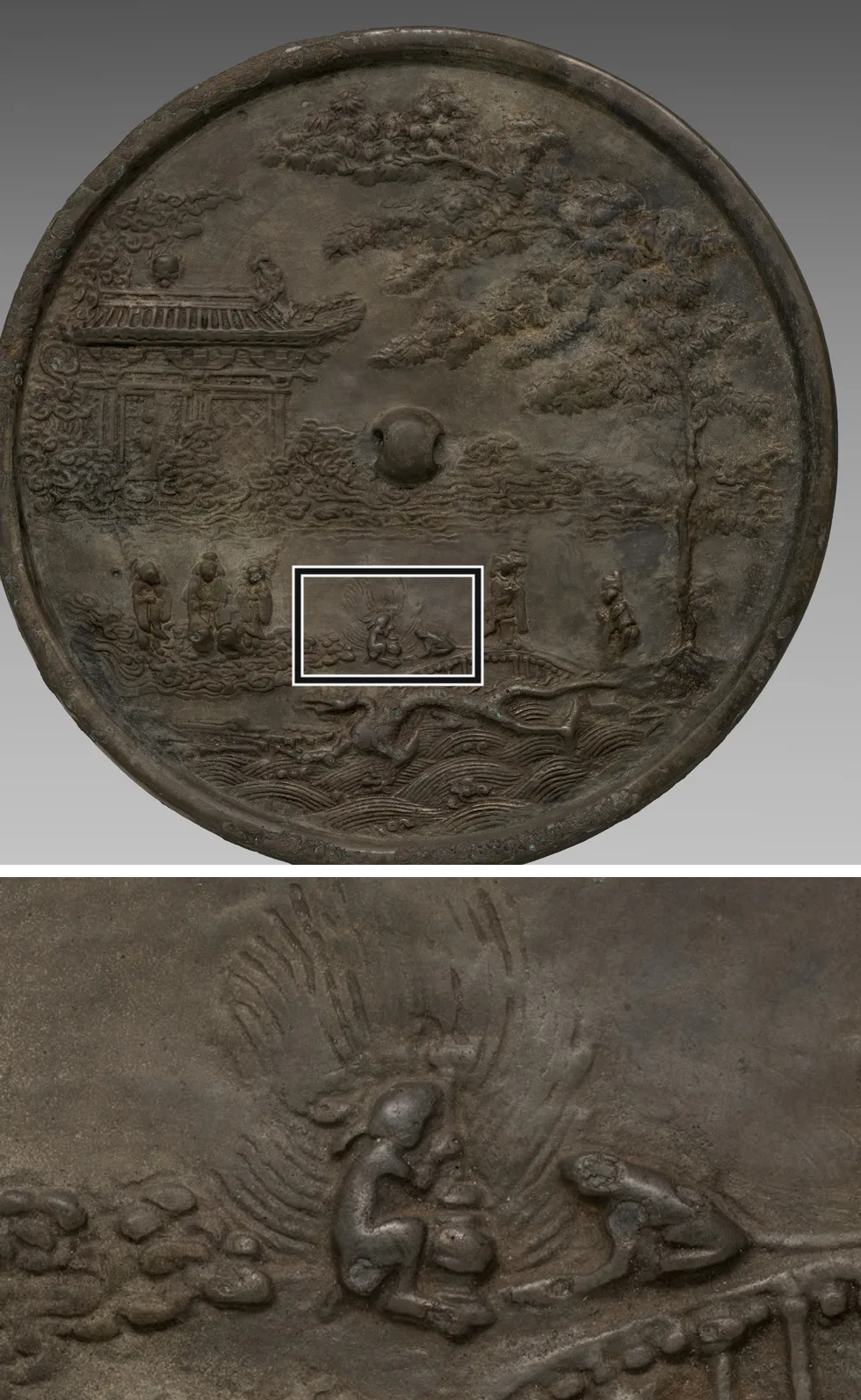
"Lan ming" hides a more famous story as well, in one sentence: Yi asked the Queen Mother of the West for the drug of immortality, and Chang'e stole it and fled to the moon. The sentence is not there to tell a myth. It is a comparison: Yi was left at a loss because he did not know where the drug came from, and the point is that one must know the root of things. More than a thousand years later, on a Jin dynasty mirror, the same story has become a moon landscape with a palace and a pine. Minumsa's Part 4, "Yi and Yu", looks by its name like the place that covers this Yi.
How, then, to take this book?
Two assessments are worth holding together. Zhou Ming, who assisted Yuan Ke, says in the article above that this work changed the belief that Chinese myth was poor. Robin McNeal, in the abstract of a 2012 paper in the Journal of Asian Studies, looks at how twentieth-century Chinese literati tried to set out a coherent mythology and notes how heavily they leaned on Western models, Greek and Norse myth among them. The two views can stand together.
Minumsa's description calls the stories in this book perfectly constructed. In this guide's view, much of that construction comes from twentieth-century compiling. That is not a criticism. For a first reader of scattered fragments, a joined-up book is a good way in. The way in just should not be mistaken for the original.
What to watch for in volume 1
The publisher's contents divide volume 1 into five parts. The part titles run in period order and read like one nation's history, and Part 6, on the Zhou and Qin, becomes volume 2. In the published contents of a 2012 Chinese edition, though, the opening part begins with the questions of "Heavenly Questions" and the tale of Hundun, and Pangu arrives only in the second chapter, after the story of the dog Panhu. Minumsa's chapter titles could not be confirmed, so check whether it keeps that order.
READING NOTES
Volume 1 in five parts
Part titles from the publisher's page · 556 pages
Part 1 · Kaipi, the opening
- The world opens.
- Contents of a 2012 Chinese edition: Pangu in chapter 2.
Part 2 · Huang and Yan
- The Yellow Emperor and the Flame Emperor.
Part 3 · Yao and Shun
- The sage rulers Yao and Shun.
Part 4 · Yi and Yu
- Yi the archer and Yu who tamed the floods.
Part 5 · Xia and Yin
- The Xia and Yin dynasties.
Box text is read from the part titles (the Pangu line from the Chinese contents) · the publisher's page also labels the fifth part 'Part 4'
Names in this guide may be spelled or rendered differently from the Minumsa edition. Try three things as you read. When a new god appears, put a question mark by the name for "first in which text, and when?" Look up passages that interest you in the annotated edition or in the Shanhaijing itself. When one god seems inconsistent from place to place, do not write it off as the author's slip; first consider that the fragments may have different sources.
If you take one thing from this book, take this. When reading Chinese myth, before asking what the original story was, ask when this fragment was written, by whom, and to say what.
Add your perspective.
Share a question, another approach, or something you have tried.
Checking sign-in…
Loading comments…