When an MCP server is connected over stdio, the server process's stdout is not a screen for people. It is the channel the client reads replies from, and a console.log line added for debugging goes down that same channel. A small server and client written with nothing but Node.js were run four ways: a normal reply, one console.log line, indented JSON, and the fix with console.error. By the end you will know what to look for in your own server code and how to check it after the fix.
On the stdio transport, stdout is the message channel
On the stdio transport the client launches the MCP server as a subprocess. The client writes requests to the server's stdin, and the server writes replies to its stdout. Responses and notifications all share this one channel; there is no separate stream per request.
The stdio transport page of the MCP specification, version 2026-07-28, sets a few rules for that channel.
- Each message is a single JSON-RPC request, notification or response, and messages are delimited by newlines. A message MUST NOT contain embedded newlines.
- The server MUST NOT write anything to its stdout that is not a valid MCP message. The client, likewise, must not write anything but MCP messages to the server's stdin.
- The server MAY write UTF-8 strings to stderr for any logging, such as informational, debug and error messages. The client MAY capture, forward or ignore stderr, and SHOULD NOT assume that output on stderr means an error.
In Node.js the global console is set up to write to process.stdout and process.stderr, and console.log writes to stdout. So a console.log inside an MCP server mixes exactly what the rule forbids, something that is not an MCP message, into the message channel. The server code does not even have to call it: if another module running in the same process calls console.log, it goes to the same stdout.
DEV NOTES
The three streams of the stdio transport
The client launches the server as a subprocess and talks over its standard streams
stdin: client to server
{"jsonrpc":"2.0","id":2,…}- Requests and notifications, one per line
- MUST NOT write anything but MCP messages
- The client does not write responses
stdout: server to client, messages only
JSON.stringify(msg) + '\n'- Responses and notifications only, one per line
- Messages MUST NOT contain newlines
- MUST NOT write anything but MCP messages
- console.log, info and debug land here
stderr: the server's logs
console.error('got request', …)- Any logs, as UTF-8 strings (MAY)
- The client MAY capture, forward or ignore it
- SHOULD NOT treat it as a sign of error
- console.error and warn land here
Rules from the stdio transport page of the MCP specification, version 2026-07-28 (checked 2026-11-09). The stream of each console method was checked by running Node.js v24.21.0.
A server and a client built with Node.js alone
No SDK was used. To see only what happens on the channel, two files were written by hand.
server.mjsreads stdin line by line and answerstools/listandtools/call(anaddtool). Both replies carry in theirresulttheresultTypethat version 2026-07-28 requires in every result, and otherwise follow a trimmed version of the examples on the specification's tools page. It has noserver/discover, no_metachecks and no capabilities, so it is not a full MCP server, only a demo for watching the channel. A command-line argument picks one of four modes.client.mjslaunches the server as a subprocess and writes two requests to its stdin, one per line (id 1tools/list, id 2tools/call). It cuts stdout at every newline, runsJSON.parseon each line, and matches the id of each message it reads to the request it sent. It prints stderr separately, prefixed withstderr:. After one second it closes the server's stdin and counts matched replies and parse errors.
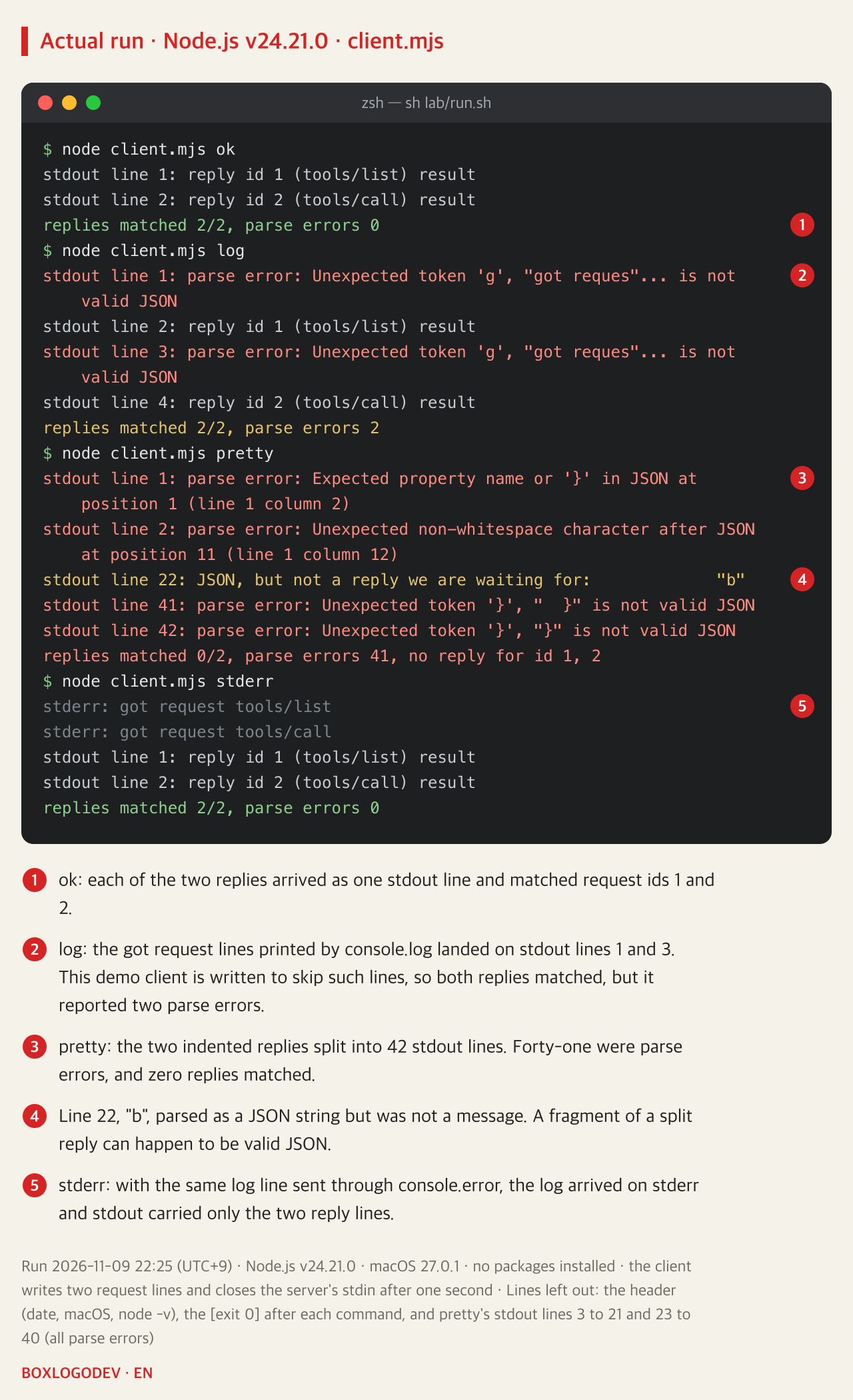
The four modes: ok writes each reply as one line with JSON.stringify(msg), and log prints console.log('got request', req.method) before each reply. pretty writes each reply indented with JSON.stringify(msg, null, 2), and stderr prints the same line as log, but with console.error. Everything ran on 2026-11-09 on macOS 27.0.1 with Node.js v24.21.0, with no packages installed.
One console.log line: a non-JSON line between the replies
In log mode the client received four stdout lines. Lines 1 and 3 were got request tools/list and got request tools/call, and JSON.parse failed on them with Unexpected token 'g'. This demo client is written to skip a line it cannot parse and read the next one, so it still matched both replies.
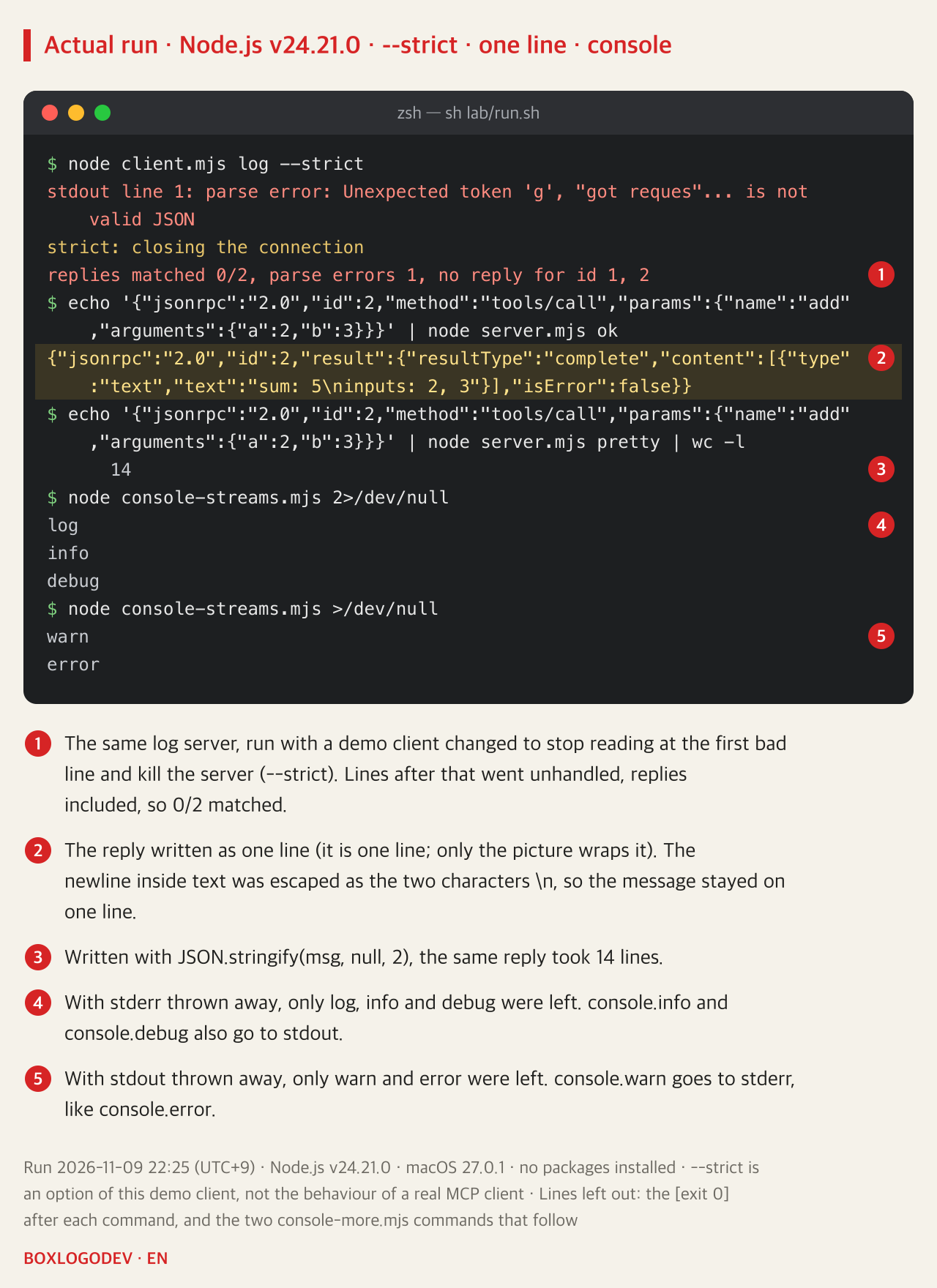
Whether to skip or to stop is the client's choice. With the same client changed to stop reading at the first bad line and kill the server (--strict), it left every later line unhandled, replies included, and matched no reply (0/2). What real clients such as Claude Code, Claude Desktop or the official SDKs do with such a line was not checked; Claude Code and Claude Desktop would have needed their settings changed, and the SDKs a package install, so they were left out of the experiment. Either way the server did something the specification forbids, and the outcome depends on how the client treats the line.
Indented JSON: one reply split across many lines
pretty mode printed no log line at all, and the result was worse. The two replies became 42 stdout lines, and the client hit a parse error on 41 of them. A line holding only {, or a line ending in a comma such as "jsonrpc": "2.0",, is not JSON on its own. Both replies did arrive, but in fragments, so neither id 1 nor id 2 was matched (0/2).
Line 22 did parse. The last element of the tool list's "required": ["a", "b"] array, "b", sat alone on its line, and that is a valid JSON string. A fragment that happens to be valid JSON is still not a message. This demo client checks jsonrpc and the id as well, so it did not take the line for a reply.
A reply with a newline inside a string is not a problem. The add tool's result text contains a newline, and written with JSON.stringify(msg) and no indent argument, that newline was escaped as the two characters \n and the whole message came out on one line. Written with JSON.stringify(msg, null, 2), the same reply took 14 lines. The example messages in the specification are spread over several lines, but on the stdio channel each one must go on a single line.
Logs go to stderr: the result with console.error
In stderr mode the same two log lines arrived separately as stderr:, and stdout carried only the two reply lines, with zero parse errors. The two streams flow independently, and in the 2026-11-09 run the stderr lines were printed before the stdout lines. To match logs to replies later, it helps to include the request id in each log line.
Avoiding console.log alone is not enough. In Node.js, console.info and console.debug are aliases of console.log and go to stdout, while console.warn is an alias of console.error and goes to stderr. In the run, throwing stderr away left log, info and debug; throwing stdout away left warn and error.
Some methods are not aliases. Run the same way, console.dir, console.count, console.timeEnd, the label of console.group and console.table also wrote to stdout; of the methods run alongside them, only the message of a failed console.assert and console.trace went to stderr. The Node.js v24 documentation likewise says console.dir, console.count, console.timeEnd and console.timeLog print to stdout and console.trace to stderr.
MCP also has a Logging feature, in which the server sends logs to the client as notifications/message notifications. Those are MCP messages, so sending them on stdout does not break the stdio rules, but they cannot be sent at any time. The Logging page of the same version says the server MUST NOT send them for a request whose _meta lacks io.modelcontextprotocol/logLevel. The feature is also marked deprecated as of version 2026-07-28. New implementations SHOULD NOT adopt it, and existing ones SHOULD move to stderr logging for stdio, or to OpenTelemetry for structured observability.
What to find and fix in your server
- Keep one place that writes to stdout. Only the function that sends messages calls
process.stdout.write(JSON.stringify(msg) + '\n'), and it passes no indent argument. - Search the code for
console.log,console.info,console.debug,console.dir,console.dirxml,console.table,console.count,console.timeEnd,console.timeLog,console.group,console.groupCollapsedand anyprocess.stdout.writeoutside that function, and send them toconsole.erroror stderr instead. - After the fix, feed in one request line the server answers, throw stderr away and look at stdout. Every line should pass
JSON.parseand be a message carrying"jsonrpc": "2.0", and there should be no lines other than replies and notifications.
The rules here follow version 2026-07-28 of the MCP specification; the wording of earlier versions was not rechecked for this note. The run results are the behaviour of a hand-written demo client. For an MCP server on stdio, leave one piece of code that writes to stdout, the one that sends messages, and send every other line of output to stderr.
Add your perspective.
Share a question, another approach, or something you have tried.
Checking sign-in…
Loading comments…