When a child looking at a restoration asks whether dinosaurs were really that colour, two easy answers come to mind: nobody knows, or scientists have worked it out. Each is half right. By the end you will be able to say which specimens have had patterns and colours inferred and on what evidence, where that reasoning is disputed, and what to ask in front of a restoration at a museum.
Bones and skin impressions carry no colour
Most dinosaur fossils are bones, and the rare skin impressions show the texture of scales but not their hues, as a 2022 article from the Natural History Museum of Utah points out. So for a long time the colour of a dinosaur was left to the judgement of whoever restored it.
What changed around 2010 was feathers. Melanosomes were reported inside fossil structures like bird feathers. A melanosome is a tiny organelle that holds the pigment melanin. In Nature in 2010, Zhang and colleagues reported that among Early Cretaceous fossils from the Jehol Group of northeastern China, melanosomes were preserved in the same way in the filaments of non-avian dinosaurs as in the feathers of early birds.
Comparing shapes with living birds
The reasoning works by comparison. A widely used assumption in the field is that rod-shaped granules are dark eumelanin and round ones pheomelanin, and the shapes of fossil granules or their imprints are set against data from modern birds to predict a colour. Some analyses give the result as a probability. The lone feather MB.Av.100 in Berlin, usually treated as Archaeopteryx, came out as black with 95% probability in 2012 and as matte black with 90% probability in a 2020 reanalysis. The 2020 study judged its imprint-only result the most reliable, while also recording that the three-dimensional granules alone favoured iridescent, at 79%. The feather’s owner is disputed too. A 2019 study left open that it came from a different feathered dinosaur; the 2020 study found Archaeopteryx the best-supported owner while conceding that 100% certainty is out of reach.
DINO NOTES
Four steps from fossil to colour
Following traces of melanin in feathers and skin
A stain you can see
- Dark residue where feathers or skin were
Electron microscope
- Tiny rods and ovals, or their imprints
Compare with living birds
- Assumed: rods point to eumelanin
- round shapes to pheomelanin
Predict a colour
- For example, 2020 analysis of the Berlin feather:
- matte black, 90% probability
Each step rests on the one before. If the tiny structures are microbes and not melanosomes, the colour inference falls too.
The bands on the tail of Sinosauropteryx can be seen by eye. The 2010 paper judged a chestnut to reddish-brown tone a reasonable inference for these dark bands. In 2017 Smithwick and colleagues reconstructed the light-dark pattern of the tail and body and a mask-like marking around the eye, and found the pattern matched predictions for an animal in open habitats.
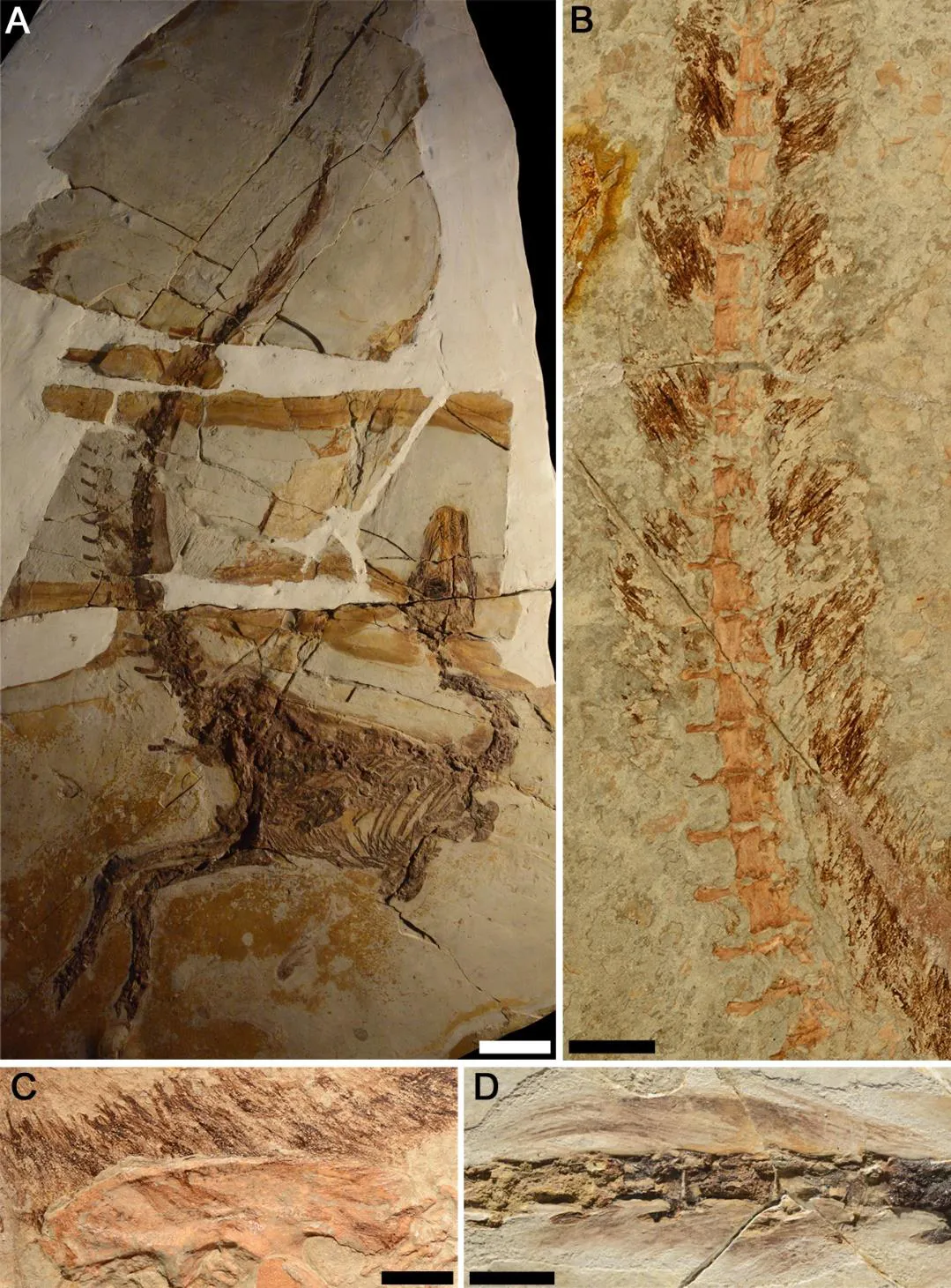

A 2010 study of Anchiornis compared granules feather by feather and proposed a grey and dark body, a rufous crown, and white long limb feathers with black markings toward the ends.
Not only feathered dinosaurs
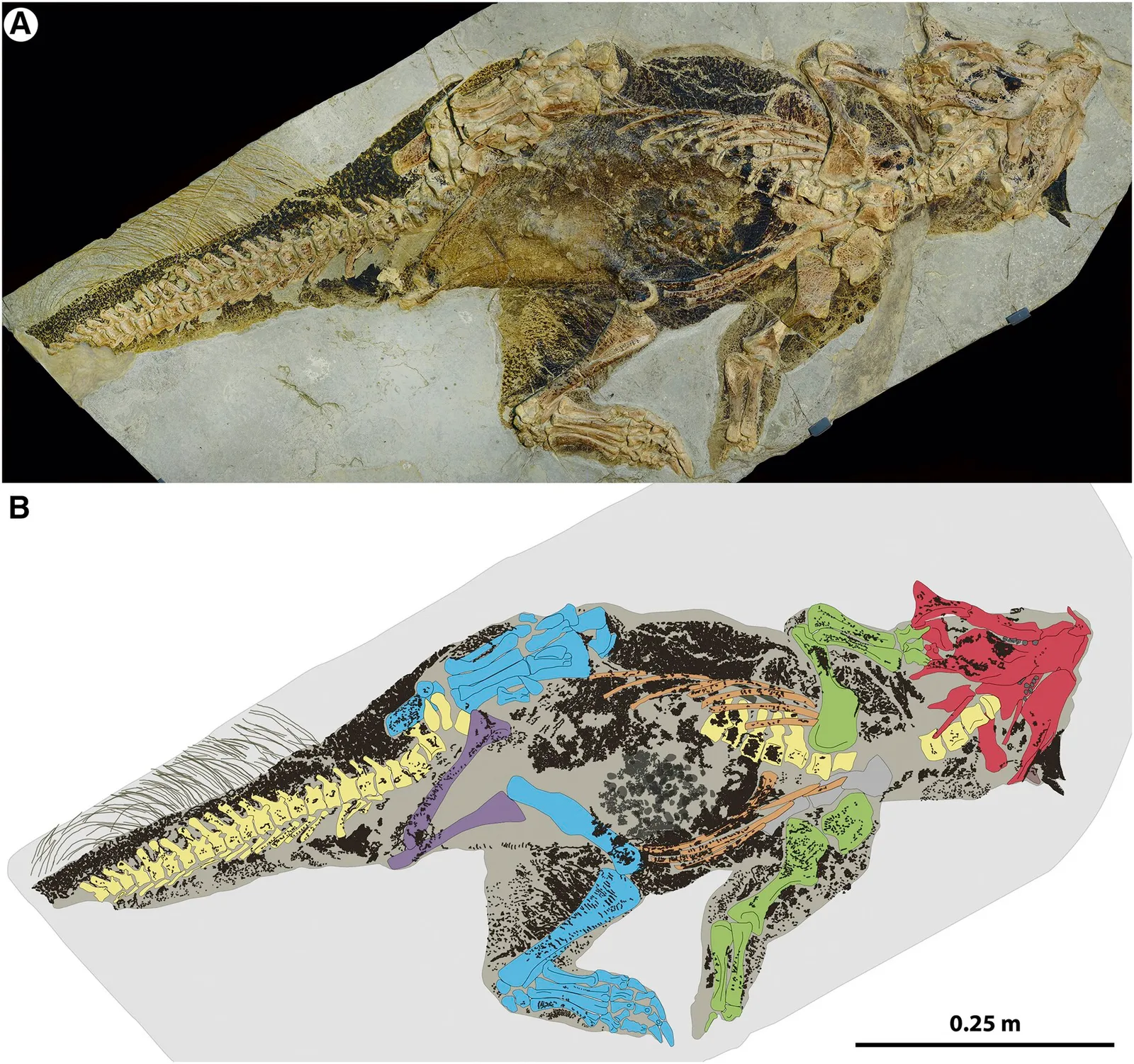
Psittacosaurus specimen SMF R 4970, from China’s Jehol biota and now at the Senckenberg Museum in Germany, keeps scales and traces of pigment. Vinther and colleagues (2016) reconstructed a relatively darker chest with a lighter lower belly and tail. Small samples showed oval imprints resembling pheomelanin granules, which suggests brown, but the researchers themselves say exact hues will be hard to fix. They painted a life-size model grey, photographed it under different light and calculated the best shading for camouflage. The specimen’s pattern came closer to the prediction for diffuse light, which they read as suggesting a closed habitat such as forest.

In the armoured dinosaur Borealopelta from Alberta, Canada (TMP 2011.033.0001, Royal Tyrrell Museum), researchers (2017) reported melanin in the organic residue from mass spectrometry. They also reported a light-dark pattern on the body with paler large shoulder spines consistent with display, and suggested that if an animal estimated at more than 1,300 kg still needed camouflage, predation pressure may have been that strong. The paper’s colour reading rests on chemistry, not shape. No melanosomes with preserved structure were found; benzothiazole was read as a marker of pheomelanin, which would make the back reddish-brown and the belly whitish. Critics ask whether that marker came from the burial environment, to which co-author Vinther replied that it was absent from the surrounding sediment; another objection is that the preserved skin does not reach the belly.
DINO NOTES
What each fossil yielded, and the catch
The same words, dinosaur colour, cover very different claims
Sinosauropteryx
- Dark tail bands: chestnut to reddish-brown
- 2010 paper
Anchiornis
- Grey and dark body, rufous crown
- 2010 paper; another specimen (2015 paper) disagrees
Lone feather MB.Av.100
- 2012: black, 95%. 2020: matte black, 90%
- Whether it is Archaeopteryx is debated
Psittacosaurus SMF R 4970
- Darker chest, lighter belly and tail
- Suggests brown; exact hues are hard
Borealopelta TMP 2011.033.0001
- Melanin reported; a light-dark body pattern
- Reddish-brown reading rests on a disputed chemical marker
All of these rest on a few specimens. Saying the same of a whole species would need more of them.
Where it is disputed
The first question is whether those granules are pigment at all. Moyer and colleagues (2014), drawing on chicken feather experiments, pointed out that microbes and melanosomes overlap in size and shape, and proposed criteria for telling them apart. Lindgren and colleagues (2015) identified eumelanin chemically in Anchiornis specimen YFGP-T5199, showing that melanosomes can survive as fossils. Its forecrown feathers, though, held only elongate granules and almost no pheomelanin-like structures, which disagrees with the 2010 specimen (BMNHC PH828) read as having a rufous crown. The authors raise growth stage, individual variation and even a different species as possible reasons. The same paper urged care in restoring feather colour from shape alone, because some imprints gave no melanin signal and a microbial origin could not be ruled out for them. The 2018 paper on the Jurassic dinosaur Caihong likewise wrote its colour inference on the stated assumption that the structures are melanosomes. A 2020 review (Roy and colleagues) says evidence from structure, chemistry and distribution has been building for melanosomes, while many studies kept arguing for microbes and others for judging case by case.
Even if the granules are melanin, they do not give the whole colour. Negro and colleagues (2018) argue that the rod-and-round assumption has weak support, citing a study that found rod-shaped granules in red chicken feathers. Fossils, they say, give at best the presence of the two main forms, and a single specimen cannot show whether individuals of a species shared one colour. They also offer another reading of the shading than camouflage: saving pigment where it is less needed. The Utah museum’s article says colours such as yellows made by chemicals rather than melanosomes escape this method, and Vinther and colleagues urge caution because reptiles can change colour with pigment cells, while arguing that most of this specimen’s patterns sit inside scales, which does not fit that case.
How far to go with a child
When the question comes, first sort out which dinosaur it is. For the specimens above you can say that this fossil showed this pattern and that researchers estimate this colour. Why it had that pattern is a further step of interpretation.
T. rex is a different case. Within the sources found while writing this note, no study of a specimen gave T. rex’s colour. That could change, so do not state there is none; saying the colour in the picture is probably the judgement of whoever restored it is about right.
DINO NOTES
How far to go with a child
Sorted by the strength of the evidence
A specimen supports it
- This one is restored with a darker chest, light belly
- (one Psittacosaurus specimen)
It is an interpretation
- The pattern may have been camouflage
- Saving pigment is another explanation
Still unknown
- Exact hues
- Variation within a species; some other colours
No specimen found
- T. rex: within this note's search
- no study of a specimen gave its colour
In front of a restoration at a museum, start by asking whether a specimen supports that colour.
In front of a restoration, look on the label for a specimen behind the colour. If a specimen number or study is named, it is closer to an evidence-based estimate; if not, it may be the artist’s choice. Either way, that distinction is itself a good answer for a child.
Add your perspective.
Share a question, another approach, or something you have tried.
Checking sign-in…
Loading comments…