Ink painting is easily imagined as black and grey alone. Twelve Views of Tiger Hill by the Ming painter Shen Zhou (1427–1509) looks that way at a glance. Yet the Cleveland Museum of Art gives the album's medium as ink, or ink and slight colour, and says he "included views in subtle colors" among the monochrome scenes. It does not say which. So where is the colour?
By the end you will be able to sort the leaves of an ink album into those with and without colour, and trace how far colour goes among the things in one leaf. The numbers here were measured on the image files the museum has released; the works themselves were not seen. In the CIE Lab colour space, a* rises from green towards red. Each leaf's median a* serves as that leaf's ground, and the measure is the area more than 4 redder than that, with seals and the outer 3% left out. The threshold of 4 was chosen to match the colour seen by eye, so the numbers would change with another photograph or threshold.
Twelve leaves from the boat up the hill
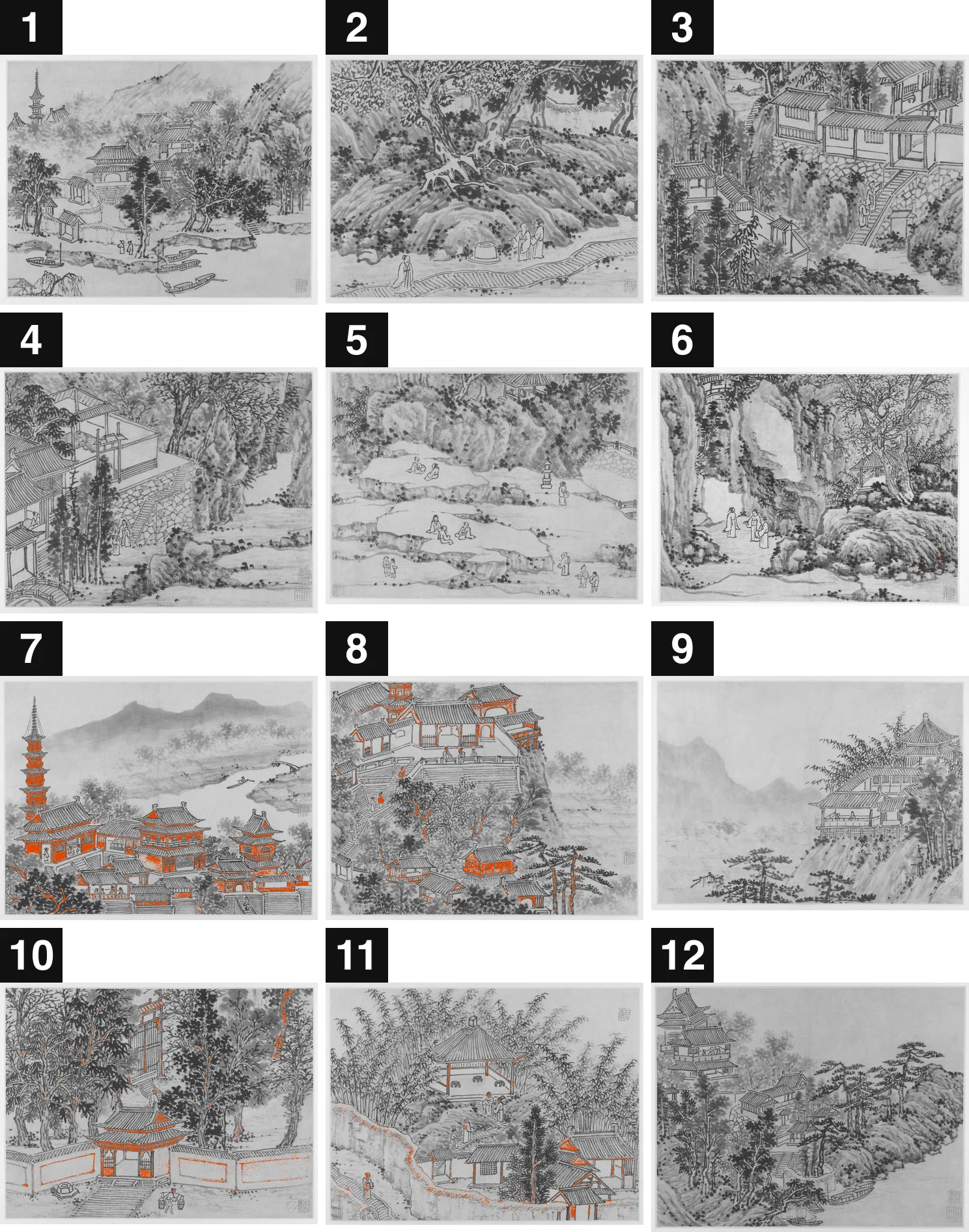
Tiger Hill lies a few miles northwest of Suzhou and has a long history. The Cleveland Museum of Art reads the album as one imagined outing: it starts where the boat lands below the hill and goes up to the Cloudy Cliff Monastery. Its date is given only as after 1490, and each leaf's image is about 41 cm wide and 31 cm high. Shen Zhou, the museum adds, came from Suzhou, turned down an official career, and is counted as the founder of the Wu School.
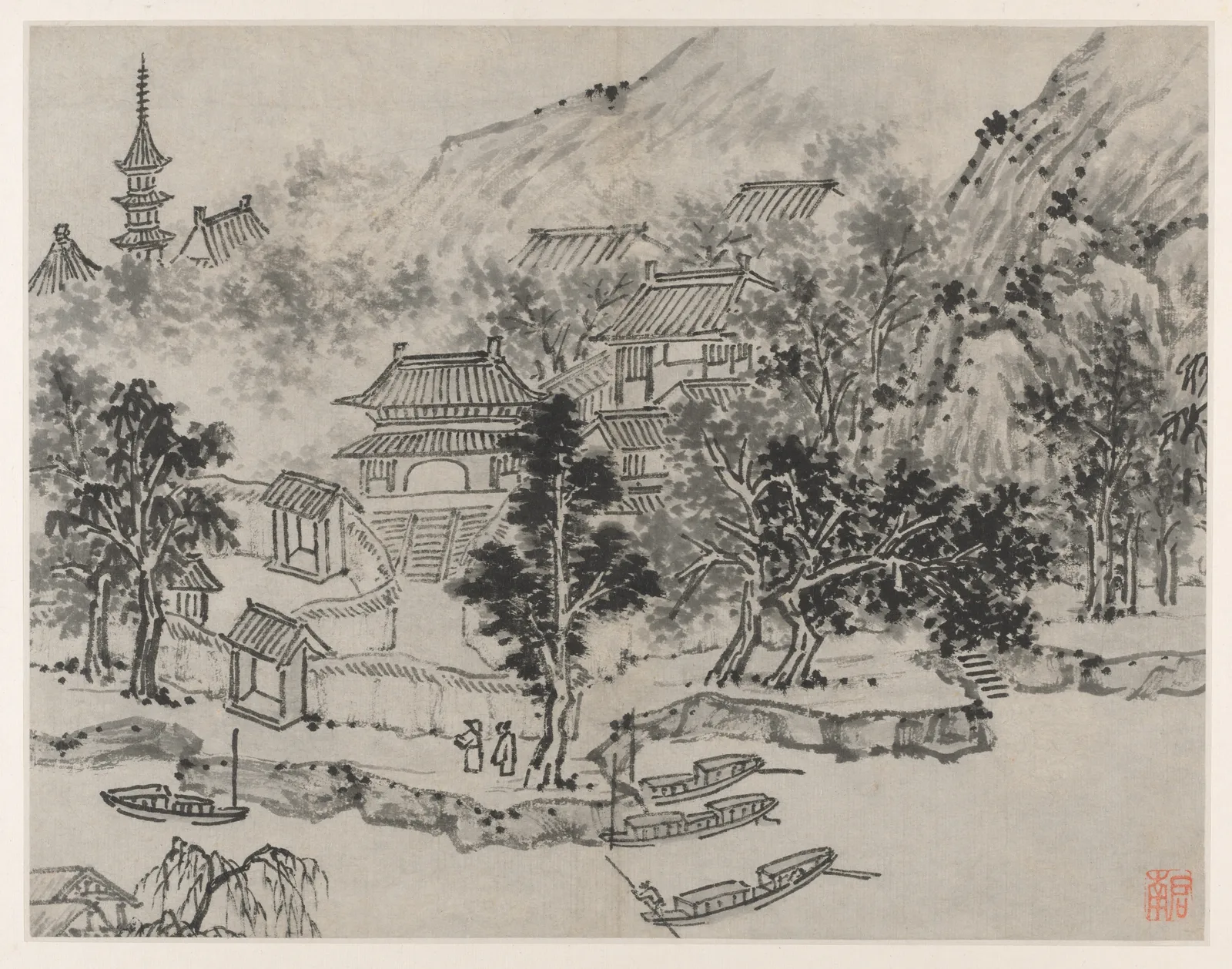
Leaf 1 is the start. Boats are moored below, gates and buildings climb among trees, and a pagoda shows far off at upper left. The buildings here are ink lines only, and the red is the seal at lower right. The museum's records give the seal on these leaves as Qinan (启南), Shen Zhou's courtesy name.
Measuring the twelve leaves
Four leaves stand out. Leaf 7, The Thousand Buddha Hall and the Pagoda, has 4.26%; leaf 8, The Five Sages Terrace, 2.27%; leaf 10, Tiger-Flight Spring at the Back Gate, 1.92%; leaf 11, Bamboo Pavilion, 1.07%. The other eight leaves have 0.06% or less. Enlarged, the same four leaves show a pale orange-pink to the eye. Leaf 6 is slightly redder overall than the others (median a* 1.88); whether that comes from the photograph or the paper could not be determined. No orange-pink could be found on it even when enlarged.
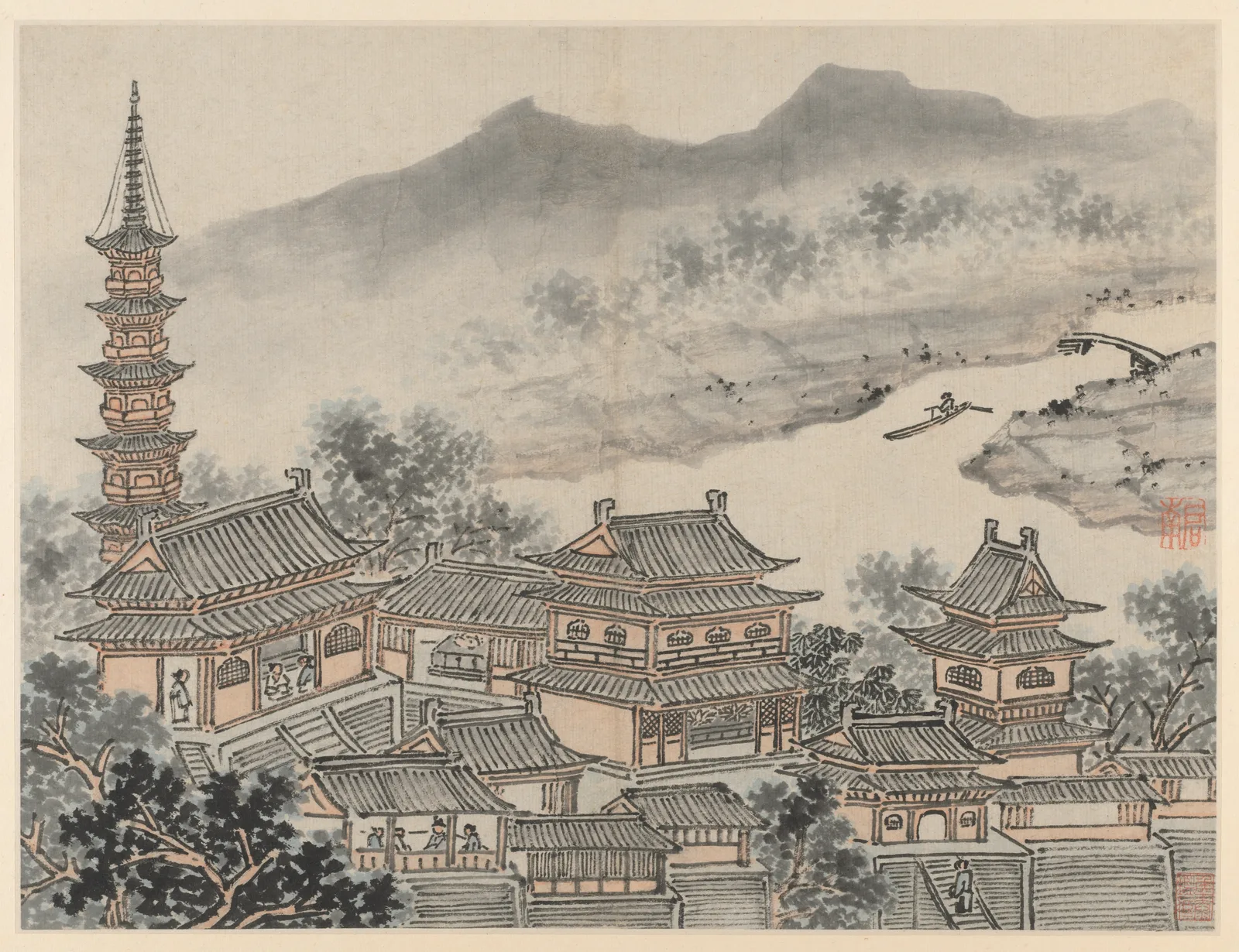
The limits of this measure are clear. It measures only towards red. Enlarging leaf 7 shows a bluish grey on robes and among the leaves, and the photograph cannot decide whether that is a pale blue or dilute ink looking that way on yellowed paper. Nor can it tell whether very pale colour lies below the threshold. It also cannot rule out that colour on the other eight leaves has faded. What can be said is that in their present state the noticeable colour gathers on four.
Did buildings get colour?
Seen first, leaf 7 invites the summary that temple buildings were coloured. Walls, the triangular gables and the pagoda's walls are all tinted. But a building does not guarantee colour. Leaves 1, 3, 4, 9 and 12, for example, also have buildings, and their walls are bare. Leaf 9 in particular sits between coloured leaves 8 and 10. In leaf 7 the tree trunks at lower left carry the same tint as well. In leaf 8 a small figure's robe on the stairs is red too; in leaf 10 it goes to the long wall, the gate and the trunks; in leaf 11 to the gables and the path along the cliff top.
Roofs, leaves, far mountains and water are hardly marked with this colour. So within a coloured leaf, colour chooses its objects. The fourth of the six laws that Xie He set down around the fifth or sixth century in the Guhuapin lu, suilei fucai (隨類賦彩), says word for word: apply colour according to kind. Translators take it differently, so here it is taken only at its literal wording. In this note's judgment, within a leaf colour mostly follows kind as those words say, with gaps: the walls of the large central hall in leaf 8 and of the building at lower centre in leaf 11 stay bare. And kind does not explain which leaves receive colour. The museum gives no reason, and this note cannot supply one. The order of the leaves is also the museum's numbering, and whether it was always this order could not be confirmed.
He could use colour
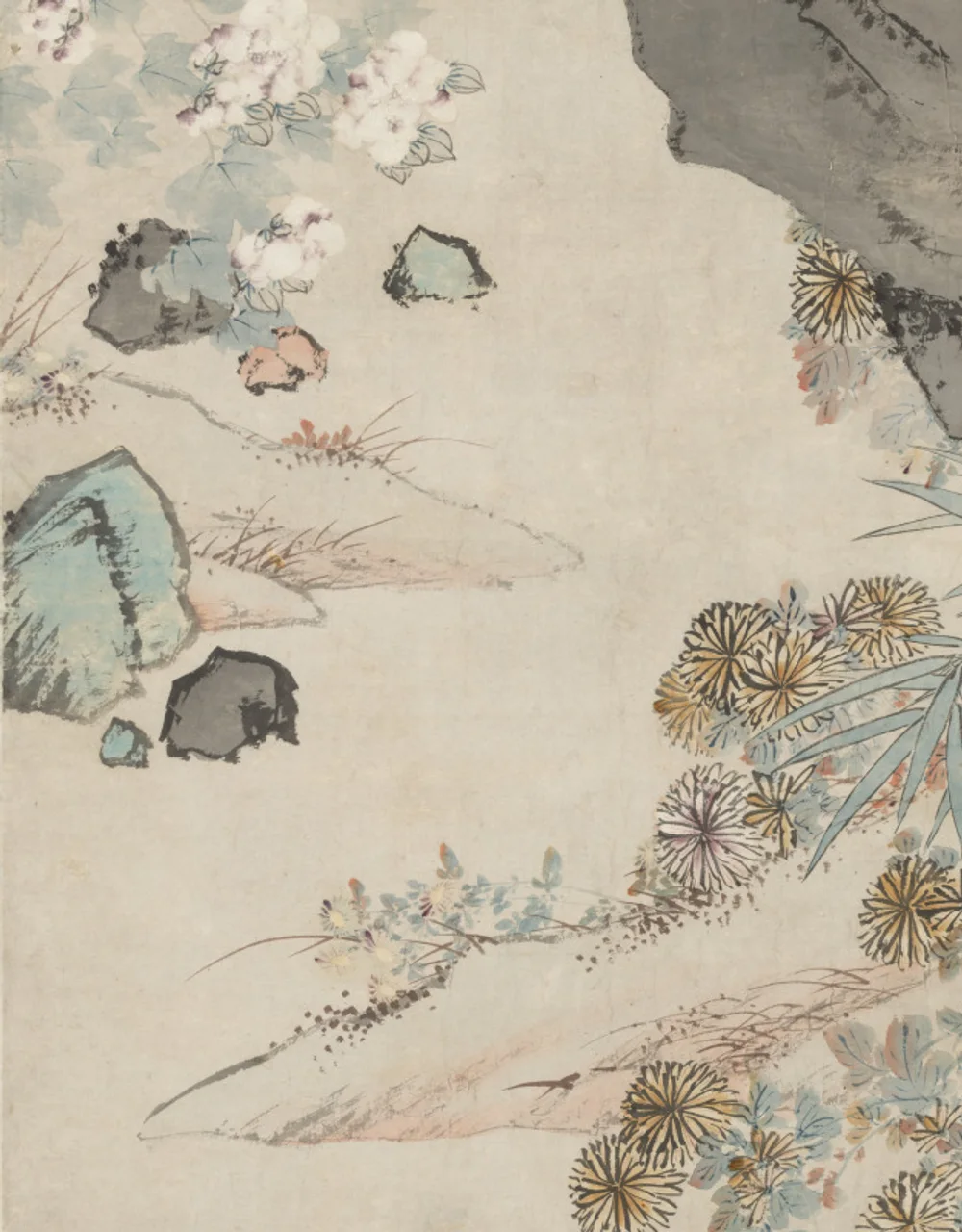
The album's sparse colour does not mean he could not use it. Cleveland's 1468 scroll Yellow Chrysanthemums and Red Osmanthus has blue-green rocks, pinkish earth and yellow chrysanthemums. The medium line of the record says only ink, but the museum's text speaks of colour-filled brushstrokes and colour shows in the photograph. There is far more of it than the album's pale tint.
In the ninth century Zhang Yanyuan wrote in the second volume of his Lidai minghua ji: grass and trees bloom without red and green pigment, and mountains are green without azurite. Therefore "yun mo er wu se ju" (運墨而五色具): to wield ink so that the five colours are complete is called grasping the idea, and if the mind is on the five colours, the images of things go wrong. The translation is this note's. The phrase is often introduced as meaning that ink's tones can produce many colours. Read with what comes before and after, it can also be read as a warning not to set the mind on colour.
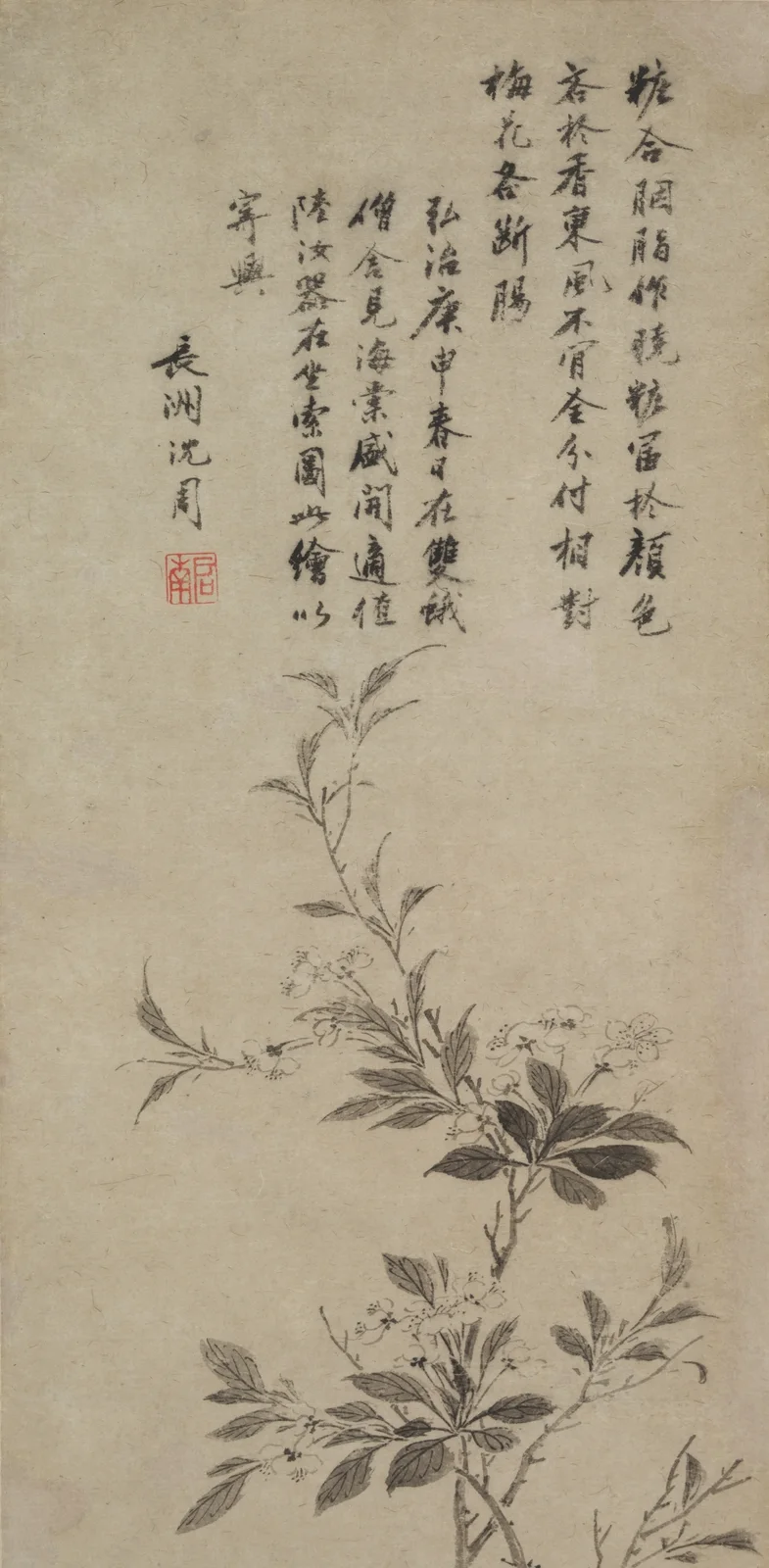
Shen Zhou's 1500 scroll Flowering Crab Apple brings this to mind. His inscription begins with powder and rouge making up a morning face and continues "富於顔色吝於香", rich in colour and sparing of fragrance. Yet the petals, as the museum says, are pure ink outlines. The colour is there in words and not in pigment. No record was found that Shen Zhou had Zhang Yanyuan in mind, so the link is this note's reading.
Where to look first in an ink album
Three works cannot speak for all of Shen Zhou's colour. This much can be said of this album: four leaves have noticeable colour, it lies on walls, gables, tree trunks and paths rather than on roofs or leaves, and a building does not always bring colour. The next time an album is introduced as ink painting, go through it leaf by leaf and look at the walls and trunks before trusting the overall impression. They are the quietest places, and in this album that is where the colour was.
Add your perspective.
Share a question, another approach, or something you have tried.
Checking sign-in…
Loading comments…