In his review of the 1868 Salon, the critic Théophile Thoré described Édouard Manet's "current vice" this way: a sort of pantheism that values a head no more than a slipper ("n’estime pas plus une tête qu’une pantoufle"). The Met's own text on Young Lady in 1866 quotes the phrase. And that painting does show what looks like a slipper: a black tip under the hem. So did Manet really paint that face like the slipper?
Four pictures whose images The Met and the Cleveland Museum of Art have made public let us test Thoré's words. By the end you will be able to stand before a Manet portrait and tell which of light, colour and brushwork the face claims and which it gives up. The numbers here are averages over areas picked by eye on the published image files. Lightness runs from 0 for black to 100 for white, chroma is higher where colour is stronger, and fine variation shows how much lightness departs from its surroundings. Fine variation includes contours and canvas weave as well as brush marks. These values depend on the photograph, so they are compared only within one picture.
What Thoré actually wrote
The review appears in the second volume, published in 1870, of the Salons he wrote as W. Bürger. The sentences around it change the impression. He first says that Manet sees very well. He sees colour and light, and once he has put on canvas the "patch of colour" a figure or object makes against its surroundings, he considers himself done. Then he adds "for the moment", and predicts that this will sort itself out when Manet thinks of giving their relative value to the essential parts of beings. The slipper sentence comes next.
That sentence names two pictures as examples. One is the "Black Cat", which gives a bouquet more importance than a woman's expression; he appears to mean Olympia, which he introduces elsewhere in the same book by its bouquet and black cat. The other is the Portrait of Émile Zola, where furniture, carpets, books, clothes, flesh and the accents of the face are painted almost uniformly. So the slipper may not refer to the slipper in this picture. Young Lady in 1866 comes separately, after a paragraph on the Zola portrait. After praising its harmony of pink, grey and a small note of lemon at the foot of the perch, he writes that the head, though frontal and in the same light as the pink cloth, hardly draws attention and is lost in the modulation of colour. That second statement is the one to test.
A year earlier Émile Zola had made a similar observation as praise: Manet treats figure paintings the way the schools allow one to treat still lifes. One writer's vice is another's merit.
1866: light and colour do not gather on the face
Look at the slipper first. Even enlarged, it is little more than a black lump with a grey smear. The face is different. Eyes, eyelids, the shadow of the nose and the lips are separated, and the cheek has some red in it. To the eye, it does not get the slipper's treatment. The numbers catch this difference poorly: fine variation is 4.0 for the face and 3.8 for the slipper. The slipper's area is small, and its border with the hem appears to raise the value.
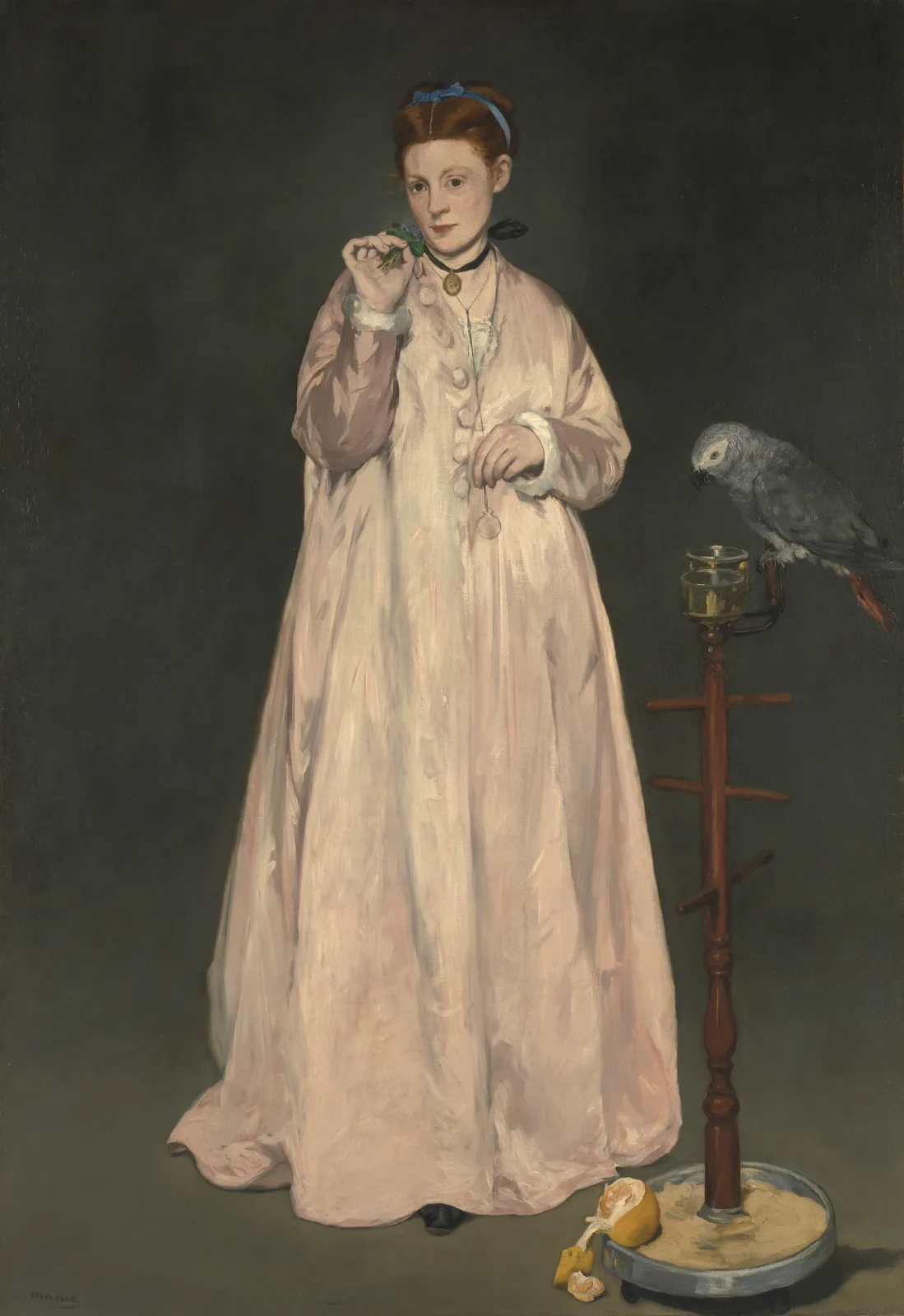
In the picture as it stands now, Thoré looks right about light and colour. The face has a lightness of 57, darker than the middle of the gown at 74, and a chroma of 21, nearly the same as the gown's 20. The fruit on the floor has a chroma of 36, stronger than the face. Thoré calls this note lemon; The Met's main text calls it an orange, and the references it lists also say citron and lemon peel. Fine variation beside the face, in the tangle of bouquet and fingers, is 7.9, above the 5.6 of a same-size box around the mouth. Thoré's complaint about a bouquet coming before a woman's expression fits here to some extent too. But a same-size box on the neckband and locket reaches 11.8, so this comparison depends on which areas are measured. Still, it is hard to say that the face that survives is lost. In today's photograph it meets a dark ground (lightness 21), and the blue ribbon and the black neckband hold it above and below. That is this note's own judgment.
That judgment comes with caveats. Thoré describes this ground as fine pearl-coloured ("couleur de perle fine"), and in today's photograph it is dark. Above all, according to the references in The Met's record, X-rays show that Manet scraped out this head several times and repainted it extensively, and his final changes to the picture may postdate the criticism of 1867–68. The face we see now may not be the one Thoré saw.
A matador from the same years: face and embroidery
The Met identifies the sitter of A Matador as the bullfighter Cayetano Sanz y Pozas, whom Manet watched in the ring on his 1865 trip to Spain, and calls the canvas "the first of the full-length figure paintings" he finished after studying Velázquez in Madrid. Enlarged, the flesh of the face is a broad plane that meets the black beard almost directly. The white stockings are also close to broad light planes, and their lightness is similar: 65 for the stockings and 62 for the skin of the face.
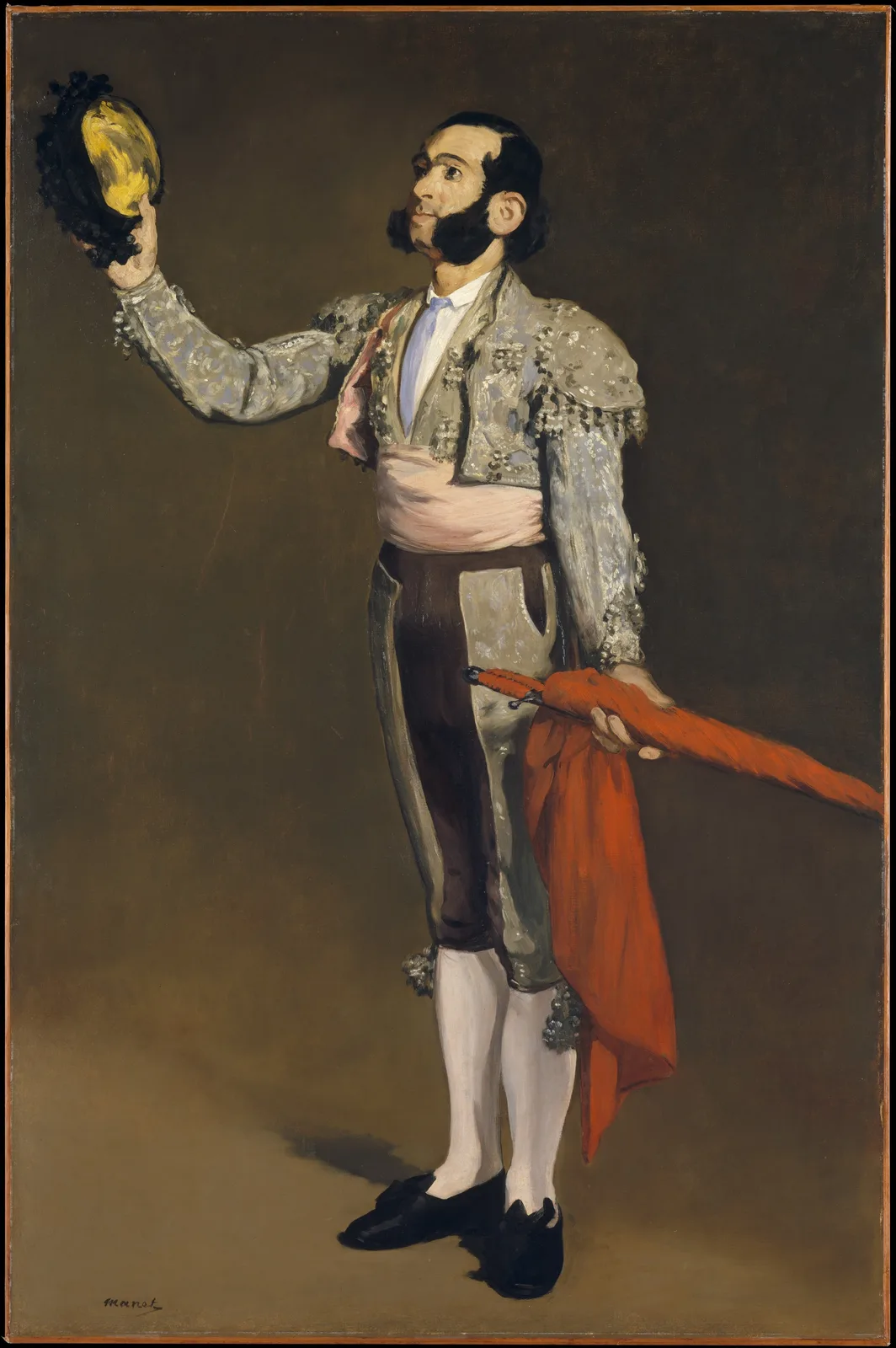
Fine variation is similar for the skin of the face at 7.0, the embroidered jacket at 7.3 and the hat at 6.4, while the stockings stand low at 2.6. Chroma is 30 for the skin, 34 for the hat and 36 for the red cloth. By brushwork the face ranks above the stockings but not above the embroidery, and in colour it falls a little behind the hat and the cloth. Of the four, this picture comes closest to "almost uniformly".
About 1871: the head becomes the lightest
Berthe Morisot with a Muff is framed differently. The figure is cut near the waist, so the head is much larger on the canvas. The face, at a lightness of 49, is above the muff at 30, the coat at 20 and the ground at 17, and slightly above the feathers at 45. In chroma too the face leads at 26, against 18 for the muff and 12 for the coat. Among the areas measured, light and colour both come to the head.
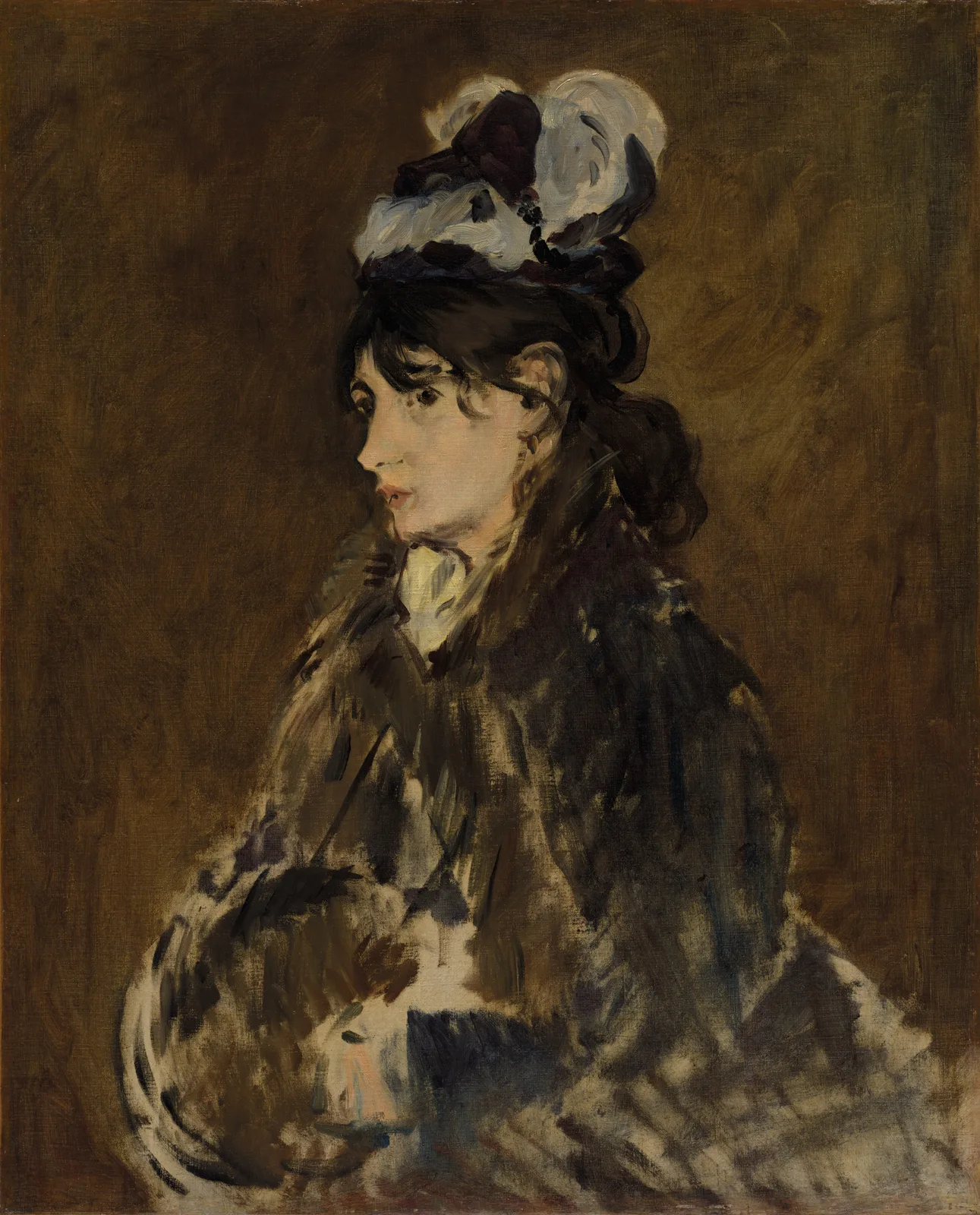
The fine-variation number does not separate the brushwork: 3.7 for the face and 3.6 for the muff. In the roughly scrubbed muff, canvas weave and wide marks appear to raise the value. To the eye, the face is softly blended with small dark touches at the eye, nostril and mouth, while the muff is overlapping wide marks that can barely be read as a muff. The Cleveland Museum of Art reads the painting's broad strokes through the sitter: they recall the sketchy look of her own paintings, a resemblance it calls "likely Manet’s nod to his subject’s identity as an artist". So this rough muff may have been intended rather than neglected.
1879: the colour is on the head
George Moore, in pastel on canvas, shows the Irish critic and novelist. According to The Met it was done in one sitting. The skin of the face has a lightness of 78, almost the same as the ground at picture left at 76. In light alone, the head melts into that ground, which brings to mind the critics who mocked it at its 1880 showing as a drowned man fished out of the water. Fine variation is highest for the cravat at 7.1, then the beard at 5.4 and the skin of the face at 3.1. The busiest place is not the head.
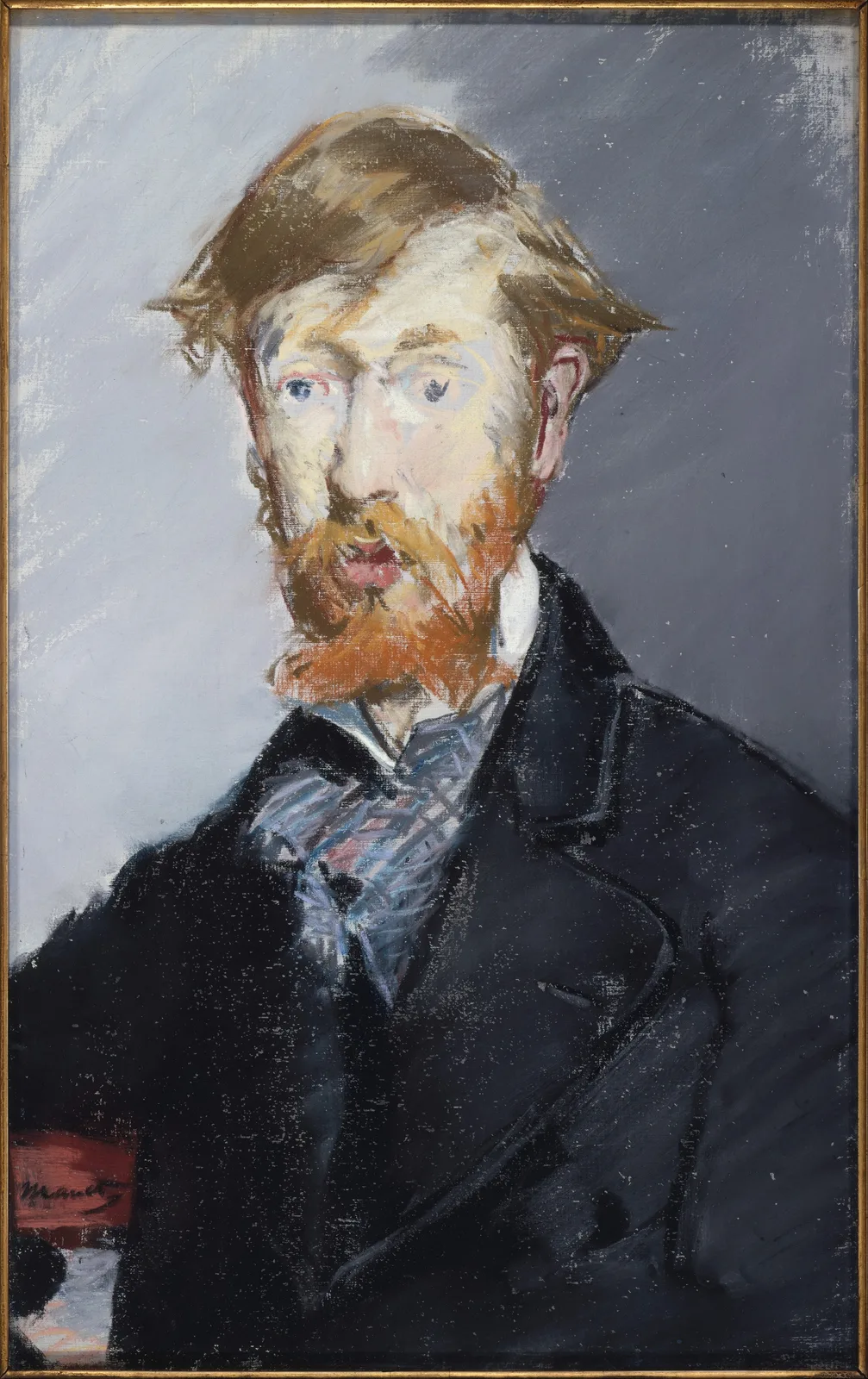
Among the areas measured, though, the strong colour is in the beard: a chroma of 26, against 10 for the skin of the face and the cravat, and 5 for the coat and the ground at left. Moore's own words point this way. According to his book as The Met quotes it, Manet saw him as a type suited to his palette and asked him to sit. According to Antonin Proust's recollections as The Met summarises them, when Moore asked for changes Manet would not make them, answering that he could not help it if Moore looked like a broken egg yolk with a crooked face. One can read the head as chosen as a place for colour rather than as the centre of a story. That resembles what Thoré said, but the result runs the other way: the colour has come to the head.
How far to accept Thoré
In this note's judgment, taking the four pictures as they survive, "values a head no more than a slipper" is about half right. In Young Lady in 1866 it holds for light and colour and, to the eye, on the face that survives, fails for brushwork. Whether it held for the face Thoré saw in 1868 cannot be judged from this picture. If anything, the record of the reworking sits badly with his phrase: whatever prompted it, a head scraped out several times until the painter was content hardly got a slipper's treatment. In A Matador it holds fairly well against the embroidery. In the last two, light or colour goes to the head. It may look as if Thoré's "for the moment" came true, but this cannot show that Manet changed. The first two are full-length figures and the last two are half-lengths with large heads, so the conditions differ; it is uncertain when the head in the first was last changed; and four pictures are a small sample of Manet's work.
So before a Manet portrait, instead of asking whether he neglected the face, split the question in three. If you cover the face with your hand, where does the strongest colour remain? Is the face lighter or darker than what surrounds it? Where is the brushwork finest? The less the three answers meet on the face, the closer the picture stands to what Thoré complained of and Zola defended.
Add your perspective.
Share a question, another approach, or something you have tried.
Checking sign-in…
Loading comments…