The fields in these paintings by Jacob van Ruisdael are not bright all over. The near ground is dark, one piece beyond it glows, it goes dark again, and somewhere further back it brightens once more. If the sun is out, the whole field ought to be lit. So why is it bright only in patches?
Four paintings released by the Cleveland Museum of Art and The Metropolitan Museum of Art, running from 1646 to about 1670, show where those bright patches are placed. By the end you will be able to go through a Ruisdael from front to back, count the bands of dark and light, and pick out what stands in the bright places.
The brightness numbers here are average values measured on the published image files, in areas chosen by eye. 0 is black and 255 is white. They change with the lighting of the photograph, so they are not values of the paint itself, and they mean something only when compared within one picture.
Jacob van Ruisdael (1628/29–1682) was born in Haarlem in the Netherlands and died in Amsterdam. According to the National Gallery in London, he probably trained with his uncle, the landscape painter Salomon van Ruysdael, and had settled in Amsterdam by 1657.
1646: one bright strip far away
The earliest date found on Ruisdael's works is 1646, when he was about eighteen. In Landscape with a Windmill the horizon lies about 71% of the way down the picture, so most of the upper part is sky. The windmill and trees at right stand as a dark mass.
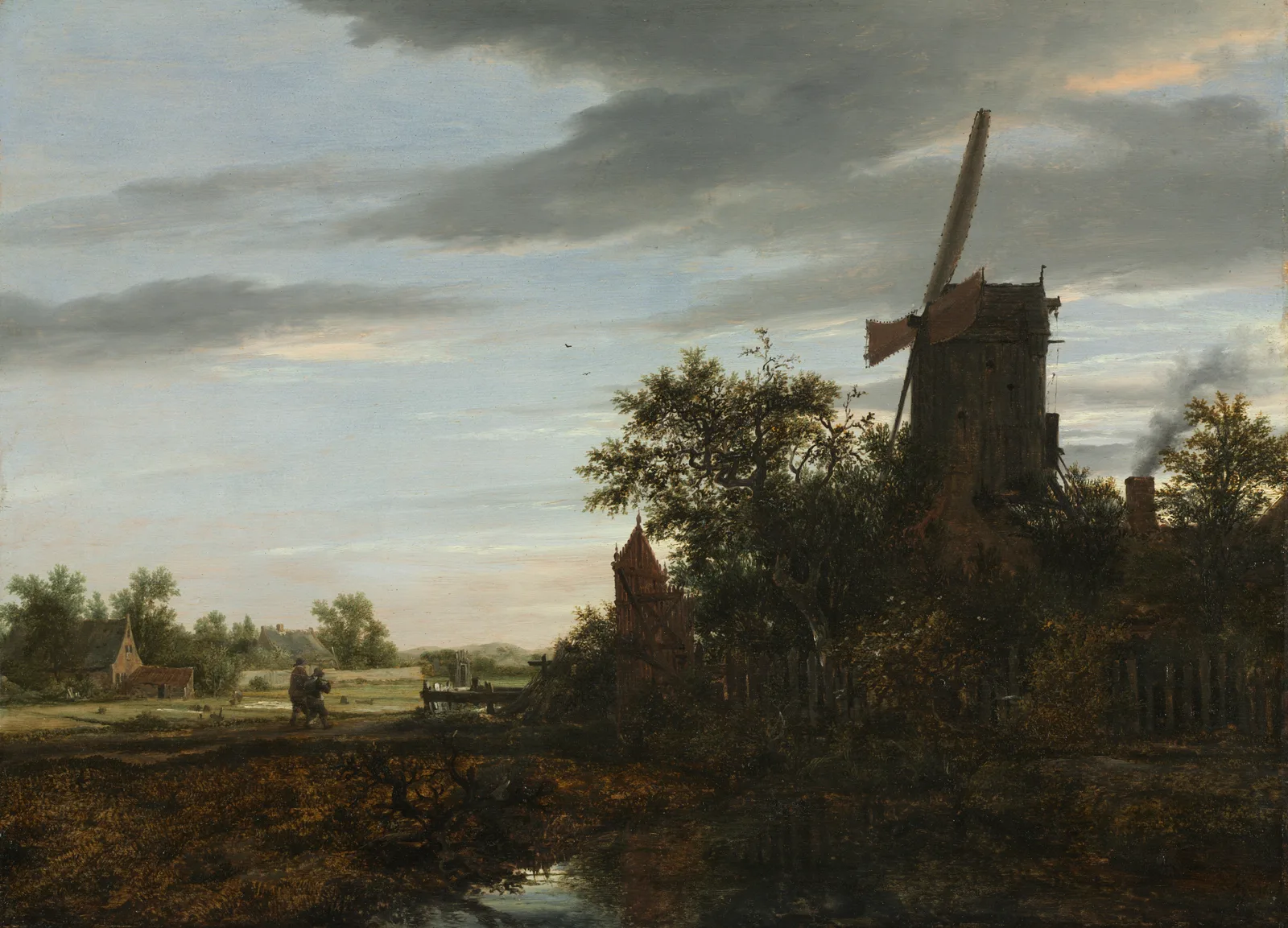
Only one part of the ground is bright. The far meadow at left, in front of the houses, measures about 92 to 117, while the near ground is about 31 to 37. The far meadow is roughly three times as bright as the near ground. Two people pass in front of that meadow as dark shapes. The Cleveland Museum of Art asks you to look closely at it: white linens are being bleached in the sun there, a process that took several months. Zoom in on the photograph and white strips show on the grass. This bright patch is not just light; it is also a place where the sun is at work.
The 1660s: two patches, apart
Grainfields, some twenty years later, is a small canvas of 47 × 57.2 cm. The horizon has barely moved, at about 69%, but now a great storm cloud covers the sky, with a blue gap open near the top. The Met's entry reads these clouds as driven quickly forward by the wind.
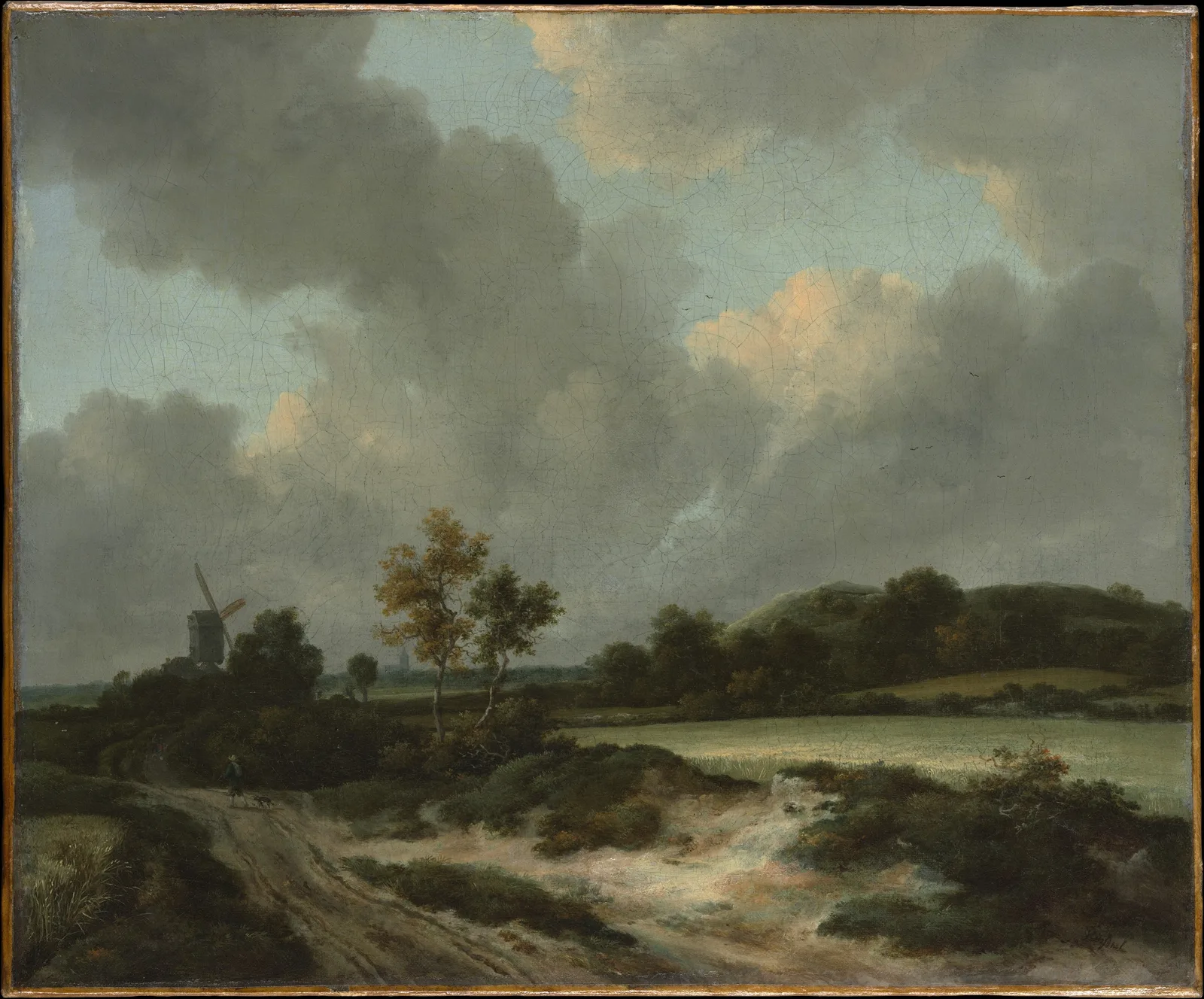
Now there are two bright patches, set apart. The grainfield at right is about 109 and the sandy bank below it about 123. The bushes between them are 57, and the ground at left drops to 41. The eye skips the dark bushes and moves from the bank in front to the field behind. The man with a sack and a dog is on the road at the darker left side, against dark bushes, so, unlike the walkers in the last picture, he does not pass in front of a bright place.
These clouds were probably not only a threat. The Met's entry holds that viewers of the time would have understood at once that the mill, the grainfields and the rain clouds all benefit people. The bright field and the storm cloud are not opposed; they are two parts of the same farming life.
About 1670: bands to count from front to back
Wheat Fields is a large canvas of 100 × 130.2 cm. The Met reports that it is generally seen as the most imposing of Ruisdael's twenty-seven known views of grainfields, and speculates from its size and design that it may have hung over a mantel. The horizon is at about 71%.
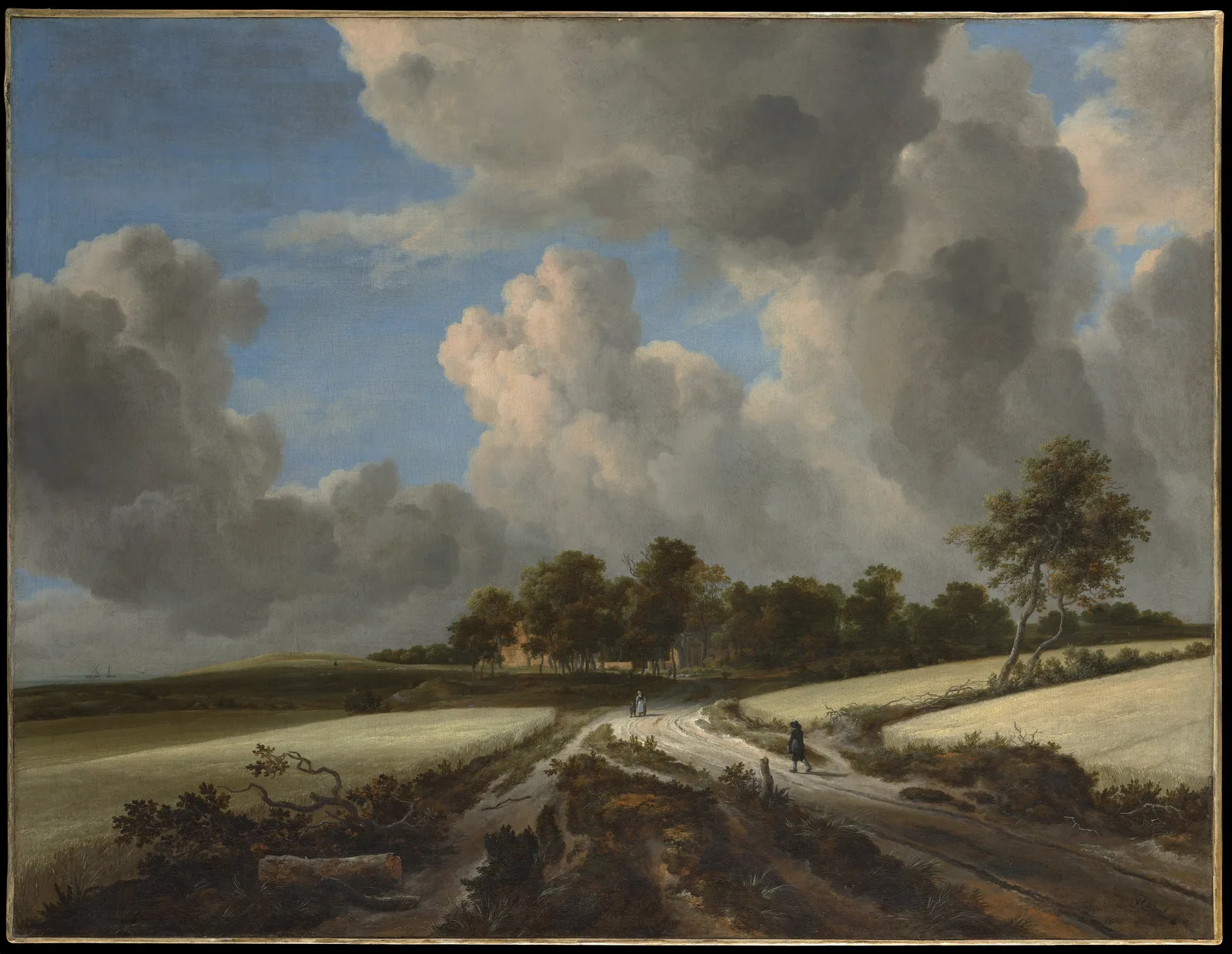
Here brightness stacks up in bands. The near ground is about 52, the left field 102, the dark land beyond it 43, the hill behind that 56, and at far left is a sea with a few boats. Dark, light and dark alternate from front to back and measure out the distance. It is the same wheat, yet the right field at 144 is much brighter than the left. The spot on the road where the woman and child stand is about 141, close to the right field.
In The Met's audio guide, the cinematographer Gavin Finney says that light through a gap in the clouds falls on the woman and child, and that they are at the edge of a cloud's shadow, as if darkness might reach them the next moment. The curator Adam Eaker explains that the light of the sky turns an ordinary Dutch landscape into something dramatic. The figures are small, but this is why the bright patch seems to have chosen them.
When there is no grainfield
Landscape with a Church by a Torrent, from about the same time, has no grainfield, only a small stretch of pasture to the left of the logs. According to the National Gallery in London, from the late 1650s Ruisdael painted waterfalls based on the work of Allart van Everdingen. In this picture the bright patch goes somewhere else.
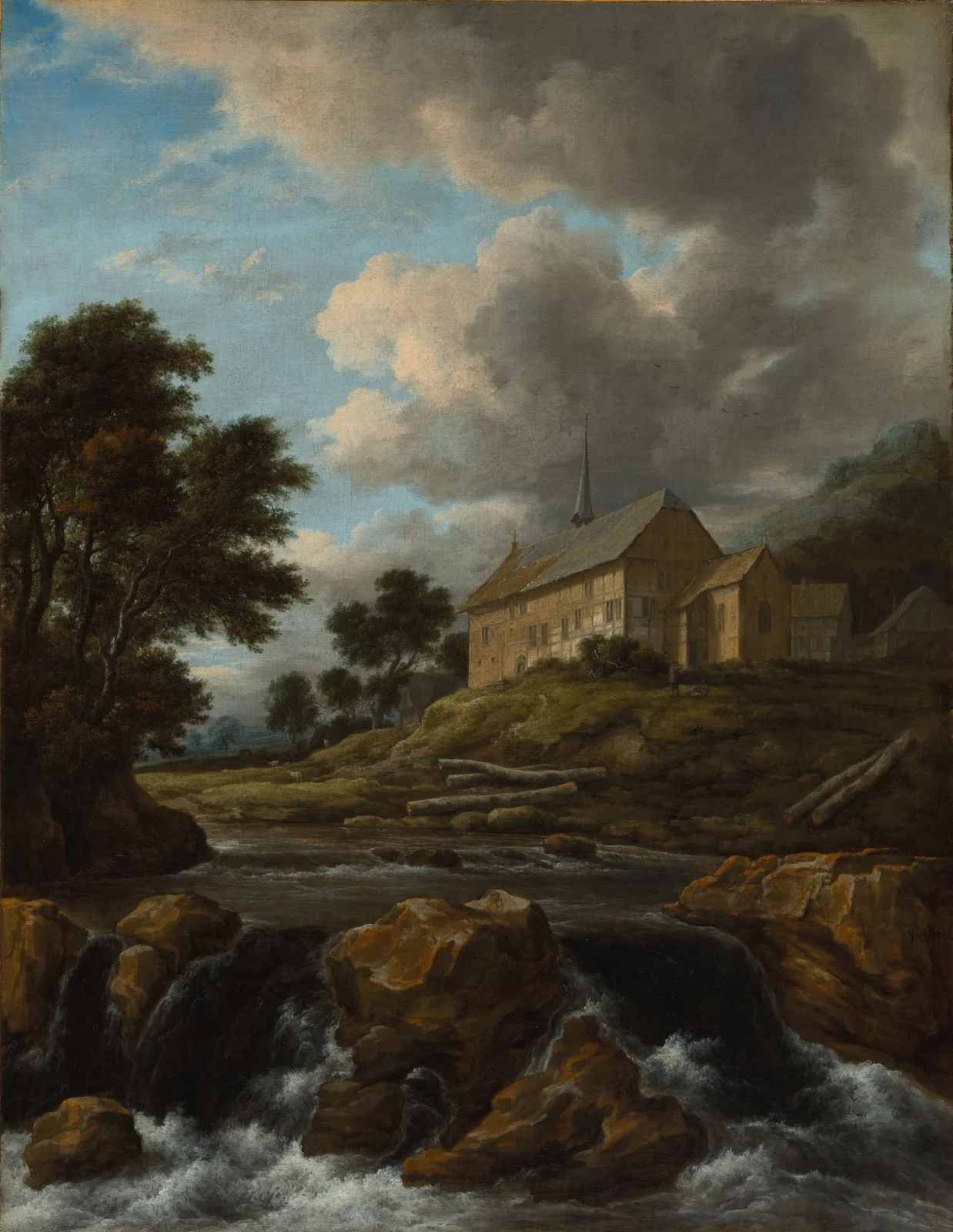
On the hill, what catches the light is the wall of the church. The wall is about 95, while the hill just below it is 57, the tree at left 35, and the black water of the fall about 20. The white foam in the foreground is also bright, about 79 in the area measured, but that is broken water. Here the building does what the wheat does elsewhere. The Cleveland Museum's short text on this picture reads the rapids and the cut logs as hints of life's transience and does not discuss the light, so this is a reading of one painting: here, at least, a bright patch is not tied to a field.
Beside a Van Goyen of 1646
To set these pictures in their time, the term “tonal phase” helps. The Met's essay on Dutch landscape names Jan van Goyen and Salomon van Ruysdael as major figures of this current in Haarlem landscape painting, which ran from the late 1620s into the 1640s. Van Goyen's View of Haarlem and the Haarlemmer Meer dates from 1646, the same year as Ruisdael's earliest date.
That picture also has huge clouds and bright strips on its low land and water, so clouds and bright patches were not Ruisdael's invention. Measured the same way on The Met's small image file (600 pixels wide), a bright strip of water is about 129 and dark land about 44, nearly three times apart. But that strip is water; the brightest land measured is about 79 to 88. These numbers hold only within one picture, so they cannot settle a comparison between two painters. What is easier to see is size and colour. Van Goyen's bright strips are thin lines, most of them in the distance, and his picture stays largely within greys, browns and pale greens. The bright patches of Wheat Fields are pale yellow fields spread wide across the lower picture, under a blue sky. The National Gallery in London calls Ruisdael “the foremost exponent of the classical phase of Dutch landscape painting”, and in this picture that change can be seen in the size and colour of the fields.
Did the clouds really part like that?
As Finney says, Wheat Fields looks like a moment caught. But The Met's entry on Grainfields explains that Ruisdael's work was done in the studio on the basis of drawings from nature, composed with skill while never leaving the realm of the plausible. What the sky was like that day cannot be known. The gap in the clouds gives the bright patch a reason to be there, and the painter chose the spot.
So in front of a Ruisdael there is no need to spend time looking for the sun. Instead, go up from the nearest ground to the horizon, count how many times dark and light change, and see what is in the brightest patch. It may be linen, wheat, a church wall, or a woman holding a child's hand. That is what the picture chose to show you.
Add your perspective.
Share a question, another approach, or something you have tried.
Checking sign-in…
Loading comments…