Stand in front of a Chardin still life and the silver is silver and the glass holds water. Yet step closer, one pace at a time, and at some point the object vanishes and only marks of paint remain. So where is the picture? In the paint on the canvas, or a few steps away, on the side of our eyes?
This note sets four oil paintings by Jean-Siméon Chardin, released into the public domain by The Metropolitan Museum of Art and the Cleveland Museum of Art, in the order they were painted, and looks at each one twice: once from a distance and once enlarged. Afterwards, in front of a Chardin, you will be able to pick one object and find for yourself the distance at which it breaks into brushstrokes and the distance at which it gathers into an object again, and tell which objects he painted with thick paint and which with thin.
Jean-Siméon Chardin (1699–1779) was born in Paris and spent his whole life there. According to The Met, he did not study at the Royal Academy of Painting and Sculpture and made no preparatory studies, working slowly and directly on the canvas. He was received into the Academy in 1728 as a painter of animals and fruit, and from 1733 he also painted genre scenes with figures. In his last decade, when his failing eyesight kept him from oils, he made heads in pastel.
The Silver Tureen: game from afar, horizontal strokes up close
The Met dates The Silver Tureen on grounds of style to about 1728–30, the very moment Chardin entered the Academy. It is a large canvas, 108 centimetres wide.
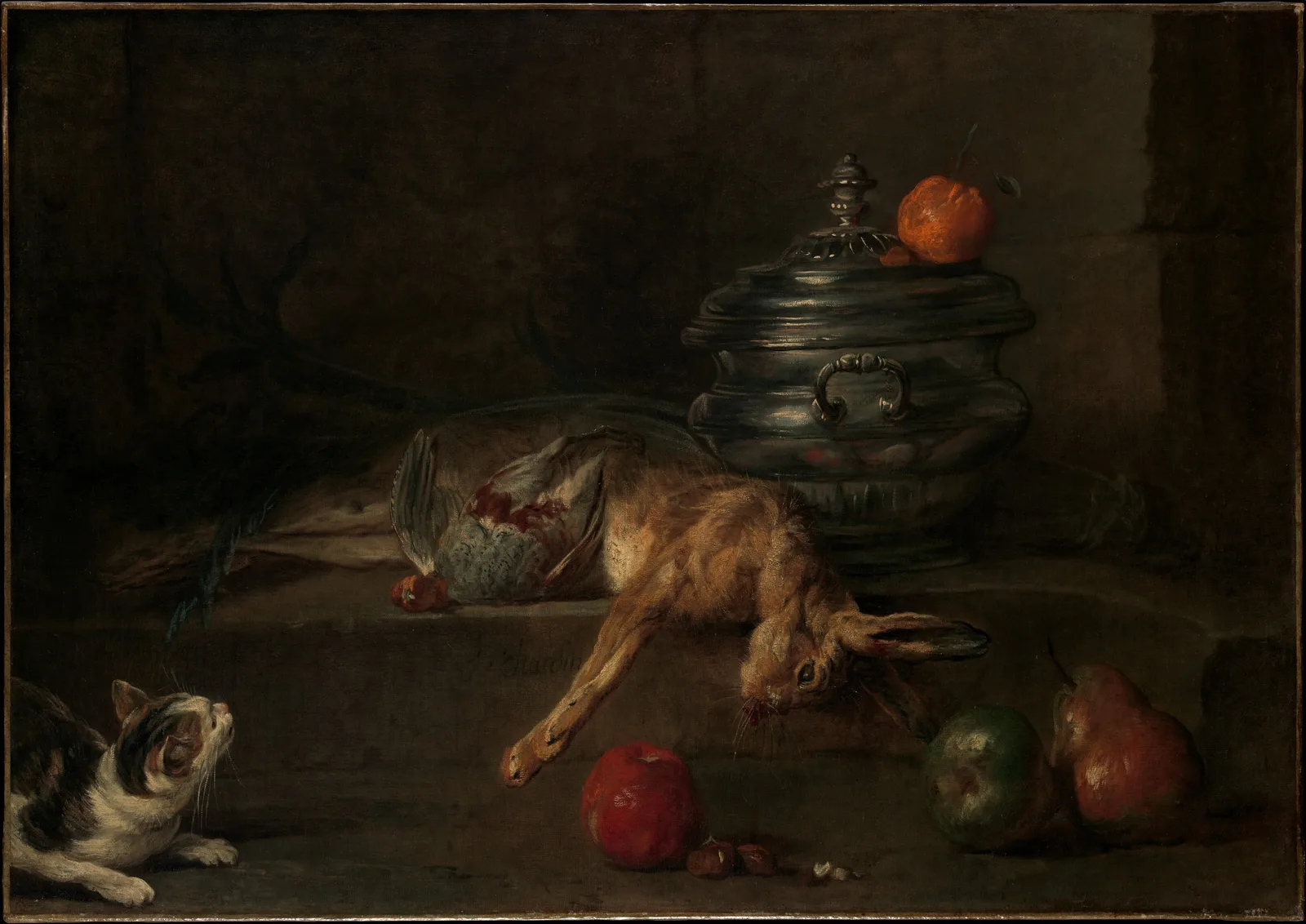
From a distance the story reads at once. A silver tureen stands on a dark stone ledge, with a dead hare and a partridge laid in front of it. The hare's hind legs hang over the edge, and in the lower left corner a cat crouches low and looks up at the game. As The Met puts it, the supple crouch of the cat contrasts with the stiffening forms of the hare and the bird, while a red apple, a green apple and a pear scattered along the front of the ledge balance the design.
Enlarge the original image and things change. The body of the tureen is not a smooth metal surface but layer upon layer of broad horizontal strokes in pale grey and white. The handle is only a few heavy lines of thickly laid light paint, and on the lower belly of the tureen red smudges spread. The Met describes these as the colours of the fruit reflected in the silver; up close they look less like a reflection than like red paint rubbed into place. The hare's fur is the same. Dry strokes of ochre, cream and brown are dragged across the weave of the canvas and break off here and there, and the whiskers are a few fine light lines. Nowhere is a single hair painted.
Soap Bubbles: one rim and two white dots
According to The Met, the collector Jean Pierre Mariette wrote that Chardin's first figure painting showed a young man blowing bubbles, though The Met adds that another figure painting, apparently dated 1733, may be earlier. Three versions of the subject survive, in The Met, the Los Angeles County Museum of Art and the National Gallery of Art in Washington, and The Met considers this one, with its thick brushwork, the earliest of the three. In seventeenth-century Dutch painting soap bubbles hinted at the brevity of life, but whether Chardin meant any such message is uncertain.
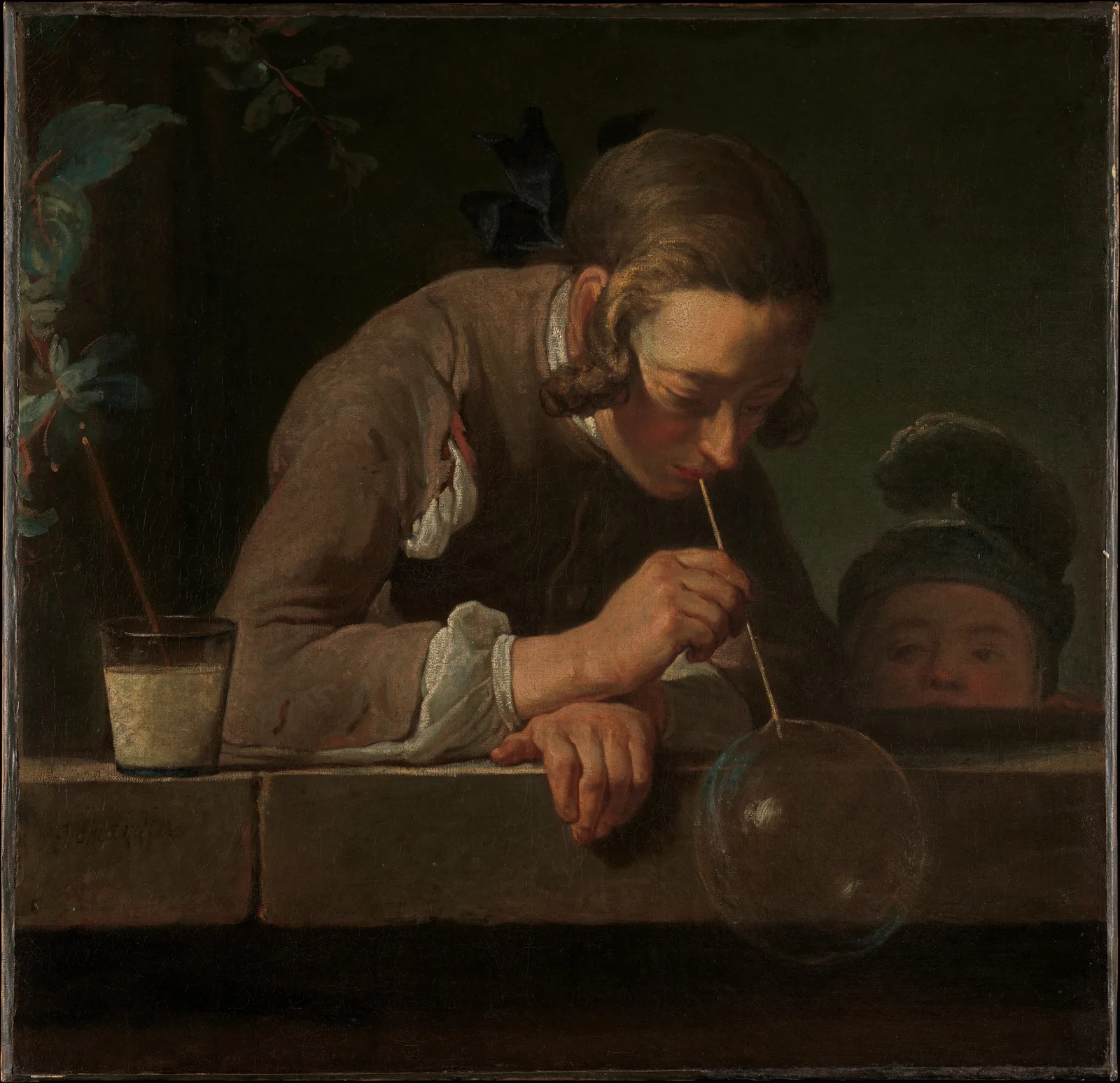
The young man leans his arms on a stone window ledge and bends to the straw. At its end a large bubble hangs below the ledge. Behind him a small child in a feathered cap peers over the ledge, only the eyes showing, watching the bubble. On the left of the ledge stands a glass of soapy water. The gaze in the picture runs from the young man's eyes down the straw to the bubble, and the child's eyes gather on the bubble again.
Enlarge the bubble and almost nothing is painted there. Thin arcs of blue-grey and pale pink make a round rim, and two short touches of white sit at upper left and lower right. Inside the bubble is the same brown paint as the wall behind, with the weave of the canvas showing through, and the lower edge of the ledge runs straight on through it. Yet step back a few paces and these few marks become a transparent ball swelling with air. The bubble is not in the paint. The paint supplies a rim and two points of light, and the viewer fills in the rest.
Kitchen Utensils: a small canvas, a thick white cloth
The Cleveland Museum of Art's Kitchen Utensils with Leeks, Fish, and Eggs dates from about 1734 and is only 40.7 centimetres wide, far smaller than the first two. Cleveland notes that Chardin began painting small, sparse kitchen still lifes like this around 1730, often reusing the same objects and shifting their positions slightly, adding or removing a utensil, to reach a balanced design.
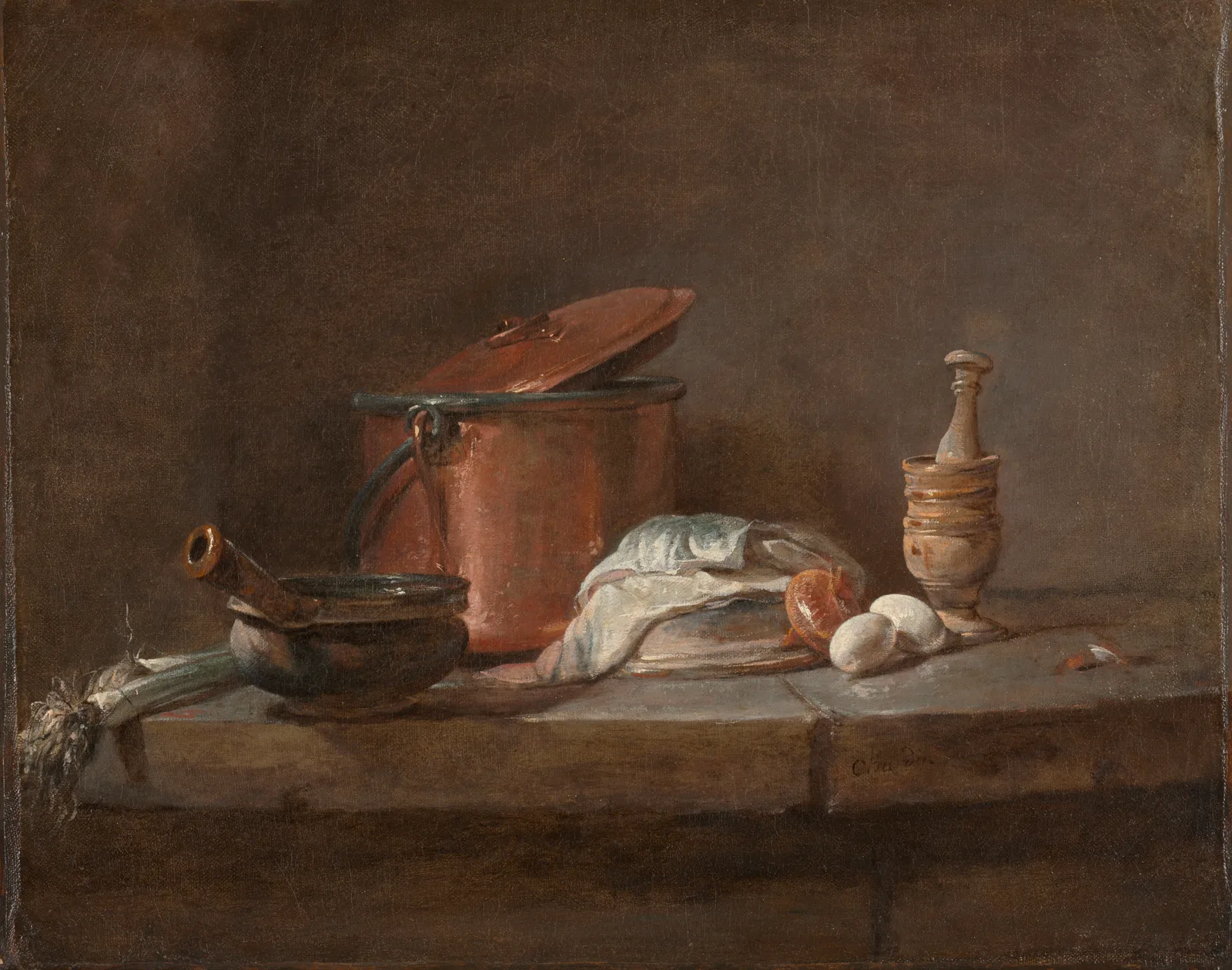
The objects stand on the ledge from left to right: a leek, a dark pan with a handle, a copper pot with its lid open, a flat round object under a white cloth, a round orange slice, two eggs and a wooden mortar. Tall and low things alternate, the copper pot holds the high point in the middle and both sides step down. The background is a single brown wall with no ornament.
Enlarged, the paint is thickest in the white cloth. Dry white paint has been dragged on so that its edges crumble and it stands up in small ridges. In each fold, shadows of grey with a hint of blue lie thinly between the thick whites. The copper pot, by contrast, is laid in with a fairly even reddish brown, with only a few light streaks drawn vertically over it. Within one picture, each object gets its own thickness of paint and its own direction of drag.
Still Life with Herrings: a thin glass, a rough loaf
Still Life with Herrings dates from about 1735 and is a small canvas, 41 centimetres high. Cleveland's text says that here Chardin combined delicate glazes with roughly dragged thick paint and fully expected his work to be inspected closely. He is also known to have worked in private.
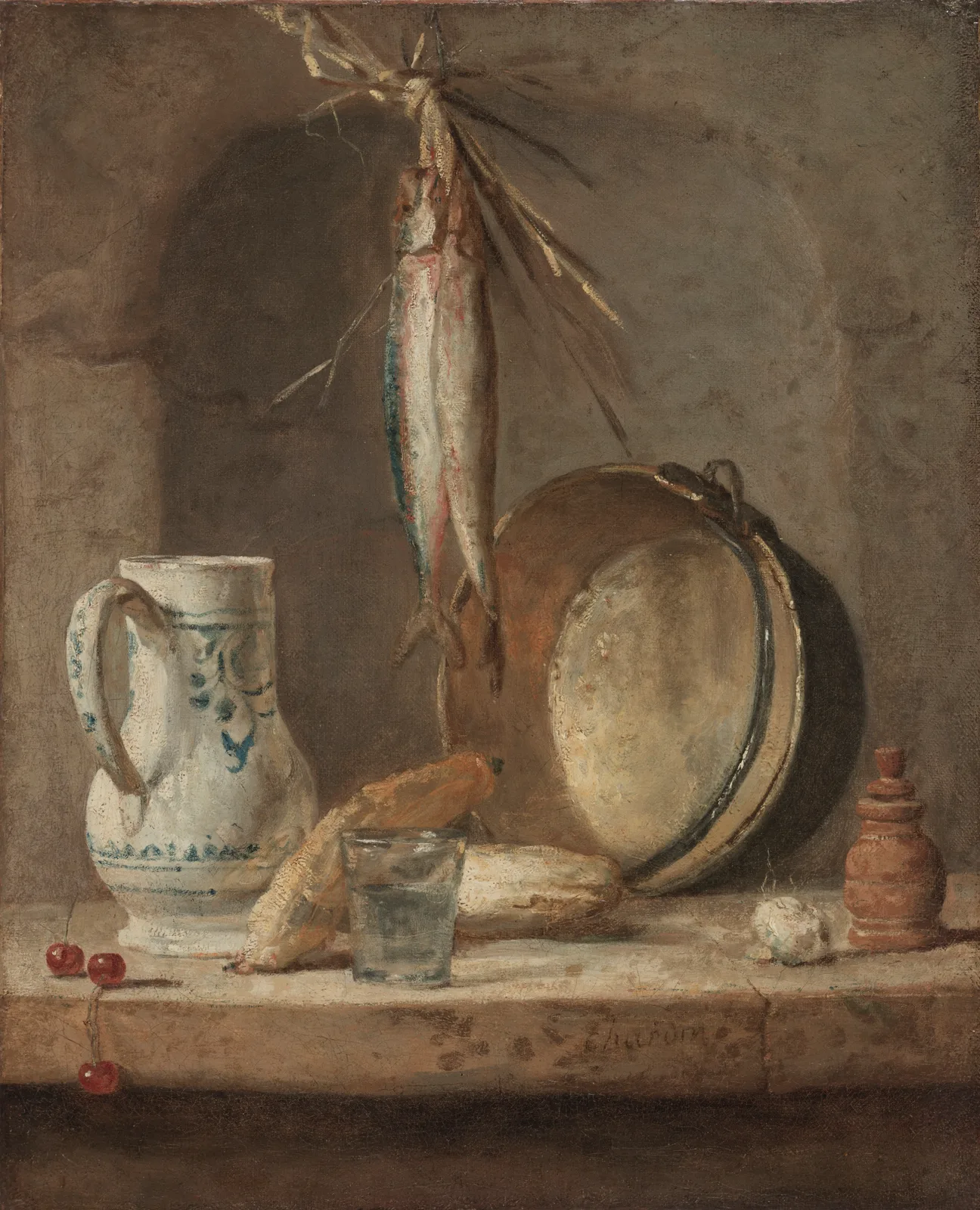
A stone ledge stands before an arched niche in a wall. Two herrings tied with straw hang from above and divide the middle of the picture vertically, and to their right a copper pan leans against the wall, showing its pale interior. On the left is a white earthenware jug with blue decoration, and at lower centre a loaf and a glass of water. One cherry has caught on the end of the ledge and hangs down.
Enlarged, two kinds of painting sit side by side. The glass is a thin film of pale grey, and the loaf behind it shows straight through. There are only a few white strokes on the rim and one faint horizontal line at the water level. The bread crust right beside it is the opposite. Ochre and white paint has been dragged roughly so that the surface crumbles, and grains of paint stand up from it. Transparent things are thin, rough things are rough: the surface of the paint takes on the quality of the surface of the thing.
Diderot: approach and it blurs, step back and it forms again
Someone put this experience into words while Chardin was still alive. In his review of the Paris Salon of 1763, the philosopher Denis Diderot wrote of Chardin's small still lifes that no one can understand this magic. Thick layers of colour are laid one on another and their effect breathes through from beneath; in one place it is as if a vapour had been blown onto the canvas, in another as if a light foam had been thrown on it. Then he added that if you approach, everything blurs, flattens and disappears, and if you step back, everything forms and comes to life again.
The pictures Diderot was looking at were other works hung at the 1763 Salon, not the four in this note. Still, his sentence fits all four exactly. The horizontal strokes of the tureen, the rim and white dots of the bubble, the crumbling paint of the cloth and the thin film of the glass are all paint up close and things at a distance. In the same review Diderot wrote that what Chardin grinds on his palette is not white, red and black but the very substance of objects, and that he takes air and light on the tip of his brush and fixes them to the canvas.
This cannot be called painting less. The marks are few, yet step back and the object appears complete. The last step in finishing the object is, in effect, left to the viewer's distance. Shrink the images in this note to the width of a phone screen and the bubble and the glass read as objects at once; making a picture smaller does the same work as stepping back. And, as Cleveland's text says, Chardin also expected people to come close. Up close, the paint takes on the quality of the thing; at a distance, the paint gathers into the thing. One canvas shows different things at two distances.
What to try in front of a Chardin
When you next see a Chardin, first choose one object: the silver, a glass, a white cloth, anything. Walk slowly towards it until it breaks into marks of paint, then step back slowly and stop at the moment it returns as an object. At that distance the object becomes a picture. You can do the same with the zoomable images on the museums' websites. Then look in the same picture for the places where paint stands up thick and where it is thin enough to see through, and match each to the object it was used for. In Chardin's pictures, the quality of a thing's surface passes into the paint as much as its shape does.
Add your perspective.
Share a question, another approach, or something you have tried.
Checking sign-in…
Loading comments…