Find the front edge of the table in a still life and follow it with your eyes from the left end to the right. At some point it is usually hidden by a cloth or a piece of fruit. When the line comes out on the other side, we expect it to reappear at the same height and the same slope. In Paul Cézanne's still lifes that expectation is often disappointed.
This note follows the table edge in four still lifes Cézanne (1839–1906) painted between about 1877 and about 1894. After the four, you will be able to tell for yourself, in front of any other still life, whether it shows a scene seen from one spot or gathers surfaces seen from several spots into one picture.
Cézanne was born in Aix-en-Provence in the south of France and died there. He is usually grouped with the Post-Impressionists, and an essay by The Metropolitan Museum of Art in New York says his way of building form with colour and his analytical approach to nature influenced the Cubists and the Fauves. All four works are released by The Met as public domain.
One yardstick: Alberti's open window
It helps to have one yardstick for comparison. In the first book of On Painting, written in 1435, the Florentine Leon Battista Alberti described how he began a picture. First he draws a rectangle of whatever size he likes and treats it as an open window through which to look at what will be painted. Then he fixes one point inside it, at the height of the figures to be painted, which is roughly the viewer's eye level, and calls it the centric point. The lines of the floor all run towards that point.
This method carries a promise. The painter and the viewer stand in one place in front of the window, and the eye does not move. The front edge of a table is then a single straight line, and even if a cloth covers its middle, its two ends must lie on the same line. Let us use that promise as a ruler and measure Cézanne's tables one by one.
An edge that carries on: Still Life with Jar, Cup, and Apples
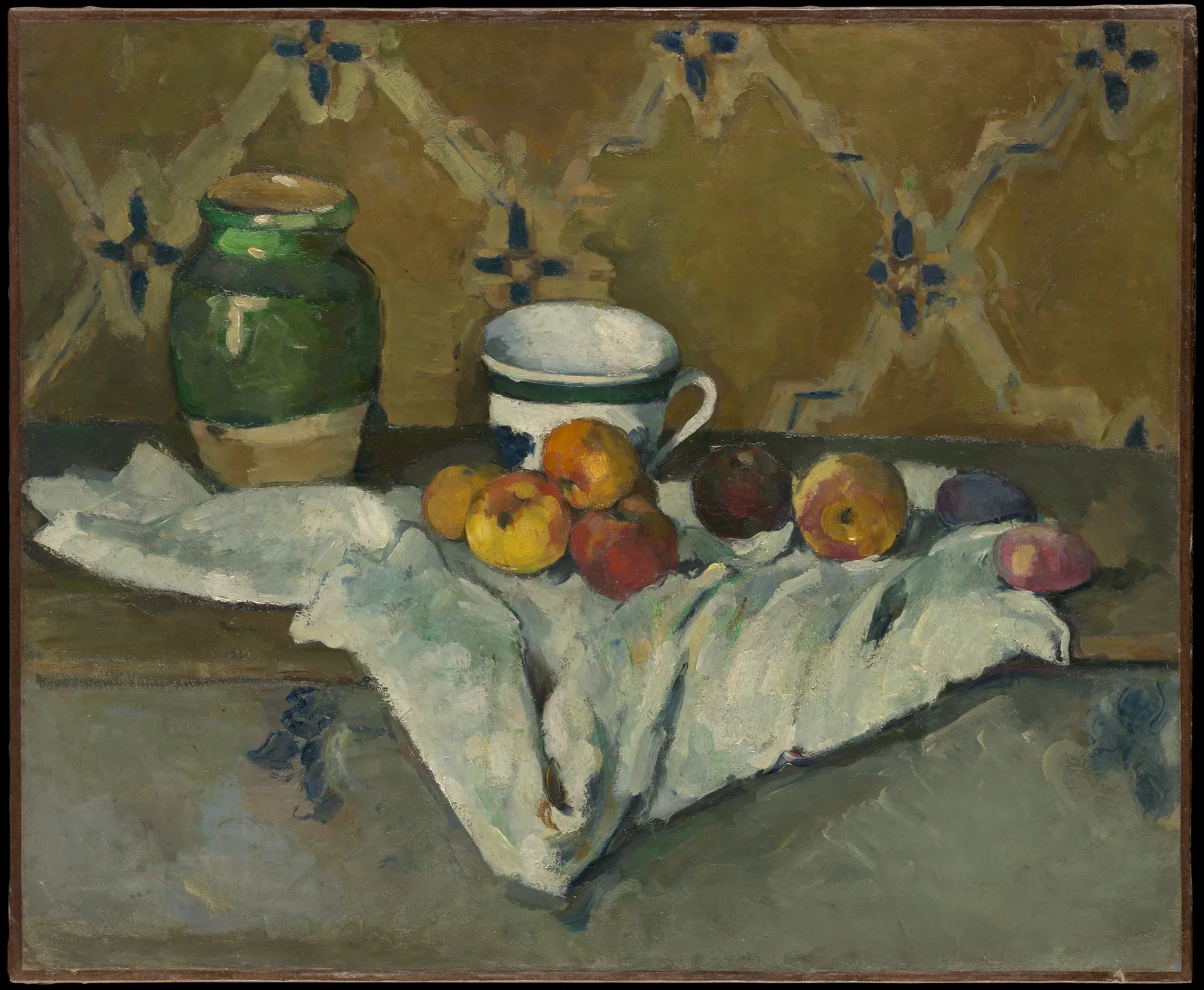
This picture dates from about 1877. A green-glazed jar, a white cup with a green band, several apples and two purple and pink fruits sit on a white napkin. According to The Met, the support is a box, and the V-shaped pattern of the wallpaper behind echoes the shape of the napkin.
Follow the front edge of the support. The line leaves the left side, goes under the napkin in the middle of the picture, comes out at the napkin's right end at almost the same height, and runs on to the right side. Measured with Alberti's ruler, it does not go far wrong. In this picture the table is still a table seen from one place.
What stands out instead is the way it is painted. The napkin is built of short strokes of white, pale grey-green and light blue laid side by side into folds. The apples have almost no dark shadows; their round surfaces turn through differences of colour, from red to orange to yellow. The Met's essay explains that around this time Cézanne gave up the strong contrasts of light and dark of his early years and began building forms from scales of neighbouring colours, and it cites this very painting. The edge is still straight, but the material that builds form is already shifting from light and shadow to colour.
A table whose ends do not match: Still Life with Apples and a Pot of Primroses
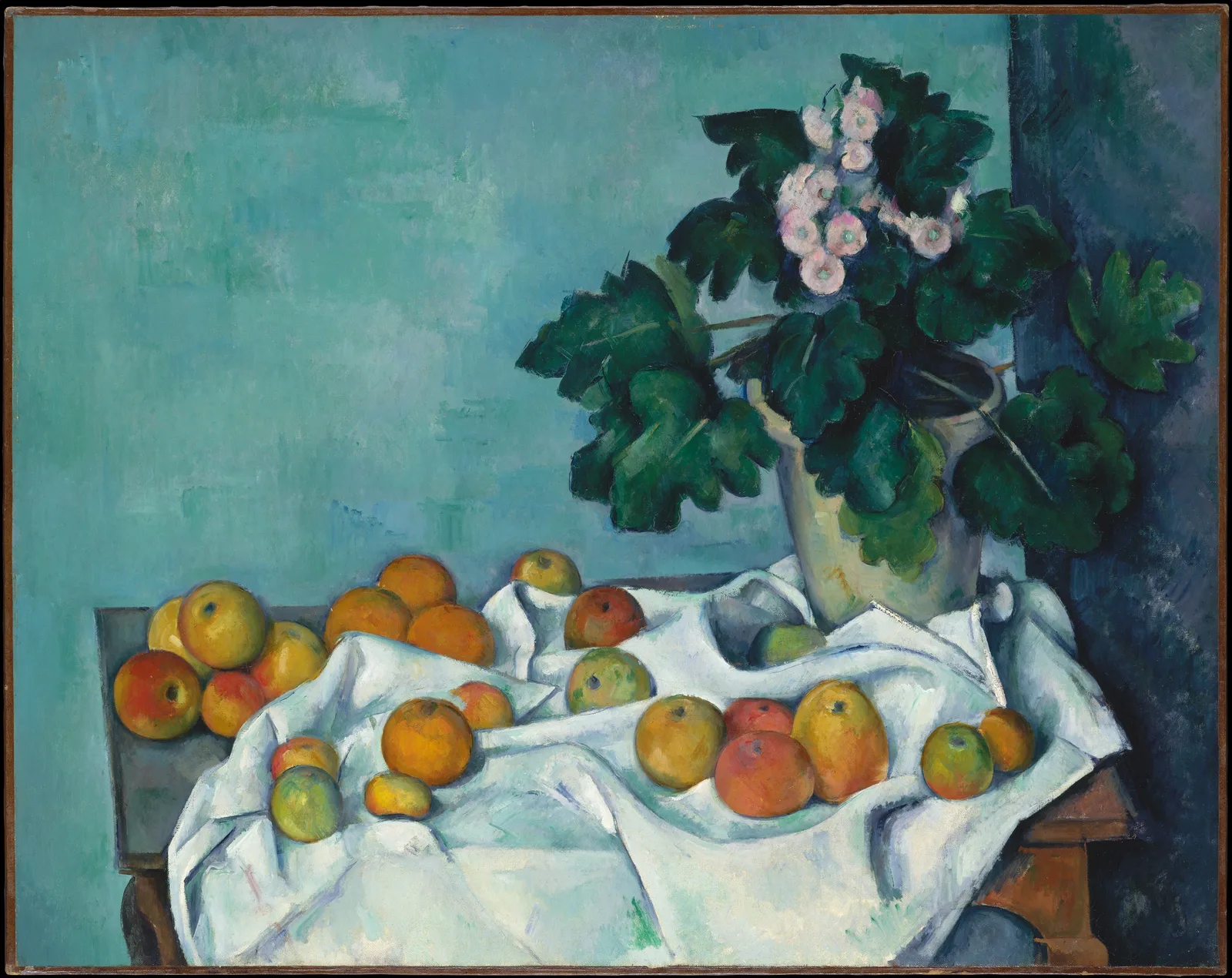
This picture is about thirteen years later. According to The Met, Cézanne rarely painted flowering plants and included potted plants in only three still lifes. He seems to have kept this table, with its scalloped apron and bowed legs, for three of his finest still lifes of the 1890s, and this painting once belonged to Claude Monet.
Follow the table edge again. On the left, the top of the table appears as a broad blue-grey board. It is wide enough to hold several apples and deep, as if seen from above. A dark bowed leg comes down below its front edge. But the edge soon disappears under the white cloth, and the table only reappears at the far right. On the right the table is red-brown, its top shows only as a thin strip, and the scalloped apron is visible beneath it. This is a table seen low, from the side. The front edge is also slightly higher on the right than on the left.
If you try to join the two ends with one straight line, you cannot check where or how they meet, because the cloth covers everything in between. The only thing telling us that these two pieces, different in colour, thickness and height, are the ends of the same table is the white cloth that lies across the gap. In the middle it swells up like a hill, and the apples sit as if lodged in its folds. The Met's essay says that here the fruit and the cloth are painted not with light and shadow but with extremely subtle gradations of colour, in a distorted perspectival space.
One table, several eye levels: Still Life with Apples and Pears
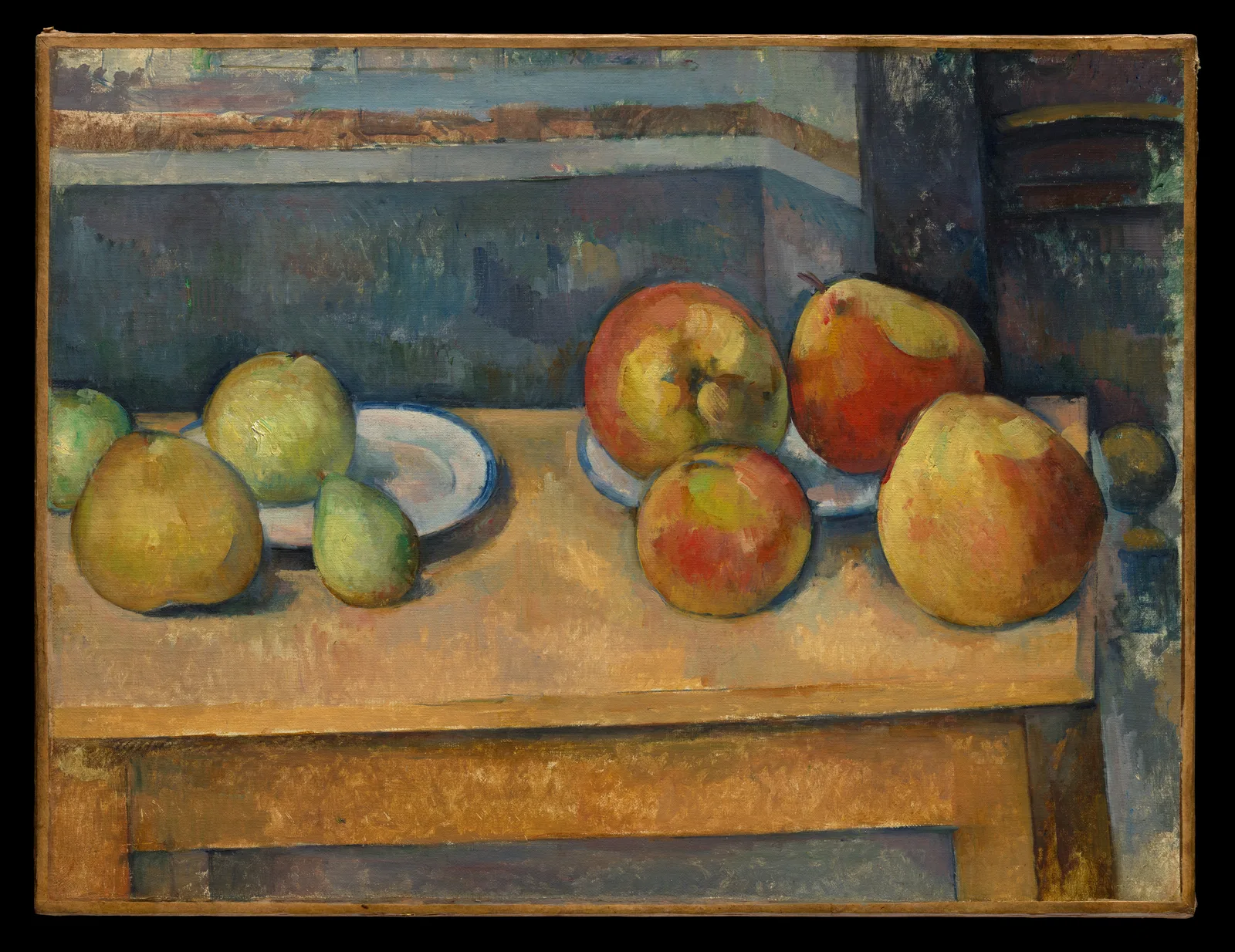
The Met reports that Cézanne once said, "With an apple I want to astonish Paris." The apples and pears in this picture grew near the family's estate outside Aix. The Met's description says that here Cézanne set aside traditional one-point perspective and studied the fruit, plates and table from several viewpoints: straight on, from above and from the side. Let us check that on the canvas.
Start with the tabletop. The ochre surface stands up so broadly that it fills the lower half of the picture. You would have to look down on the table from quite high up to see this much of it. The two plates are seen from the same height: the white plates with blue rims are drawn not as flat lines but as wide ovals you can see into. Yet most of the fruit on the table is seen almost from the side. Their round outlines rise straight up from the table. Only one large apple near the top of the group turns the dimple at one end straight towards us. Go below the table and the apron and the frame under it are painted flat, as plain rectangles. This time they are seen straight on, from about table height.
The front edge itself is not a straight horizontal either. It rises a little from the left end to the right. Although no cloth hides anything here, as it did in the previous picture, Cézanne joined the top and the apron as he saw them from different heights. Even so, the fruit does not look as if it will roll off. Each piece has a short dark shadow at its base that holds the spot where it touches the table, and two large fruits at the right end take the weight. The balance on the tilted surface is set not by perspective but by the placing of colours and masses.
Where the edge disappears: Still Life with a Ginger Jar and Eggplants
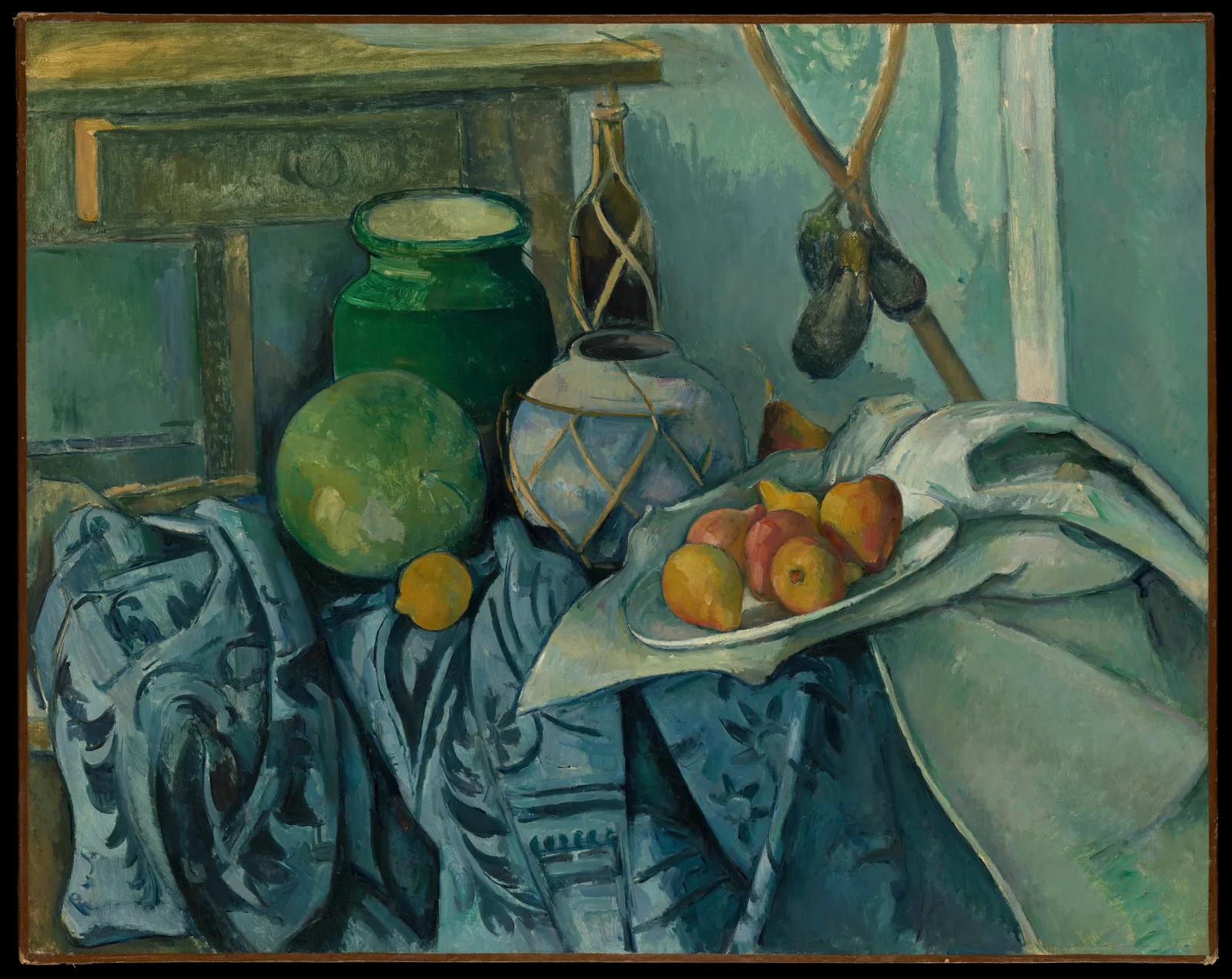
In the last picture there is no edge to follow. The lower part of the picture is covered entirely by dark and light blue patterned cloth and a white cloth. Nowhere can you find where the table begins or ends, or at what height its front edge lies. The white cloth flows down to the lower right and becomes a broad pale grey-green surface that runs to the bottom right corner of the picture.
Instead, the objects settle their places by overlapping. The green melon covers the lower part of the green jar, and a lemon rests on the blue cloth below the melon. The cord around the ginger jar becomes a yellow line that bends along the jar's round surface. The white plate of fruit tilts steeply forward so that you can see right into it, yet the fruit stays in the plate. Two eggplants hang at upper right. The Met describes the picture as a richly orchestrated play of overlapping shapes, patterns, colours and textures, and adds that the cord-wrapped ginger jar appears in more than a dozen of Cézanne's compositions.
In the painting of about 1877, the table edge was the floor on which everything stood and the baseline that told us where we were standing. Here that job is shared out between the folds of the cloth and the overlaps between objects. In the words of The Met's essay, in Cézanne's pictures the relationship of one object to another takes precedence over single-point perspective.
What to try in front of another still life
Put the four side by side and a direction appears. Around 1877 the table edge passes under the napkin and carries on straight. Around 1890 the two ends on either side of the cloth differ in colour and height. Around 1891–92, even without a cloth's help, the top and the apron of one table are painted from different eye levels. In 1893–94 the edge disappears altogether, and the cloths and overlaps take over the space. Alberti's window gave the viewer one fixed place; Cézanne's table is closer to surfaces seen by someone moving a little around the table and then joined together. According to The Met's essay, exhibitions in Paris in 1907, the year after his death, established his standing.
Next time you look at a still life, pick one line that an object interrupts and check whether its two ends lie on one straight line. If they do, the picture shows a scene seen from one place in front of the window. If they do not, ask surface by surface from which height it was seen. With Cézanne, the answer was usually different for each surface.
Add your perspective.
Share a question, another approach, or something you have tried.
Checking sign-in…
Loading comments…