The first thing you notice in a Rembrandt portrait is the dark. Look a little longer and something else stands out: the light is not scattered over the picture. It is packed into one or two places. Why does the light gather in one mass in Rembrandt's paintings?
This note looks at four portraits by Rembrandt that The Metropolitan Museum of Art has released into the public domain, in order from 1640 to the early 1660s. Afterwards you will be able to point out two things in front of a Rembrandt yourself: where the bright parts join into one shape, and where the dark parts are bound together. A way of finding and noting bright places one by one is in the note on Vermeer's interiors. Here the question is how many masses those bright places are gathered into.
Rembrandt (1606–1669) was born in Leiden, worked in Amsterdam from 1632 and became a prominent portraitist there. Judged by eye alone, brightness shifts with the screen, so for a few areas of each picture the average brightness value was also measured on the museum image (1600 pixels on its long side). 0 is black and 255 is white. These are rough values that include the conditions of the photograph, so they are compared only within the same picture.
Doomer, 1640: the face and the white ruff as one shape
According to The Met, Herman Doomer was a successful cabinetmaker who worked with the imported hardwoods fashionable in Amsterdam, ebony in particular. The Met notes the exceptional care Rembrandt took with this likeness on a wood panel. The face is so evenly painted that brushstrokes are hard to see.
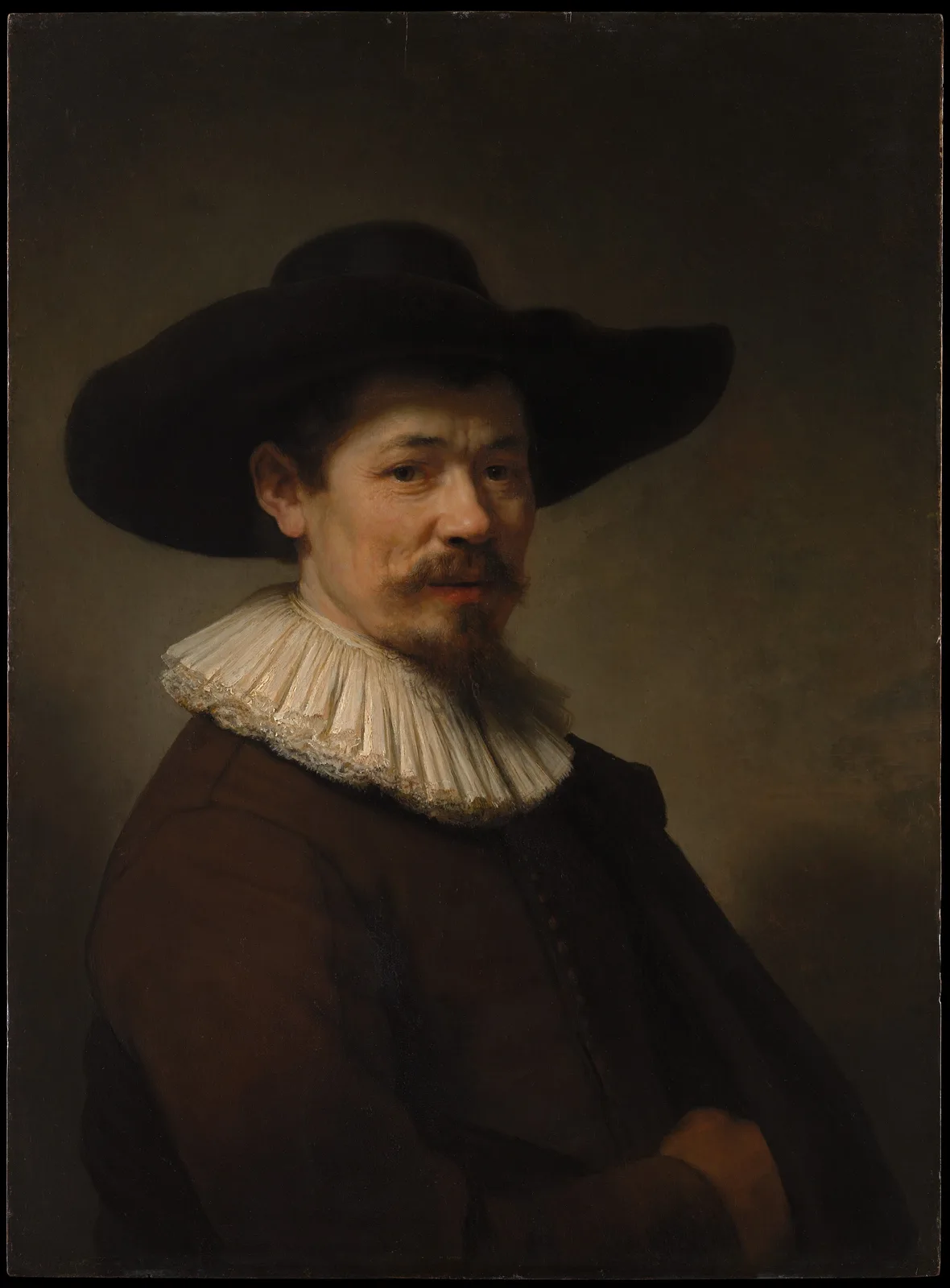
The light comes from the upper left. The shadow under the nose falls to the lower right, and the right side of the face is dark. The bright places are the left side of the face and the white pleated ruff around the neck: 109 on the left cheek, 113 on the ruff. Everything around them is dark: 18 on the black hat brim, 16 to 33 on the dark brown coat, 45 to 50 on the wall behind.
Enlarge the ruff and each pleat has its own bright line and its own shadow. That makes dozens of small lights, yet from a step back they read as a single white ring. The beard links the face to the ruff, so everything from under the hat brim down to the collar of the coat becomes one bright shape. The dark side is joined up too. The hat, the coat and the hand at lower right all sit inside black and dark brown, so you have to look for the hand to see it.
Aristotle, 1653: the widest light is not on the face
This picture was painted in 1653 for the Sicilian nobleman Don Antonio Ruffo and sent to his palace in Messina in the summer of 1654. The philosopher Aristotle rests his hand on a bust of the poet Homer, and The Met explains that he wears a gold medallion with a portrait of his pupil Alexander the Great.
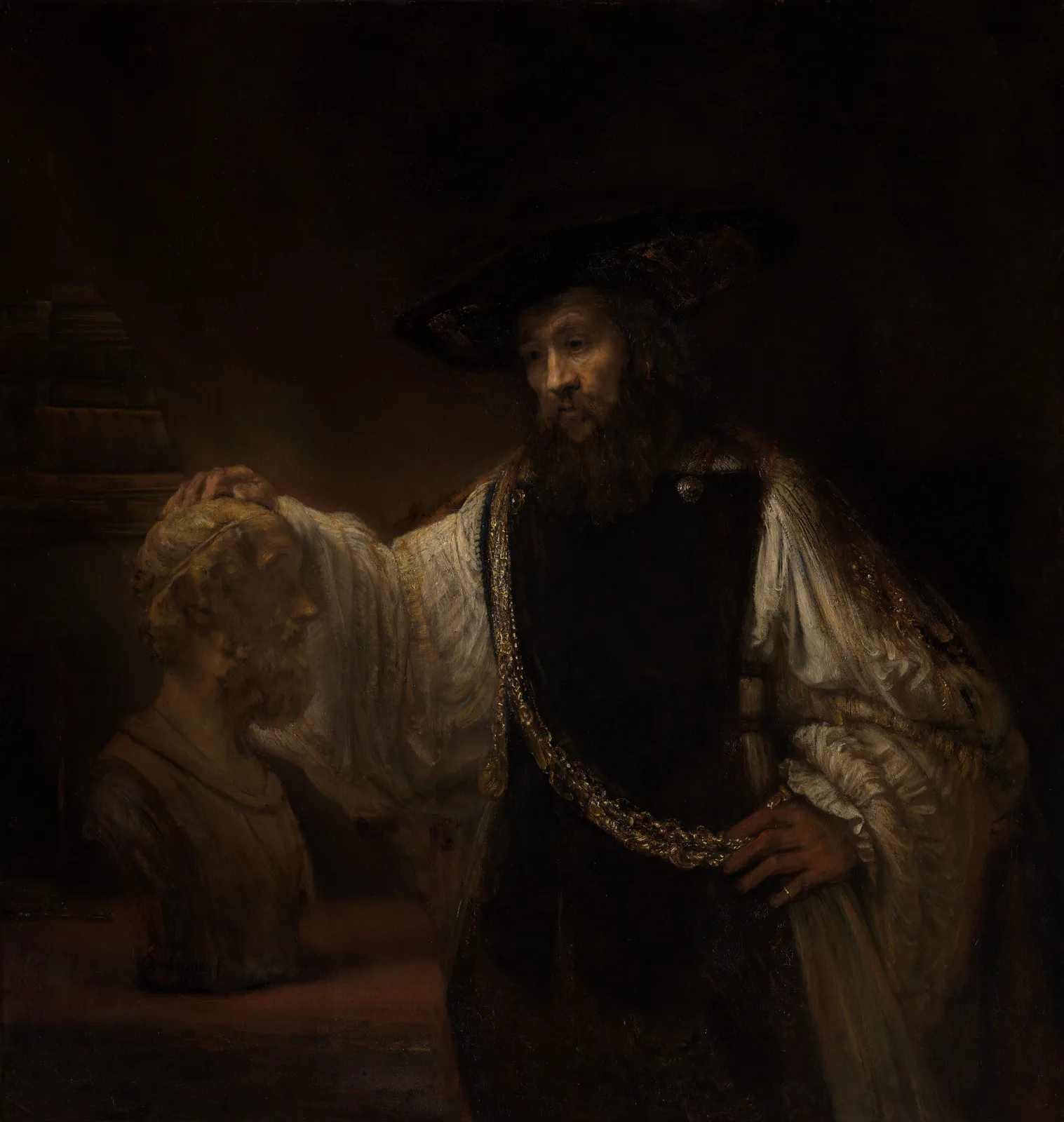
The upper half of the picture is almost black, with values around 5, and on the left a shape that reads as a pile of books is faintly visible in the dark. Light enters from the upper left and falls in turn on the head of the bust, the hand resting on it and the white sleeve stretched towards it: 50 on the bust's head, 54 on the hand, 65 on the sleeve. Because the three touch, they make one bright band running diagonally from the left towards the middle. On the right is a second white sleeve (57).
Between the two bright masses runs the black tunic, a vertical band at 8. Across it a heavy gold chain runs diagonally from the shoulder to the left hand on the hip. The yellow paint on the chain sits in thick beads, giving a row of points as bright as the brightest spots on the sleeves (up to 195). The points are small, so they do not form a mass; they act as a bridge between the two sleeves.
On the face, light reaches only the nose and the left cheek (73 on the nose). The eyes sink into the shadow of the hat brim (31). In this picture the widest light falls not on the face but on the bust and the sleeves. The Met cites Julius Held's reading: Aristotle is weighing the values he admired in Homer against the wealth and worldly honour embodied by the gold chain and medallion. The observation that the light touches the bust and the chain fits that reading well, but the picture alone cannot tell us whether Rembrandt meant it.
Self-Portrait, 1660: a picture that keeps only the face
According to The Met, roughly forty self-portraits by Rembrandt survive. This one dates from 1660; that summer he turned fifty-four.
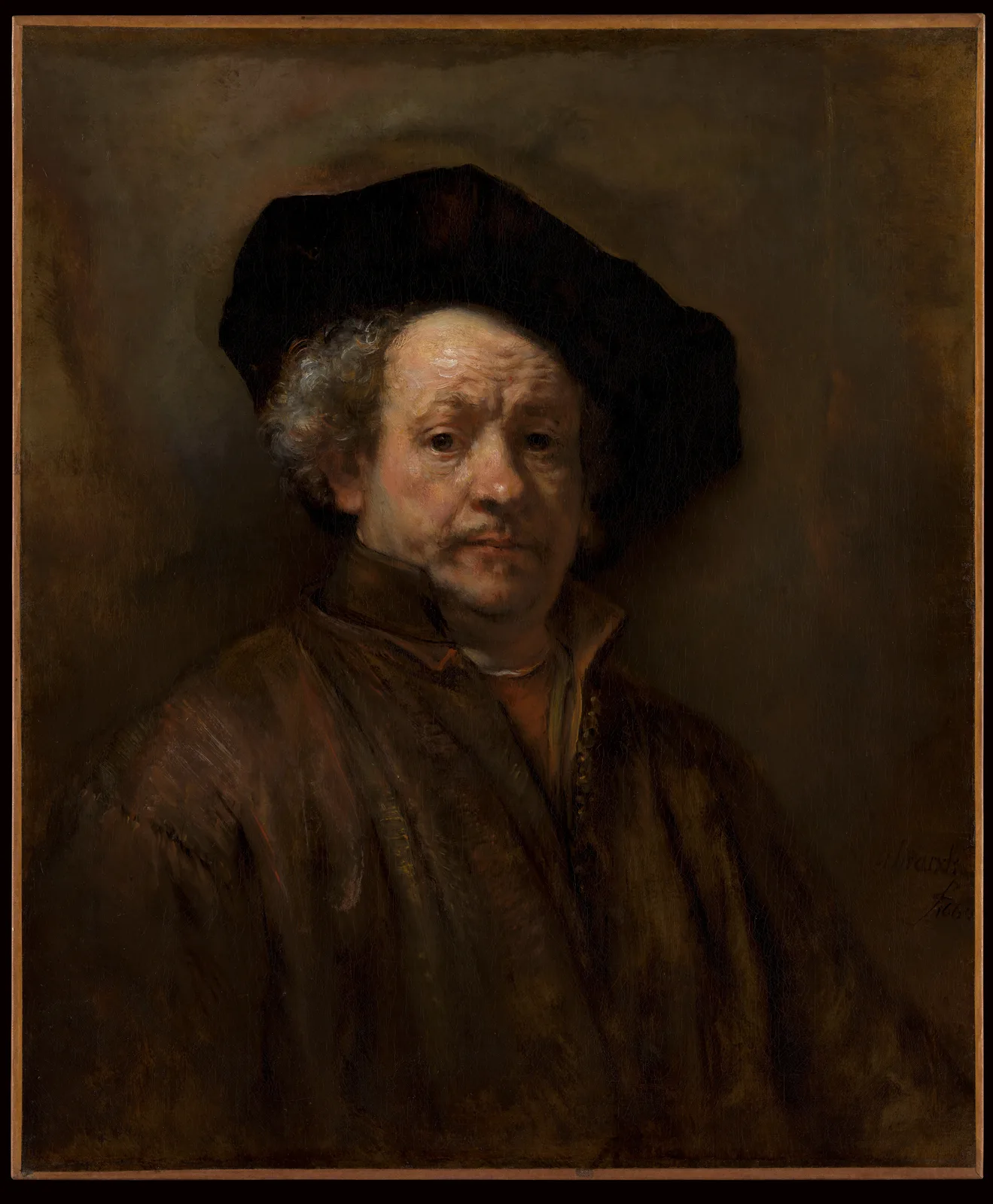
Here the light is almost entirely on the face. The forehead is brightest at 140, the left cheek 103. The black beret is 7, the lower coat 17, the background 33 to 47. In the photograph the paint can be seen standing up thickly on the forehead and the tip of the nose. The Met explains that Rembrandt built up the paint in high relief for the furrowed brow and the heavy pouches under the eyes. Light also catches the grey curls on the left, scratched with thin lines that The Met says he made by turning the brush round and incising with its butt end. Neither the coat nor the red waistcoat at the chest is bright enough to compete with the face.
There is a caveat. The Met's catalogue entry says the hat now looks flat because that area has darkened naturally over time, and the brown paint of the coat shows signs of heavy overcleaning. Originally the bust and hat would have had a stronger sense of volume, with a consistent fall of light from the upper left across the body. The "only the face is left" contrast we see now may be stronger than the one Rembrandt first made.
Man with a Magnifying Glass, early 1660s: the light reaches down to the hand
The Met says this man is most likely the Amsterdam auctioneer Pieter Haringh, who may have used the magnifying glass in his hand to evaluate paintings and other luxury goods.
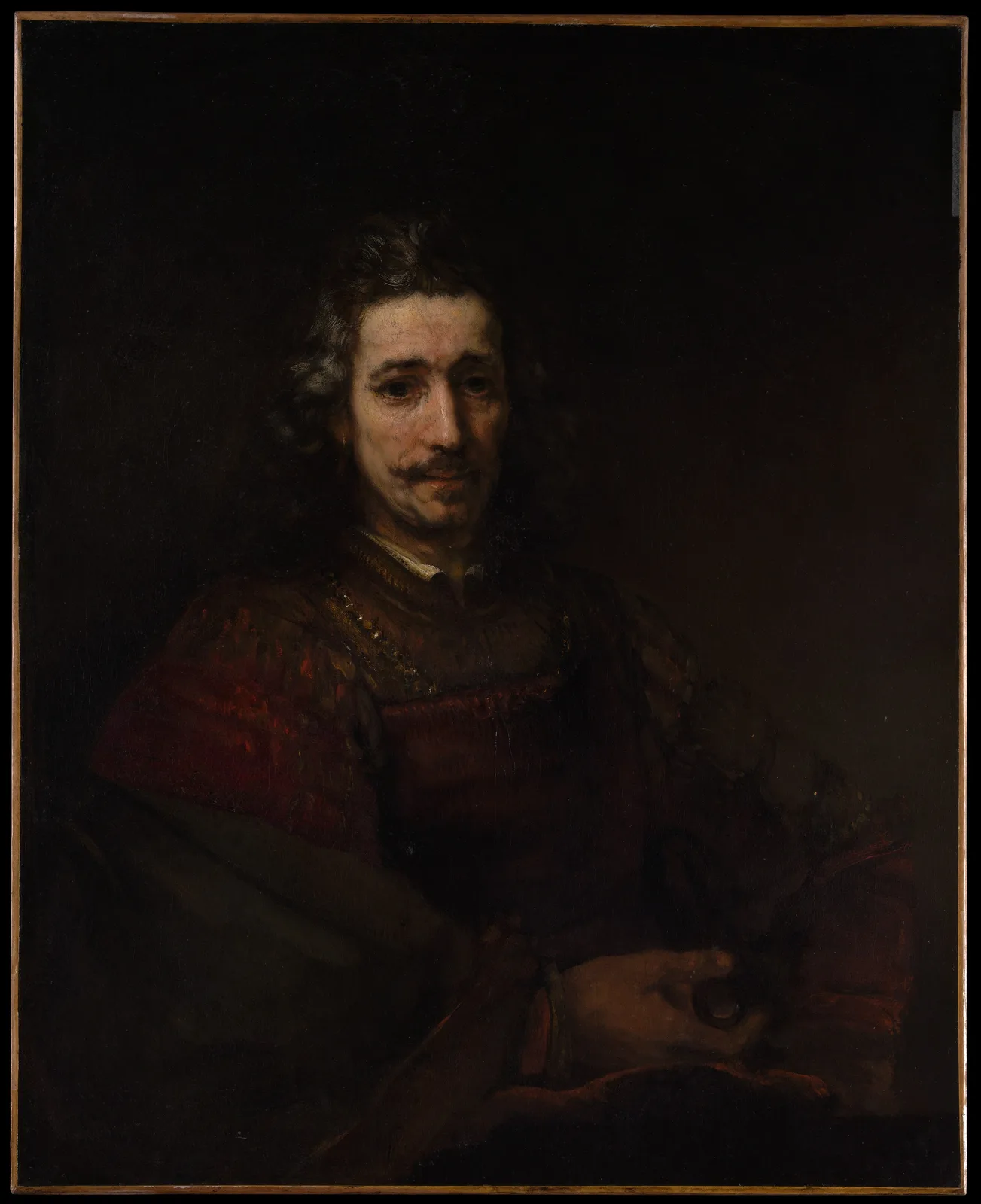
The face is brightest: 96 on the forehead, 93 on the cheek. The background is dark, at 8 to 19. In this picture the light steps down once more from the face. At lower right, the hand holding a round magnifying glass is the second bright place, though at 33 it is only about a third as bright as the face. The red garment in between (19 to 22) and the grey-green cloth at lower left belong to the dark. Small glints show on the gold chain at the chest (up to 203), but they cover too little area to form a mass.
So the light in this picture comes down to one large mass and one small one: the face, and the hand and tool that hint at who this man was. Everything else withdraws into the dark.
De Piles's bunch of grapes: lights with lights, shadows with shadows
What repeats in the four pictures is the same move: bright things are joined to bright things, and dark things are bound to dark things. The French art theorist Roger de Piles (1635–1709) put this principle into words. In 1708, thirty-nine years after Rembrandt's death, he published Cours de peinture par principes (A Course of Painting by Principles) in Paris.
In the book's chapter on chiaroscuro, de Piles separates two things. One is how light and shadow fall on each single object, which can be learned from books on perspective and which the painter has to obey. The other is clair-obscur, the art of distributing lights and shadows to advantage across the whole picture, which he says depends entirely on the painter's imagination.
His first means to it is the arrangement of objects. Objects are placed so that their lit parts come together on one side and their dark parts are bound together on another, so that the eye is not dispersed. De Piles reports that Titian called this the bunch of grapes. Separate the grapes and each has its own light and shadow, dividing the eye in many directions. Gather them into one bunch and they make one mass of light and one mass of shadow, so that, in his words, "the eyes take them in as a single object" (les yeux les embrassent comme un seul objet). He adds that the comparison should not be taken literally; it means only the joining of lights and the joining of shadows.
Doomer's ruff is exactly such a bunch of grapes. Every pleat has light and shadow, but joined to the face it reads as one mass. Aristotle's bust, hand and sleeve also touch one another and become a single bunch.
De Piles also writes that colour can build masses. What he calls dark includes not only shadows but colours that are naturally brown and stay dark even under light. He gives a deep velvet and a brown cloth as examples, and says such things can be grouped with the shadows of other objects. Rembrandt's black hats and tunic and his brown coats sit in that place. The crown of Aristotle's hat has the same value as the darkness behind it (about 6), so its outline shows only through flecks of gold, and Doomer's coat reaches a brightness of only 33 even on the shoulder that faces the light.
Where this way of painting stood in seventeenth-century Amsterdam
The Met's essay on Rembrandt's paintings says his frequently theatrical style of the 1630s gave way in the 1640s to a more contemplative manner, of which the Aristotle is a mature example. The Met also explains that the Aristotle was painted at a moment when Rembrandt's style, with its dark palette and heavily built-up paint, was beginning to fall out of fashion in Amsterdam. Of the four pictures, only the 1640 Doomer is smoothly painted on a wood panel; the later three are on canvas and show their brushstrokes.
About half a century later, de Piles saw exactly this chiaroscuro in Rembrandt. Early in the book he tells a story. Rembrandt, for amusement, painted a portrait of his maidservant and set it in a window, and passers-by only realised the trick some days later. In his account the effect came not from the beauty of the drawing or the nobility of the expression but from colour and chiaroscuro, and he says he saw the portrait in Holland and bought it. The story cannot be verified, but it shows clearly what one theorist of the early eighteenth century valued in Rembrandt.
In front of the next portrait
In front of a Rembrandt portrait, first find the single brightest mass. If you narrow your eyes, the details fade and only the masses remain, which makes this easier. Next, note what that mass contains: for Doomer the face and the ruff; for Aristotle the bust, the hand and the sleeve; for the 1660 Self-Portrait the face; for the man with the magnifying glass the face and the hand. Finally, list what has been allowed to sink into the dark: the hat, the coat, the background and, in Aristotle's case, even the eyes. If you can say in one sentence what is inside the bright mass and what has been left out, that sentence is where your next look at the picture can start.
Add your perspective.
Share a question, another approach, or something you have tried.
Checking sign-in…
Loading comments…