Say Monet and most people picture water lilies dissolving into haze. But Monet did not blur the edges of things from the start. In 1864 he set the edge of every petal firmly in place. When, and where, did those edges begin to loosen?
This note sets four paintings by Monet, released as CC0 by the Cleveland Museum of Art, in date order and follows the edges where things meet their surroundings in each one. Afterwards, in front of an Impressionist picture, you will be able to compare the edges of the nearest and the farthest thing and work out for yourself how far away the painter meant you to stand.
Claude Monet (1840–1926) was born in Paris and died in Giverny. The four works are a still life of 1864, a winter at his house in Argenteuil from around 1870, the Normandy coast in 1882, and water lilies from the pond at Giverny in his last years.
One yardstick: Riegl's near view and distant view
In "Late Roman Art Industry", published in 1901, the Viennese art historian Alois Riegl (1858–1905) described the course of ancient art as a change in viewing distance. Egyptian relief was made for a near view, one that reads things almost as a hand feels them: forms stand out from a flat ground with sharp outlines, and there is hardly any space. Greek art sat in between, seen from a normal distance, and let in some shadow and depth. By late Roman art the distant view leads, and things merge with the space around them as patches of light and shadow. Riegl first called the former mode "tactile" and later preferred the word "haptic"; the latter he called "optic".
Riegl was writing about ancient art, and he died before Monet painted his late water lilies. Here his pair of terms is borrowed only as a ruler for measuring pictures. The question is simple: does this picture make you see things as if touching them with a fingertip, or from a few steps back, through light alone?
1864: every petal has an edge
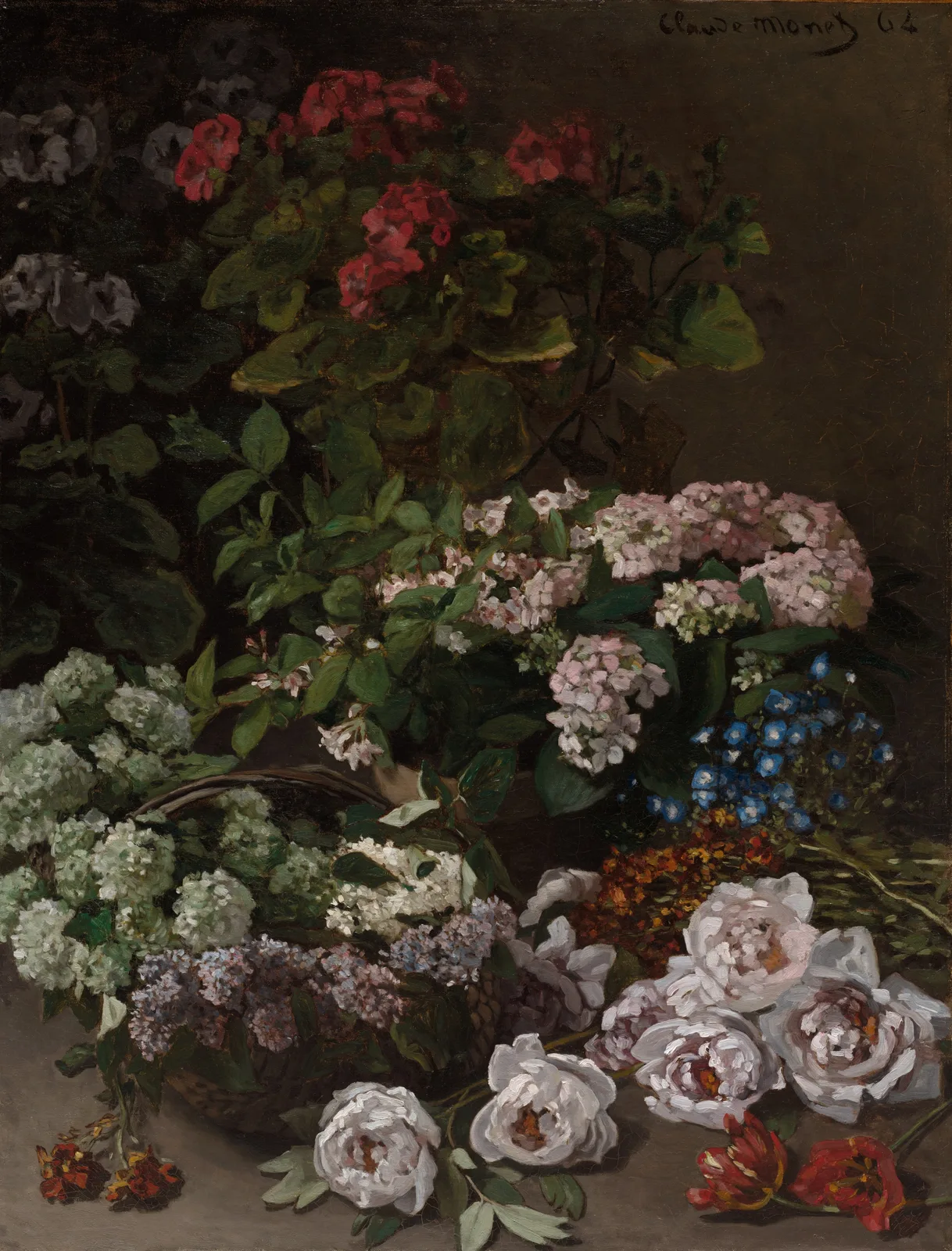
The Cleveland Museum of Art presents this still life as a work from the first productive year of Monet's career. Against a dark background, peonies in full bloom, potted hydrangeas and a basket of lilacs spill downward and outward from the geraniums at the back. In the upper right corner are a signature and the year 64.
Look closely at the white peonies in front. One petal is one thick stroke. A brush loaded with white paint bends with the curve of the petal, and where the brush stops, the petal ends. The outline of each flower is clear as well. A dark shadow lies on the table beneath the peonies, drawing an unbroken boundary between white flower and brown table. The leaves each have their contour, and the basket of lilacs shows the weave of its strands one by one.
The brushwork is already lively, but all of it is spent inside things, modelling them. In Riegl's terms this is still a picture for the near view. The eye feels its way from petal to petal, and the dark background serves as a flat ground that makes those edges stand out.
Around 1870: sharp inside, loose outside
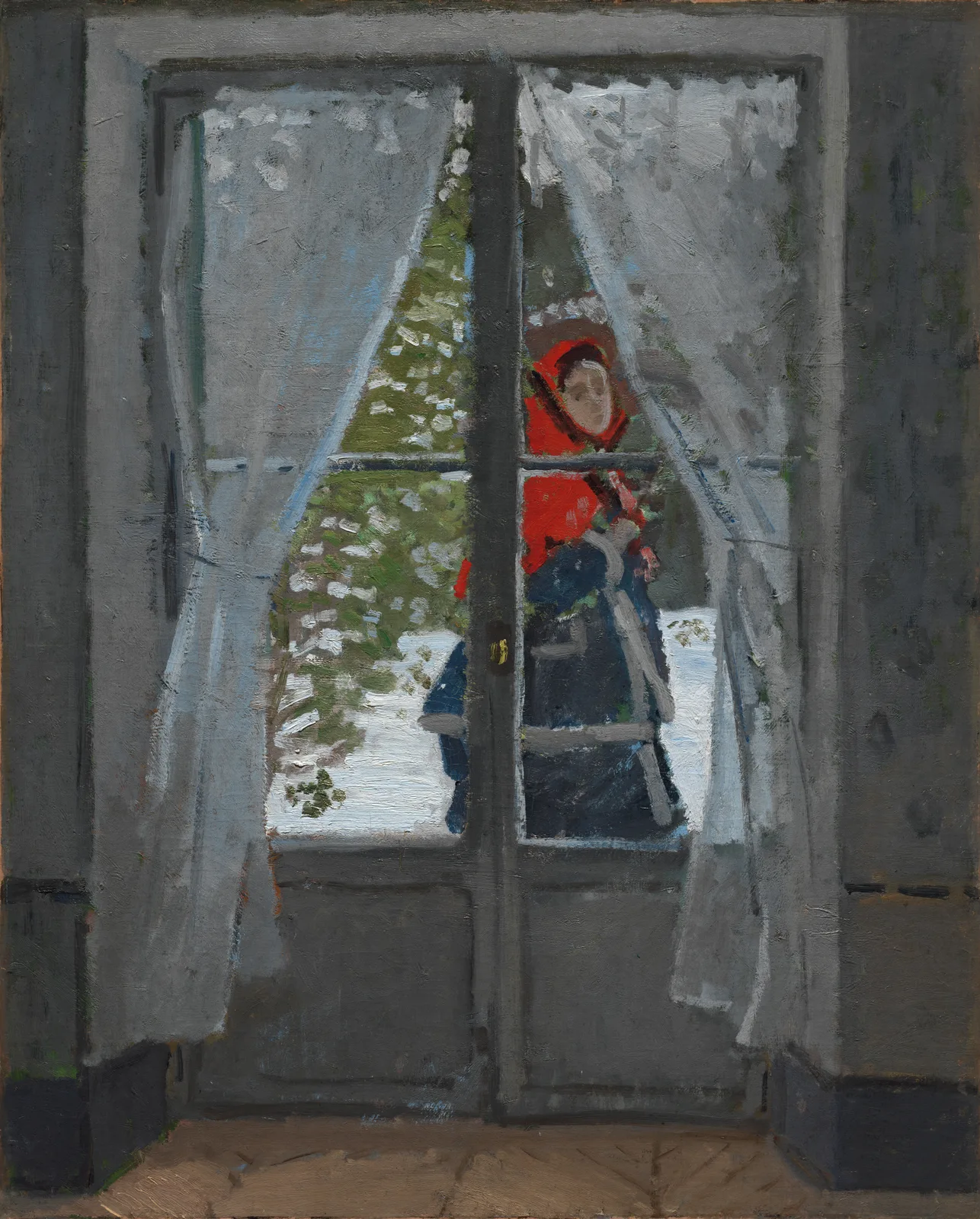
According to the Cleveland Museum of Art, this is Monet's first wife, Camille, passing the glazed doors of their house at Argenteuil on a snowy day. Monet is said to have kept the painting with him all his life.
The picture holds two distances. The near one is the room. The vertical and horizontal bars of the dark door frame, the grey walls and the rectangular lower panels of the doors have straight, definite edges. The white curtains pulled to either side follow their folds in long downward strokes. The far one is beyond the glass. The tree is a patch of white dabbed onto green, with no attempt to say whether the white is falling snow or snow lying on leaves. The snowy yard is a broad white plane.
What catches the eye most is Camille's face. Enlarged, it is a single flesh-coloured oval with a few dark dabs marking eyes and nose. The red hood is an area of red laid on in a few sweeps, with no line between hood and face. Because the door frame splits the picture vertically and passes just left of that face, the sharp black bar and the loosened face are seen side by side at a glance. The near is painted as edges you could touch, the far as patches of light. Riegl's two distances share one canvas.
1882: the cliff keeps its outline, and inside it is brushstrokes
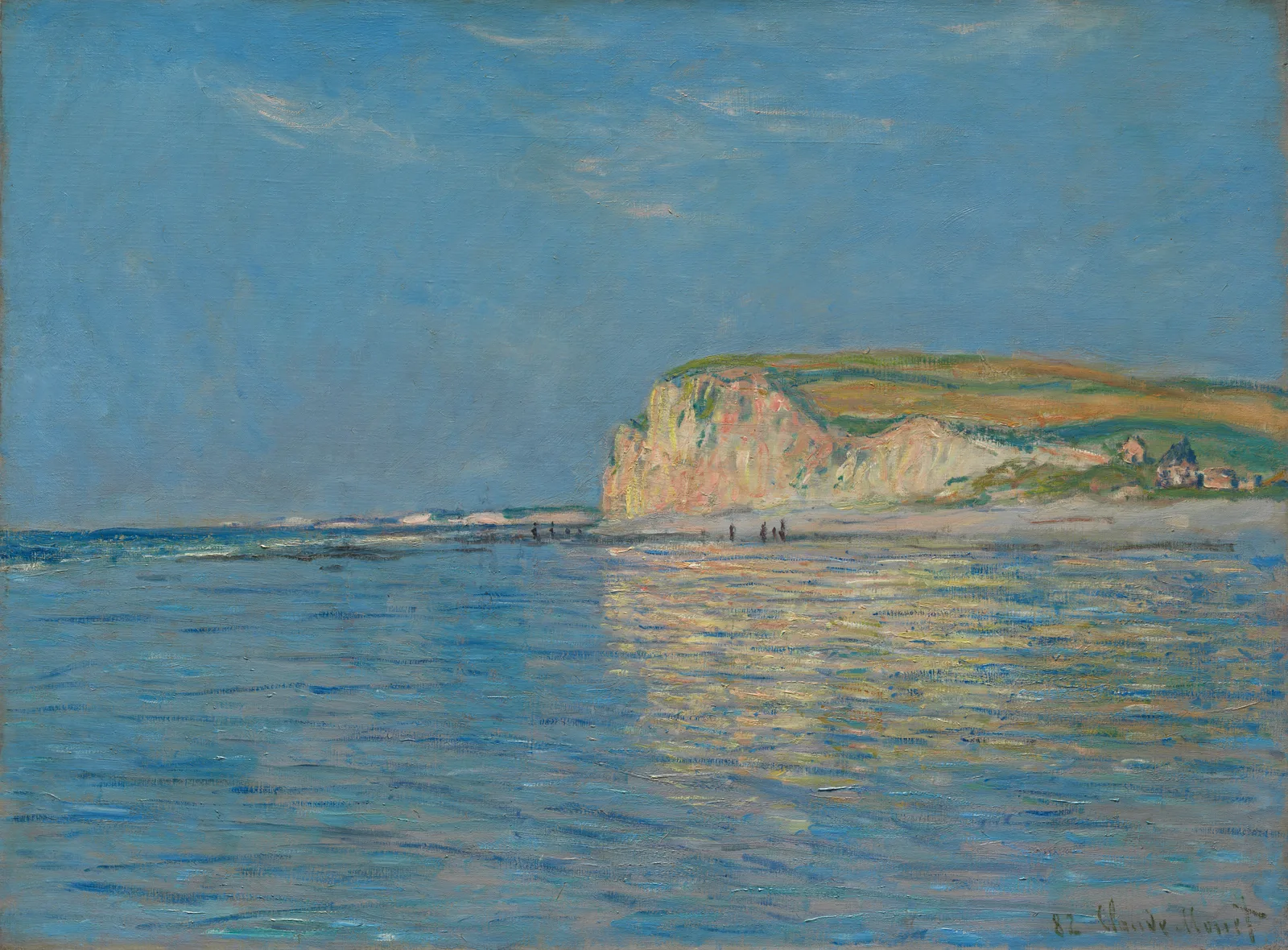
Pourville is a fishing village near Dieppe on the north coast of Normandy. The Cleveland Museum of Art explains that Monet stayed at a small hotel there in the spring of 1882 and painted several views. At lower right is the signature "82 Claude Monet".
The sky takes up more than half the picture, and on the left the horizon runs a little below the middle. Against the sky the cliff on the right still has a recognisable silhouette. Inside that silhouette, though, neither the grain of the rock nor its shadowed cracks are drawn. There are only short vertical strokes of pink, yellow and pale green standing side by side, and those stripes of colour become the surface of a chalk cliff in sunlight. The slope above it is the same stroke laid on its side.
At the water's edge below the cliff stand a few thin dark vertical strokes. The museum identifies them as bathers. One person is one touch of the brush, without head or arms. The water in front is covered with short horizontal strokes of blue, violet and yellow, with yellow and pink growing stronger only where the cliff is reflected. Here the reflection does not copy the cliff's shape upside down; the cliff's colour seeps in between horizontal strokes on the water. In the petals of 1864 the brush modelled things. Here the strokes come first, and things rise out of them only at a distance.
The last years: edges stop doing the work of edges
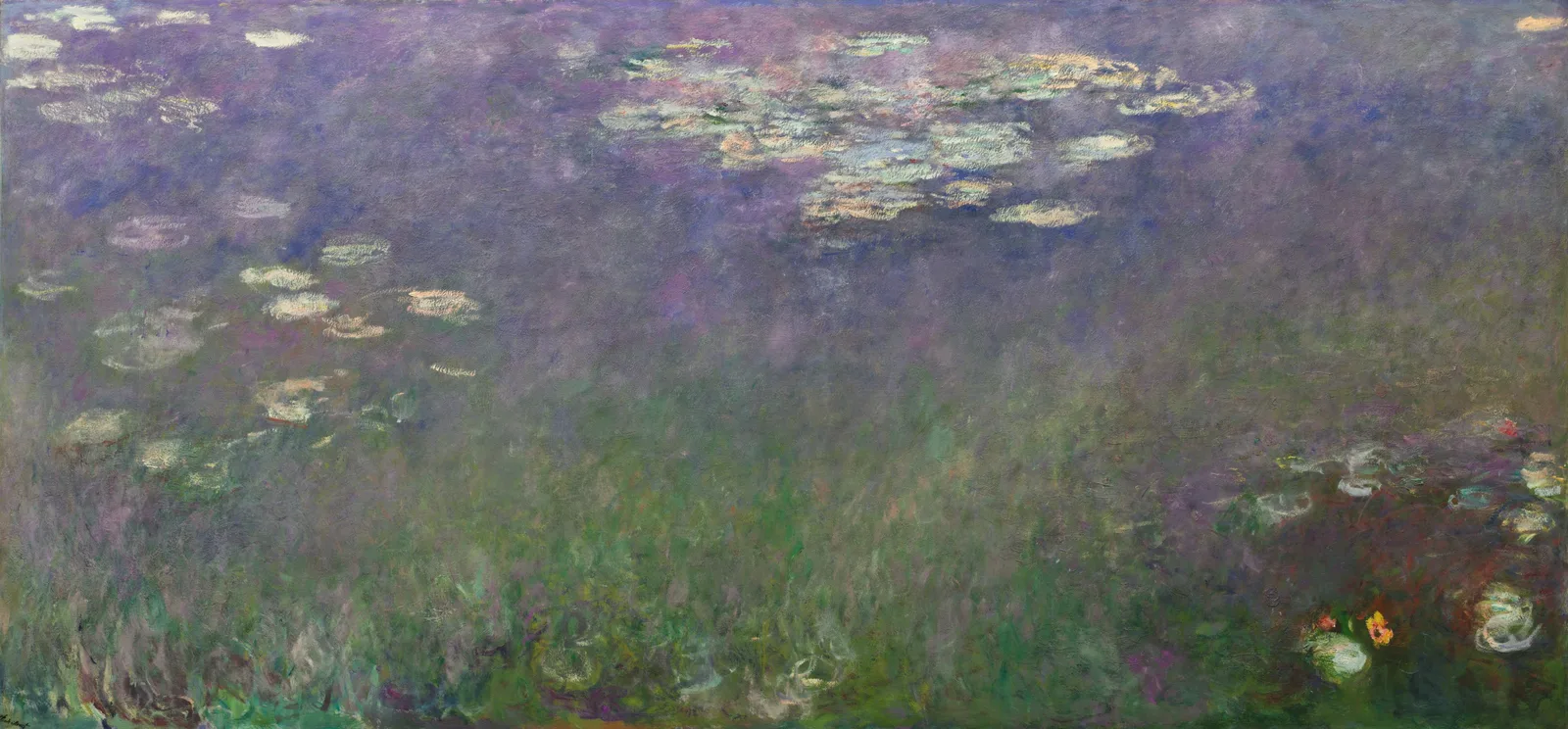
Monet spent the last 30 years of his life painting the garden he had laid out himself at Giverny. This Cleveland water lily painting is about 2 metres high and more than 4 metres wide. As the museum points out, the canvas has no horizon and no bank. What you see is a single surface of water.
The upper part mixes violet and pale blue and looks like water reflecting the sky; the lower part is deep green, with many strokes pulled downward. The lily pads are clusters of horizontal yellow-green strokes. Toward the top the clusters grow smaller and flatter, and on a canvas without a horizon this change of size is the only thing that tells you about depth.
Enlarge the lower right and something interesting appears. Some lily pads are round loops drawn in white. It looks as if the edge has come back, but the loops break off here and there, and in some of them the inside is no different from the water outside. In the peonies of 1864 an edge was a line dividing a thing from its ground. Here the loop divides nothing. It only marks that a pad is there; pad and water continue in the same strokes. A few pink and yellow flowers are the most definite forms left, and even they are small lumps of a few layered touches of paint.
In Riegl's terms this picture belongs entirely to the distant view. Yet there is something odd about it. At more than 4 metres wide, the canvas only fills your field of vision once you step close. Close up you see strokes rather than things; step back and they become a pond. Monet does not fix a viewing distance; he makes the viewer move back and forth between the two.
What to try in front of a painting
Followed through these four pictures, Monet's edges do not disappear all at once. First the edges of distant things loosen (Camille beyond the glass). Next the inside of things turns into brushstrokes and only the silhouette remains (the cliff at Pourville). Finally even the remaining edges stop dividing thing from ground (the white loops of the water lilies).
In front of another Impressionist painting you can do the same. Pick the nearest thing and the farthest thing on the canvas and compare their edges. See whether the near one ends in a line and the far one in a patch. Then take a step forward and a step back, and find the distance at which the brushstrokes turn into things. That distance is where the painter meant you to stand.
Add your perspective.
Share a question, another approach, or something you have tried.
Checking sign-in…
Loading comments…