Stand in front of a painting of a crowded street and count the people from the front row backwards. The first few have hats and coats, two legs and a shadow at their feet. A little further in, the legs go and only a body and a head remain. Further still, a head becomes a single dot, and at the end there is only a patch of colour that could be anything. The line where a person turns into a brushstroke sits in a different place in every picture.
This note looks for that line in four paintings by Camille Pissarro, from 1874 and from 1897–99. After these four you will be able to find the line in other crowd pictures yourself, and judge from it how high up and how far away the painter was looking.
Pissarro (1830–1903) was born in Charlotte Amalie on the Caribbean island of Saint Thomas and died in Paris. According to an essay by The Metropolitan Museum of Art in New York, he was the eldest of the Impressionists and the only artist who showed in all eight of their exhibitions, held between 1874 and 1886. All four works are released by The Met as public domain.
One yardstick: Ruskin's "innocence of the eye"
In a footnote to the first letter of The Elements of Drawing, a beginner's guide published in 1857, the English critic John Ruskin wrote that all we see is flat colour. That a dark stain is the shadowed side of a solid thing, or that a faint hue means distance, we learn by experience. The whole technical power of painting, he said, depends on recovering "the innocence of the eye": seeing stains of colour as stains, without knowing what they signify, as someone suddenly given sight would see them.
Used as a yardstick, this raises a question. How far does the painter paint what he knows, "there is a person there", and where does he start painting only the stain he sees? Let's find that place in Pissarro's four pictures in turn. The figure heights below are rough values measured on The Met's photographs and scaled to the canvas size.
A park where everyone is a person: The Public Garden at Pontoise
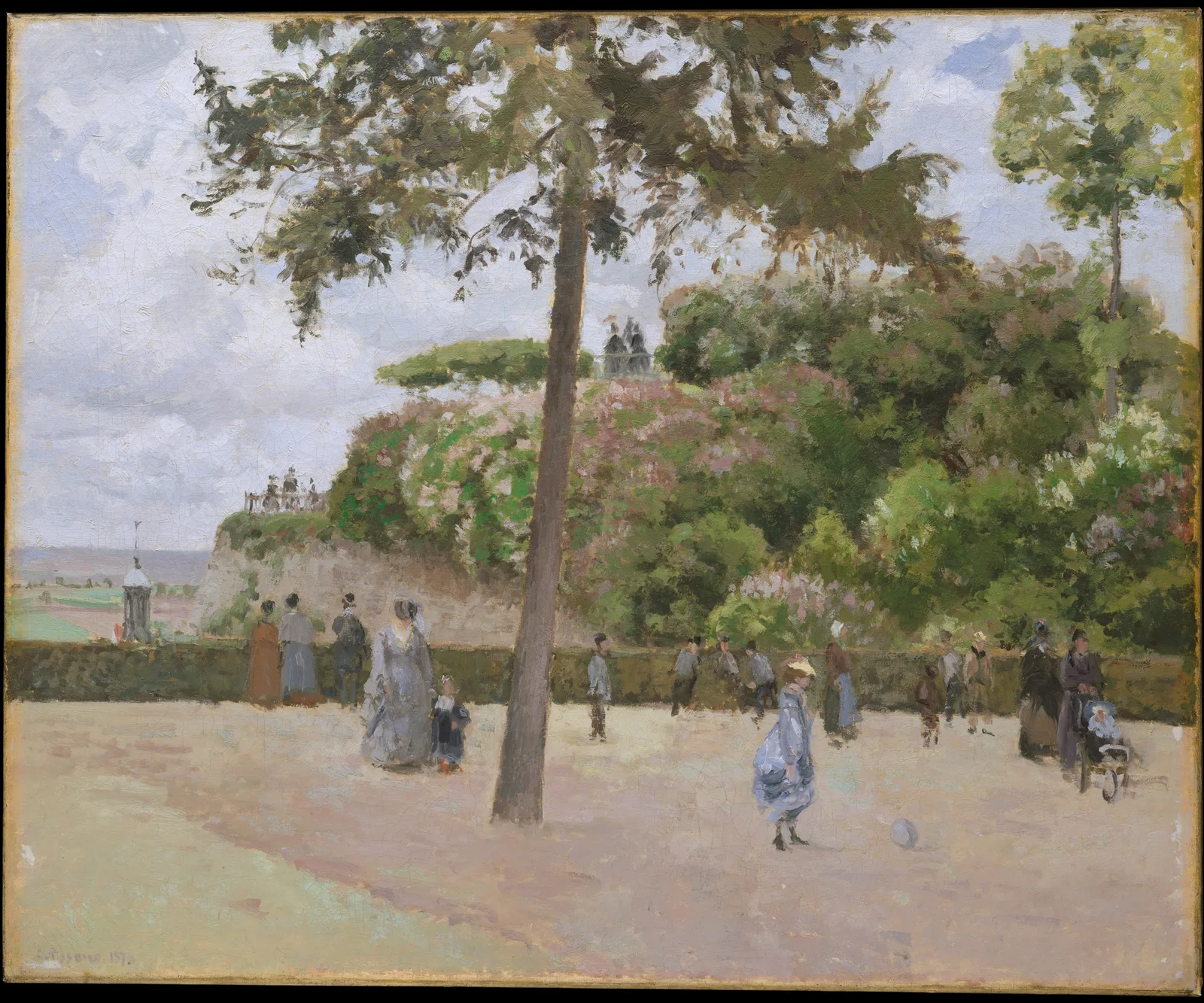
This is from 1874, the year of the first Impressionist exhibition. The Met notes that in the mid-1870s Pissarro mostly painted the fields and roads near Pontoise; here, unusually, he painted the town's public garden, its terraces and the well-dressed bourgeois and their children who came there. A view across the plain towards Paris opens at the far left beyond a spire, but Pissarro chose the terrace over the vista.
Take the people one by one. A woman in a grey dress stands beside a child in dark clothes. A child in light blue with a straw hat runs, the skirt billowing behind. On the right a woman pushes a pram with a baby in a white bonnet, and a ball lies on the ground in front of them. The largest figure is about 12 cm tall on the canvas. The faces have no eyes or mouths, but hats, sleeves, legs and shoes are all distinct.
The people further away are not very different. Those in front of the hedge are smaller, but each still has legs and a short shadow. The painter's eye is at about the height of a standing person's head, so the heads of near and far figures line up just above the top of the hedge. This picture has no line at all. Every person in it stays a person to the end.
The boulevard below the window: The Boulevard Montmartre on a Winter Morning
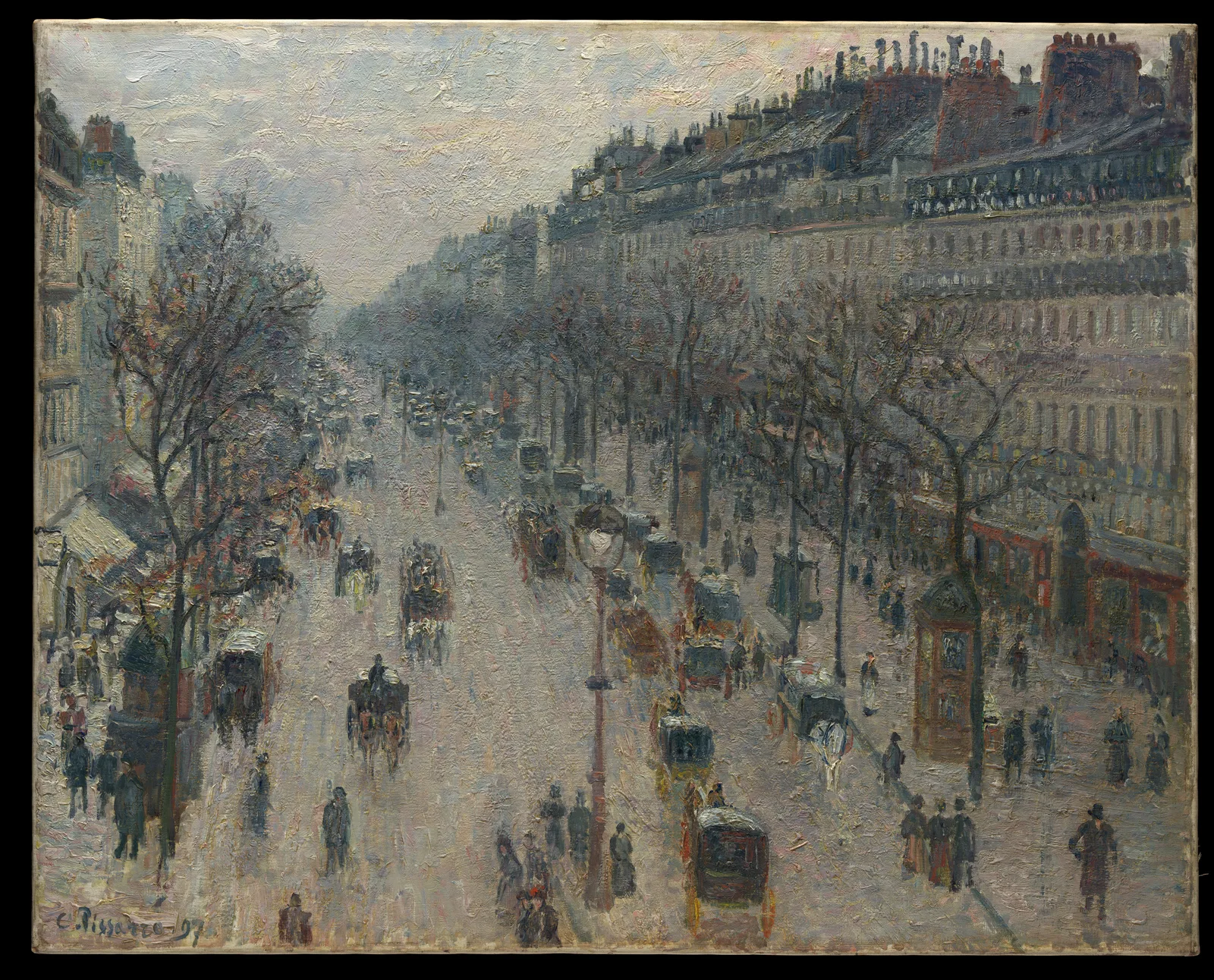
Twenty-three years later. According to The Met, early in 1897 Pissarro stayed at the Grand Hôtel de Russie in Paris and painted the boulevard from his window. He marvelled that he could see down the whole length of the boulevards, with an almost bird's-eye view of carriages, omnibuses and people between big trees and big houses. From February to April he painted fourteen views of the boulevard Montmartre from there, and two of the boulevard des Italiens to the right.
Count from the bottom. At lower right a man in a bowler hat and long coat walks alone. He is about 8 cm tall, much smaller than the child at Pontoise, but he still has two legs and a pale shadow. To his left three people stand close together; their bodies merge into a few dark and reddish vertical strokes. On the bottom edge one figure is cut off, leaving only head and shoulders. At lower left a carriage shows a driver in a tall hat and a brown horse.
About a third of the way up the picture, things change. Carriages become small dark boxes with light tops, and a person becomes a single dark vertical stroke. Higher still, carriages, people and tree trunks mix in the grey mist as the same kind of brushwork. The line is drawn about a third of the way up. Below it Pissarro painted people; above it, as Ruskin put it, he painted stains.
A market crowd: Rue de l'Epicerie, Rouen (Effect of Sunlight)
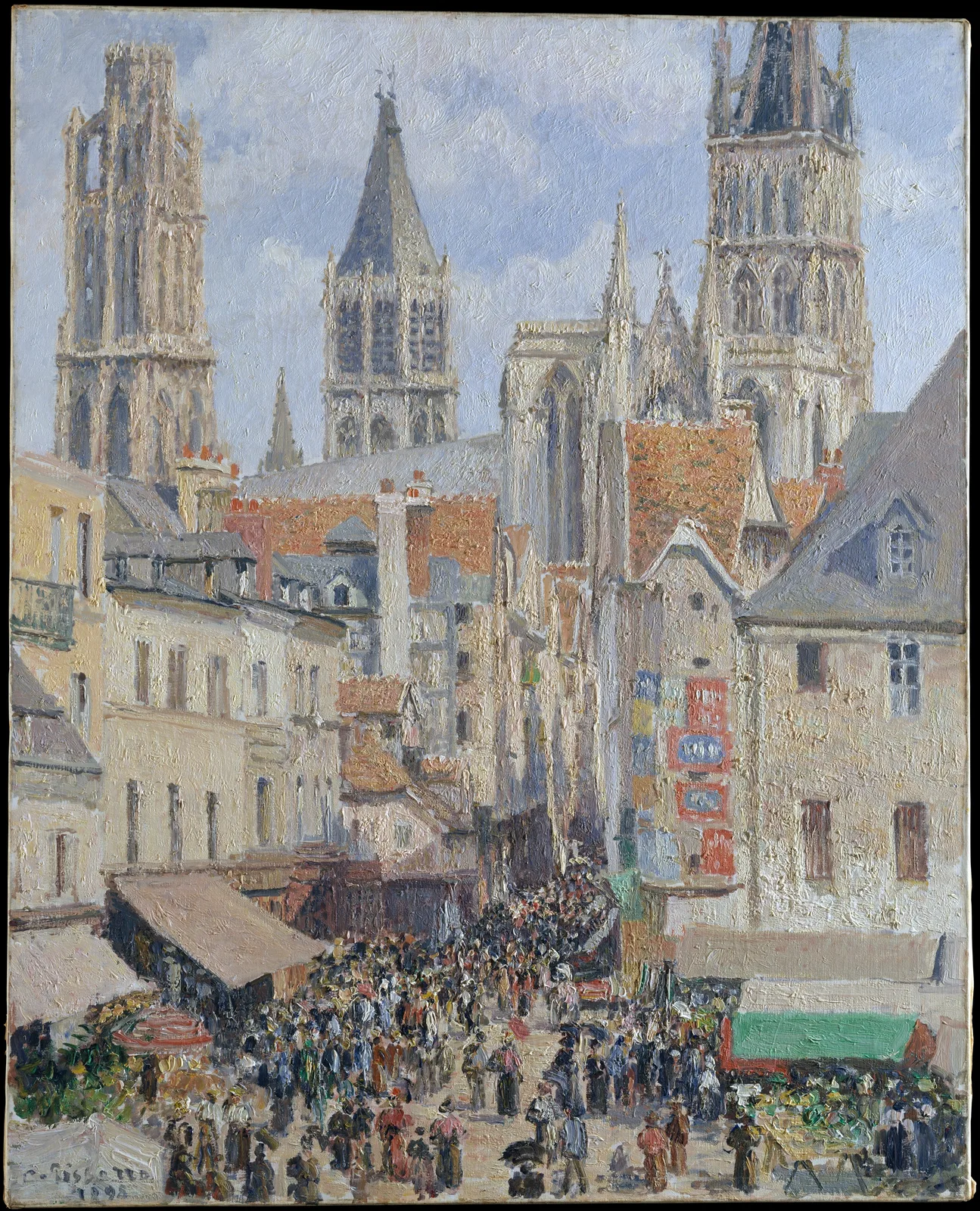
The next summer, on his fourth visit to Rouen, Pissarro wrote to his son Lucien on 19 August 1898 that he had found an excellent place from which to paint the rue de l'Epicerie and even the market held there every Friday. The Met says he painted the view three times, and this is the only one that shows the market in progress. The cathedral towers rise at the top.
Here the line comes lower. The front row of figures is about 6 cm tall. Seen from above, their bodies look foreshortened, but pink blouses, dark skirts and yellow straw hats are still told apart one by one. Two or three rows back, the bodies are gone. Short dots of yellow, white, red and black crowd together, and each dot is a hat or a head. At the far end, where the street narrows, the dots become one mass of colour squeezed between the walls.
The surface supports the difference. The wall of the house on the right is built up in thick, bumpy paint, with red and blue signs set on it as square patches of colour. The dots of the crowd sit on the same thick paint, so up close you see lumps of paint before you see people. Around 1886 Pissarro had taken up the dot technique of Seurat and Signac, but the dots here vary in size and direction and are unlike the even dots of that method.
When the line reaches the bottom edge: The Garden of the Tuileries on a Winter Afternoon
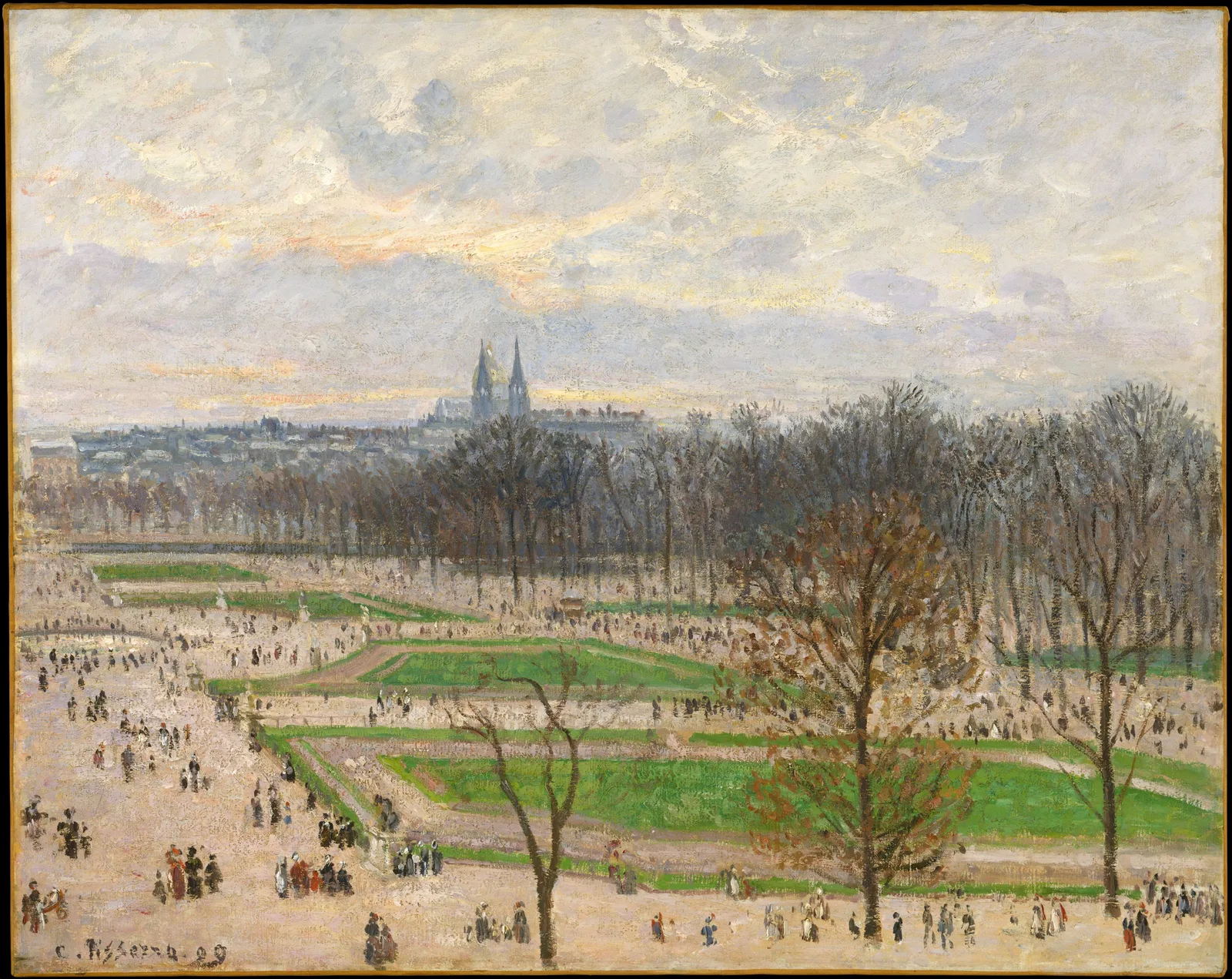
In December 1898 Pissarro wrote that he had taken an apartment at 204 rue de Rivoli, opposite the Tuileries, with a superb view of the garden. According to The Met, over the following winter and spring he painted eight views towards the Louvre from there, and six of the Tuileries Gardens with the spires of Sainte-Clotilde in the background, like this one.
In this picture even the front row is small. A figure close to the bottom edge is about 4 cm tall, and hardly anyone has separate legs. A dark vertical stroke with a light dot on top, sometimes one more red or white dot: that is all. These strokes gather in twos, threes and fours on the pink sand paths, and towards the trees in the distance they shorten into small flecks of sand colour. The lawns lie flat like a plan, green trapezoids and bands. The line has come all the way down to the bottom edge.
And still we read these marks as people. Turn Ruskin's footnote around and the reason is plain. He said that recognising things in stains is something we learn by experience. Pissarro painted only stains; turning them back into people is left to the viewer's experience, helped by the width of the paths, the size of the trees and the way the strokes move in small groups. The Met's audio guide describes Pissarro's Tuileries pictures as showing a continuing commitment to optical objectivity, which can be read as painting only as much as the eye saw.
What to try in front of another crowd picture
Put the four side by side and the direction is clear. At Pontoise in 1874 he looked from the height of a person's head, and everyone stayed a person. On the boulevard Montmartre in 1897 he looked down from a hotel window, and the line sat about a third of the way up. In Rouen in 1898 people turned into dots two or three rows back. In the Tuileries in 1899 the line came down to the bottom edge and almost everyone was a single stroke. The largest figure shrank too, to about 12, 8, 6 and 4 cm.
Next time you stand before a painting of a crowded street or square, find the last person whose legs you can see and draw an imaginary line under their feet. The lower that line sits in the picture, the higher and further the painter was looking. Then pick one stain above the line and look at what is really painted there. Usually it is not a person's shape but a single brushstroke, and what turned it into a person is your own eye.
Add your perspective.
Share a question, another approach, or something you have tried.
Checking sign-in…
Loading comments…