A white dress, heaped snow, marble in sunlight. It is easy to assume that the brightest places in a painting were painted with white. Yet enlarge a picture by John Singer Sargent and the white turns out to be mixed with violet and ochre, or to have nothing painted on it at all. So what is the white in a picture made of?
This note looks at four paintings by Sargent, released into the public domain by The Metropolitan Museum of Art, in the order they were made. The first two are oils, the last two watercolours. Afterwards, in front of any white place in a picture, you will be able to ask three questions yourself: what colours are mixed into that white, whether paint has been laid on top or the ground left bare underneath, and what the medium line of the museum record says.
John Singer Sargent (1856–1925) was born in Florence and died in London, and The Met classes him as an American painter. None of the four works here was commissioned. They are a sketch made as a diversion, a walk with family, and watercolours painted quickly while travelling.
Mannequin in the Snow: how many greys make white snow?
According to The Met, around 1891–93 Sargent was sharing a rented studio with his fellow painter Edwin Austin Abbey in Fairford, Gloucestershire, where both worked on mural commissions. One day, as a diversion, they set a mannequin in the snow and painted oil sketches of it from the studio window. As the critic Royal Cortissoz recalled, Abbey turned the mannequin into a lifelike medieval troubadour in a cloak and feathered hat (that painting has not been located), while Sargent painted the lifeless dummy that stood before him.
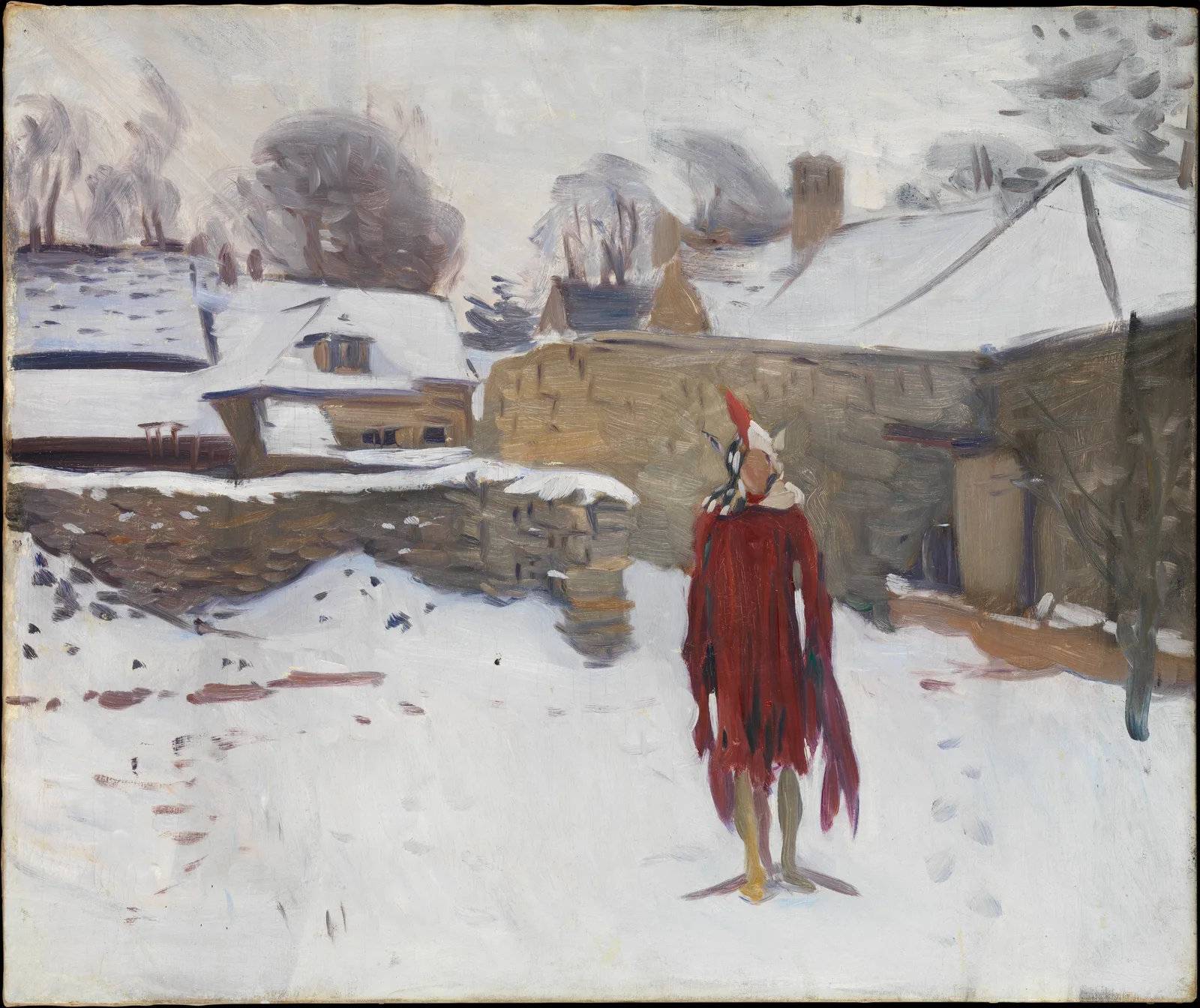
Nearly half the picture is snow. Yet this field of snow holds almost no pure white. The broad areas are painted in a grey with a tinge of violet, and the snow on the roofs and the sky are so close in value that the roof edges are separated only by a few dark lines. The whitest, thickest paint lies in a few short lines of snow on top of the stone wall at left. The footprints are short strokes of blue-black and wine-coloured brown, and as they recede they become a faint dotted line of grey-violet. The strongest colour in the picture is the mannequin's red cloak, and beside it the snow looks colder still. At the far left edge of the canvas a narrow strip of yellowish ground shows where the paint does not cover it, a reminder that this grey snow is painted on top of that ground.
Two Girls with Parasols: the colours inside a white skirt
According to The Met, from 1885 Sargent often visited Claude Monet at his home in Giverny, and over the next few years he painted Impressionist landscapes and figure subjects. He painted this picture in 1888 or 1889 at Calcot Mill in Berkshire, England; the figure in front is the artist's sister Violet, the one behind a friend on the walk. The Met records the canvas as unfinished.
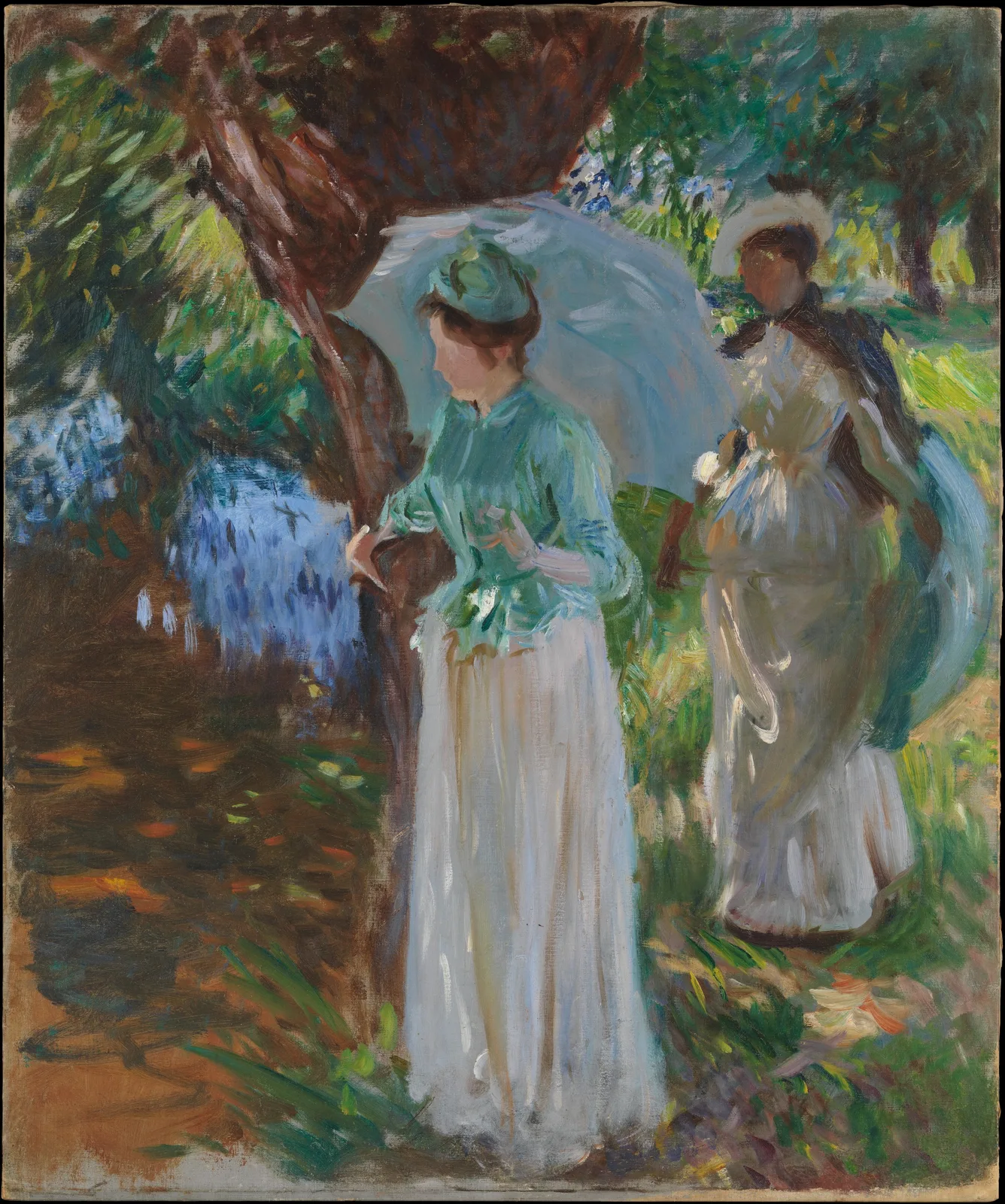
From a distance the front skirt is white. Enlarged, that white is made of many long vertical strokes drawn from top to bottom, and each stroke is a different colour. Where the folds turn, pale lilac-blue is mixed in, and between them streaks of ochre and brown run downwards: the same brown used for the tree trunk and the path at left. Near the hem, where the grass touches it, the white takes on a hint of green. The parasol is a pale surface of blue-grey mixed with green. The second figure's dress is in shade and much greyer than the first, with a single bright curved stroke laid over it as light. The same white clothing is painted as two different whites, one in light and one in shade. At the very bottom of the picture a band is left where no paint reaches, which matches the record of the canvas as unfinished.
Green Door, Santa Maria della Salute: columns of three kinds of white
According to The Met, around 1904 Sargent painted the Baroque church of Santa Maria della Salute in Venice several times. The best-known of these record architectural detail carefully, but this watercolour sets down the main portal quickly, almost in shorthand. It is one of the experimental works left in his studio when he died.
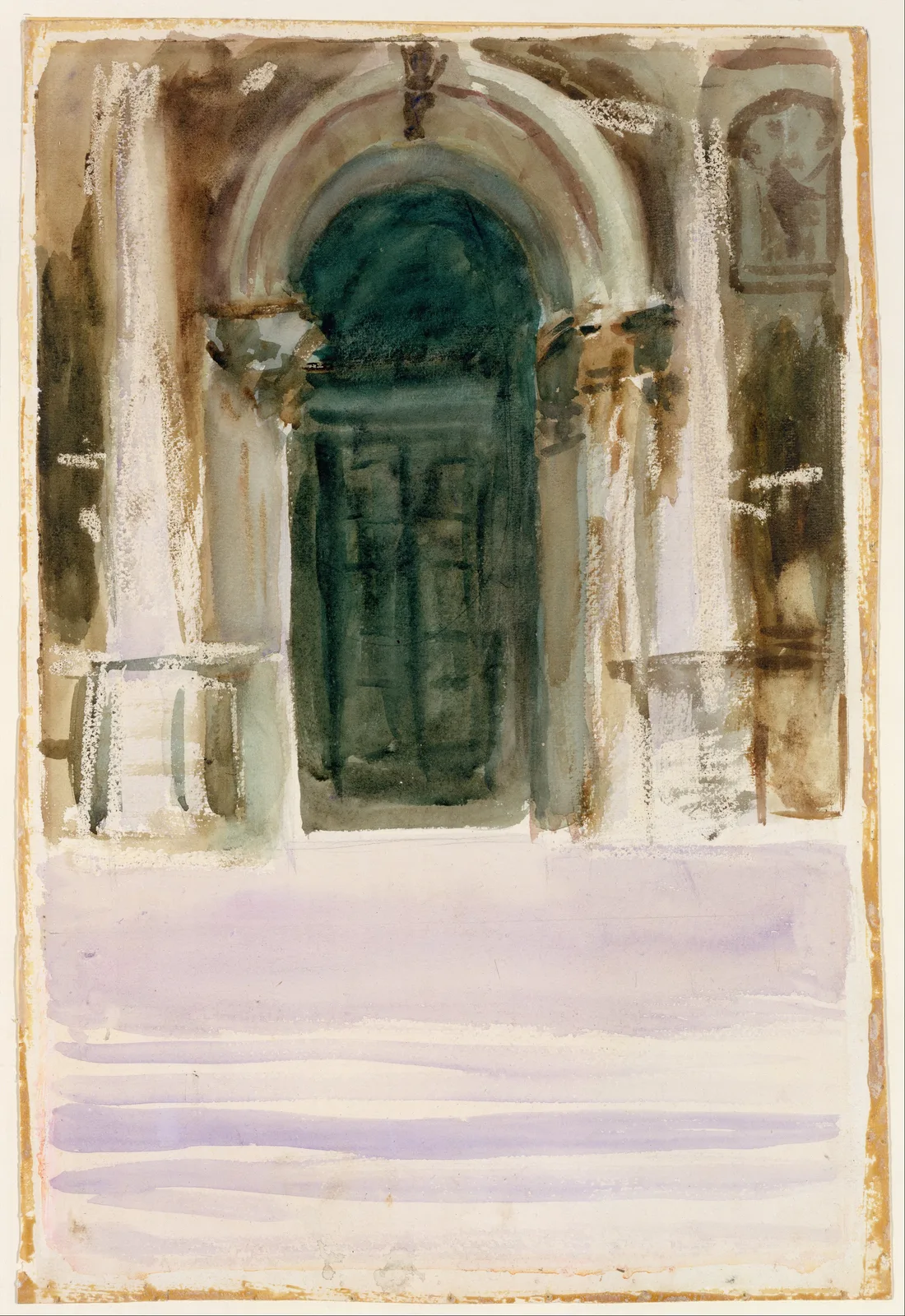
The dark green door in the middle weighs the picture down, and the columns on either side frame it in white. Enlarge a column and the white is not smooth. Where the brown wash has passed, grains of white are lodged here and there, crumbling along the texture of the paper. What this white is cannot be settled from the picture alone. The Met's medium line lists gouache and wax crayon as well as watercolour and graphite. So these grains of white may be paper the wash skipped over, places where the wash broke off over a crayon stroke, or opaque white gouache laid on top. The steps below are simpler. Several pale violet horizontal bands are drawn across, and the spaces between them are left unpainted. Those empty lines become the light catching the edges of the steps.
Spanish Midday, Aranjuez: white that was never painted
According to The Met, this watercolour shows the park in front of the palace at Aranjuez in Spain, recognisable by its distinctive marble benches. In a letter to a friend Sargent delighted in the gardens, with their cavernous avenues and long-neglected fountains and statues. The record gives the date as 1903, but the catalogue text in the same record says he visited about 1903 and again in 1912, and that this composition was probably painted in 1912.
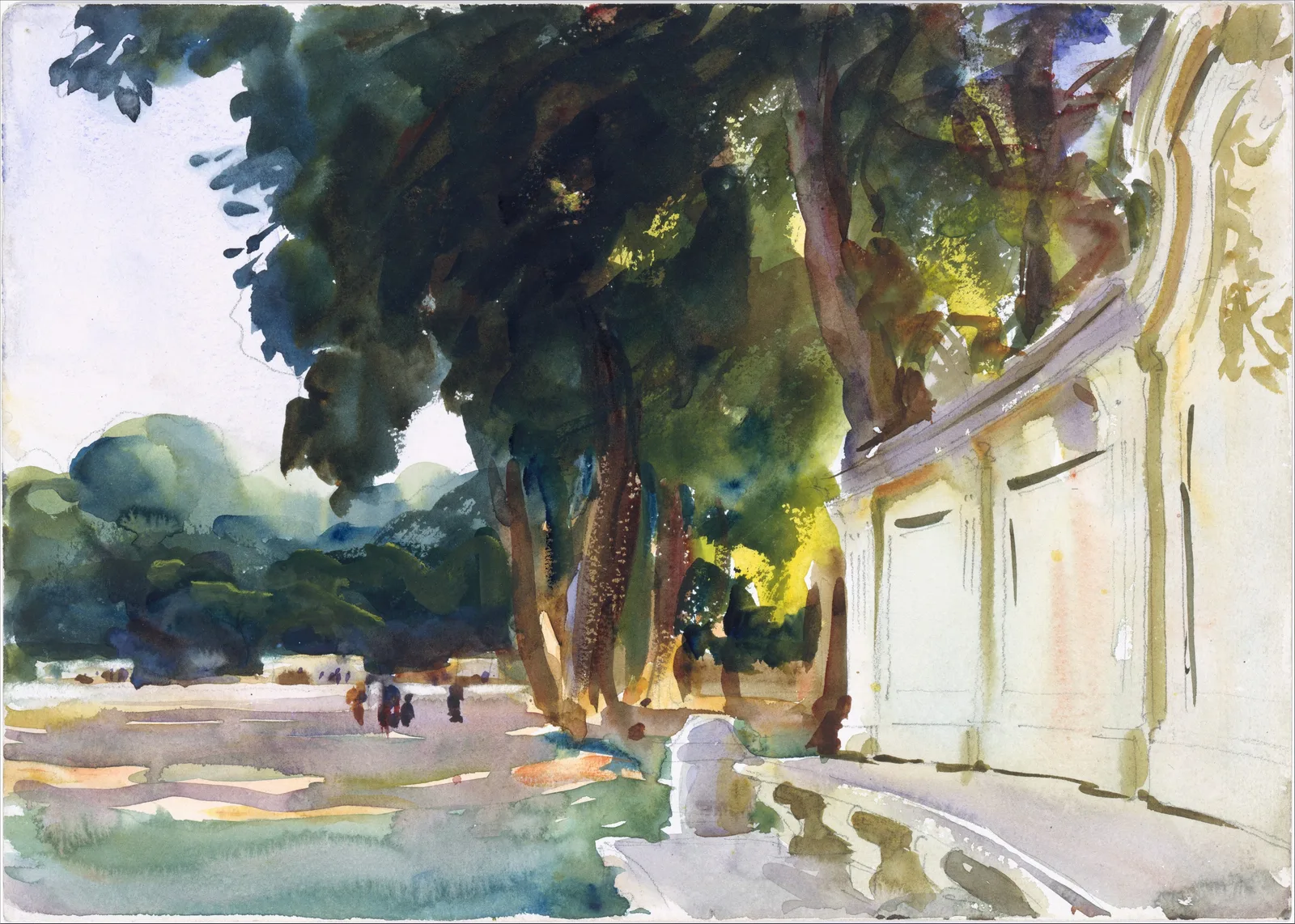
The bench, cut off at the right, recedes deep towards the centre, and dense green and yellowish foliage covers it from above. The medium line for this picture lists only watercolour and graphite. With no white gouache, the bright cream of the sunlit face of the bench is not a painted colour but the colour of the paper itself. Enlarged, fine pencil lines run across that empty surface to mark the edges of the panels, and only the shadows of the mouldings are laid in with pale grey-violet. On one panel an apricot tint has spread faintly downwards. The Met describes the bench in the same way: a few elements drawn in graphite, then pale washes for the shadows of moulding and ornament. Nothing was added to the light places. Only the shadows were painted, and the light was left.
Goethe's coloured shadows: a white surface takes the colour of the light
The observation that white itself takes on colour was written down before Sargent. In his Theory of Colours of 1810, Goethe set out two conditions for coloured shadows: that the principal light tinge the white surface with some hue, and that a contrary light illumine the cast shadow to some degree. He explained that white paper then acts as a reddish yellow, and that the complementary blue is excited in the eye. He also recalled descending the Brocken towards evening on a winter journey through the Harz. During the day the snow was yellowish and the shadows leaned towards violet; as the sun sank and the lit parts deepened to orange, the shadows became decidedly blue; and just before sunset, when a red light spread over everything, the shadows turned a green like emerald.
There is no record that Sargent read Goethe and painted this way because of it. Still, Goethe's distinction is useful for sorting the four pictures. In the two oils Sargent mixed the colour of the light and its surroundings into the white surface itself. The snow is a violet grey, and the brown of the path and the green of the grass have run into the white skirt. In the two watercolours it is the other way round: the paper stays as the lit white surface, and colour goes only into the shadows. The grey-violet shadows beside the warm paper and the pale violet steps come close to the arrangement Goethe saw in the snow, a yellowish lit surface and violet shadows. In oil, white is made by mixing; in watercolour, white is made by leaving. The same painter solved the same problem in two different ways with two materials.
Three questions to ask in front of a white
The next time you meet a white dress, snow or a white wall in a painting, first enlarge it or step close and name the colours mixed into that white one by one: violet, ochre, the colour of the thing next to it. Next, see whether the white has been laid on top and stands up thickly, or whether the ground underneath has been left bare. Finally, read the medium line of the museum record. If a watercolour lists no gouache or crayon, the brightest place is probably the paper. Once you have checked these three things, you can explain why the same white feels heavy in one picture and as light as light itself in another.
Add your perspective.
Share a question, another approach, or something you have tried.
Checking sign-in…
Loading comments…