You can recognize a Van Gogh from across a room. Short, thick brushstrokes cover the whole surface, and each one lies pointing somewhere. So what decided which way they point? The shape of the thing, the wind, or simply the habit of the painter's hand?
This note sets four works by Vincent van Gogh, released into the public domain by The Metropolitan Museum of Art, in the order 1887, 1888, 1889, and follows the direction and kind of their marks. Afterwards, standing in front of a Van Gogh, you will be able to pick one area, follow with your eye which way its strokes lie, and find for yourself that where the kind of stroke changes, one thing ends and another begins.
Vincent van Gogh (1853–1890) was born in Zundert in the Netherlands and died in Auvers-sur-Oise in France. His working life as an artist lasted barely a decade, from 1880 to 1890. These four works come from its last few years, in Paris, Arles and Saint-Rémy.
Paris, 1887: short touches that lie along the form
Van Gogh lived in Paris from February 1886 to February 1888. According to The Met, he saw Impressionist painting there at first hand and watched the Neo-Impressionists Georges Seurat and Paul Signac setting small touches of colour side by side. His palette lightened and his brushwork broke into short strokes. Self-Portrait with a Straw Hat, painted in the summer of 1887, shows that change. The canvas is the reverse of an earlier peasant study, The Potato Peeler of 1885, turned over and used again.
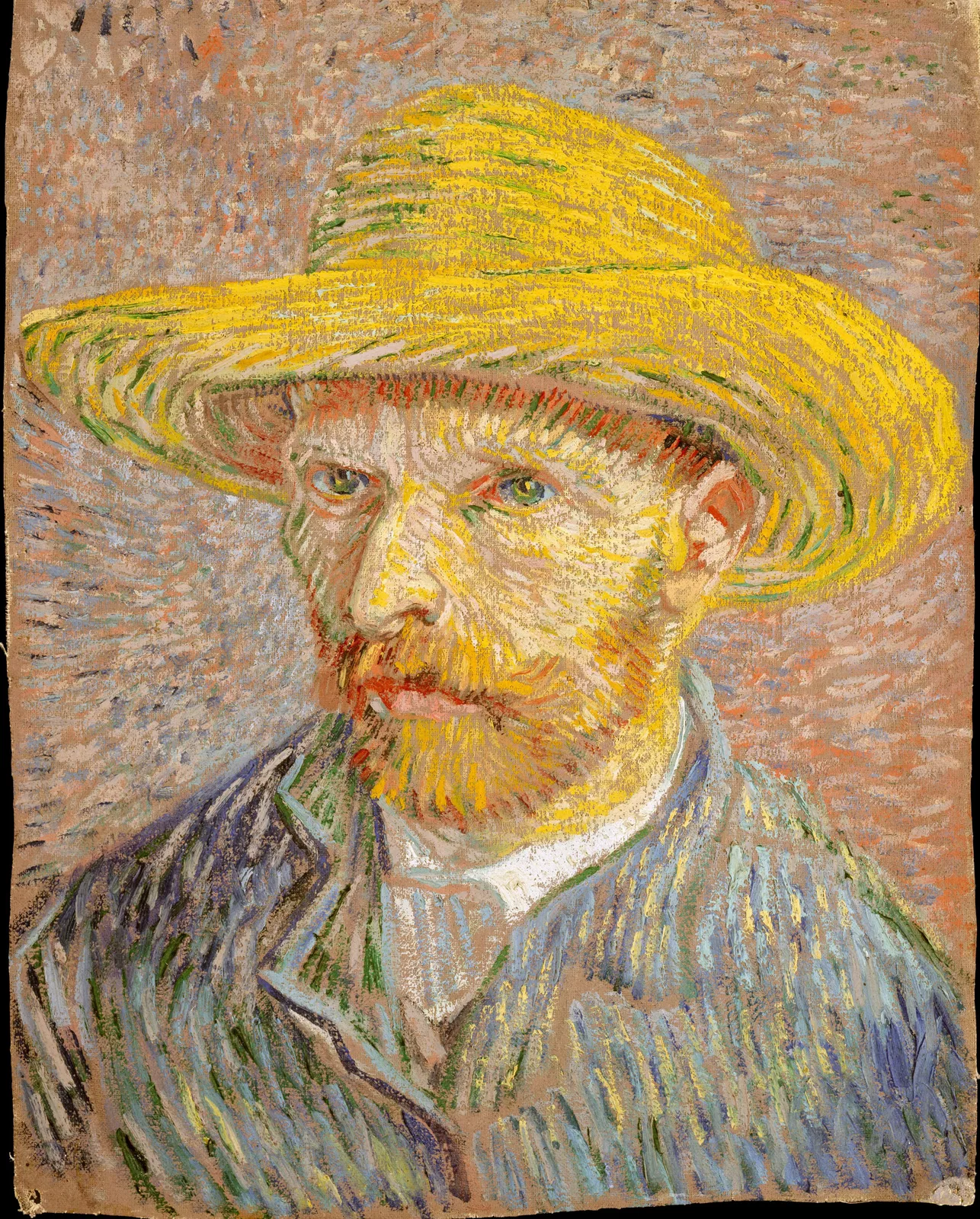
At first glance the short touches seem spread evenly over the whole picture. But they lie in a different direction in each part. On the brim of the hat, yellow strokes run sideways around its curve; in the beard, yellow and orange strokes fall downwards. On the jacket, long strokes of blue, green and yellow run diagonally down. Enlarge the face and the yellow, pink and green touches on the cheekbone bend with the round of the cheek.
The background is more interesting still. Over patches where the brown canvas shows bare, short touches of orange, blue-grey and pale pink are laid down loosely, and on either side of the head they tilt and seem to curve around it. The background has no shape, so there is no outline to follow. Yet the touches have a direction. In this picture the length of the touch is borrowed from Neo-Impressionism, but its direction is already Van Gogh's own.
Arles, 1888: dividing distance by marks alone, without colour
In February 1888 Van Gogh moved to Arles in the south of France. The Met describes the reed-pen drawings he made there as distinguished by their verve and linear invention, and indebted to the Japanese ukiyo-e prints he collected. Wheat Field, from July 1888, is one of them. It is drawn with a reed pen and logwood ink over graphite, and on screen today the ink looks brown.
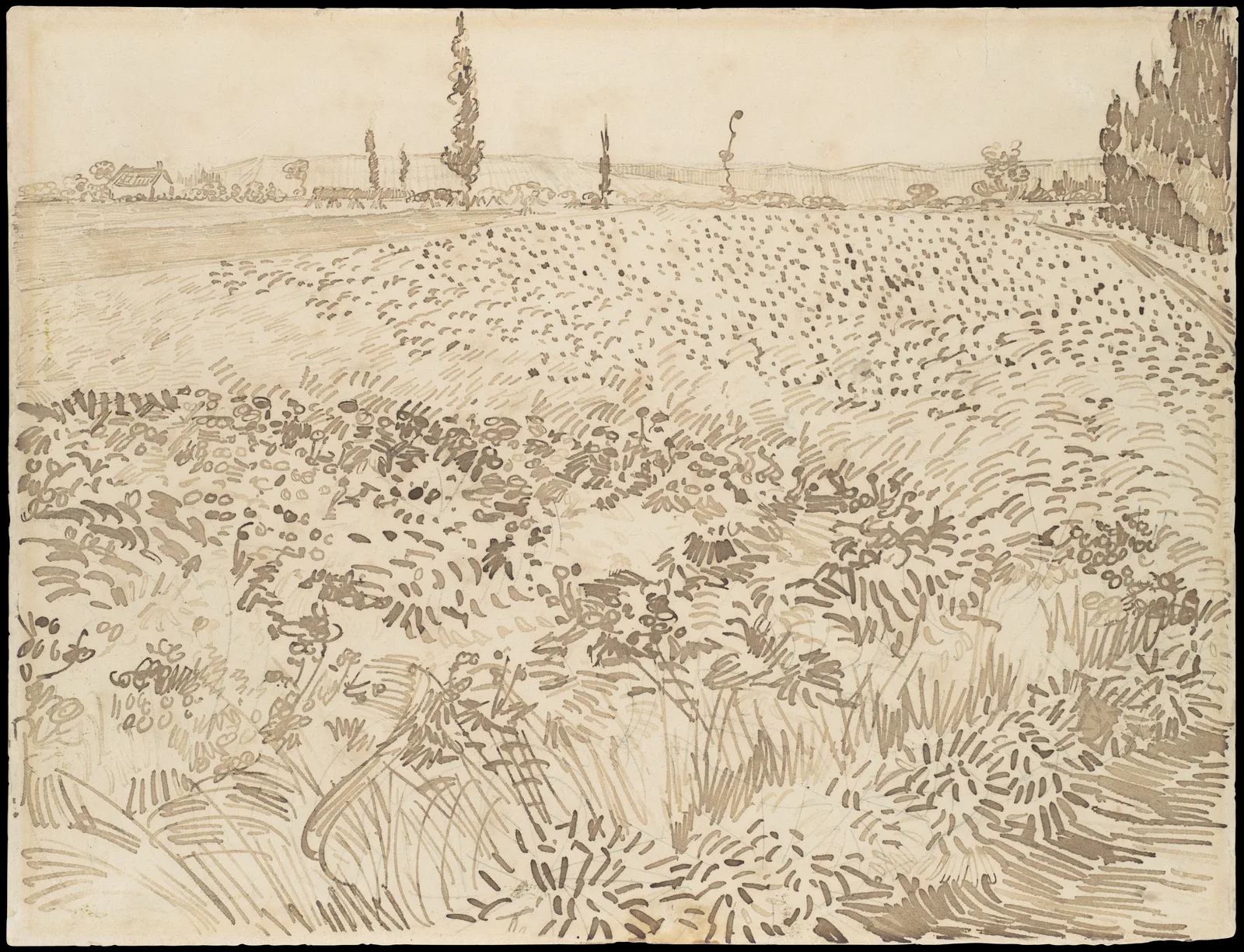
With no colour, the only thing that tells distance here is the kind of mark. In front there is a mix of long curving strokes, loops and strokes that fan out from one point like tufts of grass. In the band above, short hooks and small circles follow one another. Further back, in the middle of the field, the strokes shorten into dots, and the dots grow smaller and denser towards the top. The hills near the horizon are only a few fine, even horizontal lines, and the sky is left as bare paper.
One thing becomes visible. Direction exists only up close. The strokes in front lean or curve and read like grass swept by wind, but the dots in the middle have no direction, and the horizontal lines of the far hills divide layers more than they point anywhere. Van Gogh did not just shrink his marks; he changed their kind to draw distance. The same method returns, with colour, in an oil painting the following year.
Saint-Rémy, 1889: a different stroke for each area
After his breakdown in December 1888, Van Gogh voluntarily entered the asylum at Saint-Rémy, near Arles, in May 1889. In June he went beyond its grounds and began painting cypresses. Wheat Field with Cypresses was painted the same June, directly in front of the field. The Met's conservation record notes a wheat husk found embedded in the paint, physical evidence that it was painted out of doors. On July 2 Van Gogh sent his brother Theo a reed-pen drawing of the composition and counted the painting among his best summer landscapes. That reed-pen drawing is now in the Van Gogh Museum in Amsterdam; it is a different work from the 1888 Wheat Field above.
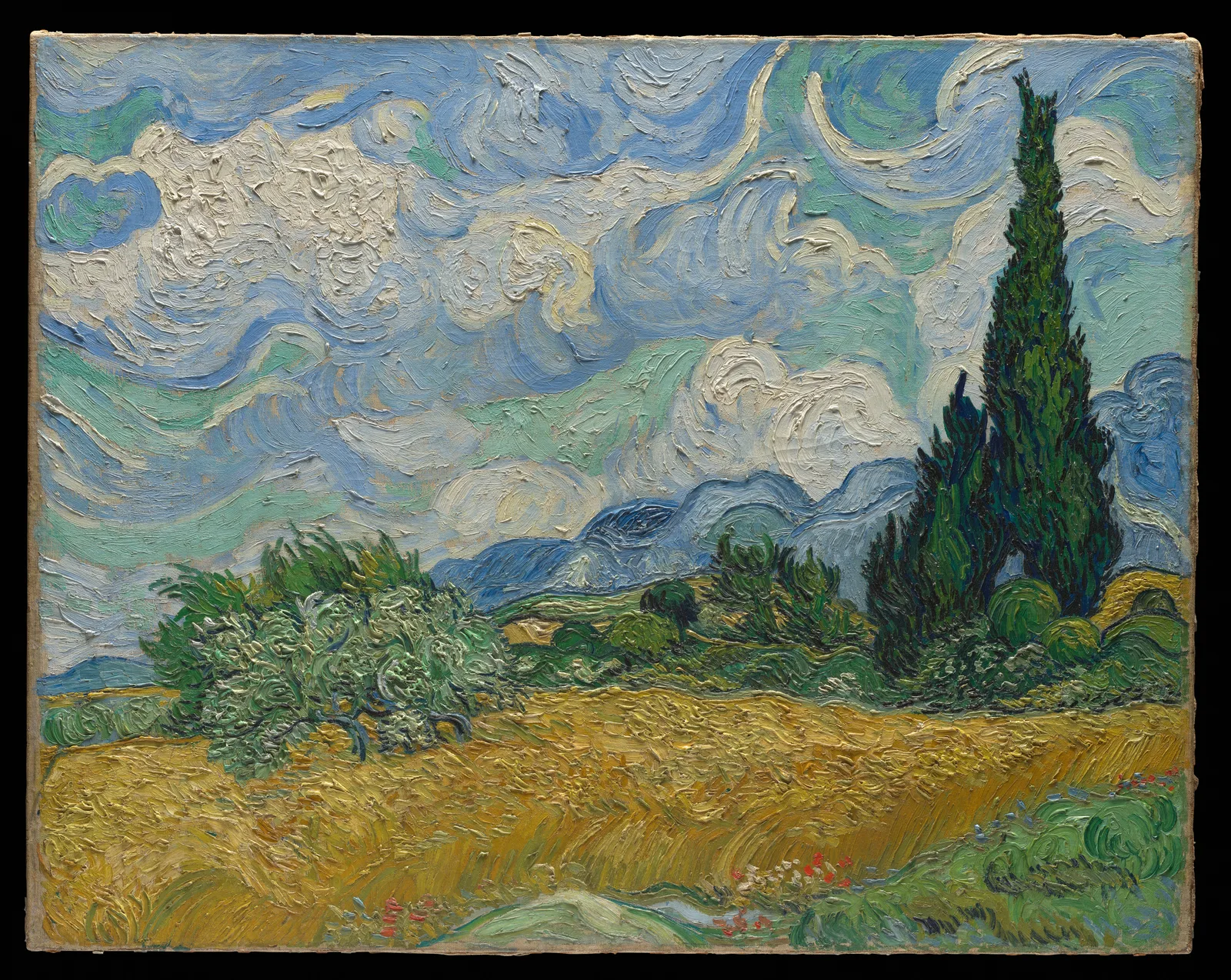
Sky takes up more than the upper half of the picture; below it a range of blue mountains passes like a wave, and the lower third is yellow wheat. On the right a dark green cypress rises nearly to the top edge. Each area has its own kind of stroke. In the sky, broad curving strokes make eddies, and the paint is thickest in the white clouds. In the cypress, narrow, short strokes overlap upwards like flickers. In the wheat, slanting hatching follows on in a steady beat, and the grass at lower right curls in loops. The olive tree on the left is a clot of lumpy paint.
The Met's conservation record makes the same distinctions: broad, curving strokes for the sky, narrower, flickering strokes for the cypresses, rhythmic hatching for the wheat stalks and calligraphic loops for the grass in front. It adds that this varied handling is reflected in the different types of marks used for each area in the Van Gogh Museum's reed-pen drawing. The kinds of mark that divided distance in the 1888 drawing have become, in the 1889 painting, kinds of brushstroke that divide one thing from another.
The x-radiograph also shows the order of work. Van Gogh left a space for the cypresses, painted the sky, and then painted the edges of the trees over the sky. So, enlarged, the outline of the cypress is not a smooth line but short green and black strokes reaching upwards and riding jaggedly over the curving strokes of the sky. What separates tree from sky is the direction of the strokes more than their colour.
Cypresses: why a standing tree seems to burn
In the same late June, Van Gogh painted two close-up views of cypresses in a vertical format. One is in the Kröller-Müller Museum in Otterlo; the other is The Met's Cypresses. He wrote that the tree was beautiful in its lines and proportions, like an Egyptian obelisk, and that as a dark patch in a sun-drenched landscape it was one of the most interesting dark notes and the most difficult to hit off exactly. The painting was shown at the 1890 Salon des Indépendants. According to The Met, tiny pieces of gravel are embedded in the paint at its bottom.
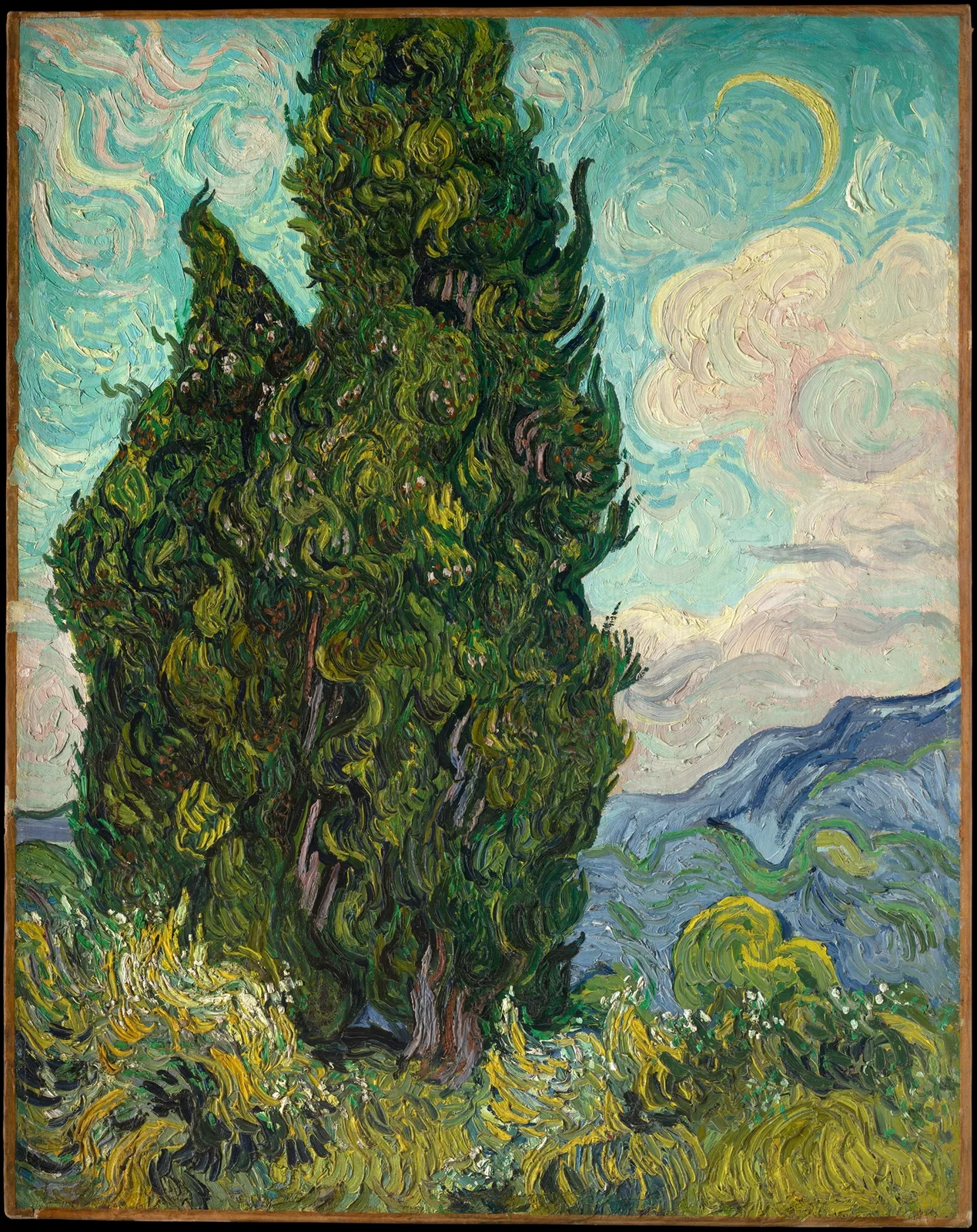
The trees fill the left two-thirds of the picture, and their top is cut off by the upper edge. Because the tree runs on out of the picture, its end is never seen. The strokes inside it do not simply point up. Strokes of dark green, olive and yellow-green curl in S and C shapes and cross one another, with dark lines following their bends. At the right edge, tongue-like strokes with pointed tips stick out into the sky. A yellow crescent moon hangs at upper right, and the sky is covered with round eddies of pale pink and white over turquoise. At lower right, blue mountains slope down.
In Wheat Field with Cypresses the kind of stroke divided one thing from another. Here both tree and sky are painted in curving strokes, so the boundary is made less by kind than by rhythm. The eddies of the sky turn broadly and slowly; the strokes of the tree curl short and fast. That is why the tree looks less like a still object than a mass writhing upwards.
The viewer's body follows the strokes
Why does a tree standing still seem to burn? Nineteenth-century German aesthetics has a concept that fits the question: empathy, or Einfühlung. The aesthetician Theodor Lipps (1851–1914) explained that when we look at a form, inner movements arise similar to those we feel when moving our own body, and because our attention is on the object, we feel those movements as being in the object. The German word was rendered into English as "empathy" by the psychologist Edward Titchener in 1909.
Lipps's theory is only one account of perception, and there is no evidence that Van Gogh knew it. But in front of his brushstrokes the account fits well. A brushstroke is the path a hand travelled, and its direction stays on the canvas. The viewer's eye walks that path again. Follow the background touches of the straw-hat self-portrait and your gaze winds towards the head; follow the strokes in front of Wheat Field and the grass leans; follow the curling strokes of Cypresses and the tree climbs. The movement is not in the tree. It arises on our side, as we retrace the strokes.
What to try in front of a Van Gogh
The next time you see a Van Gogh, do not take in the whole picture at once; choose one area. Sky, field or face will do. Pick a few strokes inside it and follow with your eye which way they lie. Then look for where the kind of stroke changes. The exact place where hatching turns into loops, a long stroke into dots, or a broad eddy into short flames is where Van Gogh ended one thing and began another. Look for where the direction and kind of the strokes part, rather than for outlines, and you will see what Van Gogh took to be a single mass.
Add your perspective.
Share a question, another approach, or something you have tried.
Checking sign-in…
Loading comments…