When we look at a portrait, we tend to interpret the expression first. We try to decide first whether the person is smiling, angry or sad. But there is something to look at before that. Where is that person looking? When the gaze turns toward us, we become the other party in the scene; when it turns inside the painting, we watch the event together; and when it turns outside the frame, we imagine an unseen object.
Let's read three works by the Danish painter Carl Bloch (1834–1890) with this question. Even with figures painted by the same artist, when the destination of the gaze changes, the feeling of standing in front of the painting changes too. The explanation below is an appreciation I put together by examining digital images of the works myself. Follow along while keeping apart the arrangement visible in the painting and the stories that arrangement can bring to mind.
1. People looking at me: can I stand outside the scene?
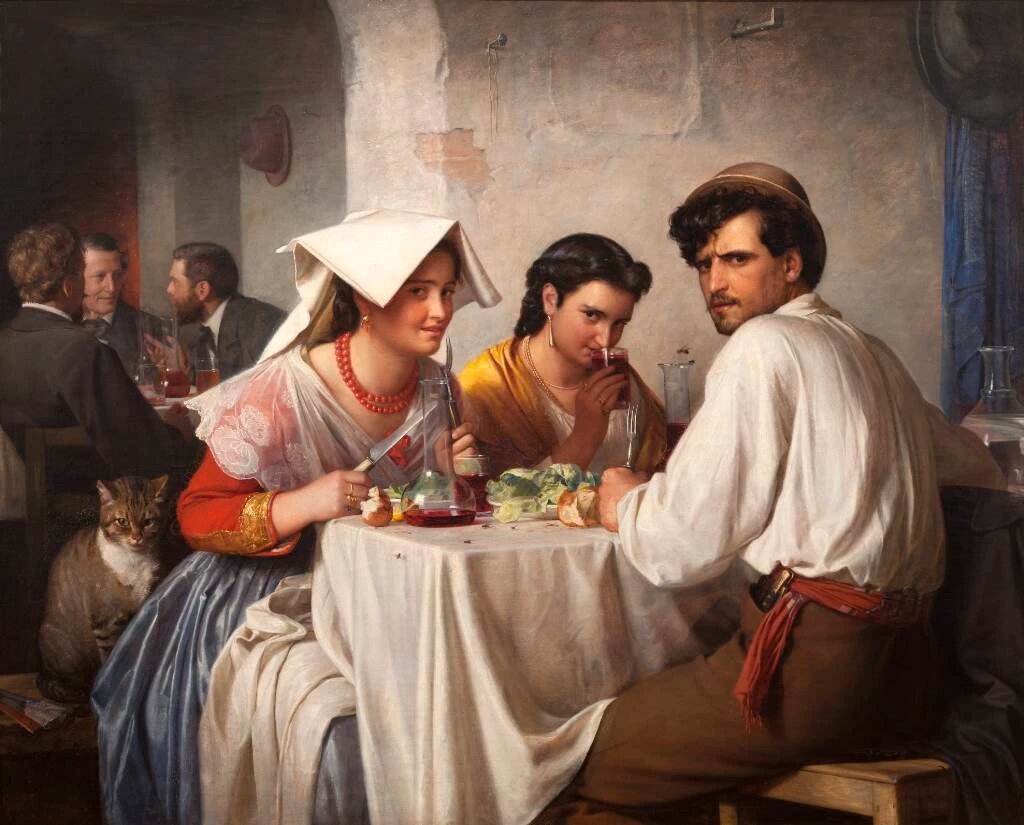
In a Roman Osteria is a work from 1866. The painting shows a meal where people have gathered. At the front table, three people sit close together, and at the back left there are people at another table. First, look at the faces of the figures at the front table. Their bodies surround the table, but their faces and eyes are turned back toward the side looking at the painting. The man on the right in particular turns his head while showing his broad back.
Because of those poses, this scene does not look like a distant view. We seem to become someone standing close beside another person's meal. The front table coming right down to the bottom of the picture, and the white shirt and white tablecloth taking up a large area, also narrow that distance. Think about the difference between discovering a gaze in a landscape where the figures are placed small, and meeting eyes with faces this close.
Now move your eyes to the table in the back. The figures there face one another. While the front table seems to be aware of us, a separate conversation seems to be going on in the back. In one picture, a group that connects with the viewer and a group bound up among themselves are placed together. It is a difference that is easy to miss if you only zoom in on the three faces.
There is no need to jump straight to the conclusion that "a stranger came in and everyone got angry." The eyebrows and mouths are visible, but exactly what was said is not written in the painting. You can read the expressions as wary, or as a moment when they briefly turned their heads. What can be confirmed is the arrangement in which several gazes gather on our side; who came in and why is a story the viewer adds.
2. A gaze to follow inside the painting: what disturbed the nap?
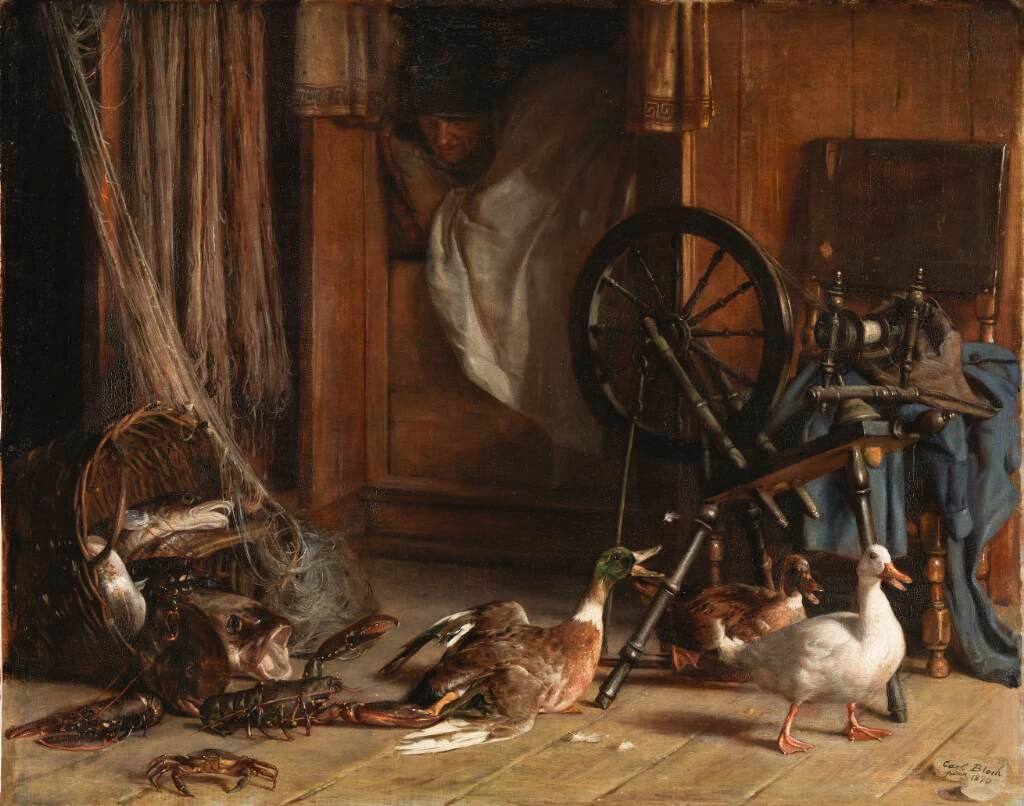
In A Disturbed Afternoon Nap from 1870, a frontal gaze toward the viewer is not the focus. A figure leaning out of the dark space above looks down. On the floor there are ducks, fish and a basket, and on the right stands a spinning wheel. At first the bright floor and the animals stand out, so you may notice the figure above only later. Once you find the small face and come back to the floor, the two parts connect into a single situation.
The title of the work gives the clue that a nap was disturbed. That does not mean you can hear sounds from the image. Whether the ducks made a racket, or what the person is about to do, is something you guess from the poses and objects in front of you. The fun of this painting is the process of moving from the observation that there are objects and animals to the hypothesis "could something like this have happened?" The title opens a path, but it does not explain everything before and after the scene.
In the first work, we were in the place where the figures' gazes landed. Here, we are closer to looking together at what the figure is looking at. If you look in turn at the figure above, the animals below, and the spinning wheel and floor between them, your eyes move within the picture. That is why you can take part in the painting even though no one looks directly at the viewer. Instead of meeting someone's eyes, you read the scene by following that person's attention.
3. A gaze turned out the window: we come to see even what is not in the painting
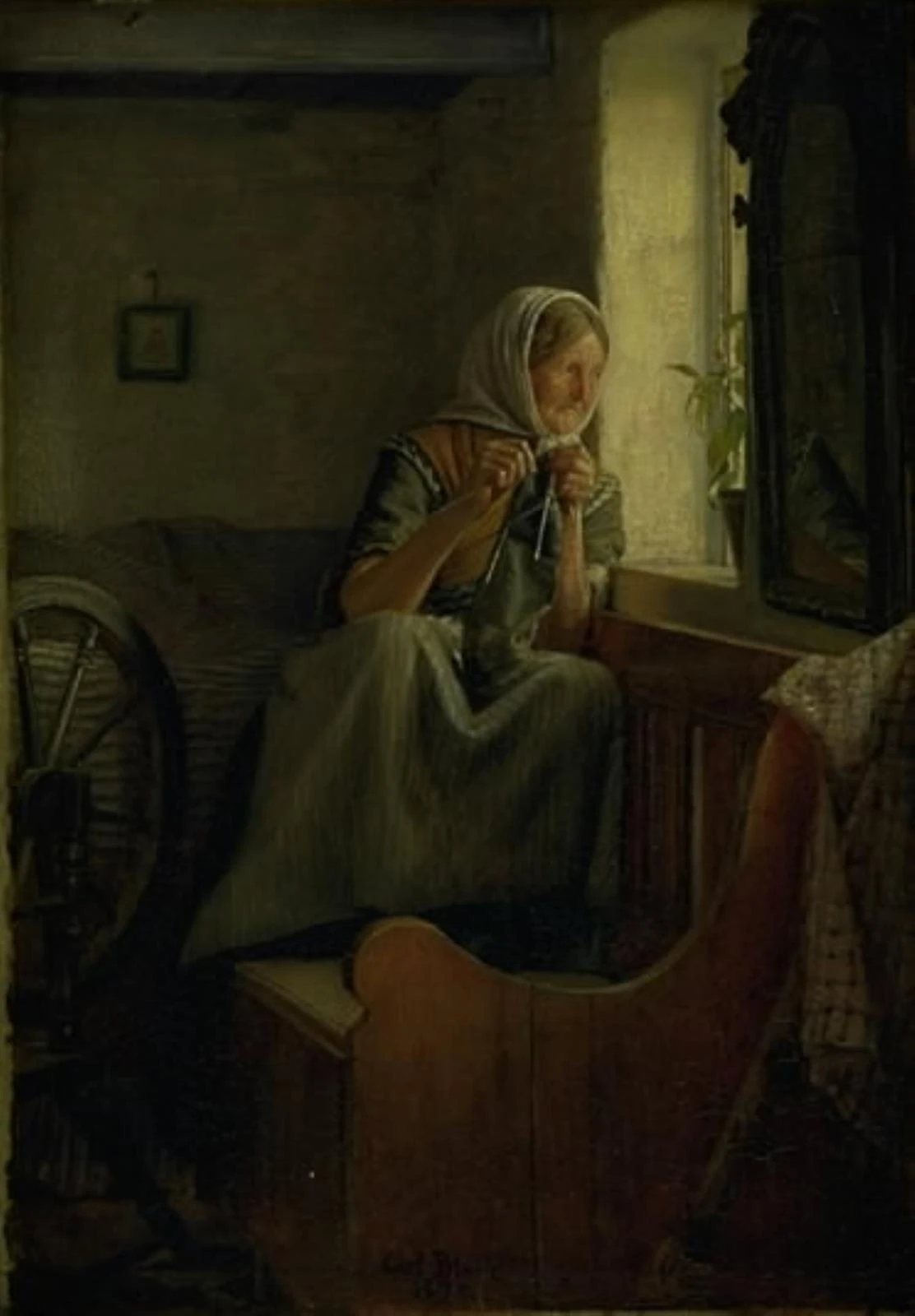
In An Old Peasant Woman Looking out of a Window from 1874, the end point of the gaze is not clearly presented within the picture. The woman sits close to the window on the right with her face turned toward it. Her hands keep a posture as if she were briefly continuing, or pausing, the work she was doing. The interior is dark, and the edge of the window and the area around her face are relatively bright. The back of a chair in the foreground also sits between us and the woman.
We can see the woman, but we cannot see the outdoor scene she is looking at. So in this painting the unseen direction becomes more important than the number of visible objects. The window reads as both the boundary of the room and a passage through which imagination goes out. If, without settling what she is looking at, you look back and forth between the face turned toward the window and the dark interior, you may feel the space of the painting extending beyond the picture.
If you decide that this woman is waiting for someone or that she is lonely, the possible stories narrow to one too quickly. She may have glanced outside for a moment while working, or her eye may have been caught by some movement outside. Neither can be confirmed from the image alone. In an old digital photograph, the details in the dark areas do not come through well enough, so rather than confidently reading small expressions or even brushstrokes, it is better to examine the direction of the face and the relationship between the bright and dark spaces.
4. Before guessing the emotion, find the relationships the gaze creates
If you set the three paintings side by side again, the viewer's position changes. In the osteria, the gaze arrives at us outside the painting. In the nap scene, we approach an object inside the picture by following the figure's gaze. At the window, we cannot know what the figure is looking at, so we imagine the space outside the picture. These differences are not criteria for sorting works into good and bad but ways of slowly entering different scenes.
When you compare them yourself, move your eyes just three times. First find the direction of the face and eyes, then find where that gaze might land. Finally, check whether you can actually see that object. As with the back table in the first painting, there can be several directions even within a single work. If you start from the face but also look around at other figures, objects and empty spaces, even the expression you first read may feel different.
For example, instead of stopping at "this person is displeased," try first saying "the body faces the table and the face faces me." Then, instead of deciding on an emotion, you can look more closely at the contradiction in the pose and the sense of distance. Even after you learn the title of the work or the artist's life, you can come back to this observation. When you can say not only what you felt but also what in the picture made you feel that way, your viewing becomes much more concrete.