Who is he? Maurice Vlaminck 😊
Maurice Vlaminck (1876–1958) was a leading French modern painter of the early 20th century and a central figure of Fauvism. His name may be somewhat unfamiliar, but anyone who sees his paintings will stop at least once and look at them for a long time. There is only one reason: the colors speak, the colors shout, and the colors can be felt.
His paintings are characterized by depicting natural scenery not "as it is," but as his emotions responded to it. So the sky becomes not blue but deep indigo, and trees turn not green but a blazing orange or red. 🎨
Life before painting: in the world of the violin and literature 🎻
Vlaminck was born in 1876 on the outskirts of Paris and grew up in an artistic atmosphere. Because both of his parents were musicians, as a child he naturally prepared for a path as a violinist. In fact, he performed as a musician until his mid-twenties, and at the same time showed a deep interest in literature.
But the path of art could not be filled by music alone. Around 1900, a fateful meeting with another painter, André Derain, led him into the world of painting, and he picked up his own brush and colors and began his artistic life in earnest.
What is Fauvism? 🔥
Fauvism became known to the world through the Salon d'Automne exhibition held in Paris in 1905. In front of paintings filled with exaggerated colors, simple forms and explosive emotion never seen in earlier painting, one critic said they looked "as if wild beasts had painted them," and that is how the name "Fauvism" came about.
Vlaminck was an early core member of the movement, and when it came to expressing emotion through color in particular, he was more radical and instinctive than anyone. He was so obsessed with color that he said, "What I loved was the passion of color," and through it he expressed his inner feelings without restraint.
Major works and what to look for 🖼️
- La Seine à Chatou
A work that reinterprets an ordinary scene on the Seine in France with intense color. The blue river, red roofs and yellow trees feel like a landscape in a dream.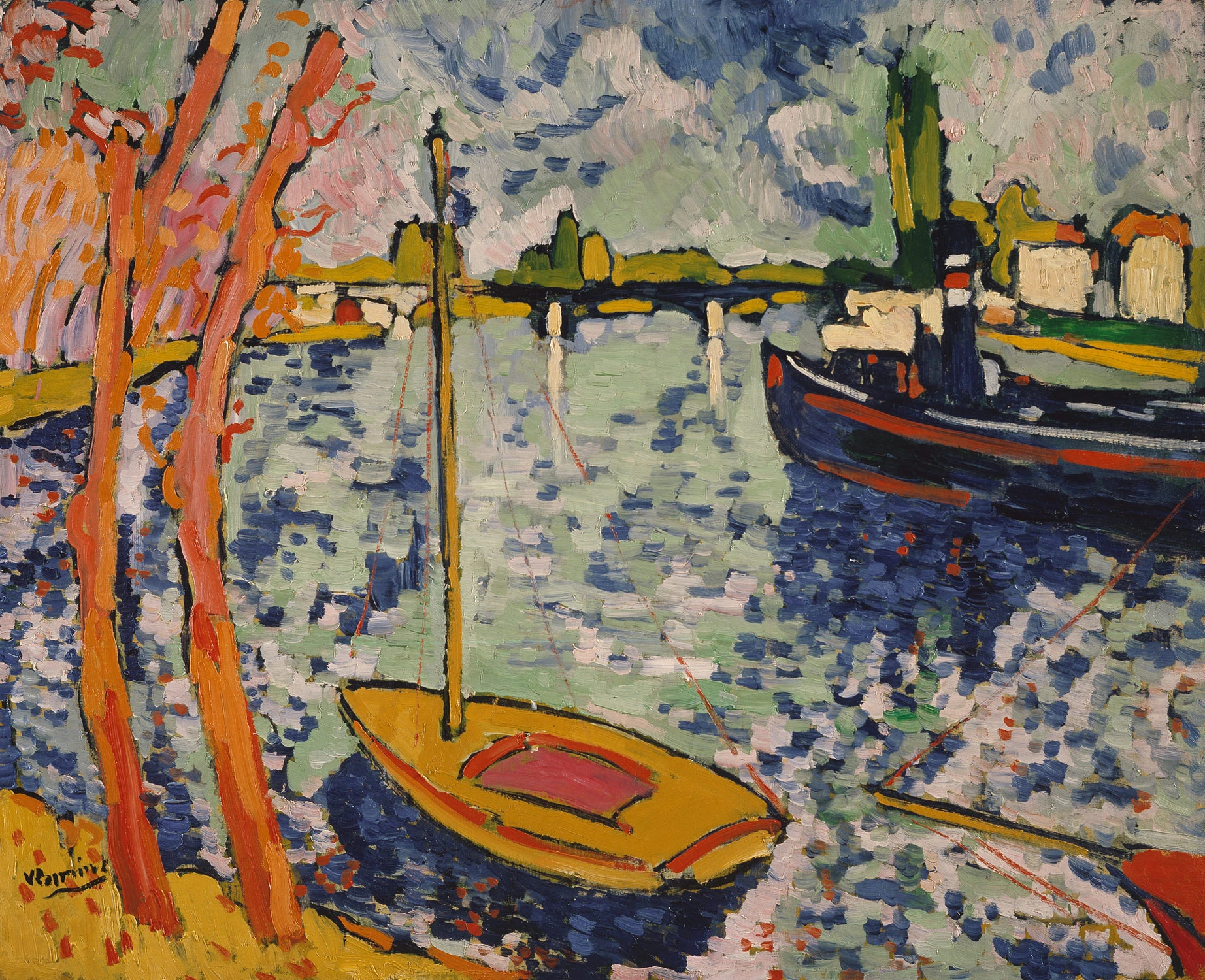
- Le Pont de Chatou
A work based on the Chatou bridge, expressing both the rhythm of the space and emotion with bold, unrestrained brushstrokes.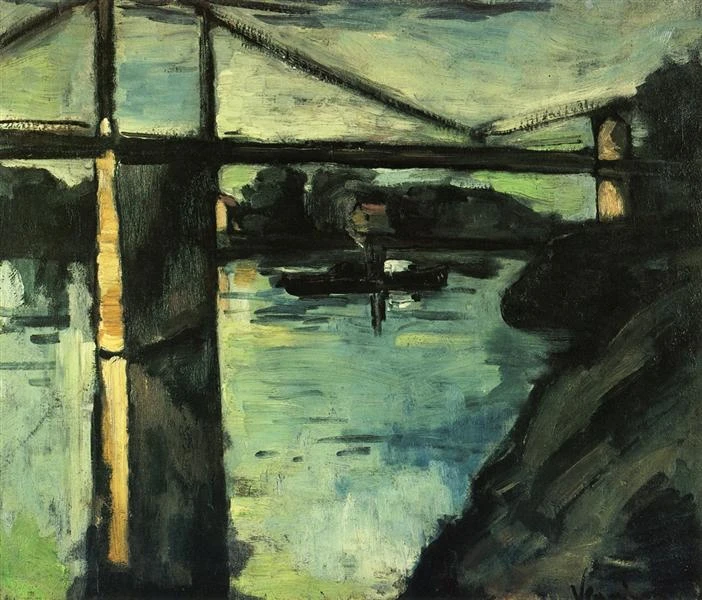
- The Red Trees
In this work, where red trees fill the canvas, the painting reads less as an impression of nature and more as a landscape of emotion within the artist.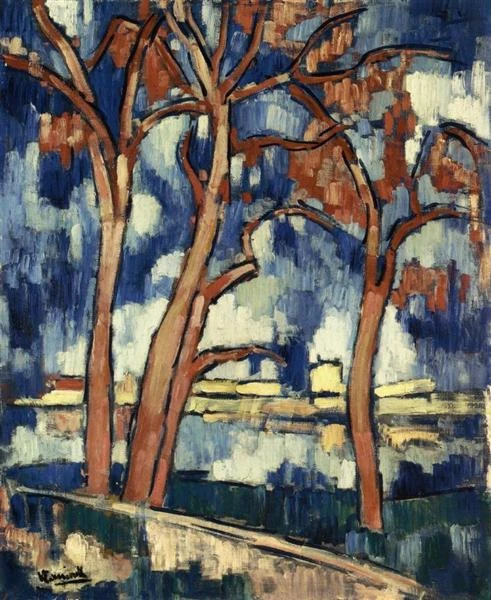
🎨 Viewing tip: when you look at his works, focus less on "where is this landscape?" and more on "why did he use this color like this?" A world of emotion beyond simple depiction opens up.
Later works and a changing style 🌌
Interestingly, as Fauvism gradually declined and Cubism and Expressionism were rising, Vlaminck gradually shifted toward darker tones and more structured expression.
In his later works, his skepticism about war and civilization and his reflection on human existence deepened, and composition and atmosphere began to be emphasized more than color.
Yet at the core there was always a gaze faithful to emotion. To the end, he spoke about people, nature and the essence of life through "color."
How he differed from his contemporaries 👨🎨
- While Henri Matisse focused on arranging color in an orderly way,
- Vlaminck used color like a weapon of emotion. Spontaneous and raw.
- If Picasso moved with a logical, analytical style,
- Vlaminck relied on an instinctive, intuitive sense.
In this way, he put emotion before technique and freedom before rules. That is why the colors he created do not look dated at all even today, and instead come across as modern and intense.
Vlaminck's influence, still alive today 💡
Vlaminck's bold colors still have a great influence on contemporary designers and artists.
Fashion brands plan collections with reference to the color contrasts he used, and film directors sometimes borrow the emotional colors of his paintings to compose scenes.
His artistic language is also being reinterpreted in digital art, poster design and mood coloring books. Visualizing emotion: that idea is even more relevant in our time. 💻🎨
Where can you see his works?
- Musée d'Orsay (Paris)
You can see Vlaminck's major works in person and understand his place within the whole Fauvist movement. - Centre Pompidou (Paris)
His changed style after Fauvism is also on display. - MoMA (The Museum of Modern Art, New York)
It has held many special exhibitions showing how his work is evaluated in the context of modern art. - Google Arts & Culture
You can also view some works online in high resolution.
In closing 🌿
Maurice Vlaminck is not merely "a painter with strong colors" but
a pioneer who visualized emotion, a poet-like painter who combined emotion and color.
When you look at his works, what washes over you is not admiration that "it's painted accurately," but
a feeling that "my heart is strangely racing." That is exactly Vlaminck's power.
The next time you see his name in a museum,
stop for a moment and think this:
"This isn't a painting of something; it's a painting of something felt." 😊