If you get stuck on "What is this a picture of?" in front of an abstract painting, pick just one color. Then move your eyes along a line and find where similar shapes repeat. It is practice in describing concretely what you actually saw before trying to guess the painting's answer.
Some abstract paintings simplify recognizable objects, and others deal with the arrangement of color and form itself. So the method of looking for the names of things is not enough to explain the picture in front of you. If you pile up small observations such as "the blue area is wide" or "the black line tilts to the right," a vague impression gradually becomes clearer.
First, look slowly at one work
Piet Mondrian's Composition with Red, Yellow and Blue is an oil painting made in 1927. In the work below, pick the one part that catches your eye first. Check whether it is the red area, the wide white area or the black lines. You do not need to try to explain the meaning of the whole work yet.
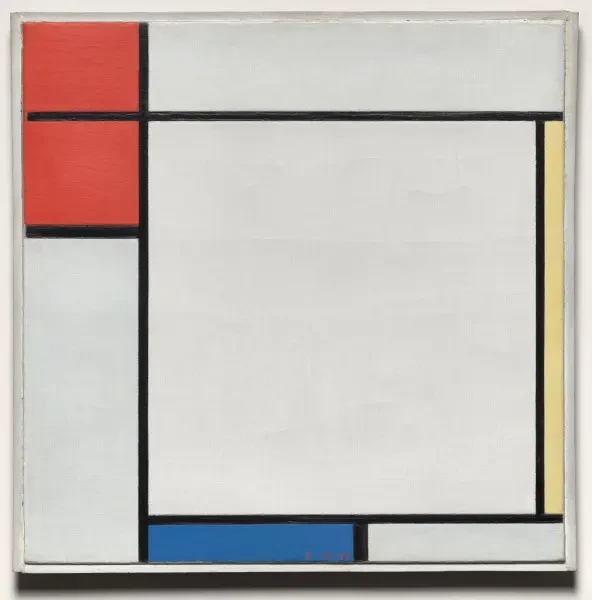
This painting is a good example for examining the relationship between horizontal and vertical lines and areas of color. Compare the two red blocks at the upper left, the thin yellow band on the right and the blue block at the bottom with the wide white areas. Even within the same picture, the area each color occupies differs. Learn the tips for looking from the diagram below, then come back to the work.
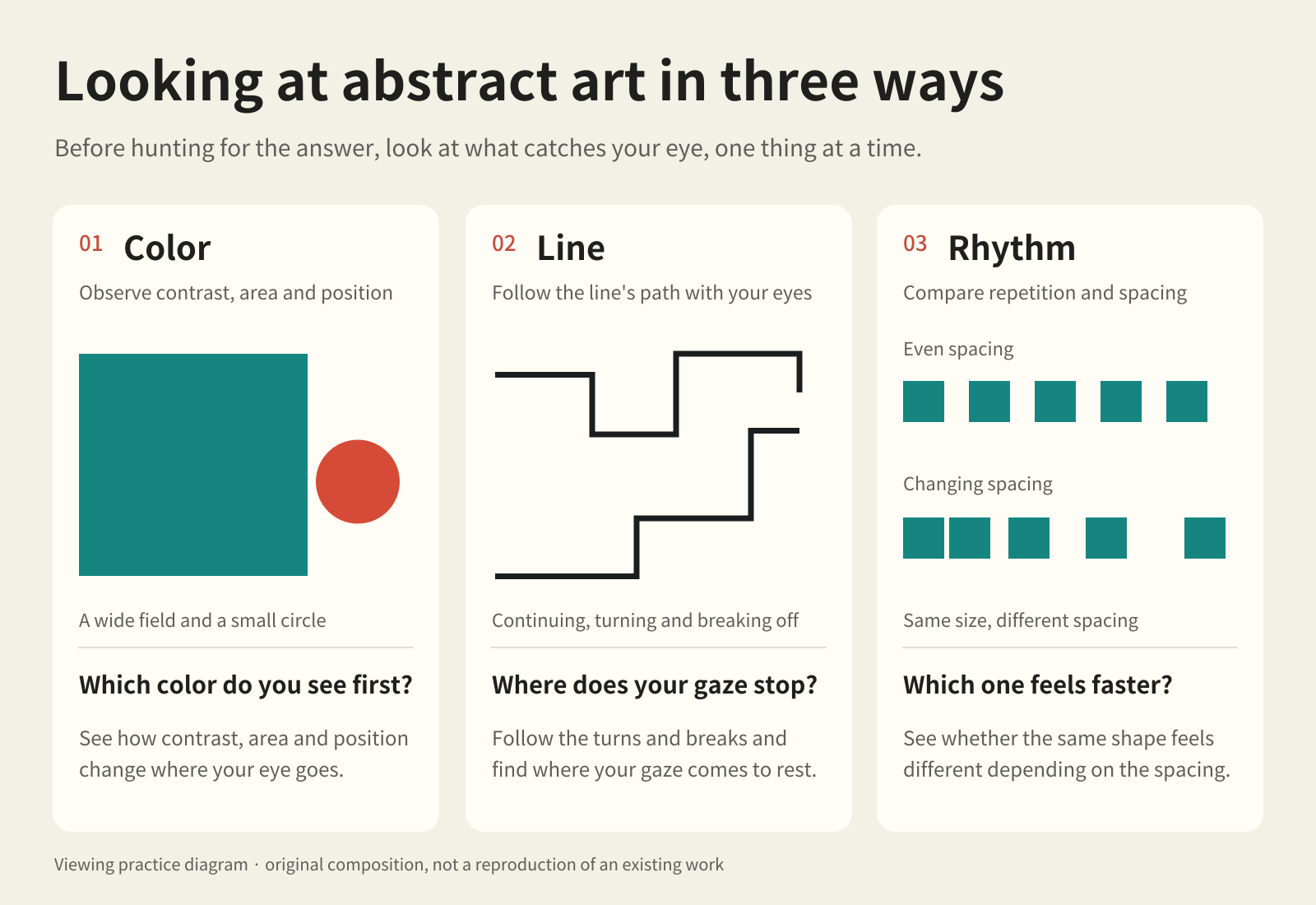
1. Color: the widest color and the color you saw first
The first question is not "What color is it?" but "Where is it placed, and how much?" The color section of the diagram has a wide teal area and a small red circle. Teal takes up a large area, but red may catch your eye first. If you write down the most abundant color and the color that feels strongest separately, your observation becomes more concrete than when you simply list color names.
Next, look at the surroundings. If the small red circle sat on an equally red background, would it look the same as it does now? Imagine keeping the circle's color and changing only the colors around it. Or you can think about how the place your gaze goes to would change if the circle were near a corner instead of in the middle. Imagining a change to one element helps you notice the characteristics of the current arrangement.
In an actual work, too, choose one color and follow where it sits in the picture. Rather than first attaching a meaning such as "red is passion," write something like "the red is split into several places, so my eye moves around." If something feels warm or cold, do not erase that feeling; add one more sentence about which combination of colors created that impression.
2. Line: finding a path to walk with your eyes
This time, pick one line and follow it slowly. At the points where the black lines in the diagram turn, your gaze may change direction. Where a line breaks off, your eyes may move on to look for the next part. The key is to check the path your own eyes actually took. Not everyone has to look in the same order.
Compare not only the direction of the lines but also their thickness and length. Which feels busier: a place where several short lines gather, or a place with one long continuous line? Where a thick line meets a thin one, which stays in your eye more? You do not need to draw over the painting; you can trace the path in the air with a finger or leave a simple arrow in your notes.
Give a reason for an impression like "it's dynamic." You can write something like "following the line that tilts to the right, my gaze shifts to another line above it, so it feels like movement." A straight line is not always calm, and a diagonal is not necessarily unsettling. You can explain your feelings more accurately only when you also look at the surrounding shapes and the way the lines meet.
3. Rhythm: examining the gaps between repetitions
Rhythm is a way of examining the sense of movement created when the same element repeats. In the two rows of the diagram, squares of the same size are placed. One row has even spacing, and the other row has changing spacing. Compare whether the speed at which you read changes when the arrangement changes even though the shapes are the same. There is no right answer about which should feel faster or slower.
Not only the repeated shapes but also the empty spaces between them matter. When you move from a dense part into a wide empty space, you may feel a moment of rest, or conversely, you may find yourself quickly looking for the next shape far away. If you want to compare it to music, do not stop at "it's like cheerful music"; break it down, for example whether short sounds follow one another or one long sound continues and then rests.
Go back to Mondrian's painting and find where the horizontal and vertical lines repeat. Are the rectangles divided by the lines all the same in size and proportion? Also see whether your gaze moves differently when passing a wide area and when following a narrow band. It is practice in examining how the spacing between lines makes the picture different even when the same straight lines repeat.
4. After reading the title, separate observation from interpretation
Now read the title Composition with Red, Yellow and Blue again. Your gaze may linger more on the three colors named in the title. Or you may become curious about the role of the white areas and black lines, which are not in the title. Write down the parts that newly caught your eye after reading the title. A title can be a clue, but it is not an answer that explains the whole painting for you.
It helps to split your notes into two sentences. In the first sentence, write what can be confirmed in the picture, such as "several black lines gather in one place." In the next sentence, write your own reaction, such as "that part feels complicated and tense to me." If you jump straight from there to "the artist expressed anxiety," you end up asserting a personal feeling as the artist's intention.
Also keep what you newly learn from reading explanations separate from your first impression. Even if your feelings change when you look at the work again later, you do not need to correct your first notes. The very fact that a different element caught your eye in the same picture can become a record of your viewing.
A five-minute exercise to try in front of the next painting
For the first minute, look at the whole picture and pick the one thing you saw first. For the next minute, examine the area that color occupies and the colors around it, and for the minute after that, follow one line with your eyes. In the fourth minute, compare the repeated elements and the spacing between them. In the last minute, read the title and write one line about what changed from the start. It is easier to think of it as practice in switching what you observe each time, rather than timing it precisely.
Three lines are enough for your closing notes. Write "what I saw first," "the reason in the picture why I felt that way," and "what I want to check when I look again." If someone looked at the painting with you, compare where each of you first looked, rather than whether your interpretations match. Following the place the other person saw, you may discover a relationship you had passed over.
Viewing does not only begin once you have picked a painting you like. Even with an unfamiliar or cluttered painting, you can say which part makes you feel that way. Hold on to one color, one line and one place of repetition, and look slowly. If you can add one concrete sentence of observation after "I'm not sure," you have already begun to read the painting.