"Accept nature as it is, but respect the order within it."
The landscape painter who painted 19th-century France's great outdoors like a poem, Henri-Joseph Harpignies. We look into his art, which captured the breath of nature with quiet but firm brushwork.
🎨 1. The beginning of his life: an artistic flower that bloomed late
Henri-Joseph Harpignies was born in 1819 in Valenciennes, France. At the relatively late age of 27, he decided to become a painter and began formal training in painting under the landscape painter Jean Achard. He started later than most artists, but like a late-blooming flower he developed his own color slowly and steadily.
He painted familiar nature, the forests, fields and riverbanks of France and the sun-filled shade of trees, honestly and lovingly.
🌳 2. His ties to Barbizon: a quiet revolutionary
Harpignies worked as one of the central figures of the Barbizon School. The Barbizon School was a group of painters who sought to bring back into art the stillness of nature that was gradually being forgotten because of industrialization. They accepted nature as it is and pursued "the true face of nature" rather than artificial composition.
Harpignies was especially good at capturing "the subtle movements of nature" such as trees, blades of grass and the drift of the wind. His paintings moved people not through passion or dramatic composition but through quiet vitality and a sense of calm.
☀️ 3. His major works
Most of Harpignies's major works depict ordinary landscapes of the French countryside. For example:
- La Vallée de la Loire
→ A misty morning landscape of the Loire valley, delicately rendering light, shade and atmosphere. - L'Étang au crépuscule (The Pond at Dusk)
→ A landscape where the sky and water meet as the light fades, as still as meditation. - Chênes près de Fontainebleau (Oaks near Fontainebleau)
→ A painting in which you can feel the embrace of nature, imposing yet comforting.
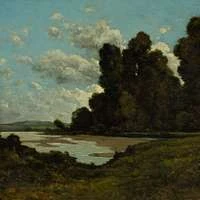
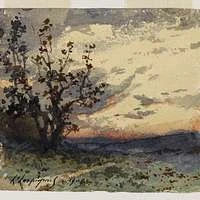
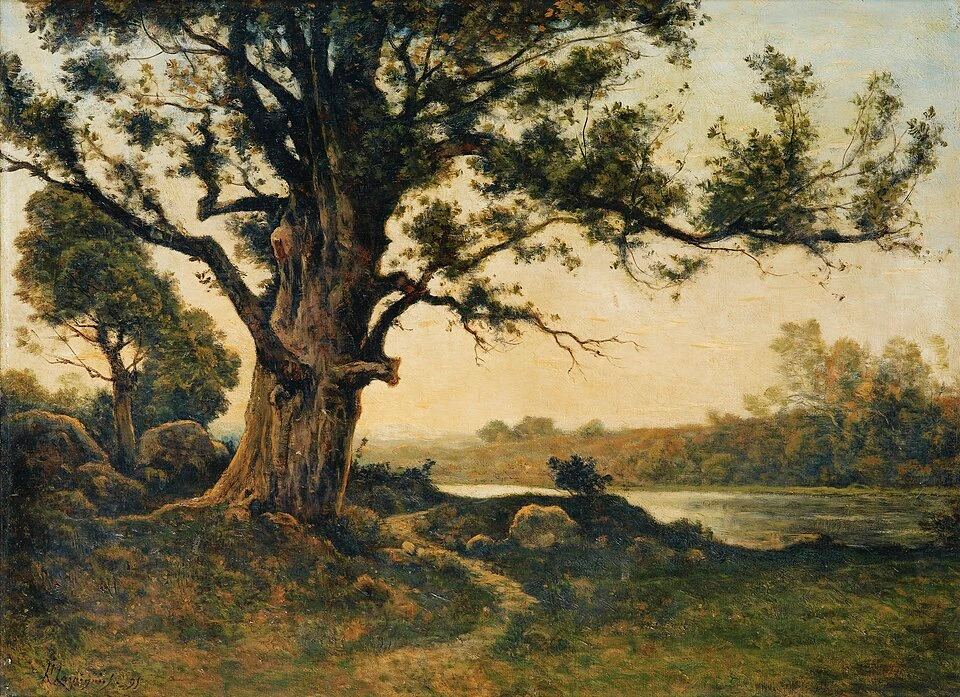
All of these remind us of "the value held by everyday nature rather than special places." In fact, they help us discover new beauty in familiar landscapes.
🖌️ 4. An original style: oil painting like watercolor
Looking at Harpignies's works, you can feel a light, transparent touch like watercolor, even though they are oil paintings. He did not force dark colors but concentrated on capturing hues that shift subtly with natural light.
The many drawings and sketches he left are a collection of the time he spent studying and observing the rhythms of nature. For him, painting was not a technique but a humble response to nature.
🧓 5. A life with nature, until the age of 97
Remarkably, Harpignies died in 1916, at the age of 97. He kept painting until his final years and continually taught his students how to respect nature.
He wanted to be remembered as a painter living in nature rather than for fame and wealth, and his legacy still breathes quietly in museums across France today.
💬 In closing: a painter like a comma in a busy day
Henri-Joseph Harpignies's works are not loud, but they are deep.
In a world that moves as fast as ours does today, his paintings offer the ease to pause for a comma and look at nature.
The moment we look at his landscapes, we are no longer in the noise of the city. We stay together in a windblown forest, on a shaded path, and in the stillness of the waterside.
📍 Viewing tip
- You can see some of his works at the Musée d'Orsay in Paris.
- If you are interested in the landscapes of northern France, look closely at the flow of light and air in his works.