Pick one tree in a landscape painting and imagine tracing its outline with a finger. In some pictures the finger follows the border between leaves and sky all the way round. In others it stops after a few centimetres, because you cannot decide where the leaves end and the sky begins.
This note looks at four paintings made by Camille Corot (1796–1875) across about fifty years, with that single question: where does a leaf end? After the four, you will be able to tell for yourself, in front of any other landscape, whether an outline is a line that separates forms or a soft edge that binds them into one mass.
Corot was born in Paris and died in Paris. The Metropolitan Museum of Art in New York introduces him as perhaps the most influential French landscape painter of the nineteenth century. All four works are released by The Met as public domain.
The ridge ends in a line: Lake Albano and Castel Gandolfo
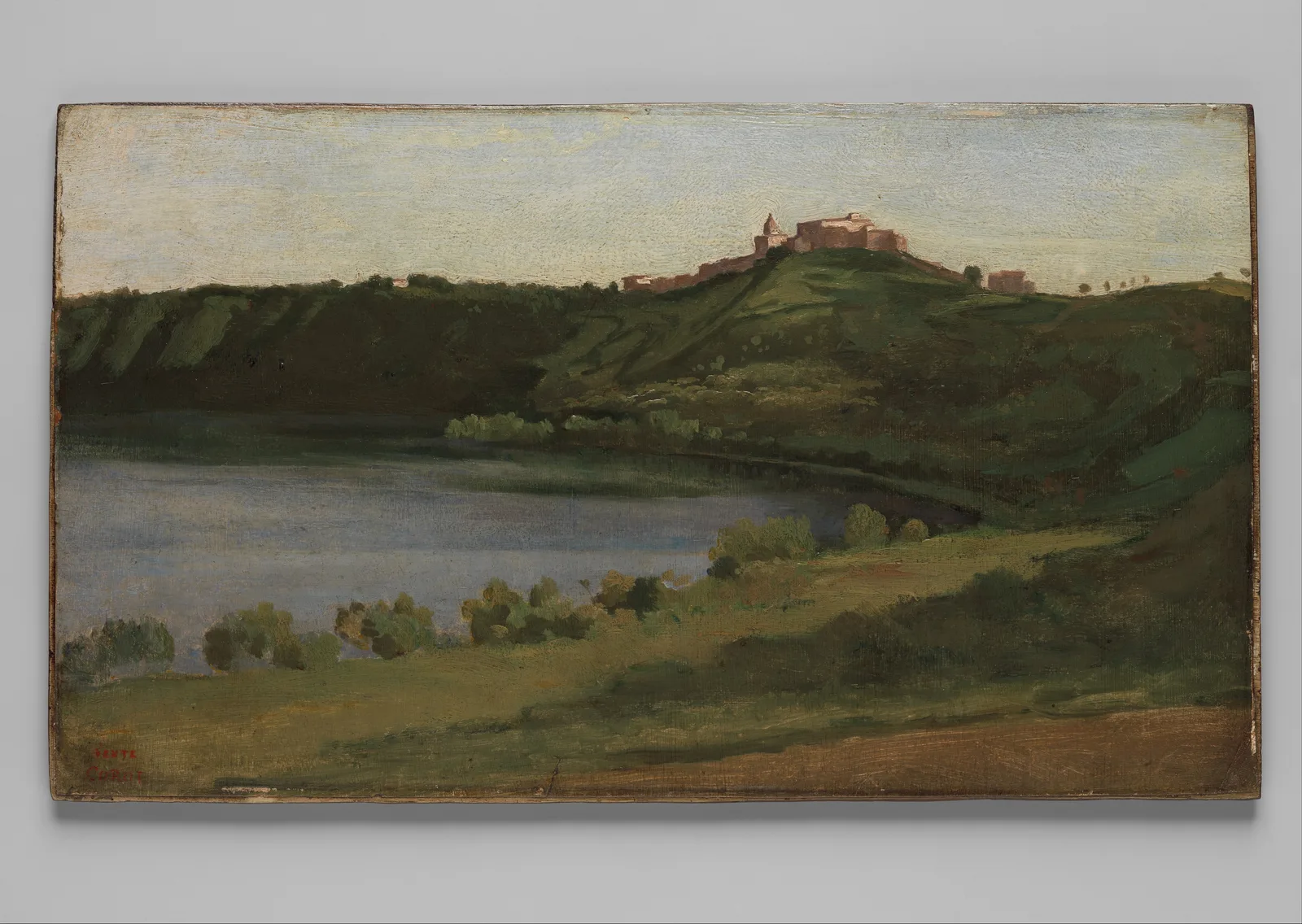
The first picture is an oil on paper just over 39 cm wide. According to The Met, Corot painted it during the first of his three stays in Italy. Castel Gandolfo, the popes' summer residence, sits on the hill above Lake Albano southeast of Rome; the palace and small dome at the top centre of the picture are that town.
Follow the ridge first. The line where the sky, a mix of pale yellow and blue, meets the dark green hill runs from the left edge to the right edge without a single break. The buildings on the ridge are painted as square blocks of pink and ochre, and their sunlit and shaded faces are divided by angular edges. The lake shore is the same: the curve between blue-grey water and green slope is distinct, and the bushes in front stand apart as separate round masses.
Look closely at the sky and you can see short, swirling brush marks left like a grain. The brushwork is fast, but there is no doubt at all about what touches what. The Met's essay on the Barbizon School explains that open-air sketches made around Rome at this time kept the formal linearity of the Neoclassical aesthetic. In this picture you can see that with your own eyes.
Leaves as dabs, the tree as a mass: Fontainebleau: Oak Trees at Bas-Bréau
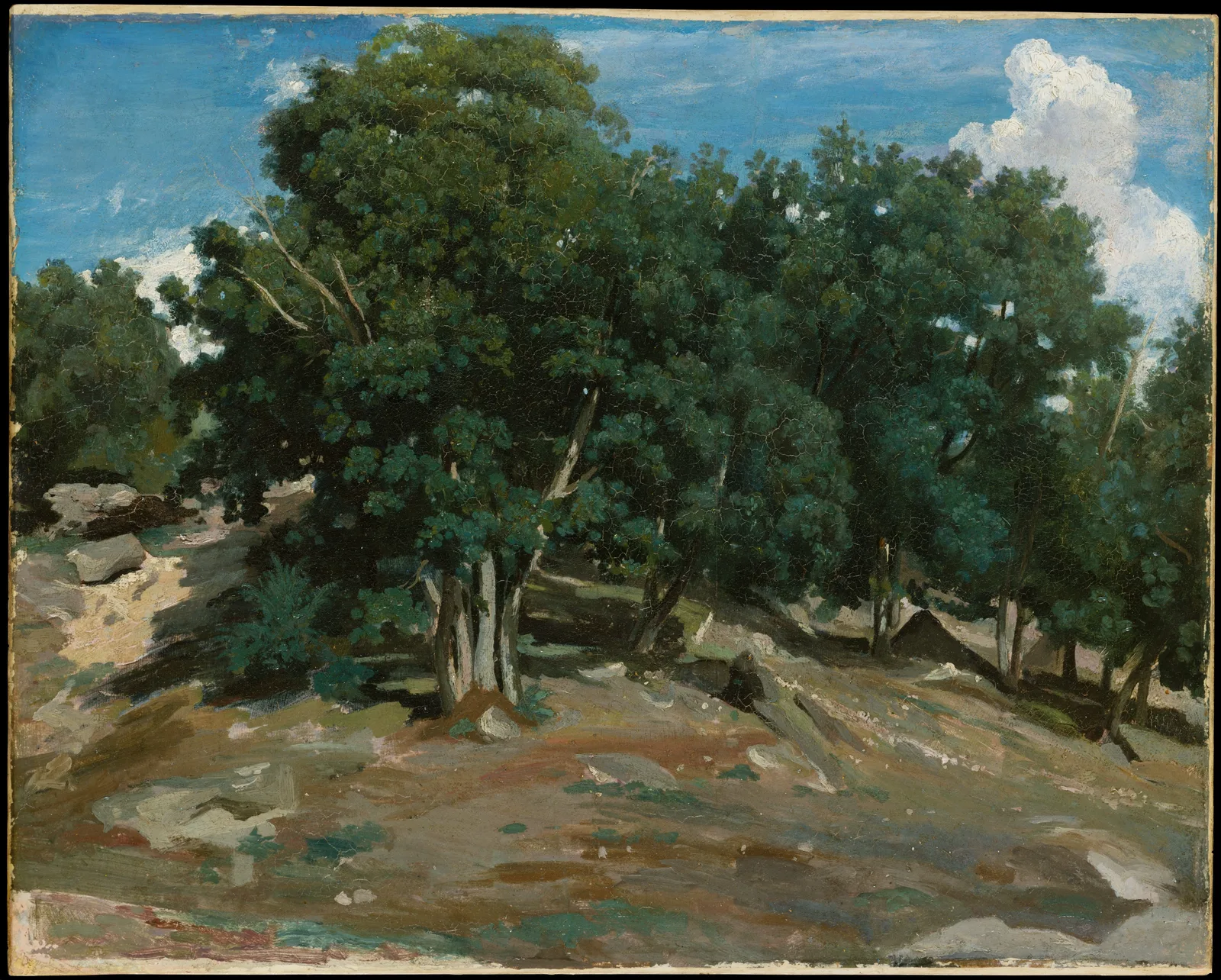
Back from Italy, Corot painted this study in the summer of 1832 or 1833 at Bas-Bréau in the Forest of Fontainebleau, near Paris. The Met says Bas-Bréau was a part of the forest famous for its immense oaks, and that Corot painted it in the naturalistic manner he had developed in Italy. The tree reappears in Hagar in the Wilderness, the large canvas he showed at the 1835 Salon: he moved an oak from northern France into the desert of a biblical scene.
This time follow the top of the largest oak. Where the dark green mass meets the strong blue sky the outline is lumpy but unbroken. Your finger can still go all the way round. What has changed is the inside. The leaves are not painted one by one. Small round dabs of dark green, blue-green and yellow-green pile over one another, and the clusters of dabs build the volume of the tree. Up close a fine net of cracks spreads over the surface, the craquelure that forms on old oil paint.
A few branches in pale grey-white cut diagonally up and to the left through the dark foliage. The trunks below stand as grey-white vertical strokes. The ground is broad strokes of ochre, pink and grey, and the stones are split by a clean edge into bright tops and dark sides. The Met's essay counts this among the most vigorous and precise of Corot's early paintings and calls its topography sharply focused.
Wölfflin's pair: seeing in lines and seeing in masses
Here one idea from the art historian Heinrich Wölfflin lets us put the difference between these two pictures, and the change in the next two, into a single sentence. In his Principles of Art History of 1915, Wölfflin set out differences of style as five pairs of concepts, and the first pair is the linear and the painterly. He sums it up: the linear style sees in lines, the painterly in masses.
Unpacked a little, his account goes like this. When we see in lines, the eye is led along the edges and form is clearly divided from form. When we see in masses, attention withdraws from the edges and things come to us first as patches of light and dark. The moment the outline loses its force as a boundary, the whole surface begins to link up and move.
One caveat is needed. Wölfflin built this pair to describe the difference between sixteenth- and seventeenth-century art, between Dürer and Rembrandt, for example. Applying it to one painter's career does not carry over his historical argument; it only borrows the tool that tells us what to look at. With that tool both pictures so far sit on the linear side. Even where the leaves have broken into dabs, the outer outline of the tree is still a boundary.
Leaves scattered into the sky: Ville-d'Avray
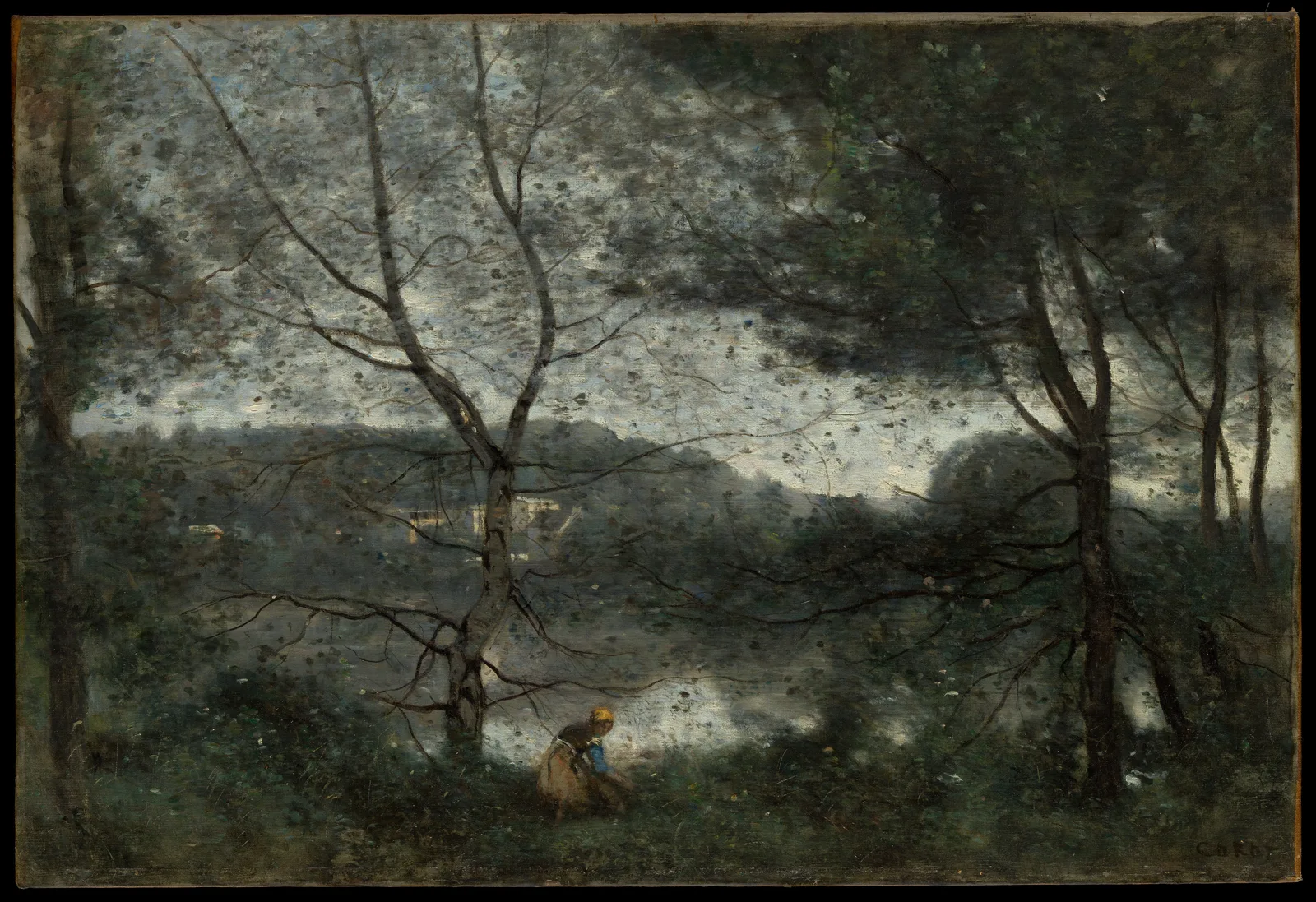
This one dates from 1870, nearly forty years later. Corot often painted the large pond on the property he had inherited from his parents at Ville-d'Avray. According to The Met, he took liberties when repeating the scene, especially with the tree just left of centre.
Try tracing the outline of that very tree. This time you are stopped at the first step. The leaves are dark grey-green dots scattered over a silver-grey sky. They are dense near the trunk and thin out towards the outside until they merge into the sky at a point you cannot fix. In Wölfflin's terms the edge has lost its force as a boundary. The tree reads first not as an outline but as a dark patch on a light sky.
Yet the line has not gone. Thin branches cross the sky as dark lines and fork. Line is no longer used to wrap the outside of a form; it survives only as a skeleton running through the blurred mass. The Met reports that the silhouette of branches and foliage against the sky led Corot's biographer Alfred Robaut to liken this work to a spider's web.
At lower centre a small peasant woman crouches. Her yellow headscarf, blue sleeve and reddish-brown skirt are almost the only clear colours in a picture that is grey-green throughout. According to The Met, Corot first painted a child with outstretched arms beside her, then seems to have found that detail too anecdotal and removed it. When the picture was shown at the 1870 Salon, critics admired the calm poetry of the composition. The Met's essay says that in this painting nature dissolves in a silvery mist, and adds that Corot always went back to the studio to work over what he had seen.
Where light eats the outline: A Lane through the Trees
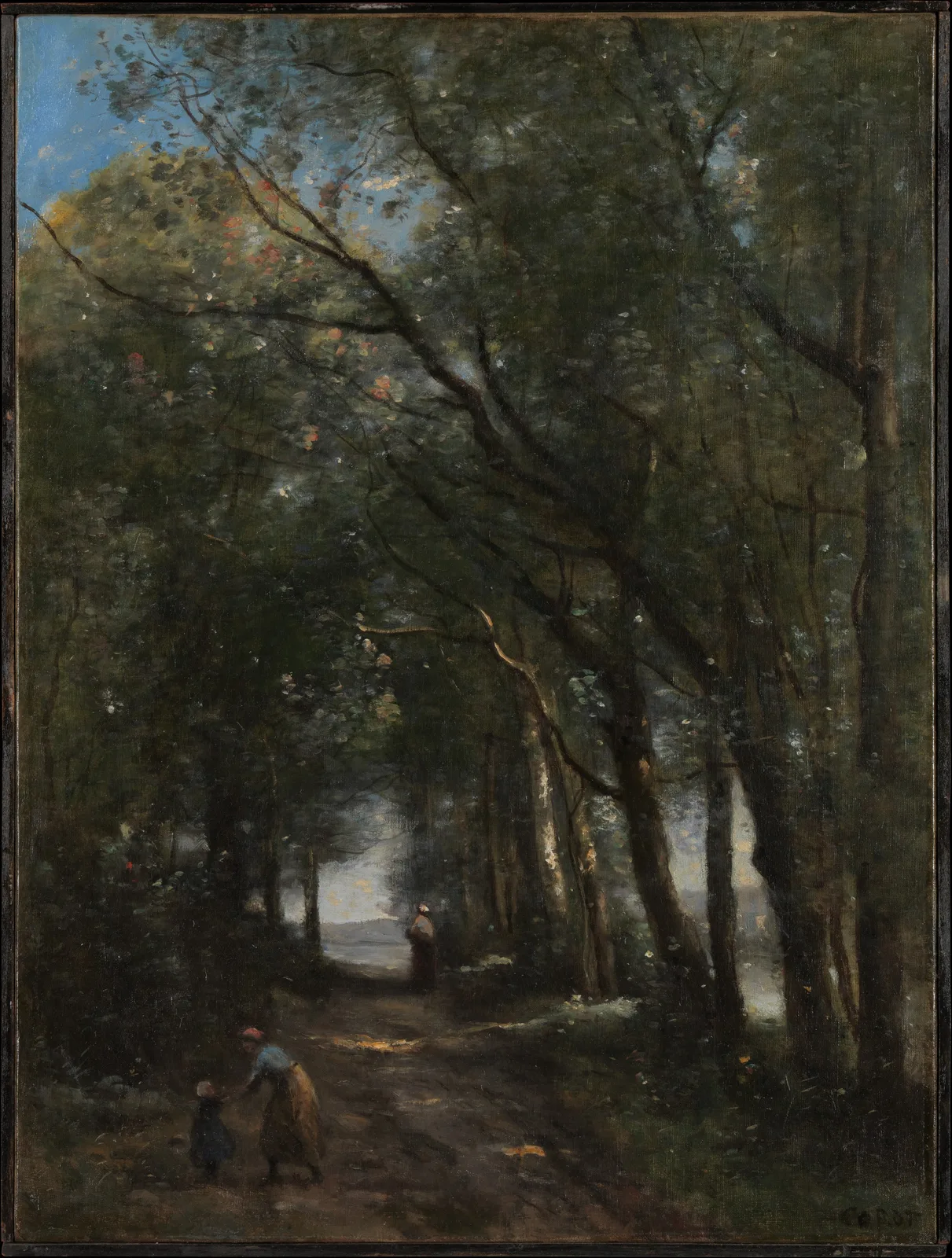
The last picture is upright. Tall trees on both sides bend over the lane to make a dark tunnel, and at its end are a bright waterside and a standing figure. In the lower left foreground a woman in a pink cap walks holding a child's hand.
Look at the leaves at upper left, where the blue sky shows. They are soft, flattened brush marks, with dots of orange and red among them. The edge of each cluster loosens and bleeds into the sky. Only the thicker branches cross it as dark lines, the same approach as in Ville-d'Avray. Some of the trunks at right, by contrast, stay crisp in pale grey-white on their lit side. The outline breaks down most at the end of the lane. The bright water and the distance eat into the edges of the trunks, so that it becomes unclear where the trees stop and the light begins.
The Met describes the painting as showing Corot's continued attention to capturing natural effects of light, even while he renders foliage in an abbreviated language of soft brushstrokes. The blur is not the same thing as carelessness. The places where the edges are loosened coincide with the places where the light is strongest.
What to try in front of another landscape
Set the four side by side and the direction of change is clear. In the ridge of the 1820s and the oaks of the 1830s the outline is a boundary all the way. In the two pictures from around 1870 the edges of the foliage loosen into the sky, and line survives only as the skeleton of the branches. Corot did not give up line; he changed the job it does.
Next time you look at a landscape, choose one tree and follow its outline with your eyes. If you can follow it all the way round, the painting is showing you forms divided from one another; if you are made to stop partway, it is showing you forms bound together. Then look at what is there where you stopped. In Corot's case it was usually the brightest light.
Add your perspective.
Share a question, another approach, or something you have tried.
Checking sign-in…
Loading comments…