In front of a picture we usually start at the middle, because that is where we expect the main figure to be. In Edgar Degas's pictures that expectation often fails. The middle holds a bouquet or an empty floor, and the people are pushed to the edges with parts of them cut off.
This note looks at four paintings by Degas that The Metropolitan Museum of Art has released into the public domain, in the order he painted them, from 1865 to 1877. By the end you will be able to start a Degas at the frame instead of the middle, follow what the edges cut and where they leave space empty, and read from that what the picture has chosen to show.
Edgar Degas (1834–1917) was a French painter who was born and died in Paris. He was a founding member of the group of artists that held the first Impressionist exhibition in 1874, yet he preferred to call himself a “Realist” or an “Independent” rather than an “Impressionist.”
1865: the bouquet in the middle, the woman at the right edge
The middle of this wide canvas belongs to a large bouquet. The flowers are dahlias, asters and gaillardias. White, pale violet, blue and reddish-brown blooms swell almost to the top edge, and below them a table covered with a red cloth runs across the bottom of the picture. Draw a vertical line that folds the canvas in half and it passes through the bouquet, not the woman.
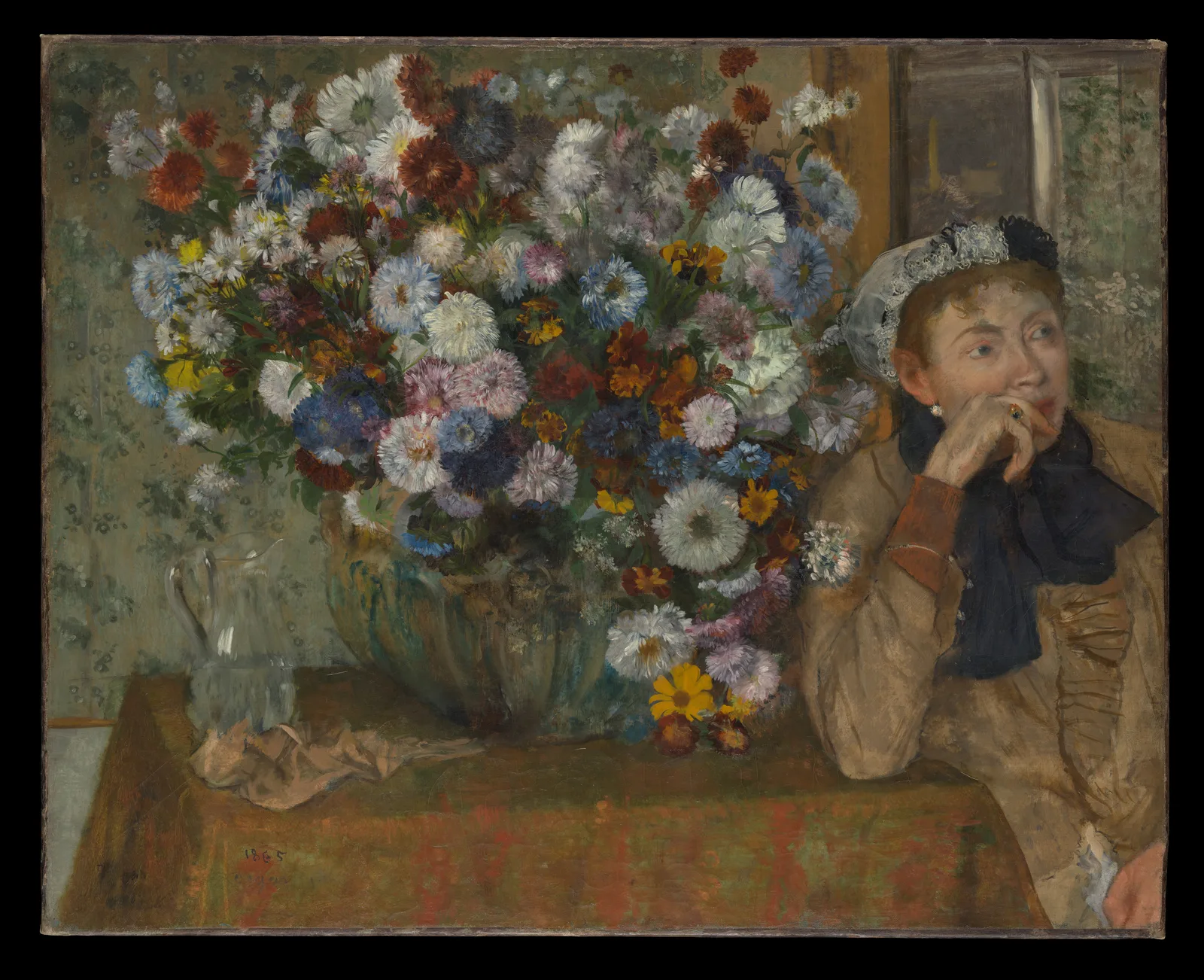
The person is at the right edge. The sitter is probably the wife of Paul Valpinçon, Degas's friend from his school years. She sits with her elbow on the table and one hand at her mouth; her body is cut by the right edge, and her other hand shows only in part in the lower right corner. Her eyes look neither at the flowers nor at us but to the right, out of the picture.
So the painting reads as a portrait and also as a flower still life. In The Met's audio guide, the curator Keith Christiansen calls giving a vase of flowers and a person equal weight a subversive move. X-rays taken in 1987 add one more fact: the bouquet once reached farther to the right, and Degas scraped that part out and painted the woman over it. Her place at the right edge was not empty from the start; it was made by removing flowers. The same audio guide recalls Degas saying that no art was less spontaneous than his.
What the edge cuts in this picture is not the flowers but the person. And her gaze then leaves through that same edge. The frame does not close the picture; it leaves it open to the outside.
1871: dark heads below the stage
Six years later Degas painted this tall canvas. It shows the third act of Giacomo Meyerbeer's opera Robert le Diable, in which the spirits of nuns rise from their tombs and dance in the ruins of a moonlit monastery.
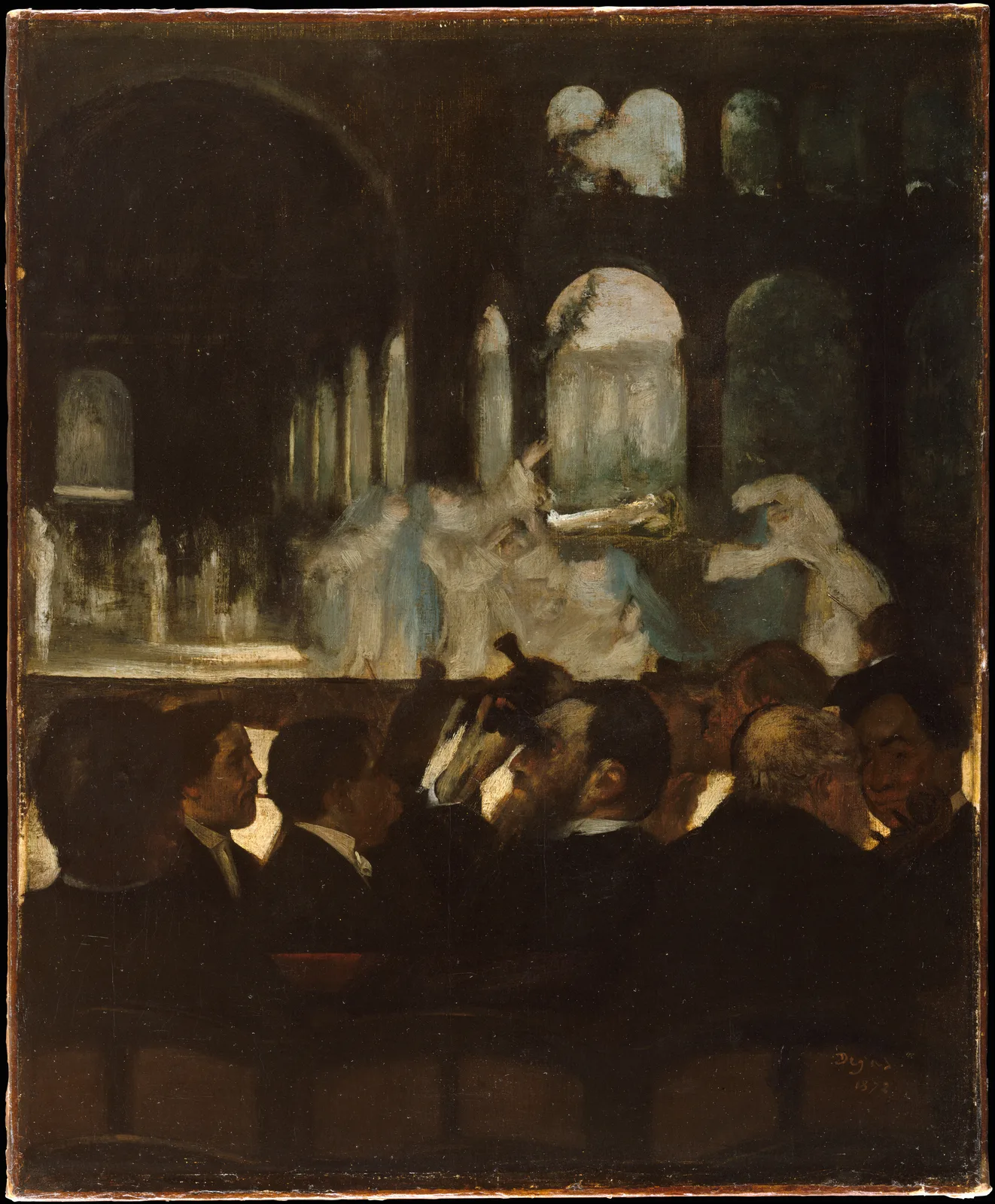
Yet the ballet named in the title fits into the upper half of the picture. Faint light falls between dark arches, and the white-robed nuns are soft blurs made with a few strokes of the brush. Below the bright front edge of the stage runs a row of men's heads in black clothes. Under them, roughly the bottom quarter of the picture is darkness in which only vague shapes, perhaps a rail or seats, can be made out. The man at the far right is cut by the edge.
Degas's friend Désiré Dihau, the bassoonist, is among the musicians in the front row. Just above and to the left of the bearded man in the middle, someone holds up a pair of dark opera glasses. The Met describes this man as indifferent to the action, pointing his opera glasses at the audience rather than the stage. X-rays taken in 1987 show that the figure with the opera glasses was painted over another musician, and that one more dancing nun was once in the recesses of the cloister on the right. Degas took one figure off the stage and, in place of a musician, put a man who is not watching it.
As a result, the lower half of the picture is darkness and the backs of heads of people who are not the subject. We are placed not squarely in front of the stage but behind the heads in front of us, and the stage is pushed up toward the top of the canvas.
1874: the middle of the room, the right of the canvas
The Dance Class is painted on a nearly square canvas. It was commissioned by the baritone and collector Jean-Baptiste Faure, and Degas delivered it in November 1874. In the middle, a dancer in a pink sash performs a step with one arm raised high, watched by the ballet master Jules Perrot (1810–1892), who leans on a long cane.
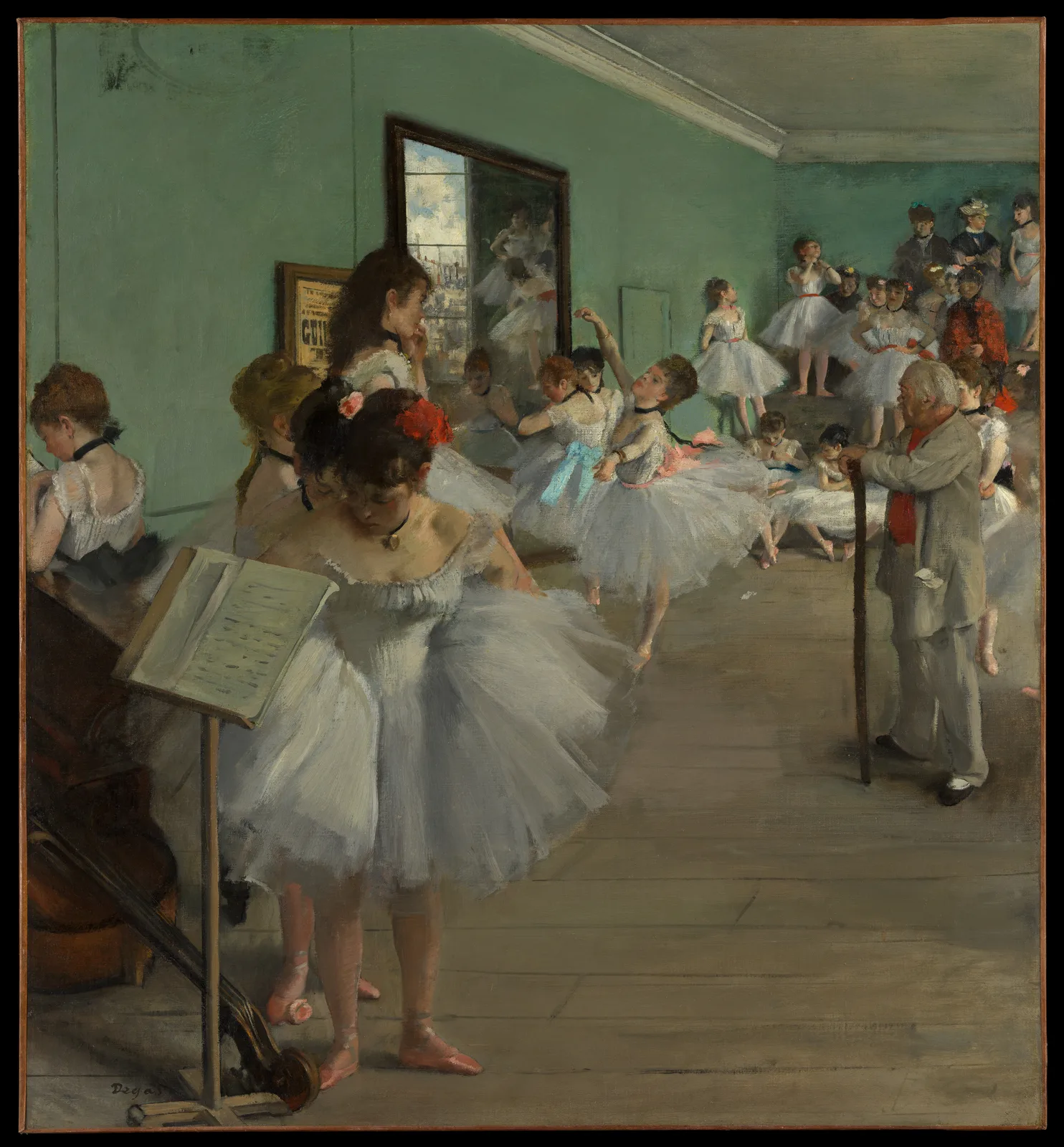
The Met's entry explains that Perrot stands at the right of the canvas but seems to stand in the middle of the room. The floor makes the difference. The seams of the floorboards rise in layers almost parallel to the bottom edge, while the left wall and the ceiling moulding recede at a slant from front left to back right. The perspective tilts the floor upward. Because the floor is tipped up like this, the lower right of the picture, between the front dancers and Perrot, is a wide stretch of floorboards with nobody on it.
The edges were not left alone either. At lower left, a double bass lying on the floor sits at a sharp angle to the left edge and most of its body is cut away; at the far right, a dancer is cut vertically so that only about a third of her remains. Any piano accompanist has been cropped out, and the score on the music stand was left illegible on purpose. The Met's entry suggests that the radically cropped instrument and dancer were most probably compositional ideas taken from Japanese ukiyo-e woodblock prints.
X-rays confirmed changes to the size of the mirror, the position of the central dancer, and the head and feet of the dancer at front left. The picture is a carefully built composition, not an impression caught on the spot. It hung at the second Impressionist exhibition in 1876 under the title Examen de danse (Dance Examination).
1877: the floor left empty
Three years later, the figures are pushed even farther away. Two dancers in the upper right hold a barre fixed to the wall and stretch one leg each along it. The foot of the dancer on the right stops just short of the right edge. The lower half of the picture is grey floor with almost nothing on it.
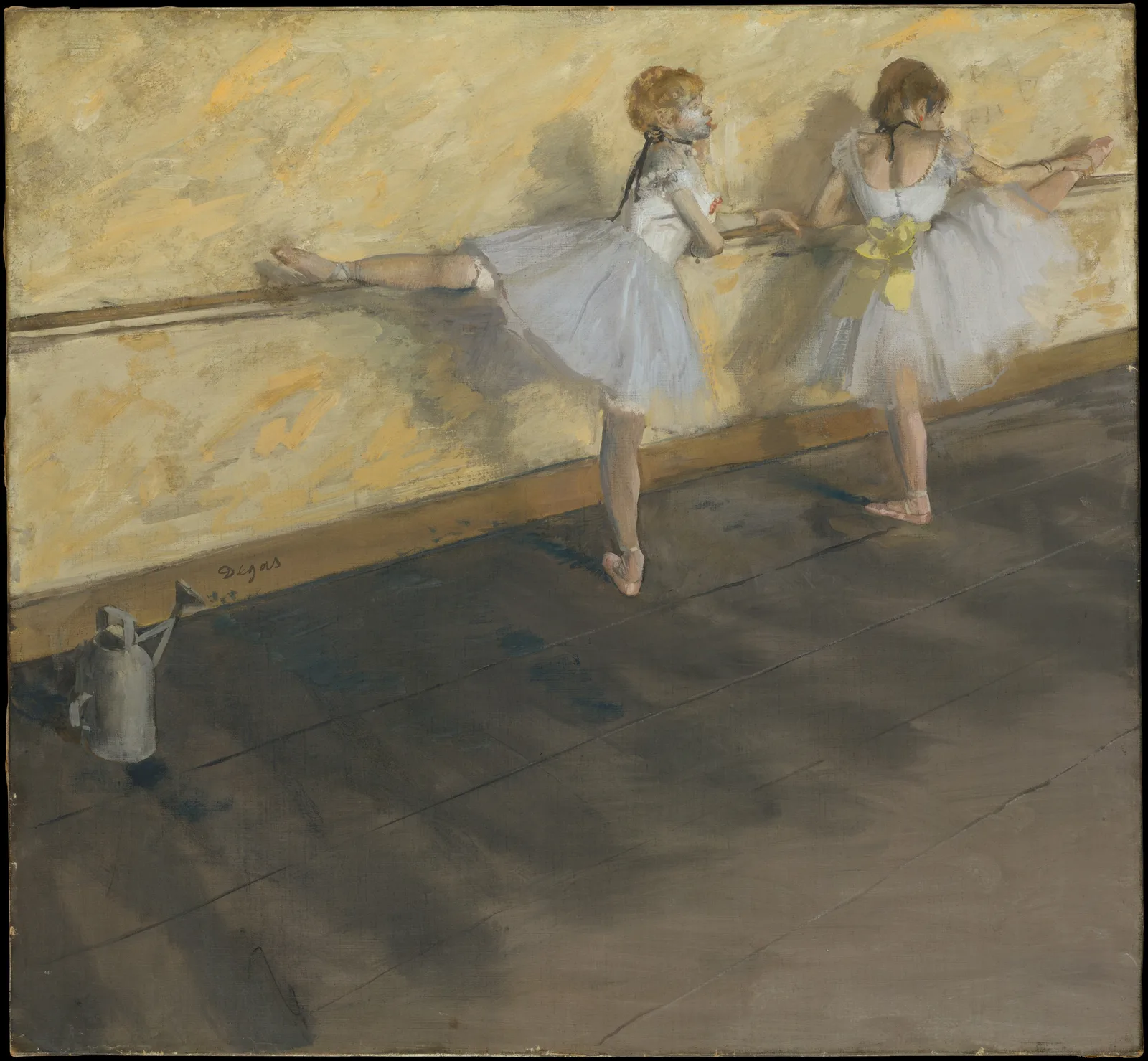
The skirting board and the seams of the floorboards all rise at a slant from lower left to upper right. We look down on the floor from a fairly high point. Near the exact centre of the canvas there is only the toe of the left-hand dancer and the bare floor beside it.
Against the wall at the left stands a watering can. Rehearsal rooms kept one to sprinkle the floor so that dust would not rise while the dancers worked. The Met sees it as a visual pun: the shape of the dancer on the right echoes it. Across the empty floor, the can with its spout stretched out and the dancer with her leg stretched out make a pair. The painting was shown at the 1877 Impressionist exhibition.
1876: what Duranty put into words
According to the French Ministry of Culture, in April 1876 the Impressionists rented three rooms at the Durand-Ruel gallery, 11 rue Le Peletier in Paris, for their second exhibition. In the same year the writer and critic Edmond Duranty published a 38-page pamphlet, La Nouvelle Peinture (The New Painting), about the group of artists exhibiting in the Durand-Ruel galleries.
On page 29 there is this sentence: the figure “is never at the centre of the canvas” (il n'est jamais au centre de la toile). Duranty goes on to say that the figure is not always seen whole and sometimes appears cut at mid-leg or mid-body, or sliced lengthwise. Just before, in a passage that runs from page 28 to the top of page 29, he finds the reason in our eyes. Our viewpoint is not always in the middle of a room; it cannot simply get rid of the wide stretches of ground and floor in the foreground, and it is sometimes very high, sometimes very low. Our field of view seems bounded by a frame, so things to the side are seen only as caught in the edge of that frame; indoors, the window frame cuts the view outside in ever unexpected ways.
Duranty names no painter in this passage. Still, set beside the four pictures, his sentences fit clearly: the woman of 1865 is squeezed to one side and cut by the edge, the dancer of 1874 is cut lengthwise, and the floor of 1877 spreads out from a high viewpoint. But apart from the 1877 picture, all of them came before his text, and the 1874 one hung in that very 1876 exhibition. His sentences are less a rule Degas followed than a contemporary putting into words what had already been painted. The Met's essay on Degas explains that he took cropping and asymmetry from Japanese prints and had also seen how sixteenth-century Italian Mannerists cut off parts of figures.
How to start at the edge
In these four pictures the edge is more than the line where the picture stops. As the X-rays show, Degas reworked these arrangements while he was painting, scraping out, moving and painting over figures.
So in front of a Degas, change the order. Do not start at the middle; go once around the four sides and look for two things: one thing the edge cuts, and one place left empty. Find those two and you will see why the main figure is where it is. In Degas, the edge decides what you see.
Add your perspective.
Share a question, another approach, or something you have tried.
Checking sign-in…
Loading comments…