When we look at a gold-leaf screen, we tend to call the gold the background. In front of Ogata Kōrin's Irises at Yatsuhashi that word soon stops working. The wooden bridge crossing the picture ought to stand over water, yet there is no water under it. There is only gold. So is that gold ground, or is it water?
You can pick one spot on a gold ground, check whether a sharp border runs around it and what passes over it, and read from that what the spot is doing at that moment. Three screens and one drawing with no gold, released by The Metropolitan Museum of Art and the Cleveland Museum of Art, show how.
Ogata Kōrin (1658–1716) was born into a family of textile merchants in Kyoto. He carefully studied the works by Tawaraya Sōtatsu and Hon'ami Kōetsu that his family owned, and made pictures more abstract and simplified than theirs. The name Rinpa, for a decorative painting style of the Edo period, comes from his name. According to The Met's essay, though, Rinpa was not an organized or hereditary school; the word groups artists who worked in a similar style.
A bridge with no water
Irises at Yatsuhashi is a pair of six-panel screens, and one of the pair is shown here. The scene comes from The Tales of Ise. Driven out of Kyoto, the protagonist reaches Yatsuhashi, where a stream splits into eight channels with a bridge over each. The irises there prompt him to write a poem longing for the person he left behind. The first syllables of its lines spell kakitsubata, the word for irises.
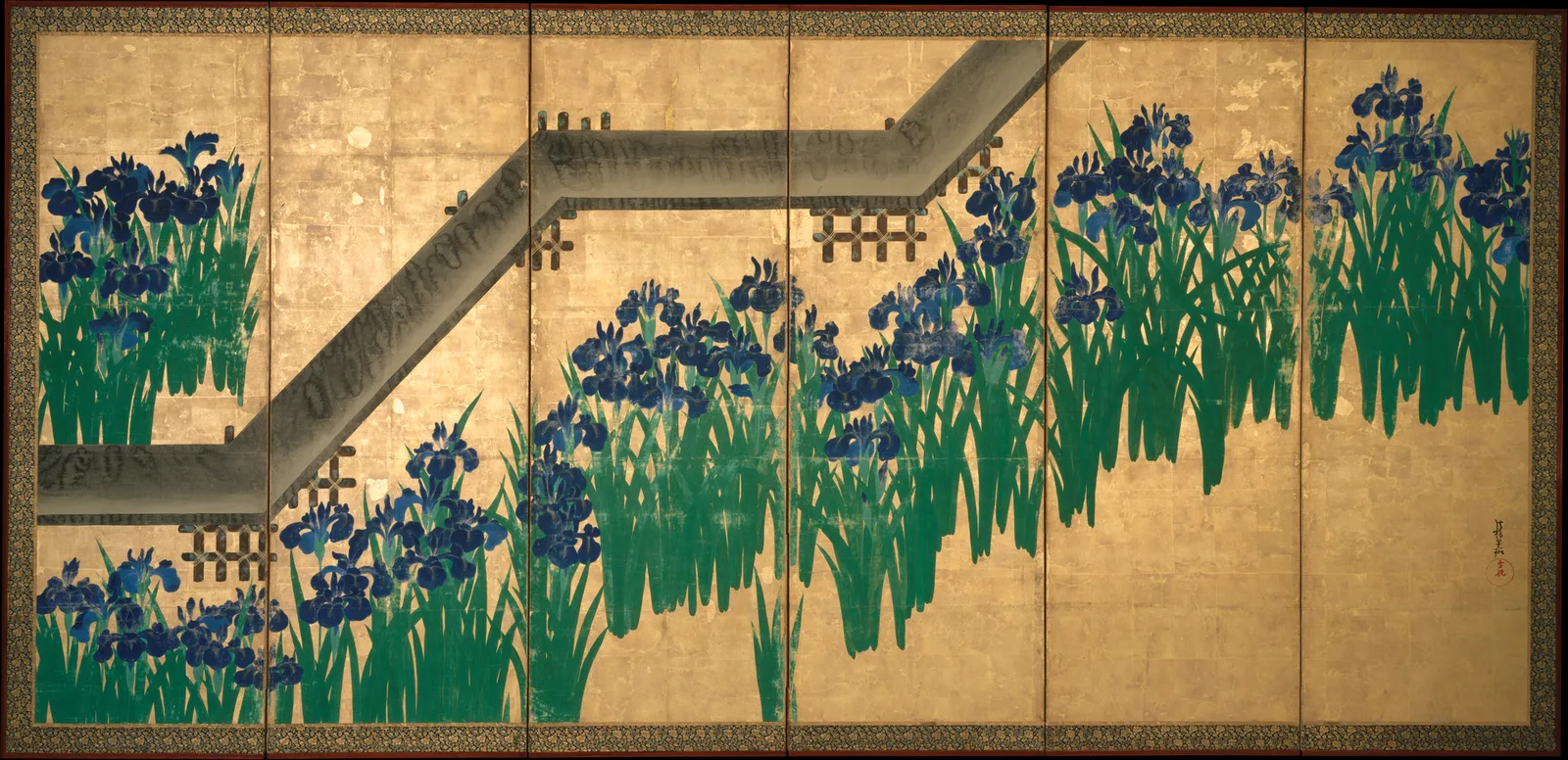
Yet the eight channels are not in the picture. Blue goes to the flowers and green to the leaves, apart from a few blue-green patches on the bridge supports, and neither a colour nor a line stands for water. The only sign of it is the dark grey bridge with the lattice supports beneath. The bridge bends its way up from the left edge toward the upper right and is cut off at the top edge. The bases of the leaves also simply end on the gold, with no line for the ground. The gold under the bridge has to be water. The gold under the irises could be ground or shallow water, since kakitsubata grows in marshes and shallows. But nothing marks where one becomes the other. The poet himself is not painted in this screen.
The gold itself does not allow depth either. Zoom in on The Met's photograph and the square seams of the leaf show like a grid, with the vertical folds of the screen running across them. The moment you try to read it as water or ground, what is in front of you turns back into flat pieces of metal.
When gold becomes the body of a wave
Rough Waves is a two-panel screen. It is earlier than the last picture and its materials are nearly the same, but the gold does something else. A dark blue-green band crosses the picture, and the waves appear as gold left within it. Thin wave lines are drawn in ink on their bodies, and the bodies themselves seem to be the gold ground showing through.
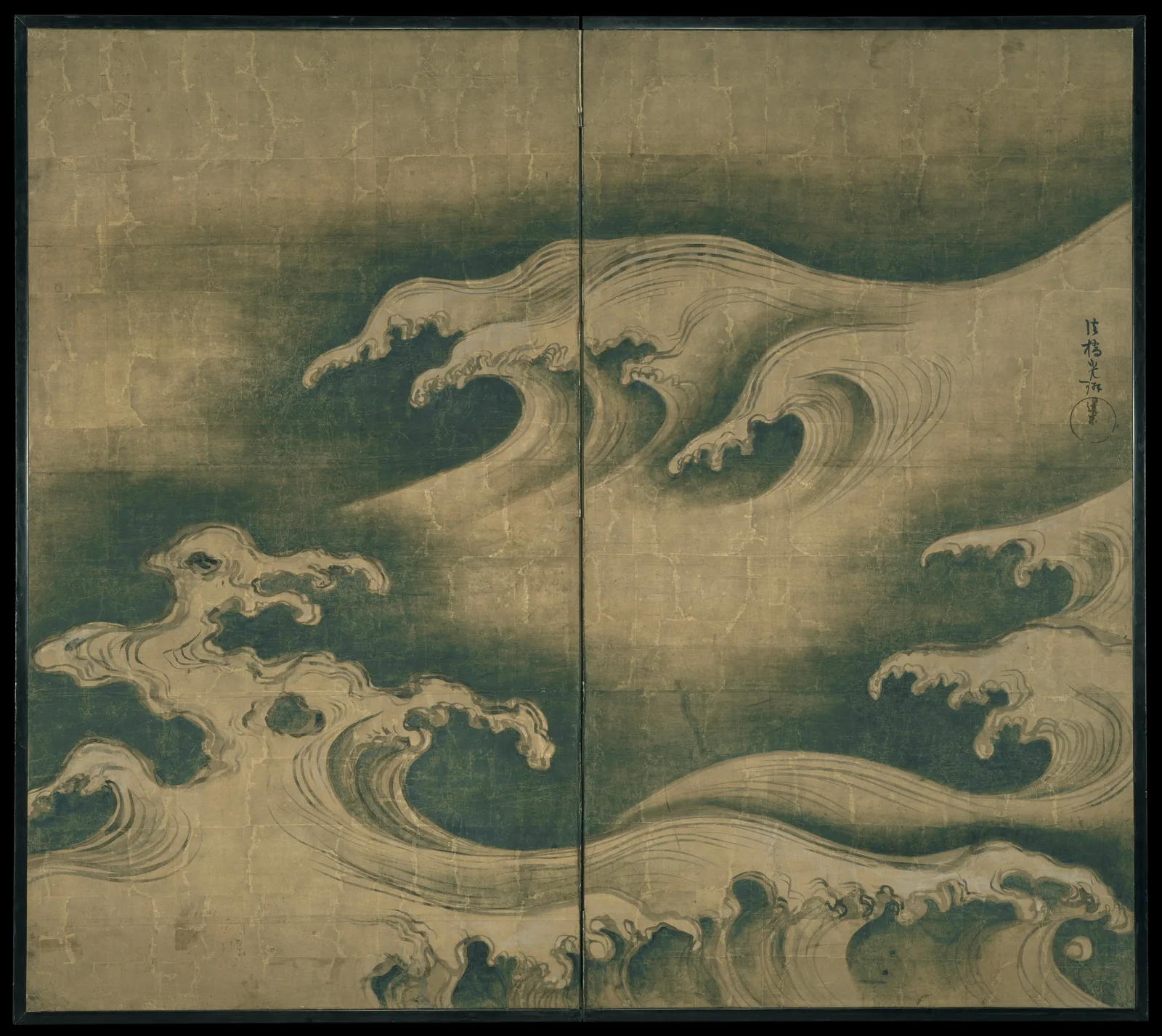
The place to watch is the border. Where a wave meets the dark, the edge is as sharp as if cut with a knife, right down to the curled foam and the holes in the crests. But the top of the dark band and its end in the middle of the picture fade away into the gold. So the same gold is the body of a wave below, and above it stays undecided between sky and sea mist.
According to The Met, this screen may have been inspired by images of waves by Sesson Shūkei (ca. 1504–ca. 1589), and the outlines of its claw-shaped waves were drawn in an old Chinese technique that holds two brushes in one hand. Sesson was a Zen monk and painter of the Muromachi period. The seal at upper right gives the name Dōsū, which Kōrin began using in 1704. Pale cracked lines run across the gold; whether they were there from the start or came with age cannot be told from a photograph.
A drawing with no gold
Cranes, Pines, and Bamboo is a preparatory drawing on paper with no gold on it. According to The Met it is thought to have been among the sketches and drawings once owned by the Konishi family, Kōrin's descendants, and was later remounted as screens. The smudged upper trunk of a pine and its faint branches show that it is unfinished. The screen here is the right one, with four panels.
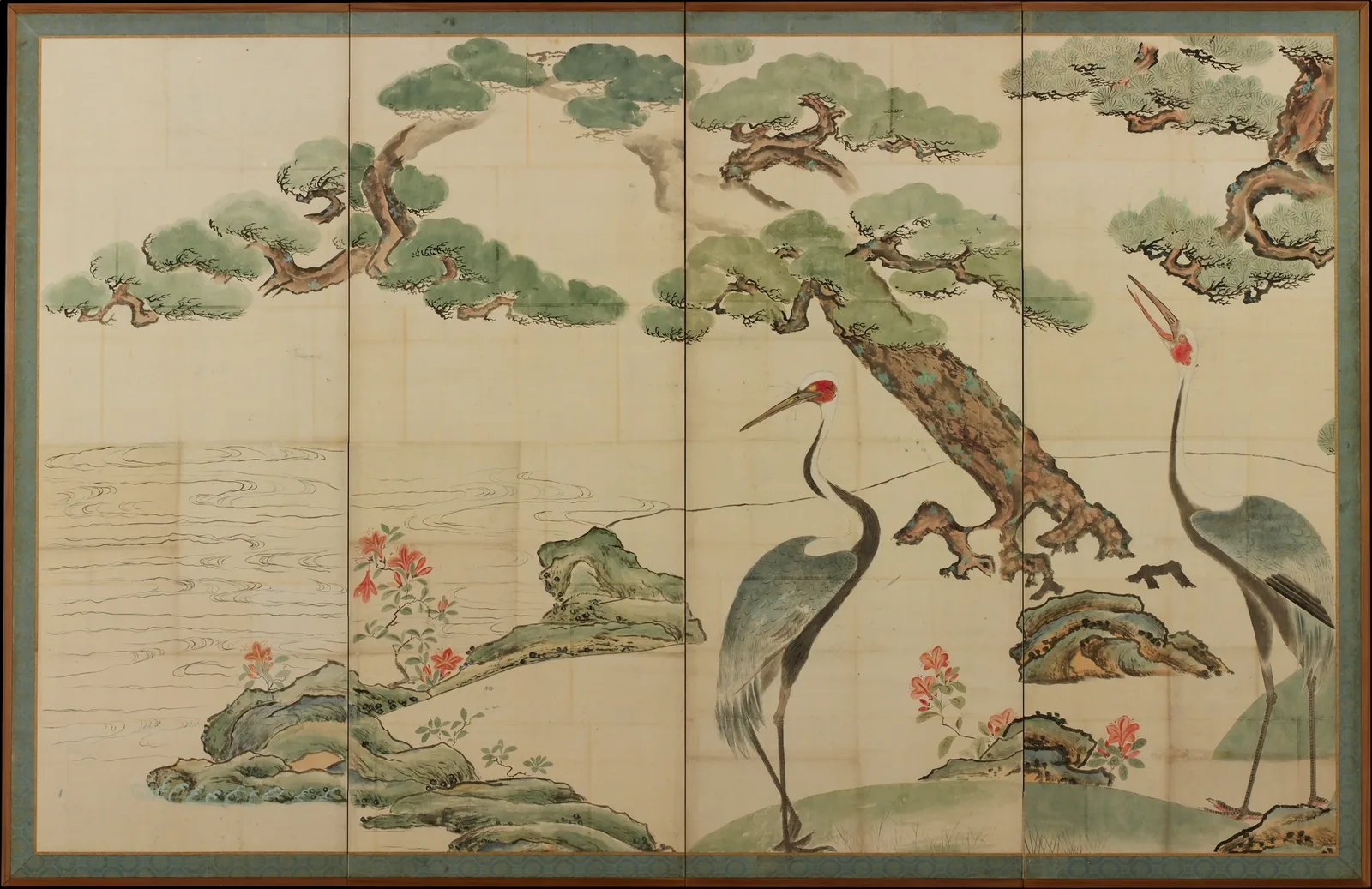
With the gold taken away, it is easier to see what the ground does. The water at lower left has no colour. It is only thin swirling ink lines laid over one another, with bare paper between them. Above where the lines stop the paper is the same, but there it no longer looks like water. The Met also names the placing of the stream, flowing toward the viewer, as the most striking feature of the pair. What sets how far the water reaches is not the ground but the lines laid on it.
The square lines where the paper seems to be joined, visible across the whole picture, also resemble the seams in gold leaf. But this drawing is dated only to the early 18th century, so it cannot be said to come before or after the first two screens. What it shows is not a sequence but how one painter used an empty ground.
Colour the water and the gold splits
The last screen needs care. The Cleveland Museum of Art lists Chrysanthemums by a Stream as possibly by Ogata Kōrin and dates it about 1715–30 or later. The museum says works with this signature are sometimes placed in the last year of his life or after his death, with studio assistants doing most of the work either way, and that a later artist emulating his designs is also possible. So this one screen cannot speak for Kōrin's own hand, but it does show how his method carried on.
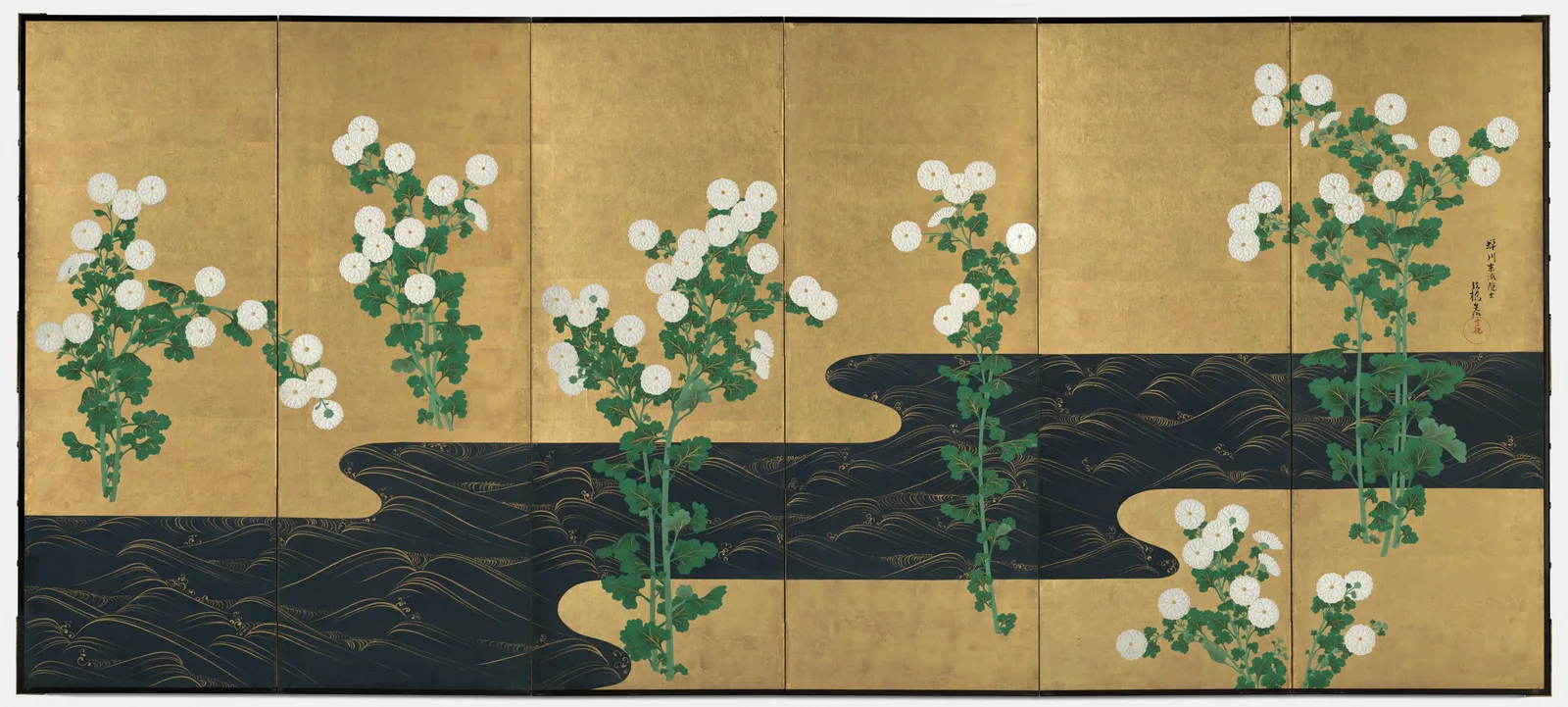
Here the water is painted as a dark navy mass, the exact opposite of Irises at Yatsuhashi. You might expect that to settle the gold as ground, but follow the chrysanthemum stems and it does not. The base of the plant at upper left ends on the gold above the stream, so there the gold is ground. The middle plant starts on the gold bank below the stream, rises across the navy water and flowers in front of the gold above it, so there the same gold is air. Gold also returns inside the navy water as fine wave lines.
Whose border is it?
There is a useful term for this difference. About two centuries after Kōrin, in 1915, the Danish psychologist Edgar Rubin set out figure and ground with his picture that flips between a vase and two faces. As a 2012 review of Gestalt psychology explains it, a border gives shape to one region, which is seen as the figure, while the region next to it has no shape from that border and seems to continue behind as ground. This is of course a modern term that Kōrin could not have known.
Seen this way, the three gold screens fall into place. In Rough Waves the sharp border belongs to the wave, so that gold becomes a figure, and the gold above, where the border fades, gets no shape. The gold of Irises at Yatsuhashi touches the edges of the bridge and the leaves, but those borders belong to them. The gold has none of its own, which is why it can be water or ground. Low in Chrysanthemums by a Stream, where the stream and the gold bank meet in a rounded curve, the curve is the shape of the water and at once the shape of the gold bank, and the eye goes back and forth. The word “decorative” alone does not show this movement.
Three things to check in front of gold
When you meet a gold-leaf screen, pick one empty spot of gold before the flowers or the bridge. Then ask three things. Does a sharp border run around this spot? What passes over it? Is the same gold right next to it doing something else? You can do this with The Met's photographs too.
That gives the first question its answer. In these screens the gold is neither ground nor water. It becomes ground or water, moment by moment, depending on the line that comes next to it.
Add your perspective.
Share a question, another approach, or something you have tried.
Checking sign-in…
Loading comments…