Ask someone to draw a person and they will usually start with an outline: the edge of the face, the curve of the shoulder, the border of the arm, closed with a line and then filled in. Look closely at a picture by Georges Seurat, though, and that line is hard to find. The shape of the person is clear, but there is no line around it. Where did the line go in Seurat's pictures?
This note looks at four works by Seurat that The Metropolitan Museum of Art has released into the public domain, in the order he made them: a pencil copy after Ingres from his teens, two conté crayon drawings from his early twenties, and one painting made of dots. Afterwards you will be able to check two things in front of any edge in any picture. Is this boundary a drawn line, or the place where two values meet? And if a line is there, is the thing itself thin?
Georges Seurat (1859–1891) was a French painter, born in Paris and died in Paris. He died at thirty-one, so the four works here sit at the beginning and in the middle of a short career.
In his late teens: a hand copied from Ingres
According to The Met, the young Seurat made more drawings after Ingres than after any other source. This sheet takes a single detail from Ingres's The Apotheosis of Homer in the Louvre, the hand of the painter Poussin, who sits at the lower left of that canvas, and copies it in pencil. Seurat wrote on the drawing "voila le génie" (there is the genius).
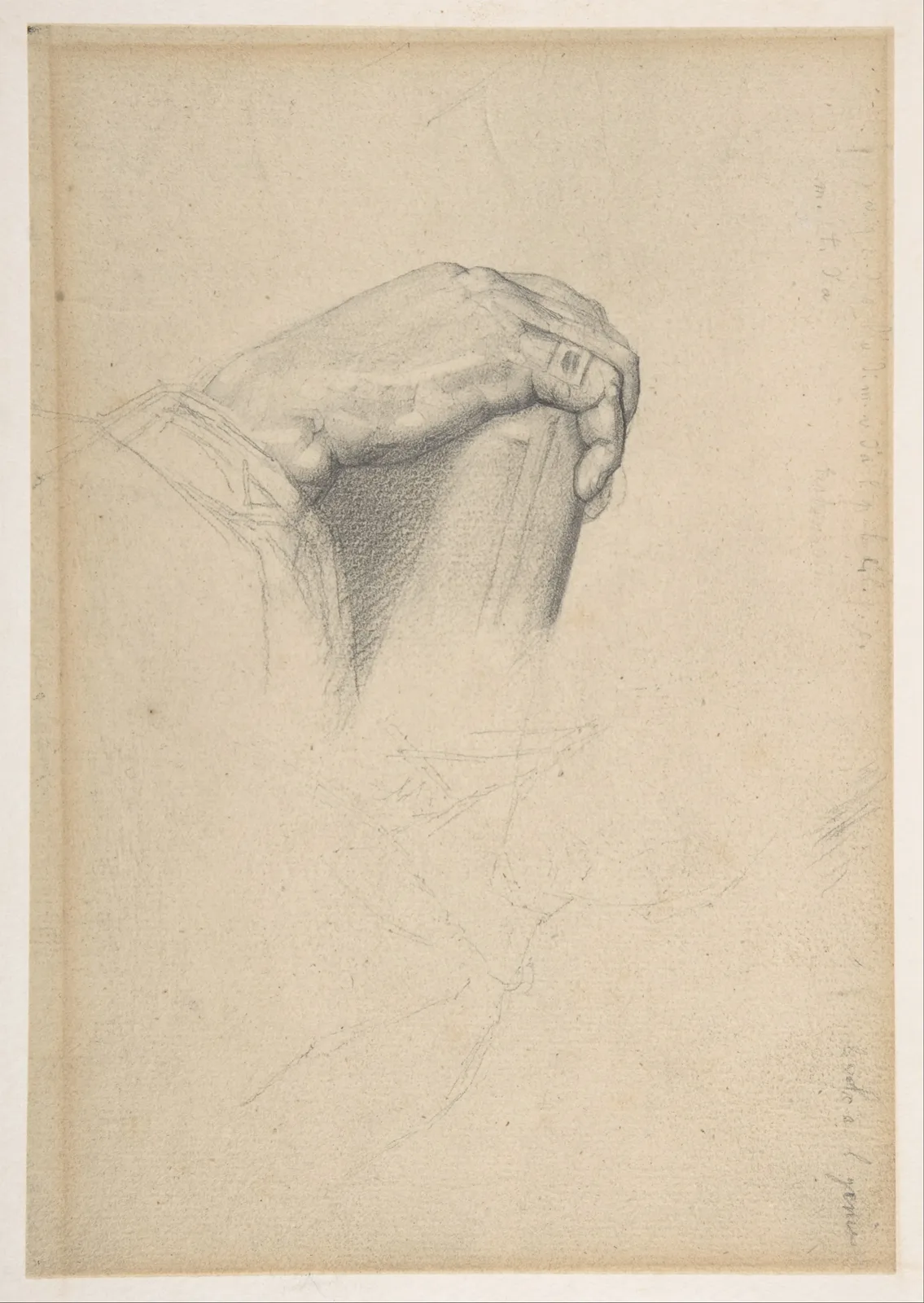
Divide the sheet into two parts and it becomes interesting. The finished part, the hand, stands on shading more than on line. The back of the hand swells with grey rubbed in with the pencil laid almost flat, and the bright spots on the knuckles are paper left untouched. The shadow of the gripped object is pressed darkest, in dense hatching. Even the outer edge of the fingers reads less as a separate line than as the boundary where the light hand meets the dark shadow.
The unfinished part, the sleeve on the left and the lower half of the sheet, holds only thin lines. Here the line is scaffolding that fixes the form, and the more finished the drawing becomes, the more it disappears under the shading. That is already true on this sheet made by a teenager copying Ingres.
1882–83, Embroidery; The Artist's Mother: a face drawn without line
A few years later Seurat put down the pencil for conté crayon, which The Met describes as his favourite graphic medium. He drew his mother, Ernestine Faivre, as she sewed. The Met says the work is "drawn entirely without line in tonal passages of velvety black."
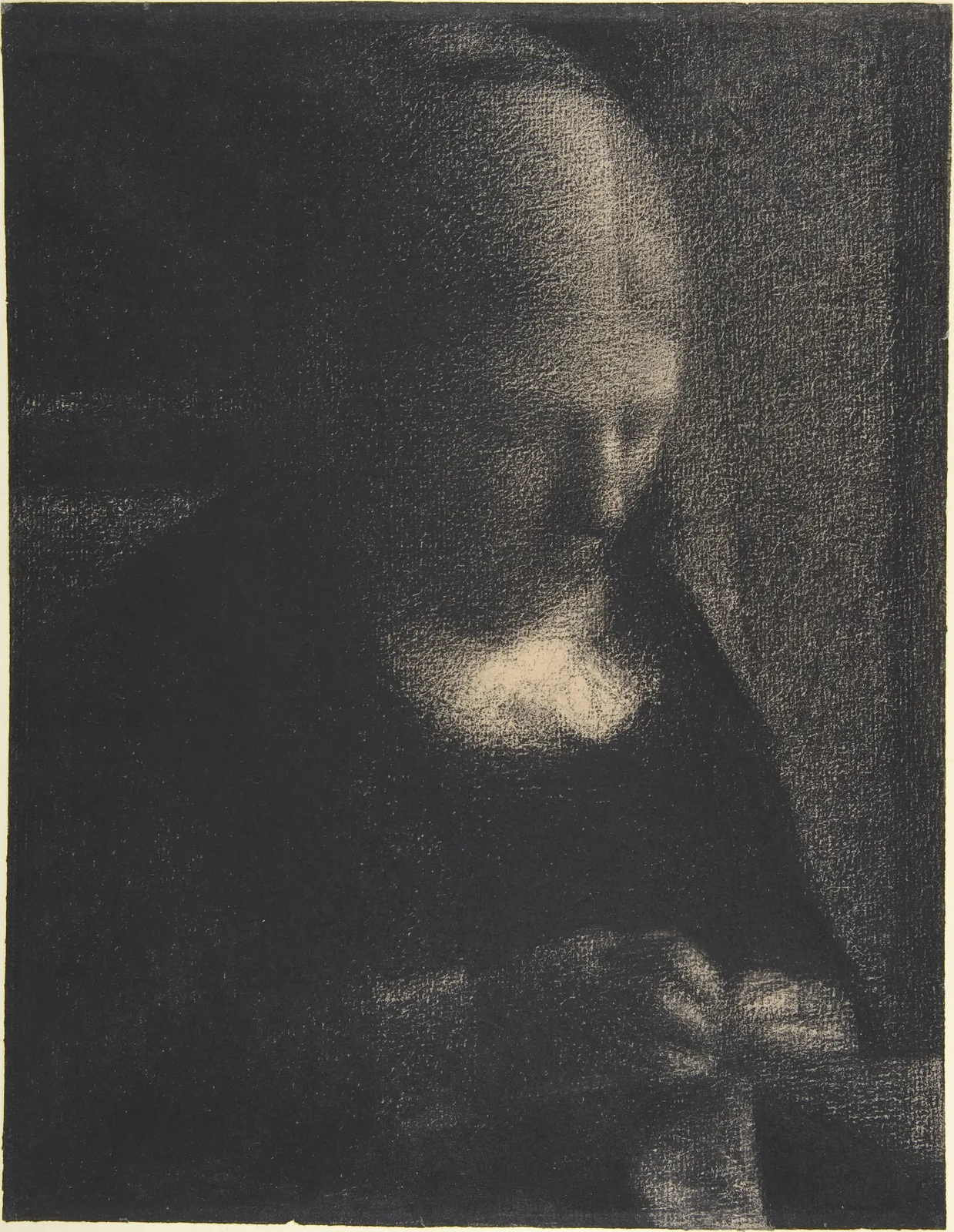
There are only three bright places on the sheet. The top of the head, lit from the upper right, shines in a rounded arc; the ridge of the nose is a short bright vertical stroke; and the white collar under the chin is the brightest of all. The face between them is almost as dark as the background. Follow the left half of the head in particular and there is no point where you can decide what is head and what is wall. The head is not closed by an edge; only the parts the light reaches rise out of the dark.
The way the light is made is the opposite of line, too. The Met writes that the light is evoked by lessening pressure on the crayon. Enlarge the image and, in the grey areas, the grain of the paper shows through the black as close-set white specks, while in the blackest areas those specks are almost filled. The light in this drawing is not white that was applied; it is paper that was left less covered. The painter Paul Signac called such drawings "the most beautiful painter's drawings that ever existed."
Aman-Jean at the Salon of 1883: where is the edge of the profile?
At about the same time Seurat drew his friend, the painter Edmond-François Aman-Jean (1858–1936), in profile. The two had studied together at art schools in Paris and shared a studio in 1879. The drawing is a finished work, not a study; it was shown at the Paris Salon of 1883 and was the first work the twenty-three-year-old Seurat exhibited. At 62 cm high, it is about twice the height of the drawing of his mother.
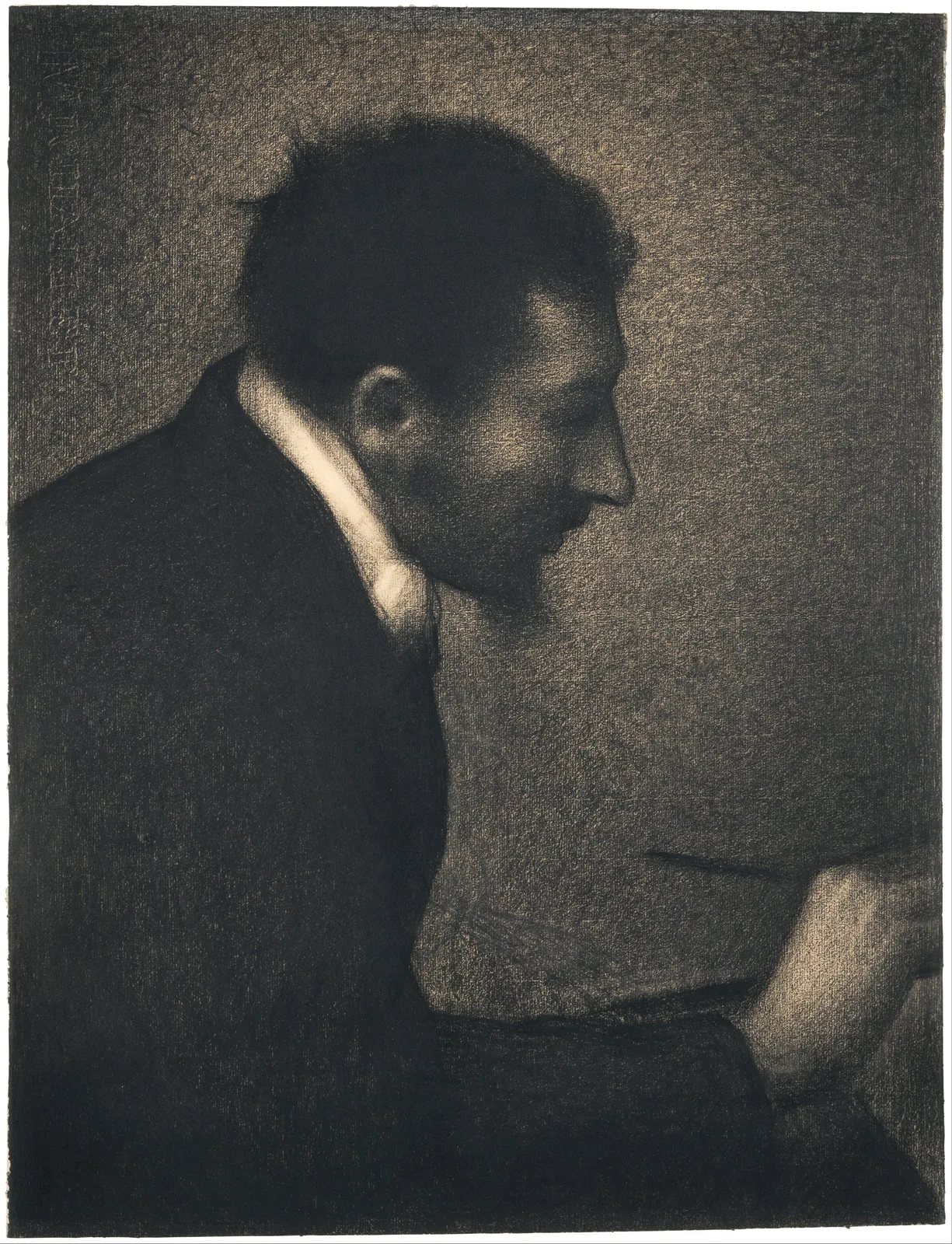
A profile is the pose in which an outline does the most work in a portrait. A single line running from the forehead to the tip of the nose, the lips and the chin is enough to show what a face looks like. Yet enlarge this drawing at the edge of the forehead and nose and that line is not there. The grey face meets a slightly lighter grey-brown background, and at the boundary the density of the crayon changes by one step. At the top, the hair frays out into the background altogether.
Still, the profile is not blurred. If anything it looks like a solid mass. The black coat and the head take up a large part of the left side of the sheet, and the white band of the collar and the grey of the face grow lighter from that mass step by step. A staircase of values holds the shape instead of a line.
The mark closest to a line in this drawing is at lower right: the thin stick in the light hand. It is drawn as a single dark horizontal stroke reaching left from the hand, narrowing and fading towards its end. A line appears only where the thing itself is thin and long. The same rule carries on into the painting below.
Looking again through Wölfflin's "linear and painterly"
In Principles of Art History (Kunstgeschichtliche Grundbegriffe), published in 1915, the art historian Heinrich Wölfflin set out differences of style as five pairs of concepts. The first pair is the linear and the painterly. The linear way grasps bodies as if they could be touched, in outline and surface, and puts its weight on the boundaries of things; the painterly way gives itself up to mere visual appearance and lets those boundaries dissolve. Wölfflin also called this a way of "seeing in patches instead of lines."
Wölfflin used these concepts for the difference between sixteenth- and seventeenth-century European art, not for Seurat. So this is not a matter of fitting Seurat into the scheme, only of borrowing the pair as a lens. Held up to that lens, Seurat stands on neither side. His forms are closed and distinct, as in a linear picture: Aman-Jean's profile and his mother's white collar do not blend into their surroundings. But the material of those forms is, as in a painterly picture, nothing but patches of value. Seurat makes linear forms without lines.
1887–88, Circus Sideshow: the line hid under the dots
The last work is a painting about 1 m high and 1.5 m wide. According to The Met it is Seurat's first night scene and his first picture of popular entertainment: the sideshow of the Circus Corvi at an annual fair in eastern Paris in spring 1887. A sideshow (parade) was a free sample performance on a stage outside the tent. The painting was first shown at the Salon des Indépendants in 1888.
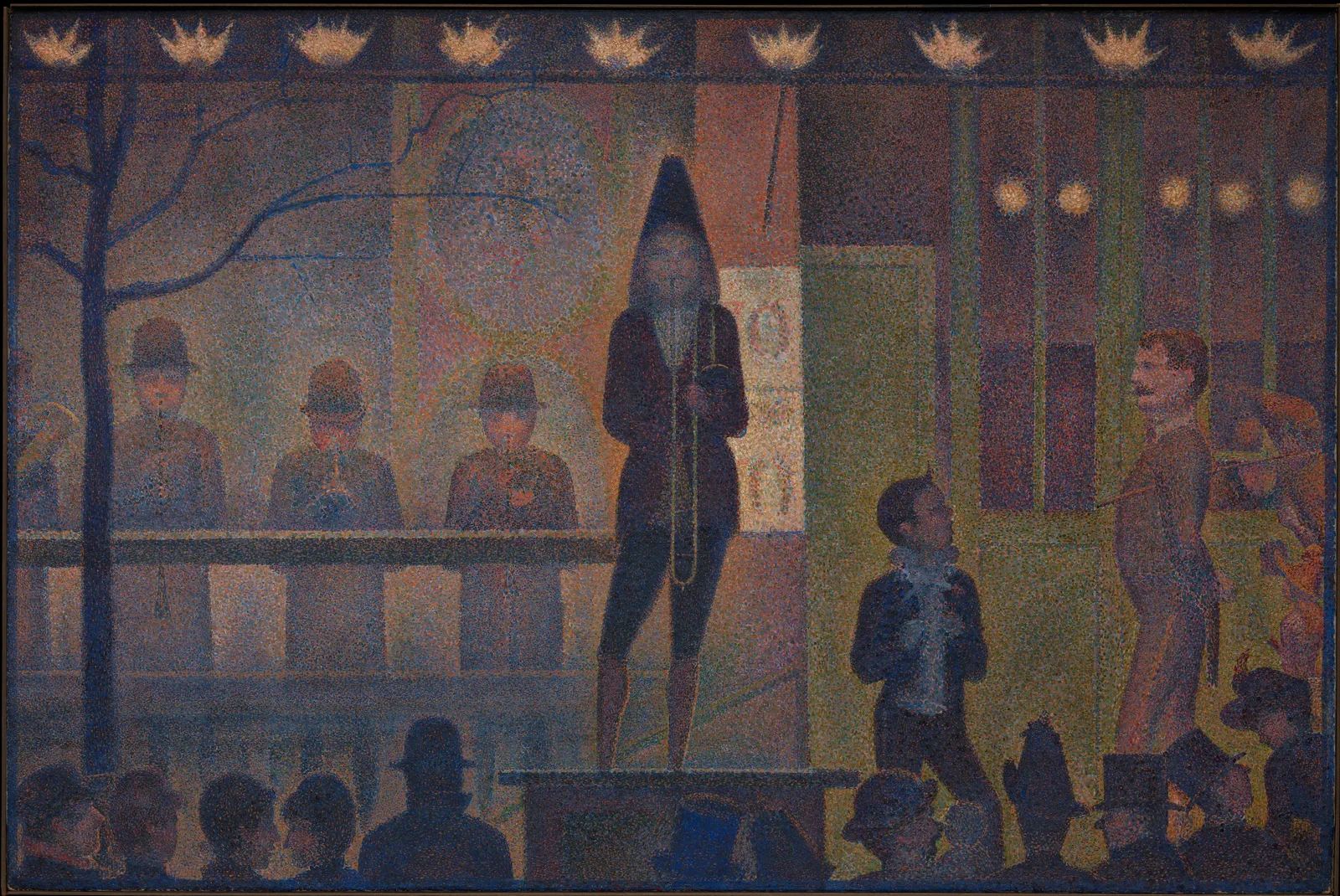
Enlarge the trombonist in the centre and his edge is a band, not a line. The dark blue-violet dots of the conical hat mix with the dots of the orange background over a width of a few dots and then stop. The heads of the onlookers along the bottom work the same way: where dark blue dots gather is a head, and where the dots thin out and orange mixes in is the boundary. The Met's technical notes say the dotted technique was particularly well suited to evoking the soft edges of night vision. Even the strokes that look black are mostly extremely finely divided cobalt blue.
So was there no line at all? The same notes answer. Examination in 2016 showed a grid of squares, six across and four down, which Seurat likely laid in with coloured chalk, and he seems to have used thinned Prussian blue paint for the contours of some of the figures. Over this he first set large, widely spaced dots and dashes, then covered them with dots of diminishing size. The line did not vanish; it was buried under the dots. The scaffolding that disappeared under shading in the pencil drawing lies here beneath the layers of paint.
There are places where a line stays on the surface: the thin blue branches of the tree on the left, the railing across the front of the musicians, and the slanting rod at the upper right of the trombonist that ties the gas pipe to the tent. All of them are things that are themselves thin and long. Like the stick in Aman-Jean's hand, Seurat drew only thin things as lines.
What to check in front of a picture
Across the four works, the line went to three places. It stayed as scaffolding in unfinished parts, it was buried under shading and layers of paint, or it showed only on things that are thin to begin with. Every other edge is a place where two values meet.
Next time, in front of any picture, choose one edge and look at it for a while. Is there a mark there that exists only for the boundary, or does the value simply change between inside and outside? And if you do see a line, ask whether the thing is thin, like a branch or a stick. These two questions go a long way towards telling a painter who thinks in lines from one who thinks in masses.
Add your perspective.
Share a question, another approach, or something you have tried.
Checking sign-in…
Loading comments…