Standing in front of a painting by Thomas Eakins is oddly quiet. The people are in the middle of doing something, yet they hold still, and the room or the river does not recede so much as sit firmly in place. Where does that firmness come from? Before a large picture, Eakins laid out its space with a ruler and pencil, and a few of those plans happen to survive alongside the paintings.
This note sets two finished pictures beside the two perspective drawings beneath them, and looks for where the drawings' straight lines survive in the paintings and where they vanish under the paint. Afterwards, in front of other realist pictures, you will be able to pick one straight line left on the surface, extend it, and work out for yourself how the painter built the space.
Eakins (1844–1916) was born in Philadelphia and worked there for almost his whole life. According to an essay by The Metropolitan Museum of Art, he studied at the Pennsylvania Academy of the Fine Arts from 1862 to 1866 and attended anatomy lectures at Jefferson Medical College; in 1866 he went to Paris, where for almost three years he studied principally with Jean-Léon Gérôme at the École des Beaux-Arts. After a winter in Spain he returned to Philadelphia in July 1870. All four works are released as public domain or CC0 by The Met and the Cleveland Museum of Art.
One yardstick: Panofsky's "mathematical space"
In "Perspective as Symbolic Form", published in 1927, the art historian Erwin Panofsky wrote that perspective turns the space we live through with our bodies into mathematical space. In fact we see with two eyes that never stop moving. A perspective picture assumes a single, motionless eye and turns the floor into a grid that runs on evenly without end. On that grid every object gets an exact place and an exact size.
Taken as a yardstick, this raises a question. How much of the mathematical grid a painter ruled in a drawing can still be seen in the finished picture? And if it cannot be seen, what covers it, and what is left of it?
The finished picture first: The Chess Players
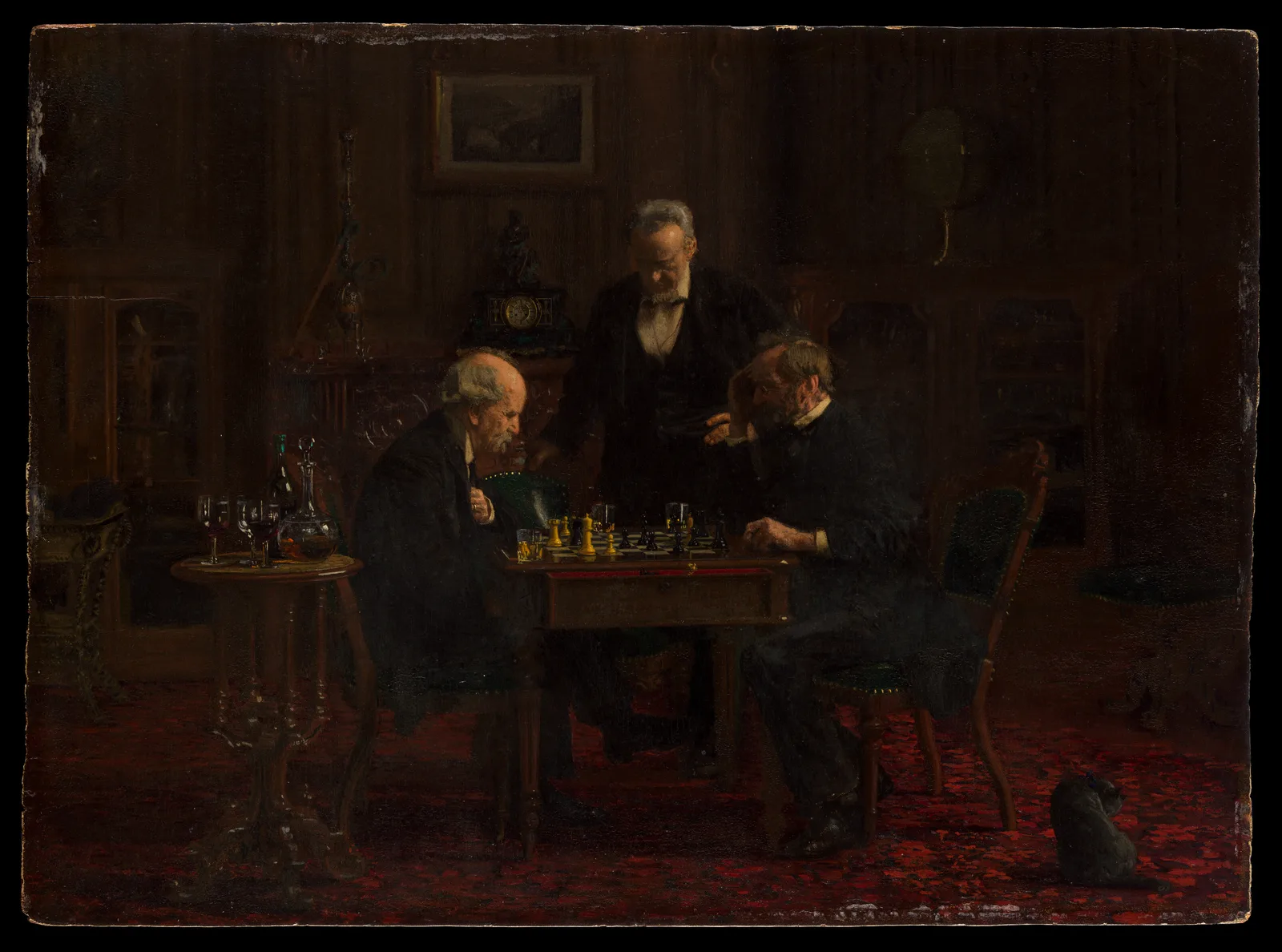
The Met describes the scene as the artist's father watching two friends play chess in the parlour of a Philadelphia home. The standing man with the white beard is the father, Benjamin Eakins, and the front of the table's drawer carries a Latin inscription meaning "Benjamin Eakins's son painted this in '76". A reproduction of a painting by Gérôme hangs over the mantel. In 1881 this became the first work the Met accepted as a gift from a living artist.
The picture is dark. Between the brown walls and the black clothes, the only bright things are the three men's foreheads and white hair, the yellow chessmen and a few glasses of amber liquor. All three faces turn down, towards the board. The old man on the left bows his head deeply; the man on the right props his forehead on his hand. The standing father looks down at the board between them. The three heads form a triangle with the board below its apex, and inside it the gazes meet at one point.
Now look at the floor. A red carpet fills the lower third, its pattern loosened into slack patches of red and black. Nothing there could be called a line. Only one regular grid remains in this room: the chessboard, its black and white squares stepping back in rows. Extend the board's left and right edges upwards and they meet near the horizontal centre of the picture, in front of the standing father's body. These are lines drawn by eye on a photograph, so the position is approximate.
The plan under the paint: the perspective drawing
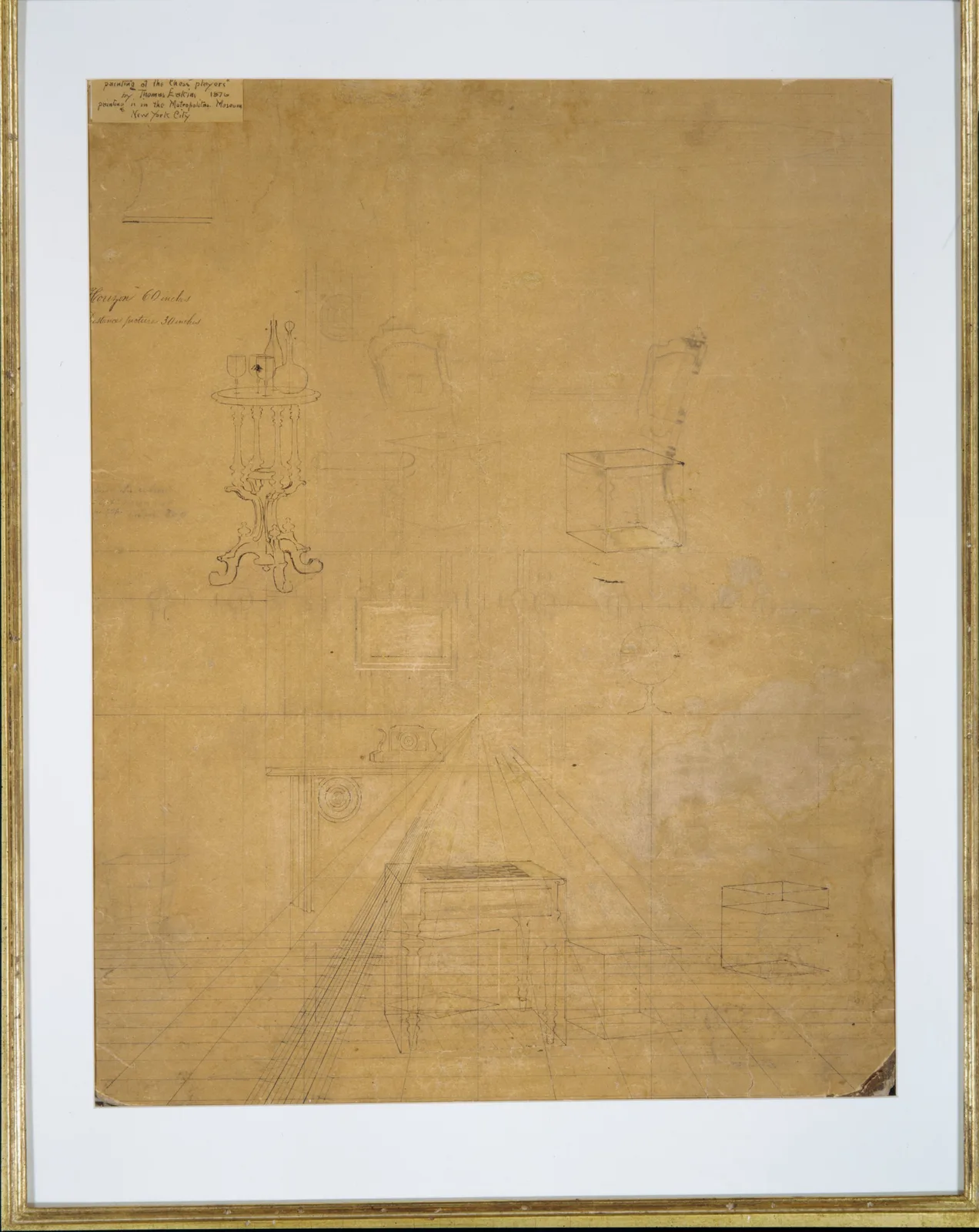
This is the plan of the same room. At 61 × 48.3 cm the cardboard is larger than the painting (29.8 × 42.6 cm), and upright rather than wide. The first thing to notice is that there is not a single person in it. There are only the table and chairs, the fireplace and clock, the small table with its bottles, and a picture frame.
The floor at the bottom is ruled with close horizontal lines, and above them a fan of thin lines spreads out and gathers to a single point. That point lies just to the right of the clock on the mantel, a little higher than the top of the clock. The chess table is drawn like a transparent box, every edge in place, so that even the lines of the back legs show. The two chairs near the top sit inside slanted cubes as well. Objects are first set down as boxes, and their shapes are then carved into them.
On the left edge are two handwritten lines, which read "Horizon 60 inches" and "Distance picture 30 inches". The first letter of the second line runs off the edge of the board, but that line appears to record the distance from the eye to the picture. A horizon at 60 inches (about 152 cm) is roughly the eye level of a standing adult. That explains why, in the painting, we look down onto the chessboard. The picture is set up for the eye of someone standing, not of the two seated players: about the height of the father bending over the board.
Set against the painting, the difference is plain. The floor grid that held up the space in the drawing has disappeared completely under the patches of carpet. The logic of the grid remains, but the visible grid has shrunk to the chessboard alone. To borrow Panofsky's terms, mathematical space supports the whole picture, yet shows its face only as a game board.
Straight lines on a river: The Biglin Brothers Turning the Stake
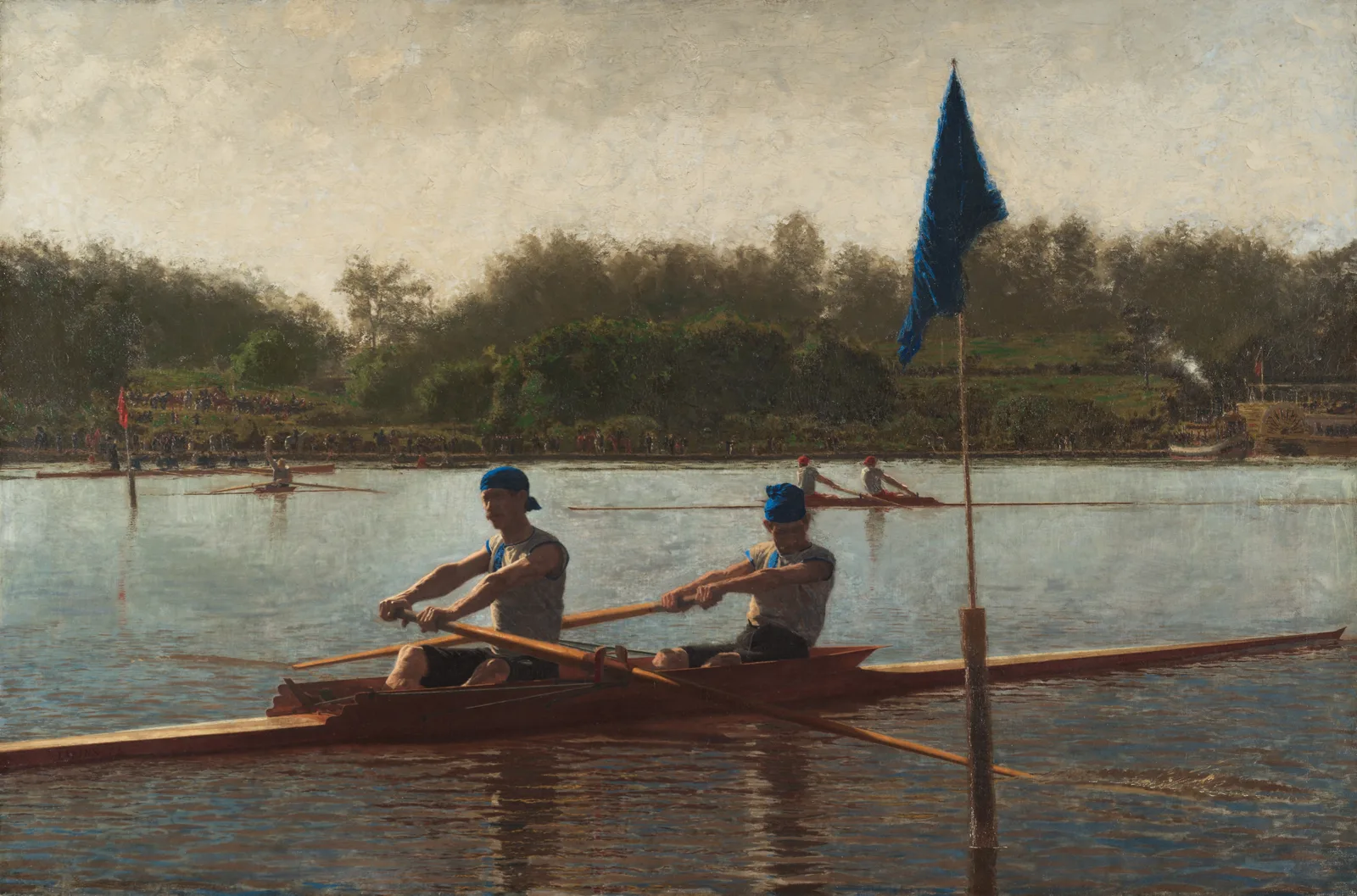
According to the Cleveland Museum of Art, this is a famous rowing race held on the Schuylkill River in Philadelphia in May 1872. Barney and John Biglin are turning around the stake that marked the halfway point, and their competitors in the middle distance on the right lag behind. The brothers won. Spectators line the far bank, and at the far right a paddle steamer sends up smoke.
Water takes up more than half the picture. The line where the far bank meets the water crosses the canvas almost as if ruled, and the competitors' boat and the distant boats all lie just below it as thin horizontal strips. The brothers' boat is a long diagonal running from lower left almost all the way across to the right, and the oars the two men pull cross that diagonal to make an X. On the right a single stake runs top to bottom through the picture. The blue flag at its tip is the same colour as the blue cloths the brothers wear on their heads.
Look at the reflections in the water. Under each brother's body, short horizontal strokes of flesh colour and grey pile up one below another: a reflection broken by ripples. Each pile of strokes sits straight down, vertically, beneath the man it belongs to.
The plan of the river: the drawing of the same title
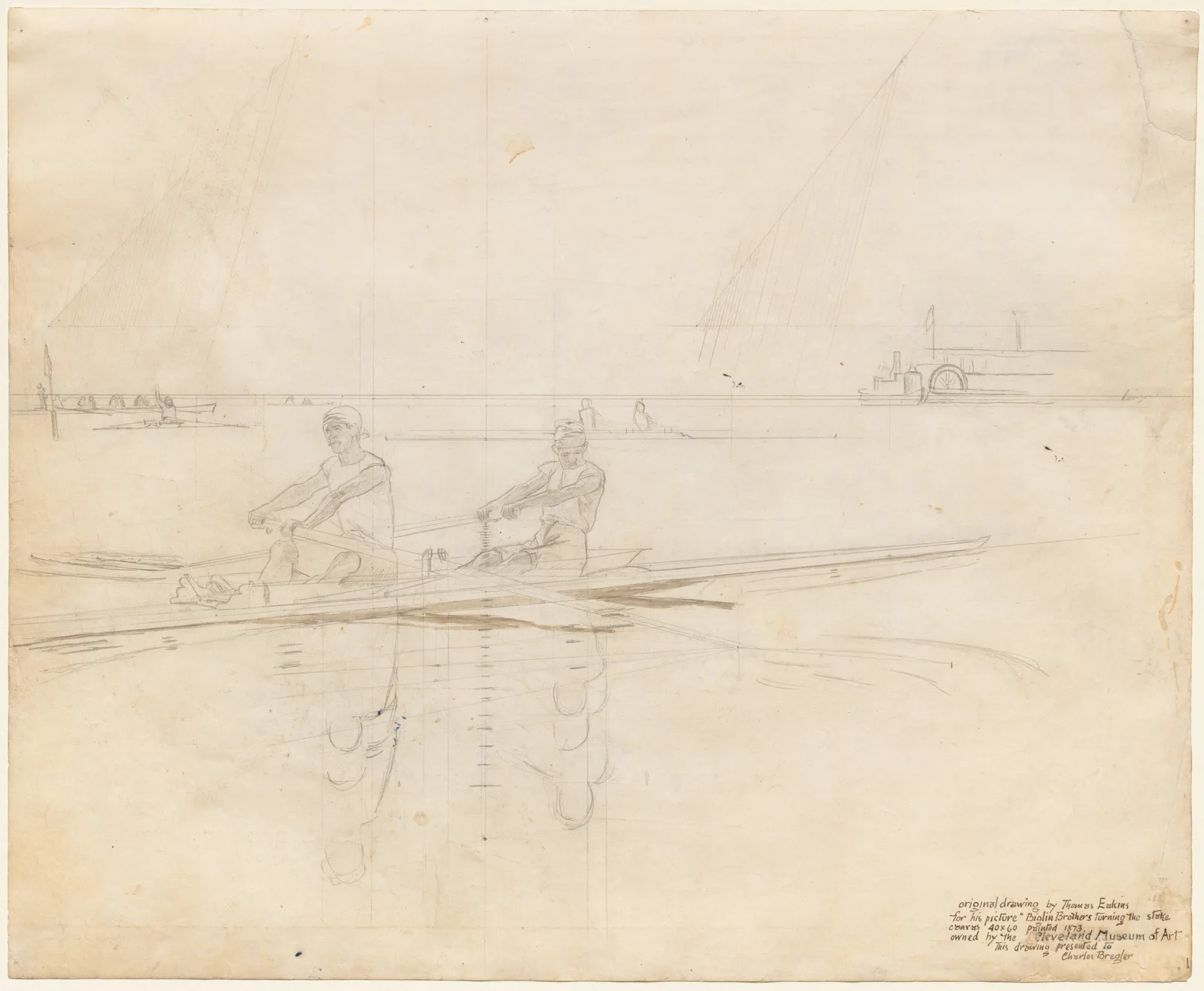
The Cleveland Museum of Art presents this sheet as a perspective drawing that outlined the space of the painting. It notes that working out a painting's space in perspective drawings is a practice going back to the Renaissance, and that it reveals Eakins's academic training.
Here the horizon really is a single ruled line. The distant boats, the spectators and the paddle steamer on the right all sit on it in outline only. The brothers and their boat are in almost the same place as in the painting. The water is where it gets interesting. A vertical line drops below each man, with short ticks marked along it at regular intervals, and beside it the reflected body is drawn as a stack of rounded loops. The vertical piles of horizontal strokes in the painting found their places along these ticked verticals in the drawing. Between the oars and their reflections a few thin lines are drawn that gather towards a point on the right.
And there is no stake in the drawing. The place where the stake and flag run top to bottom through the right side of the painting is empty. This sheet alone cannot tell us when or why the stake was added. In the painting, though, that one stake raises a vertical axis between the horizon and the diagonal of the boat, so the picture has straight lines in all three directions.
Just as the floor grid of the chess picture hid under the carpet, the ticked verticals have disappeared from the river picture. But the places they fixed remain, and the reflections, broken by the ripples, still stand upright beneath the men instead of scattering.
What to try in front of a painting
In Eakins's pictures the lines of the plan survive in two ways. One is the straight line you can actually see. Things that really are straight within the scene, such as a chessboard, a horizon, oars and a boat, or a stake, stand in for the grid. The other is the place you cannot see. Carpet patches or ripple strokes look loose, but where each patch sits was fixed with a ruler.
You can try this in front of other realist pictures too. Find the straightest object on the surface and extend its edges with a finger. See at what height the lines meet and whose eye that height belongs to; then find the most loosely painted part of the picture and see exactly where its patches sit. Once you see loose strokes and straight lines sharing one space between them, you can also see why Eakins's pictures are so quiet.
Add your perspective.
Share a question, another approach, or something you have tried.
Checking sign-in…
Loading comments…