When people look at Hokusai’s Thirty-six Views of Mount Fuji, they often search for the mountain first. That can make the mountain harder to see. In one print it is a small triangle tucked beneath a wave; in another it is the long ridge that guides the whole composition. Put three prints side by side and follow the longest line before you look for a meaning. The mountain’s changing position becomes clear.
The works here are three woodblock prints by Katsushika Hokusai (1760–1849). The Metropolitan Museum of Art dates each one to about 1830–32 and describes them as woodblock prints with ink and color on paper. Rather than guessing a precise time of day or weather from the colors, we will stay with what can be seen in the images: where the mountain sits and which direction the lines take.
1. Find the mountain in the gap made by the wave
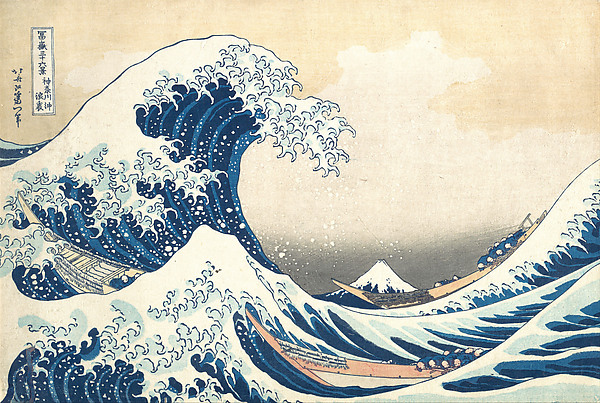
In Under the Wave off Kanagawa, the large wave takes up most of the frame. Three boats move into it, while Mount Fuji appears small behind them. Try temporarily removing the wave from your attention. Follow the long curve that rises from the left. Between that curve and the broken spray, a triangular opening appears. Mount Fuji sits low in that opening.
There is no need to immediately declare that the spray is the mountain’s snow. The first visible fact is that the spray is not one smooth stroke; it is divided into many white fragments. Those fragments sit close to the pale face of the mountain, creating a visual resemblance. Separating what merely looks similar from lines that actually connect makes the boundary between wave and mountain easier to read.
Look at the boats as well. The people lean into the wave that rises from the bottom of the picture. The mountain is not a destination that the movement points toward. It is a distant background briefly exposed by the hollow of the wave. The scene shows how a long line around a mountain can make the mountain look very small.
2. When the slope of the mountain carries the image
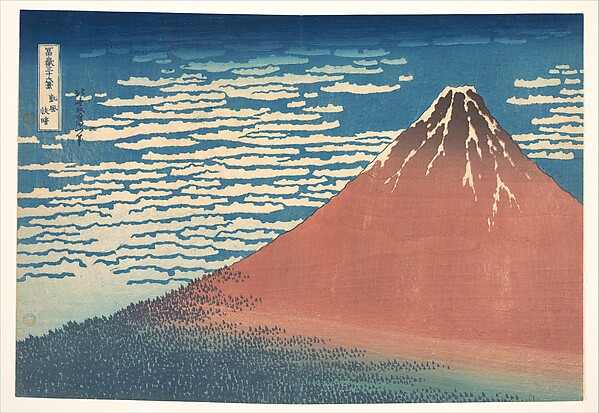
In South Wind, Clear Sky, the longest line belongs to the mountain itself. Follow the slope from the left foothill up to the summit. In the wave print, the mountain survived in a space cleared by water. Here, the slope is the main direction of the composition.
The Metropolitan Museum identifies the work as part of the series and as the print commonly called Red Fuji. Its record also notes another impression from the same block in which a line of trees is visible. The useful comparison is not which impression is better. In this impression, a broad area below the mountain is left open. Clouds divide behind the summit rather than blocking it, while the darker lower side contrasts with the red slope.
Placed beside the first print, the difference is about the job of the line rather than the size of Fuji. In Under the Wave off Kanagawa, the long curve circles outside the mountain and leaves a small peak behind. In South Wind, Clear Sky, the long ridge is the mountain’s contour and carries the eye to the summit. Comparing the mountains only as small or large would miss that change.
3. A distant mountain beside the diagonal of the wind
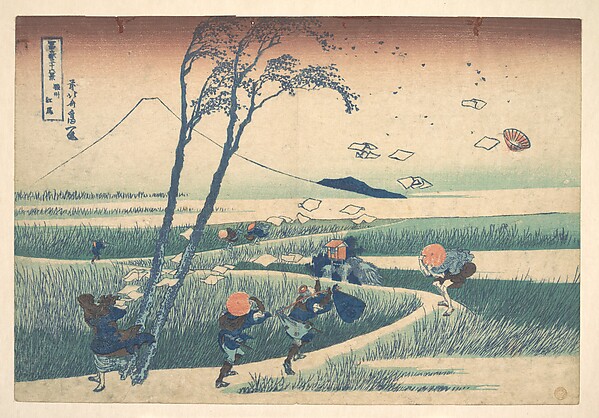
In Ejiri in Suruga Province, the long line is neither the mountain nor a wave. Figures lean into the wind while paper, hats, and leaves scatter through the air. Follow the flying paper from the lower left toward the upper right. That diagonal does not end at Mount Fuji. The mountain sits near the horizon beside the movement, rather than at its destination.
The figures and trees in the foreground are large and sharp, so the distant mountain appears small. Yet the mountain is not the goal of the scene. The wind changes the direction of bodies and paper; Fuji becomes a fixed point existing alongside that movement. The same mountain can be drawn without the main lines pointing toward it.
Notice what continues and what breaks. Each body leans differently, while the separate scraps of paper share one wind. The distant Fuji is reduced to a simple triangular outline. Because there are few details, we read the diagonal of the wind and its distance from the mountain before we read the mountain itself.
Compare the three prints at once
To compare the prints quickly, do not measure the mountain. Write down how the longest line relates to it.
- The wave print: the mountain sits below the gap made by a long curve.
- Red Fuji: the longest ridge forms the mountain’s outline and rises to the summit.
- Ejiri: the diagonal of the wind passes beside the mountain, which remains a distant reference point.
The question “Where is Mount Fuji?” is therefore not only a question about location. It asks which line the eye follows first, and whether that line hides the mountain, forms it, or passes by it. The largest object in a picture does not always supply its most important direction.
Three sentences to take into the next viewing
For the first print, try writing: “A small peak sits below the opening between broken sprays.” For the second: “The ridge that begins at the left foothill lifts the eye to the summit.” For the third: “The diagonal of the flying paper passes beside Fuji rather than reaching it.”
These sentences are not verdicts about the correct interpretation. They are short records of what you saw and a way to check it again. When you look at another print, choose one long line first and describe its relationship to the subject. Hokusai repeats the same mountain across the series, but the path by which the eye reaches it changes every time.
Add your perspective.
Share a question, another approach, or something you have tried.
Checking sign-in…
Loading comments…