Some landscapes by the late Ming painter Dong Qichang (董其昌, 1555–1636) carry an inscription saying they follow an old painter, for example "in the manner of Beiyuan (北苑)". Beiyuan is another name for Dong Yuan (董源), a painter of the tenth century. Yet put two pictures that both claim to follow Dong Yuan side by side, and their proportions, compositions and the feel of the ink all differ. In Dong Qichang's landscapes after old masters, where is the likeness?
This note looks at four works in date order: one hanging scroll at the Cleveland Museum of Art, and two hanging scrolls and an album at The Metropolitan Museum of Art. The museums have released all four images into the public domain (CC0). Afterwards, in front of a landscape inscribed as following someone, you will be able to look past the scenery and check two things: the kind of stroke used on the slopes, and the way the masses are built up.
In The Met's account, Dong Qichang was the leading painter and theorist of landscape in the early seventeenth century, and he argued for meeting the old masters in spirit rather than copying them to the letter. The question here is where in a picture that spirit can be seen.
Mt. Qingbian, 1617: in the manner of Beiyuan
According to the first inscription at the upper right, this picture shows the Qingbian Mountains, painted in Beiyuan's manner and sent to someone senior to him on the last day of the fifth month of the dingsi year (1617). Dong had been to the Bian Mountains. They lie near Wuxing and Lake Tai in Zhejiang and are part of a low range. The picture takes its name from a place he had been, and its manner from a painter of the tenth century.
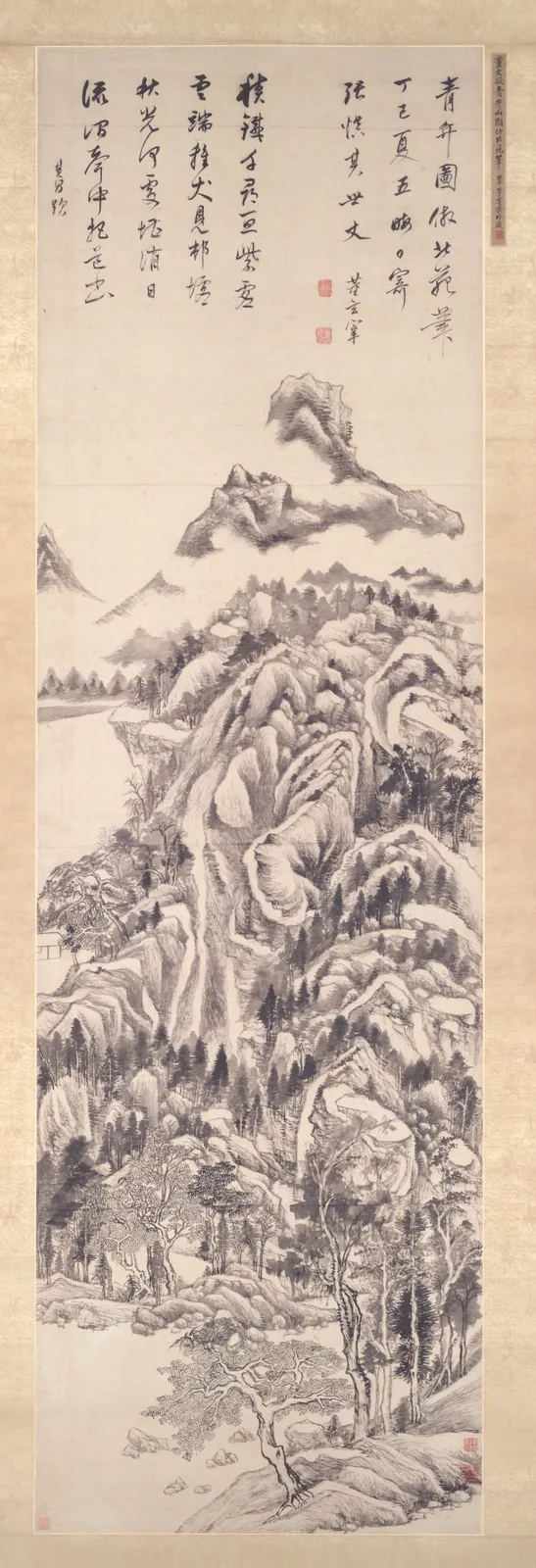
The painting is 225 cm high and 67.6 cm wide, more than three times as tall as it is wide. Rounded mountain masses fill that long format, twisting upwards from the bottom. On each mass, long, slightly curved strokes run side by side down the slope, and the paper is left white along the ridge edges, separating one mass from the next. Small dark trees stand in rows along the ridges. Nothing is painted in the wide water at middle left or in the clouds below the top peak.
In the Cleveland Museum of Art's reading, Dong arranges the mountain forms so that energy (qi, 氣) flows and force (shi, 勢) builds across the whole design, and in his work the brush and ink come alive apart from the forms they depict. In this picture too, the coiling upward movement of the masses catches the eye before any clue to what the Bian Mountains look like.
Shaded Dwellings, 1620s: "quite some resemblance"
Shaded Dwellings among Streams and Mountains (溪山樾館圖) is based on a painting of the same name by Dong Yuan. In the six columns of writing at the upper right, Dong Qichang records that he once saw Dong Yuan's Shaded Dwellings at a eunuch's quarters, copied it in a sketch that he kept in his case, and has only now completed the painting. He ends: "It shows quite some resemblance (頗有肖似)."
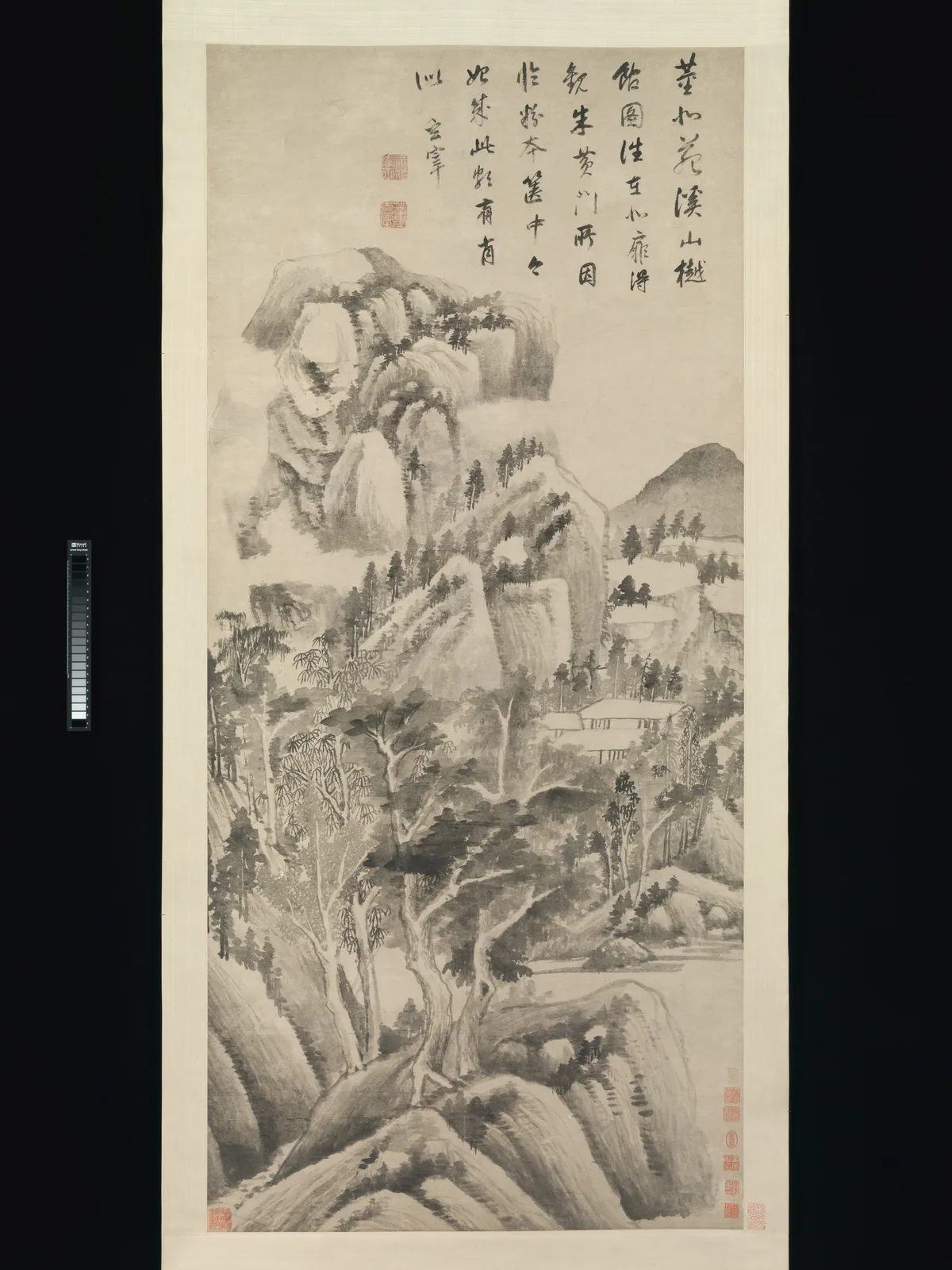
Set beside the 1617 picture, this one looks quite different, though both follow Dong Yuan. It is only a little more than twice as tall as it is wide, so it is less elongated, and a group of large trees takes up the front centre. The mountain masses are gathered at the upper left, with a single rounded peak in the distance at the right. The ink also looks wetter than in the 1617 picture, so the leaves and shadows are dark and soft, as if they had spread.
Some things have not changed. On the slopes of rocks and mountains, long, curving downward strokes again overlap side by side, and small trees again line the ridges. The Met sees this painting as a calligraphic study that builds rocks and trees into cube-like masses, and says Dong's landscapes alternate "positive" and "negative" patterns. Apart from that reading, a comparison by eye shows the same habit as in 1617: tops left light and hollows painted dark, laid over each other in turn.
The museum's record does not say whether Dong Yuan's original survives, so Dong Qichang's "resemblance" cannot be checked against it. What can be seen is what changed and what stayed between two paintings that both claim to follow the same master.
Trees after Ni Zan: not the scenery but the brush idea
The third picture follows the Yuan dynasty painter Ni Zan (倪瓚). The two columns of writing at the upper right read "imitating the brush idea of Ni the lofty scholar (擬倪高士筆意)". What he names as imitated is a brush idea (筆意); he says nothing of the view.
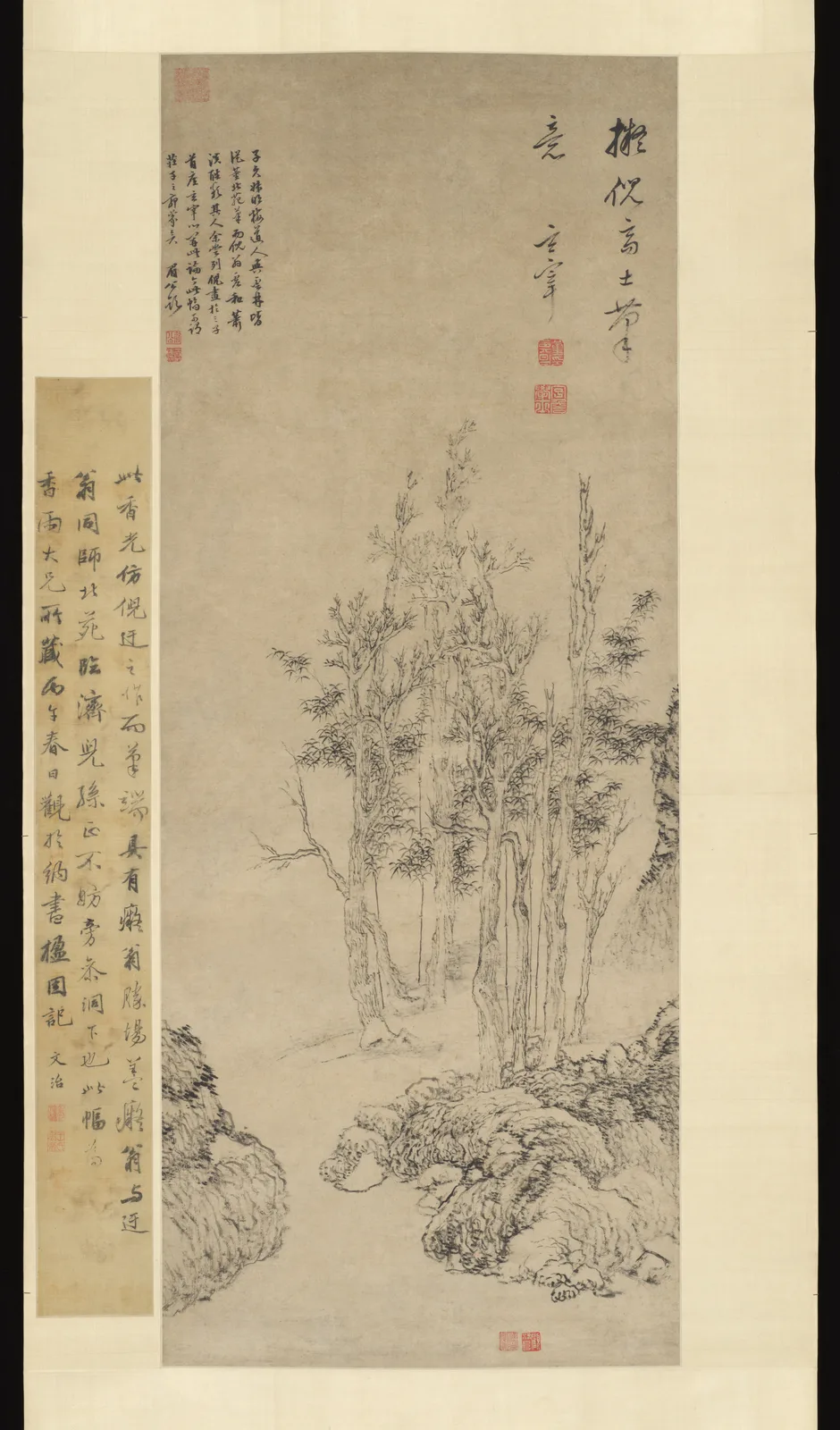
A few tall, thin trees stand together on a low rise, with heaps of rock below. A little over the top quarter is blank paper apart from the writing. The ink is dry and pale, and the rocks are rounded out of short curling strokes laid layer on layer. According to The Met, Dong saw Ni Zan's pictures as an abstract, calligraphic version of Dong Yuan's manner. To rebuild Ni Zan's way of painting landscape, he turned to Dong Yuan's texture strokes of the kind called "hemp-fiber".
The two colophons attached to the painting describe the same lineage. In the small writing at the upper left, Chen Jiru (陳繼儒, 1558–1639) wrote that Huang Gongwang, Wang Meng, Wu Zhen and Ni Zan all came from Dong Yuan's brush. On the strip at the left, Wang Wenzhi (王文治, 1730–1802), writing in 1786, said that although the picture follows Ni Zan, its brush tip has Huang Gongwang's strengths, and explained this by the two having both taken Dong Yuan as their master.
The 1630 album: two kinds of stroke set against each other
The album Landscapes after old masters has eight leaves, each 24.4 × 16 cm. On one of them Dong Qichang wrote that he painted these eight scenes on the ninth day of the ninth month of the gengwu year (1630), and ended with "the seventy-six-year-old man (七十六翁)".
The Met reads the album as a survey of Song and Yuan styles through a few contrasting kinds of brushstroke. There are two poles: the "earthen" landscape, with round, parallel "hemp-fiber" strokes, and the "rocky" one, with angular, oblique "folded-ribbon" strokes. The first two leaves set these two strokes against each other in what Dong took to be Ni Zan's early and late manners. On a text leaf Dong wrote that these two pictures hold the marrow of Ni Zan's painting, apparently meaning the first two. In the leaves that follow, earthen and rocky themes are paired in different ways to call up the model styles of the Northern Song. On another leaf he wrote the title Solitary Temple amid Streams and Mountains (江山蕭寺) followed by the words "in imitation of Juran's (巨然) brushwork".
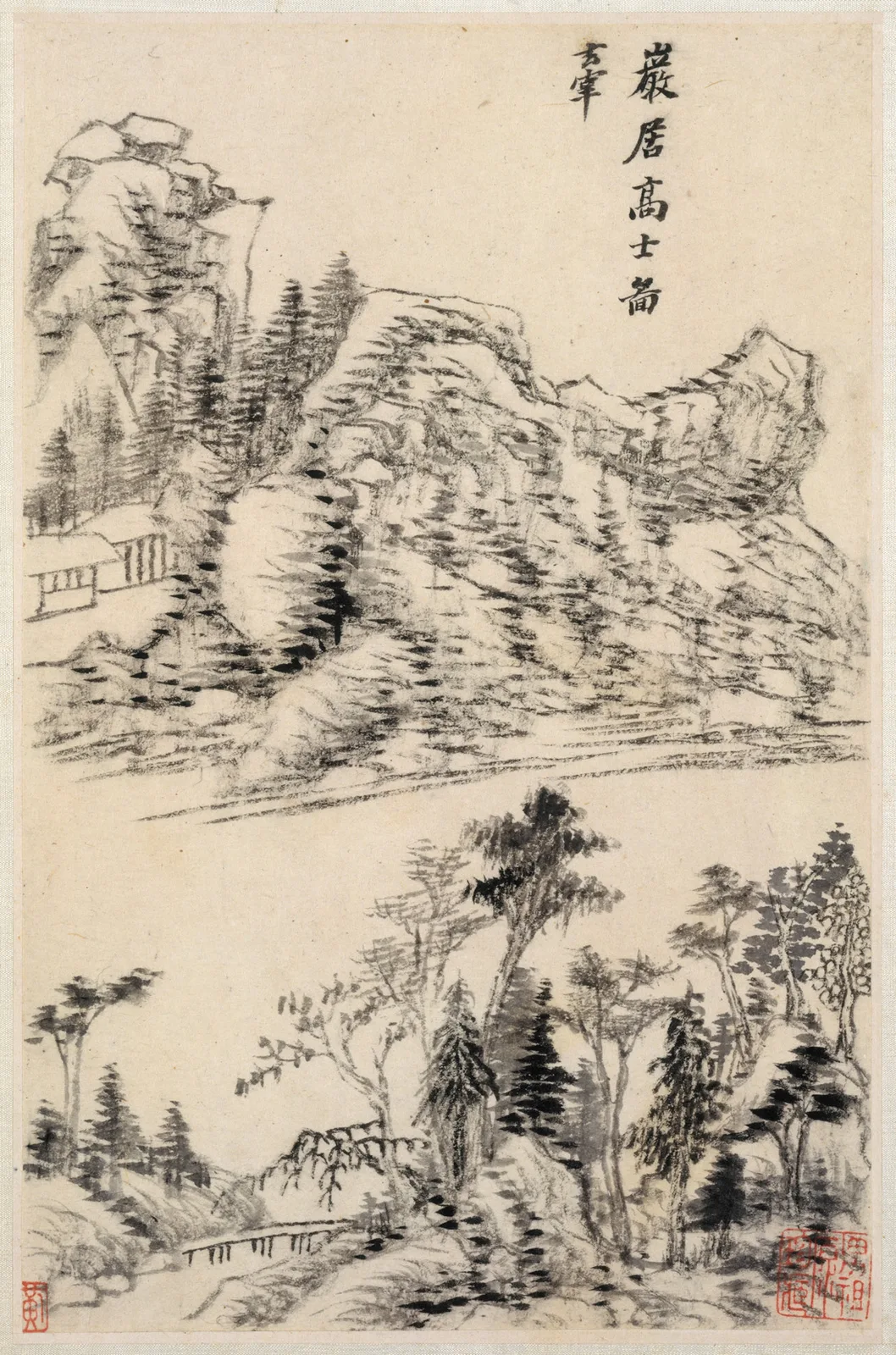
The leaf the museum publishes as its main image is Lofty Scholar in a Mountain Retreat (巖居高士圖). It does not say which master it follows, so none is assigned here. Going only by what is visible, rows of small pointed trees stand on the mountain at the top, and its slopes are covered with short, slanting strokes and dots. Their grain differs from the long strokes that ran down the slopes in the two scrolls after Dong Yuan. Below are several trees with different kinds of foliage, and a small bridge.
Dong's own words: copying is easy, the spirit is hard to pass on
Dong Qichang himself left words on where to look for likeness. A passage in the second chapter of his Huachanshi suibi (畫禪室隨筆) begins with calligraphy. The writing of Wang Xizhi and his son, he says, had lost its flavour by the Qi and Liang dynasties, but when the calligraphers of the early Tang changed their method, they matched by not matching (不合而合). He gives the reason: "Copying is the easiest thing, and the spirit (神氣) is hard to pass on (臨摹最易,神氣難傳故也)."
He carries the same thought over to painting. Juran, Huang Gongwang and Ni Zan all learned from Beiyuan, yet "it is one Beiyuan, and each one differs (一北苑耳,而各各不相似)". Had a vulgar painter done it, he asks, the result would match the model exactly, so how could it be handed down to later ages? He was speaking of different painters, but if the words are extended to one painter's own pictures, a picture after Dong Yuan that differs from Dong Yuan is less a failure than something close to what he wanted. Even so, he did not give up resemblance: Shaded Dwellings grew from a sketch of one particular Dong Yuan painting, and he wrote that it shows "quite some resemblance".
The same chapter also names what divides one master's school from another. "In painted landscape, placing (位置) and texture strokes (皴法) each have their own school, and they cannot be interchanged." Trees alone are different, he goes on, and may be borrowed from many masters. What Dong named as the marks of a school were not the trees but the placing and the texture strokes of the landscape.
The first sentence of the fourth chapter is shorter still: "Judged by the strangeness of its scenery, painting is not equal to real landscape; judged by the finesse of brush and ink, real landscape is never a match for painting (以蹊徑之怪奇論,則畫不如山水;以筆墨之精妙論,則山水決不如畫)."
What to look for in a landscape after an old master
Hold the three passages up to the four pictures, and one reading follows. In the two scrolls after Dong Yuan, the proportions and the composition changed, while the habit of piling up rounded masses and laying curved strokes side by side on the slopes stayed. In the picture after Ni Zan, Dong Yuan's strokes moved into Ni Zan's empty picture space, and in the album, following a master became a matter of choosing kinds of stroke and setting them against each other.
Still, Dong said that placing, that is, arrangement, also divides the schools, so his idea cannot be reduced to strokes alone. Whether the placing he meant is the composition of the whole picture or the way masses are set down, and how two scrolls with different compositions fit his words, cannot be answered from the material gathered here.
So in front of a landscape inscribed as following someone, do not search for the same mountain. Pick one slope and look at the strokes first: do they curve and lie side by side, or turn at sharp angles and slant? Length is not this note's test, so short strokes that curve and run with the same grain, like those on the rocks in the picture after Ni Zan, are counted here on the hemp-fiber side. Then look at how the masses are piled up and where the paper is left empty. In Dong Qichang's paintings, the likeness shows in those strokes and in the way the masses are built up, before it shows in the scenery.
Add your perspective.
Share a question, another approach, or something you have tried.
Checking sign-in…
Loading comments…