An interior often invites a search for the window first. Even when the window sits inside the frame, the brightest passage is not limited to the glass. A bowl in front of the hands, a sheet of paper, or the front of a jacket can catch the eye before the window does.
Look at three interiors by Johannes Vermeer in the same order: The Milkmaid and Woman in Blue Reading a Letter at the Rijksmuseum in Amsterdam, and Woman Holding a Balance at the National Gallery of Art in Washington. All three are oil on canvas, and each painted surface measures about 35 to 47 cm on a side. The task here is not to name the hour in the room. Pick a passage that looks bright, then note whether it sits beside the window or on an object in front of the figure.
The photographs below are the ones the museums have released. On a different screen, a yellow may read closer to cream and a blue closer to gray, so a comparison of two neighboring passages is more stable than a single color name. A separate article follows bright passages on a beach and in two gardens by Sorolla. The examples here are these three rooms.
If the window is inside the frame, where do you look next?
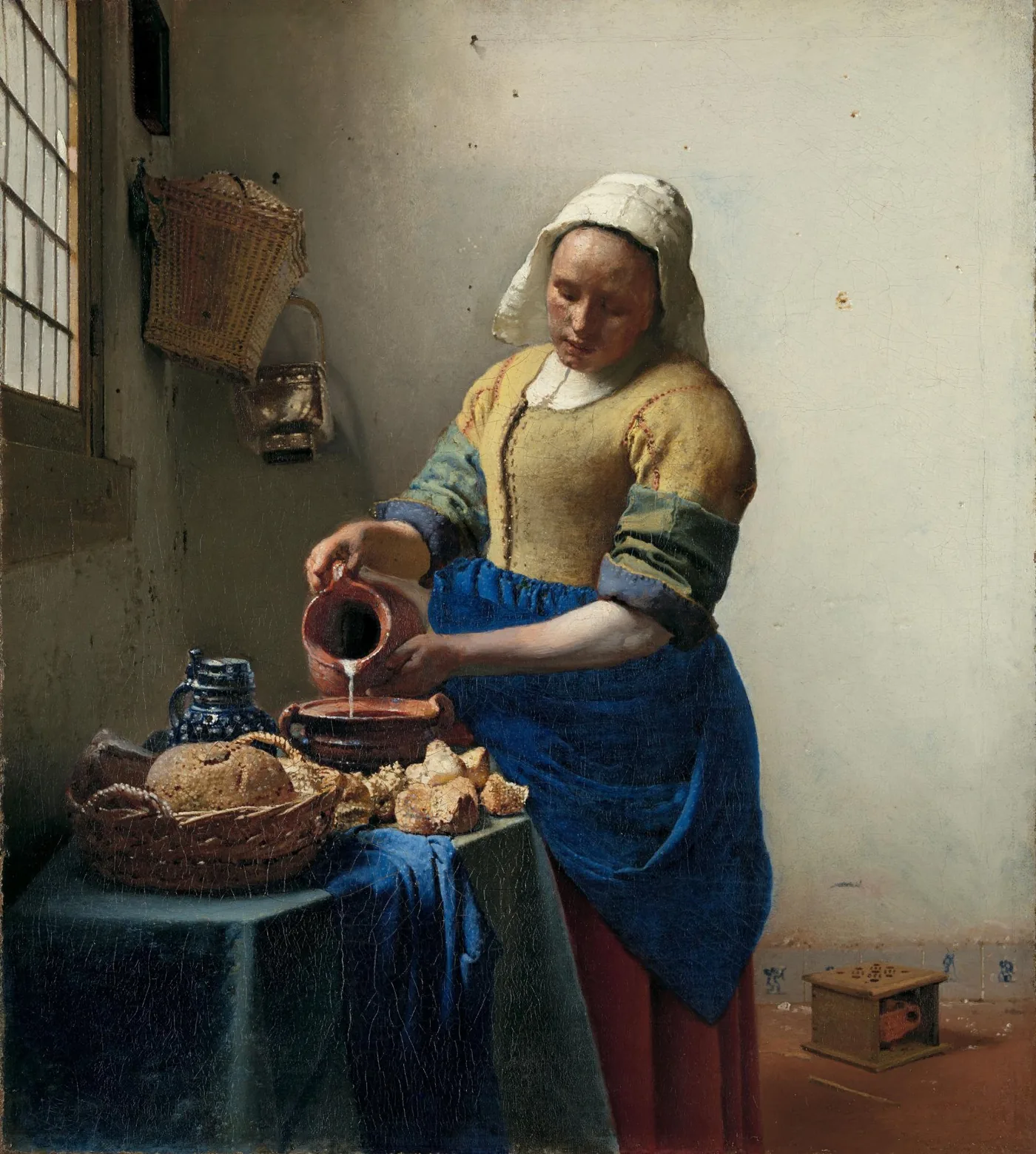
The Milkmaid is dated about 1660. The canvas is 45.5 cm high and 41 cm wide. A window divided into small panes occupies the upper left. The woman wears a white cap, a yellow bodice, and a blue apron, and she pours milk from a brown jug into a red earthenware bowl. On the table are a basket of bread, a blue cloth, and a white jug.
Once the window is found, move to the table. The white stream of milk, the crust of the bread, and the lit face of the white jug are clearer than the glass itself. The edge of the cap and the front of the yellow bodice are also brighter than the wall behind her. The wall at the lower right is darker, and a small foot stove sits beneath it.
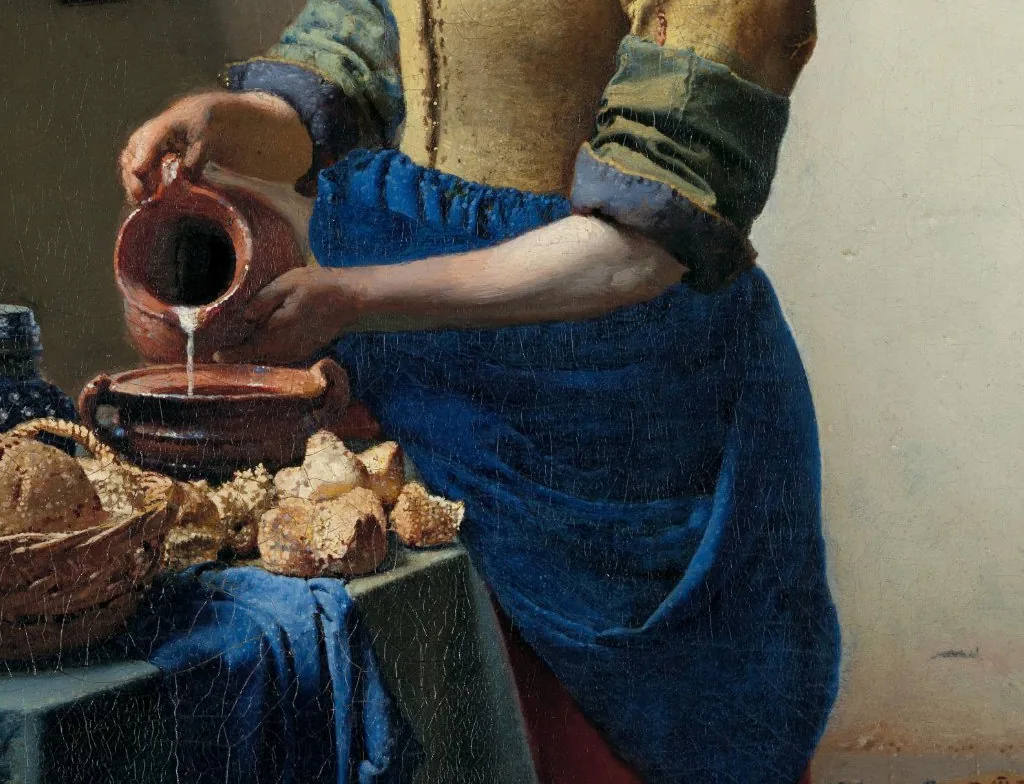
Cropped toward the table, the same photograph shows small light and dark touches mixed across the bread crust and the white jug. From farther away the bread reads as one loaf. Up close it breaks into small areas of different color. The stream of milk is thin, and it still holds the eye because it is brighter than what surrounds it. Writing down both facts — the window is at the upper left, and the first bright passages are on the table — makes the light in this picture easier to describe.
Where does a bright place remain when no window frame is visible?
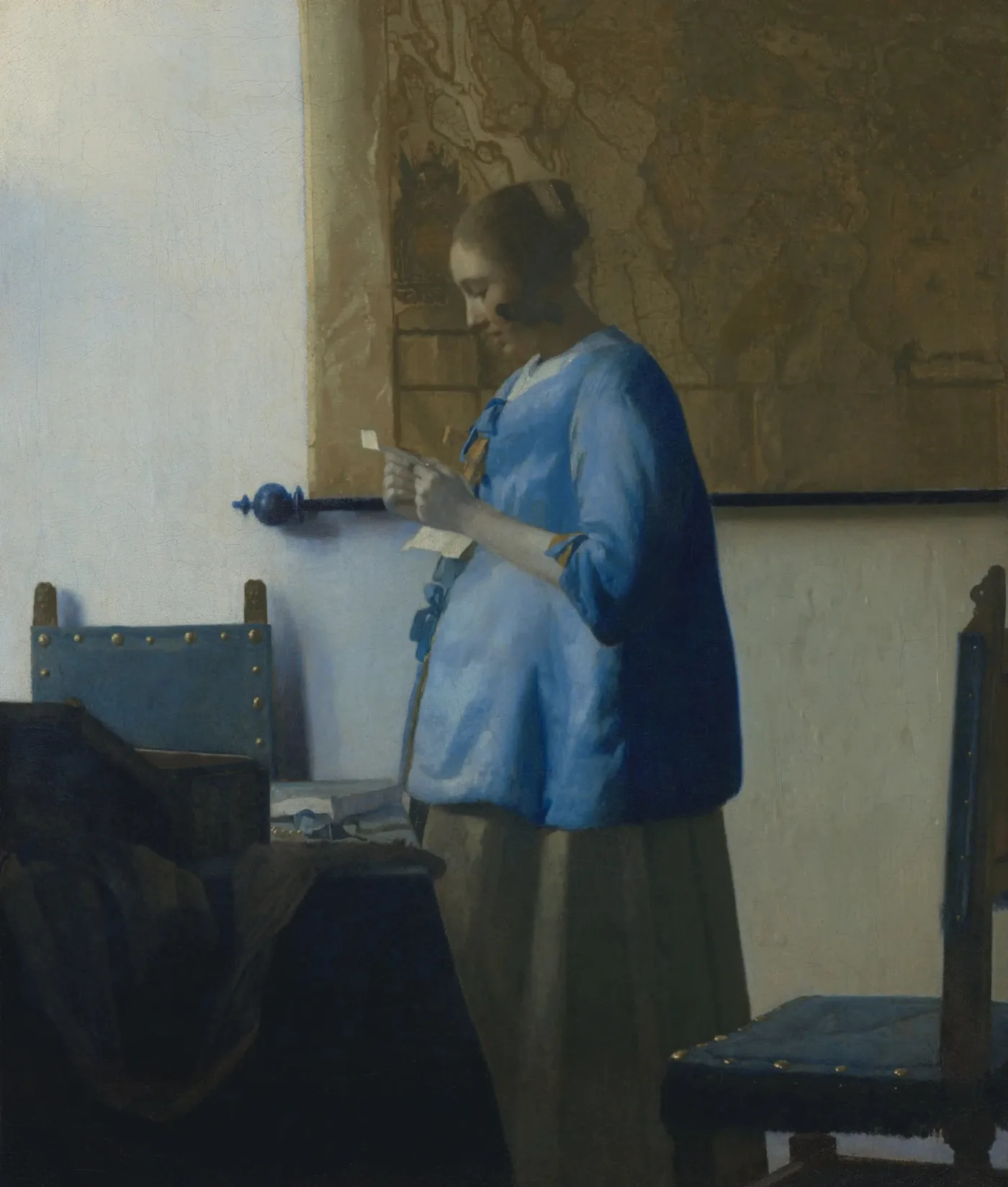
Woman in Blue Reading a Letter is dated about 1663. The canvas is 46.5 cm high and 39 cm wide. The City of Amsterdam owns it, and the Rijksmuseum shows it on loan. The woman wears a white head covering, a yellow garment, and a blue jacket, and she reads a letter. A large map hangs on the wall behind her. A blue cloth and a box sit on the table in front, with chairs at either side.
No divided window frame enters this photograph. The paper of the letter, the front of the jacket, and the white head covering are still brighter than the right side of the map and the darker corner of the room. The map is large, and its brightness is not even. Split the part nearer the woman from the right edge, and the bright passages gather on one sheet of paper and on the front of the clothing.
In the first painting the window frame can be pointed to inside the picture. The sentence for this one changes: the letter and the front of the jacket are brighter than the map behind them. Whether a window has entered the frame, and where the bright passage is, are separate checks.
Against which darker surface does the small balance stand out?
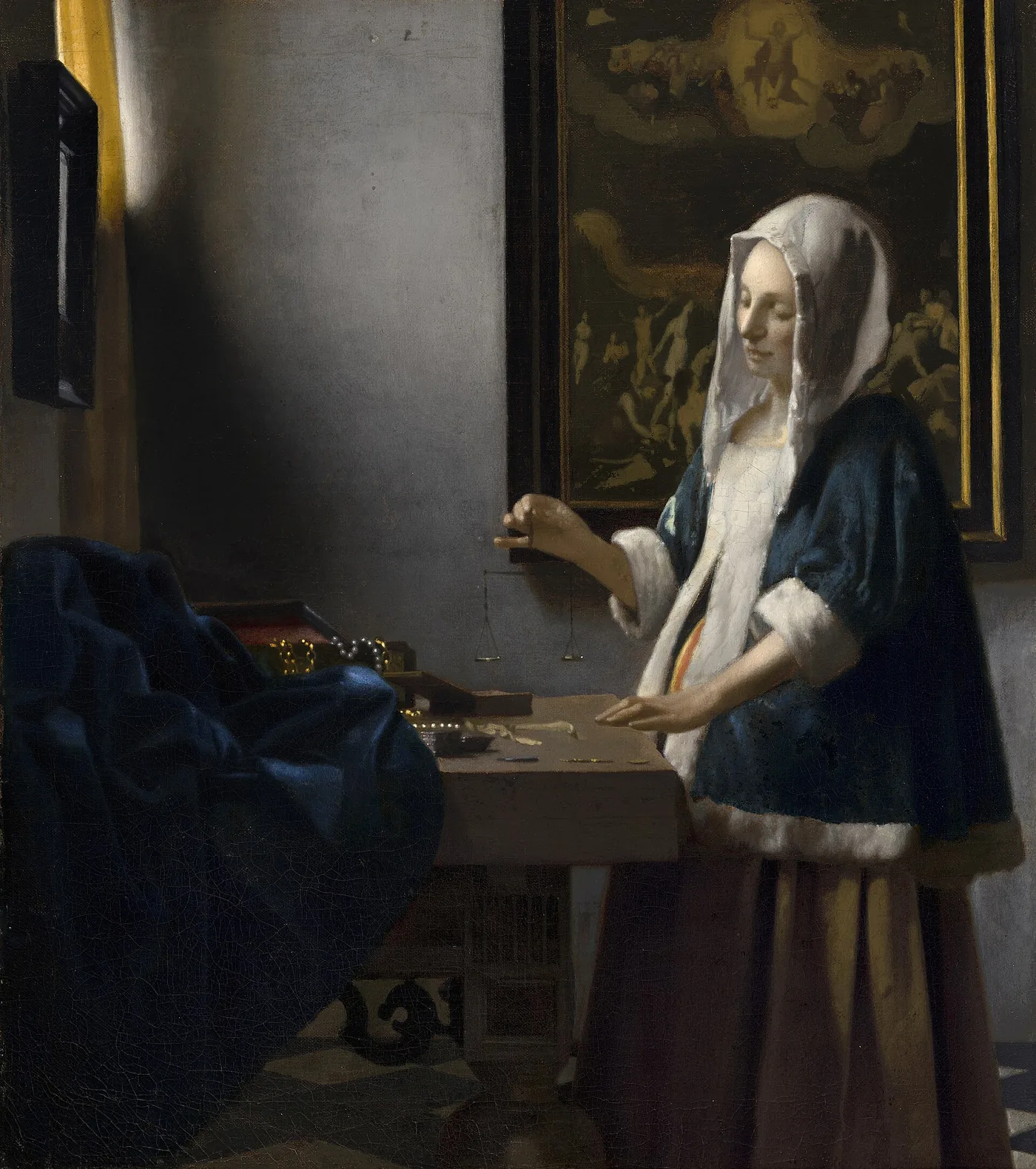
Woman Holding a Balance is dated about 1664. The painted surface is 39.7 cm high and 35.5 cm wide, in the Widener Collection at the National Gallery of Art in Washington. A window with a yellow curtain appears at the upper left. The woman wears a white head covering, a yellow garment, and a blue jacket, and she holds a small balance. The two pans hang at a similar height. A blue cloth, an open box, pearls, and a gold chain lie on the table. A large picture in a dark frame hangs on the wall behind her.
After finding the window, look at the hand. The beam and the two pans cover little area. They still separate brightly from the darker wall. The white cloth and the open box on the table join that brighter group. The framed picture is large and its frame is dark, so a direct comparison makes the small balance look brighter.
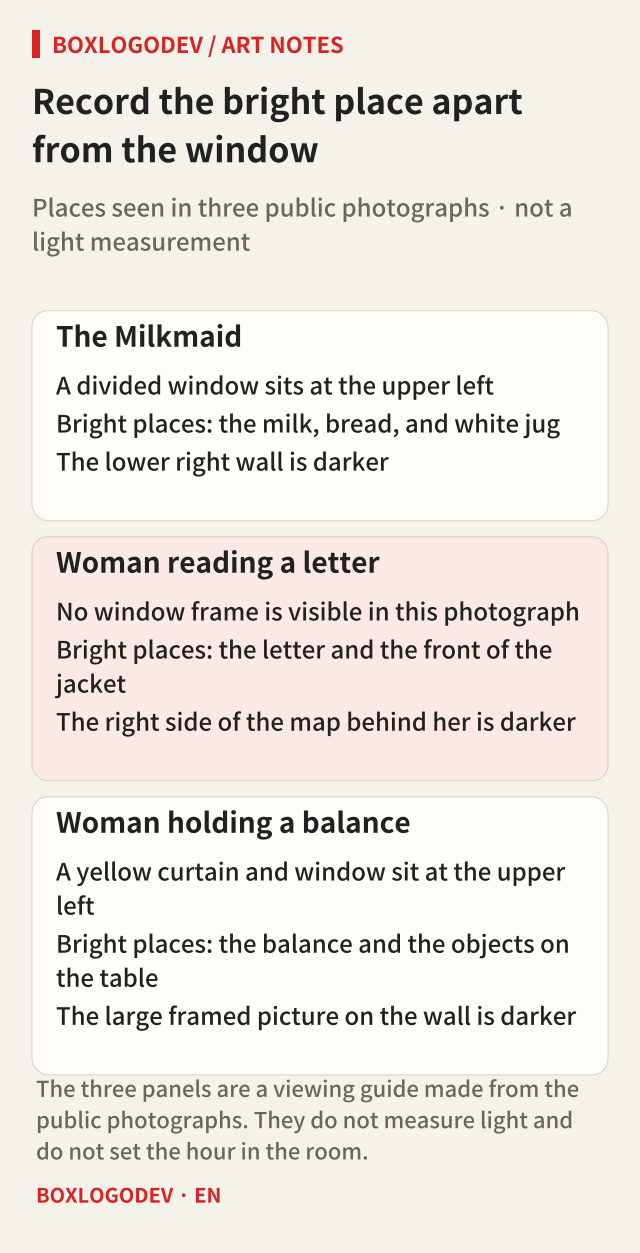
Placed side by side, the three pictures follow a similar order of looking. In the first, the window is inside the frame and the bright passages are the milk, the bread, and the white jug. In the second, no window frame is visible and the bright passages are the letter and the front of the jacket. In the third, the window and yellow curtain are inside the frame again, and the bright passages gather on the balance and the objects on the table. The presence of a window does not by itself explain the three pictures as one case. The bright place has to be written down with it.
Which three sentences are worth keeping?
One sentence per painting is enough. For The Milkmaid: the window is at the upper left, and the bread, the white jug, and the stream of milk are brighter than the wall. For Woman in Blue Reading a Letter: this photograph has no window frame, and the letter is brighter than the map behind it. For Woman Holding a Balance: the curtained window is at the upper left, and the small balance is bright against the darker wall.
A difference in color names is not a reason to discard the sentence. Screen size and lighting can push yellow toward cream and blue toward gray. Naming the two passages you compared keeps that difference smaller. The next interior can be read the same way: note whether the window is inside the frame, then note which object in front of the hands is brighter than its neighbor.
Add your perspective.
Share a question, another approach, or something you have tried.
Checking sign-in…
Loading comments…