Sunlight is often the first thing we notice in Sorolla's paintings. Yet following only the bright areas does not fully explain that impression. Pink and violet mingle in pale fabric, while deep green sits beside a luminous garden wall. Looking at the differences between neighboring light and dark areas makes the experience of light on the canvas more concrete.
Let us look at one beach painting and two garden paintings by Joaquín Sorolla. The aim is not to identify the precise time of day or weather. Choose a bright area that catches your eye, then compare the colors and edges immediately beside it. Begin by looking for white, and gradually widen your attention to how light works across the whole picture.
How many colors are there in the pale fabric on the beach?
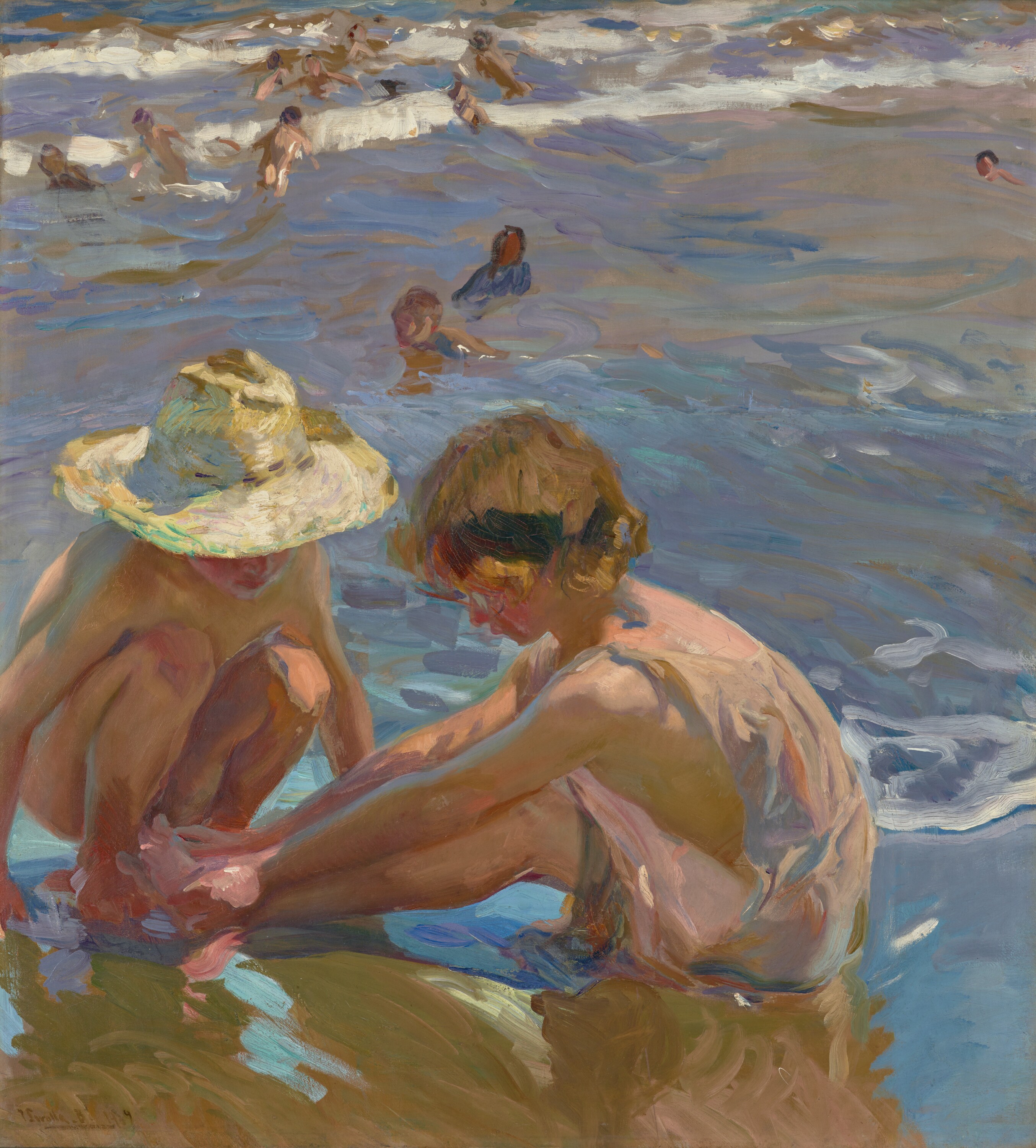
In The Wounded Foot, two children in the foreground share the scene with people playing in the water behind them. Their actions may initially make us curious, but set the story aside for a moment and look at the hat and fabric. The broad hat on the left is not made of pale yellow alone. Turquoise and violet appear between its edge and surface, and the face beneath it looks darker.
The pale cloth around the child on the right is similar. Cream and pink appear in its brighter areas, while gray and violet appear where it folds or darkens. What reads as one light-colored cloth from a distance breaks into differently colored planes up close. Following these differences makes the folds and the direction of the body clearer.
Try a small thought experiment. Imagine filling the entire cloth with a single white of uniform brightness. It might look brighter overall, but there would be fewer clues to which parts project forward and where it folds. Return to the actual painting and you can see that the darker colors within the pale cloth also contribute to the sensation of light.
Next, look at the water. It is not filled with a single clear blue. Short, bright ripple marks are scattered among gray-violet and turquoise passages. From farther away, those bright marks join into a continuous water surface; up close, they separate into individual brushstrokes. The brightness that appears as relatively broad planes in the cloth becomes small, interrupted fragments in the water.
Look at the garden wall together with the trees beside it
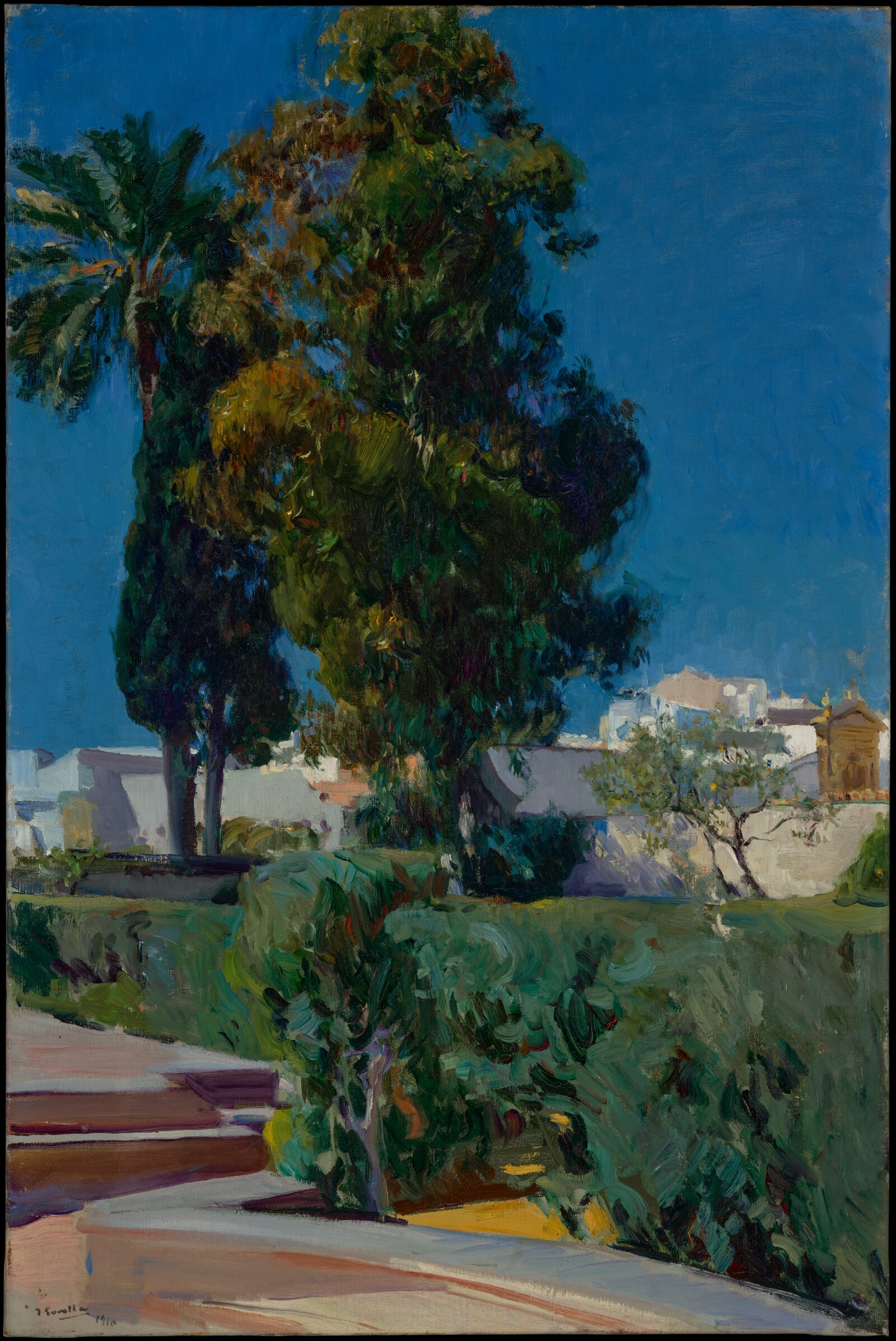
In the second painting, trees, walls, and paths fill the scene instead of people. Blue sky occupies the upper part, while dark trees meet a pale wall below. Look first at the wall, then shift your eyes to the tree beside it. The strong difference in brightness between two areas at a similar height makes the wall's light surface easier to notice.
This wall is not a single block of white either. Cream-colored passages that seem sunlit give way to gray-violet areas that grow darker. Add the pinkish path in front, the low wall, and the green hedge, and the scene takes on several layers. Moving from the nearby path past the hedge to the wall and trees behind it can give a sense of the garden's depth.
The size of the bright area is useful to observe here. On the beach, small patches of brightness were scattered across the waves; here, a relatively broad stretch of wall becomes the reference point. Find the wall first and follow the trees' outlines. You can read the relationship between the dark mass and the bright plane without identifying individual leaves. This gives you something different to examine when viewing the painting at a small size and when enlarging it.
There is no need to assume that a garden must feel cool or peaceful. Lingering on the bright sky and wall may make it seem intensely sunny, while following the dark trees and hedge may make the weight of the shade feel stronger. Try connecting your response to the painting's colors and to the part you looked at first.
Find where the light breaks along a shaded path
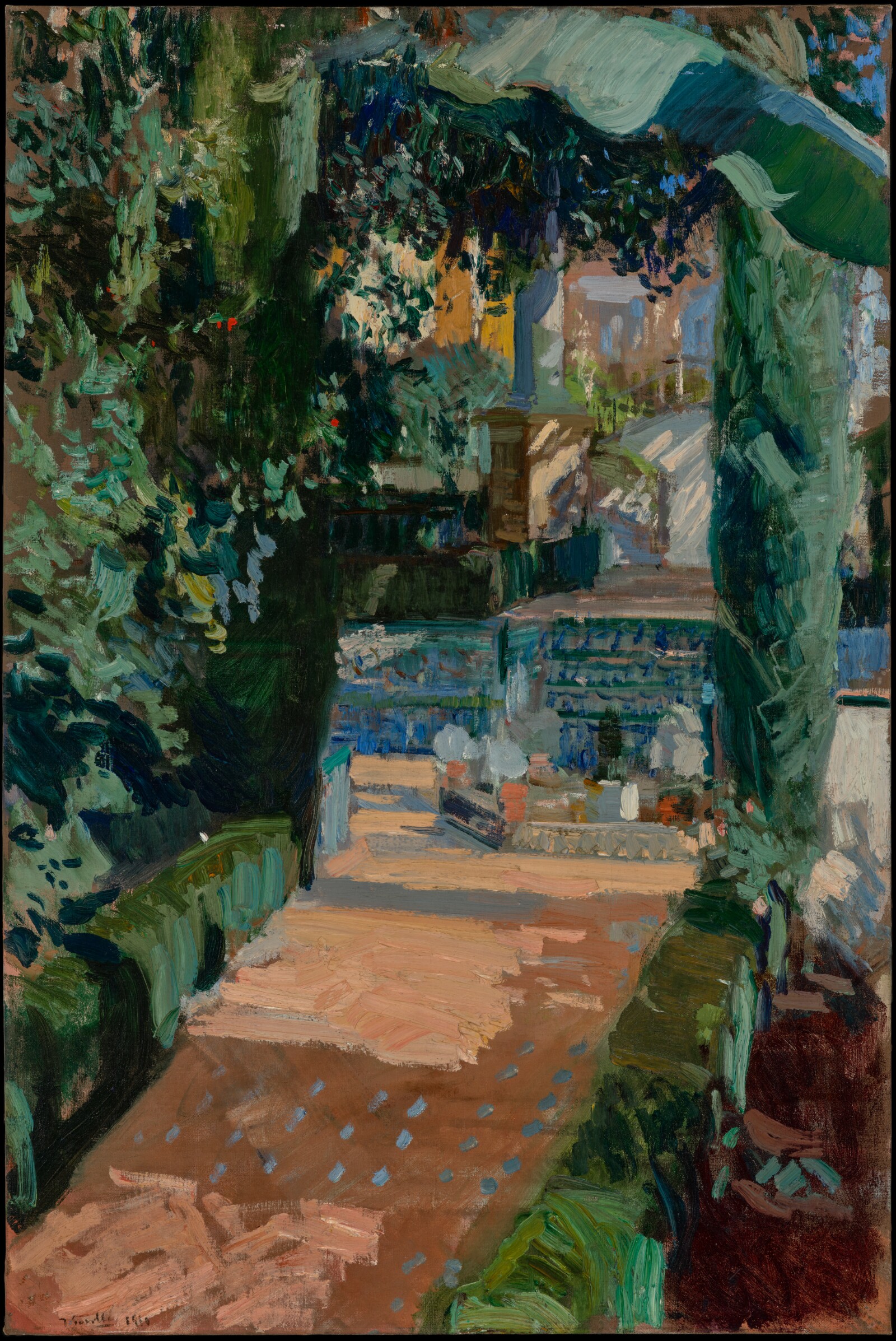
The third painting was made in the same year as the preceding garden, but it draws the eye inward differently. A narrow path continues between leaves and trees on both sides, with a bright wall and blue patterned tiles farther back. Notice whether your eyes move past the dark edges toward the light inside. The place you see first need not be the same as someone else's.
Following the ground, you can see broad blue-gray shadows crossing the pink and apricot-colored path. Distinguish those broad changes of light and dark from the small blue patterns on the paving. Patches of brightness alternate with shade. Slowly tracing these changes with your eyes can feel like stepping through different kinds of light toward the interior. This is one possible way to experience the painting.
Alternating between the two gardens makes the difference clearer. Move your eyes from the broad wall in the second painting to the narrowing path in the third, and changes in the ground's brightness may seem to lead you inward. Even with the same garden subject, light can feel broadly spread out or divided into smaller intervals, depending on what you use as your reference.
Three sentences to write when you revisit the paintings
Now try writing one sentence for each work. For the beach, ask, “Which part of the pale cloth darkens, and into what color?” For the first garden, ask, “What sits directly beside the wall that looks brightest?” For the second garden, ask, “Where does the brightness change along the path?” This exercise adds a location and a point of comparison to an impression such as “the colors are beautiful.”
For example: “Violet appears in the folds of the cloth, making the cream beside it feel brighter.” If someone else reads the same area as gray, you do not need to declare one observation wrong. Screen size, brightness, and surrounding colors can alter the impression. Explaining which areas you compared is more helpful than insisting on a single color name.
After looking at all three paintings, return to the beach. If you initially saw only the children, you may now notice the shade below the hat, the colors mixed into the cloth, and the interrupted bright marks on the water as separate features. Connecting Sorolla's dazzle to specific places in this way gives you a starting point for your own observations of the next landscape painting.