El Greco's figures are long. Bodies stretch upward and heads look small. A long-lived explanation goes with them: his eyes were astigmatic, the world looked vertically stretched to him, and he simply painted what he saw. It is plausible, but it was already being refuted in the 1910s, and psychology even has a name for the idea. Still, the refutation has gaps of its own.
Four paintings released by The Metropolitan Museum of Art and the Cleveland Museum of Art let us test the story. By the end you will be able to try any "painter's eye disease" explanation yourself: count a figure's height in head lengths, and look at round objects and hands lying sideways. The pixel values below were picked by eye on the published image files, so they are approximate and are compared only within one picture.
The diagnosis came before the refutation
Andrea Pinotti set out the history of the story in the journal Predella, no. 35. The claims of Goldschmidt, Beritens, Katz, Anstis, Huber and Strebel below all come through his survey; their original texts were not read for this note. The ophthalmologist August Goldschmidt in a 1911 article treated El Greco's "mannerism" as a typical case of astigmatism. In 1913 the Madrid ophthalmologist Germán Beritens argued for astigmatism combined with a squint. In Beritens's account the painter sees worse and worse from about the age of thirty-seven.
None of the sources checked for this note reports an actual examination of his eyes. The psychologist David Katz also said that no biographical evidence supports an eye disease acquired during life, so one can only suppose it indirectly. The doctors' diagnoses work backward from the paintings. So the question here is not what his eyes were like but whether astigmatism can explain the long bodies in these pictures.
The canvas stretches too
In his 1914 book War Greco astigmatisch? (Was Greco astigmatic?), Katz reasoned like this. If the eye stretches the world vertically, it stretches the canvas in front of it in the same way. The numbers below are invented for the explanation.
An eye that stretches height by 1.25 looks at a round plate 30 cm across. It sees an oval 30 wide and 37.5 tall (30 × 1.25 = 37.5). If the painter puts that oval on the canvas, the same eye sees it about 46.9 tall (37.5 × 1.25 = 46.875), which no longer matches the plate. To make the picture look like the plate, he has to paint a circle 30 by 30. The distortions cancel.
The mistaken idea that he painted what his eye stretched later got a name, the "El Greco fallacy". Pinotti traces the label to a 1966 book by Irvin Rock. In a 2013 note Chaz Firestone calls the astigmatism story a popular but incorrect attribution.
The refutation has gaps too
There are two.
First, the distortions cancel when the painter copies something in front of him. Katz separated four cases and accepted that with astigmatism acquired during life, drawing from memory or imagination could show a distortion. Testing himself, he drew a remembered circle as an oval. He called this only a "partial hypothesis", though, and thought that unless both eyes failed together the healthy eye would make up for it. The psychologist Stuart Anstis's 2002 experiment points the same way. People wearing a cylindrical lens copied a square in front of them correctly, but from memory drew a vertically long rectangle. One volunteer wore the lens for two days, and even the drawings from memory gradually returned to squares. Anstis concluded that El Greco would have adapted even if he was astigmatic. Still, that experiment lets two days and one person stand in for a lifetime, and for a painter of many imagined religious scenes the memory case is not an empty one.
Second, does astigmatism really stretch the world evenly? Writing in JAMA Ophthalmology in 2014, the ophthalmology researcher Matthew Simunovic argued from an analysis of the retinal image that treating astigmatism as a constant perceptual error is itself another fallacy. In a 2018 article, Andrew Anderson of the University of Melbourne also explains that uncorrected astigmatism mainly blurs vision rather than changing image size. Seen this way, the point shakes both sides, because the arithmetic of the canvas argument and the original "stretched world" both assume an even stretch.
What changes when you count in heads
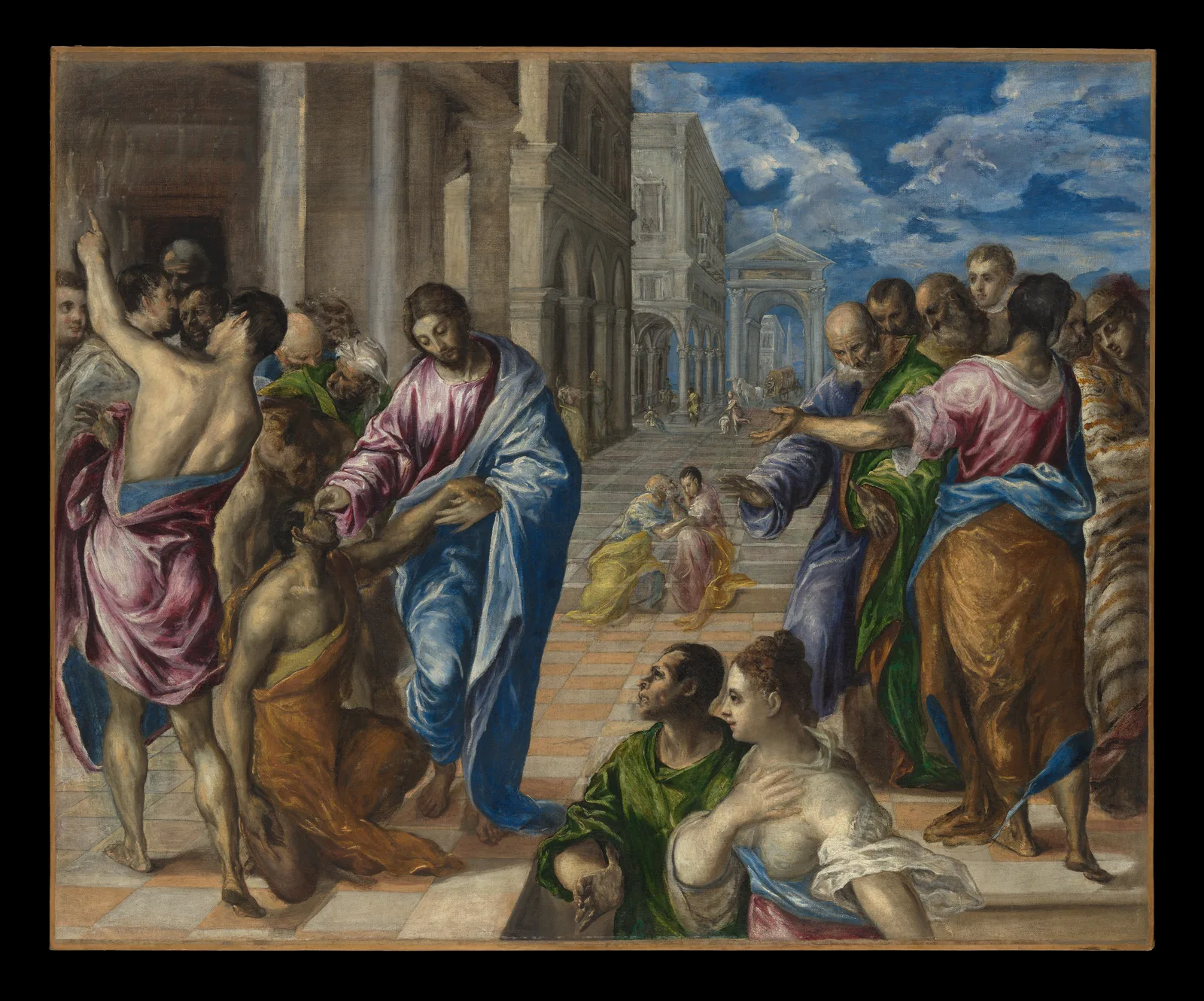
So it is better to look at the pictures. Christ Healing the Blind, of about 1570, belongs to his Italian years. The Met presents it as an early work that tries out lessons from Venetian Renaissance painting, and thinks he took it with him when he left for Spain in 1576. The same text calls its figures "elongated". Measure the height of Christ. From the top of the head to the tip of the beard is 112 pixels; to the end of the front foot is 740 pixels, and to the back foot 712. His height is about 6.4 to 6.6 head lengths (712 ÷ 112, 740 ÷ 112). He leans forward with his legs apart, so he would gain a little standing straight, but counted in head lengths this Christ at least is not noticeably elongated. That sits awkwardly with The Met's word, and it is only one figure measured by eye. The painter is only about twenty-nine, though. If Beritens was right that his sight worsened after thirty-seven, this picture does not refute him.
Thirty to forty years later, the same measurement on Christ on the Cross gives a head of 112 pixels and a height of 1,014 pixels, about 9 head lengths (1,014 ÷ 112 ≈ 9.05). The head is tipped back and may be measured short, but even a generous 130 pixels gives 7.8. The hanging body and the toes pointing down also add height. Each value comes from one figure and the measuring points were set by eye, so read this only as a rough difference.
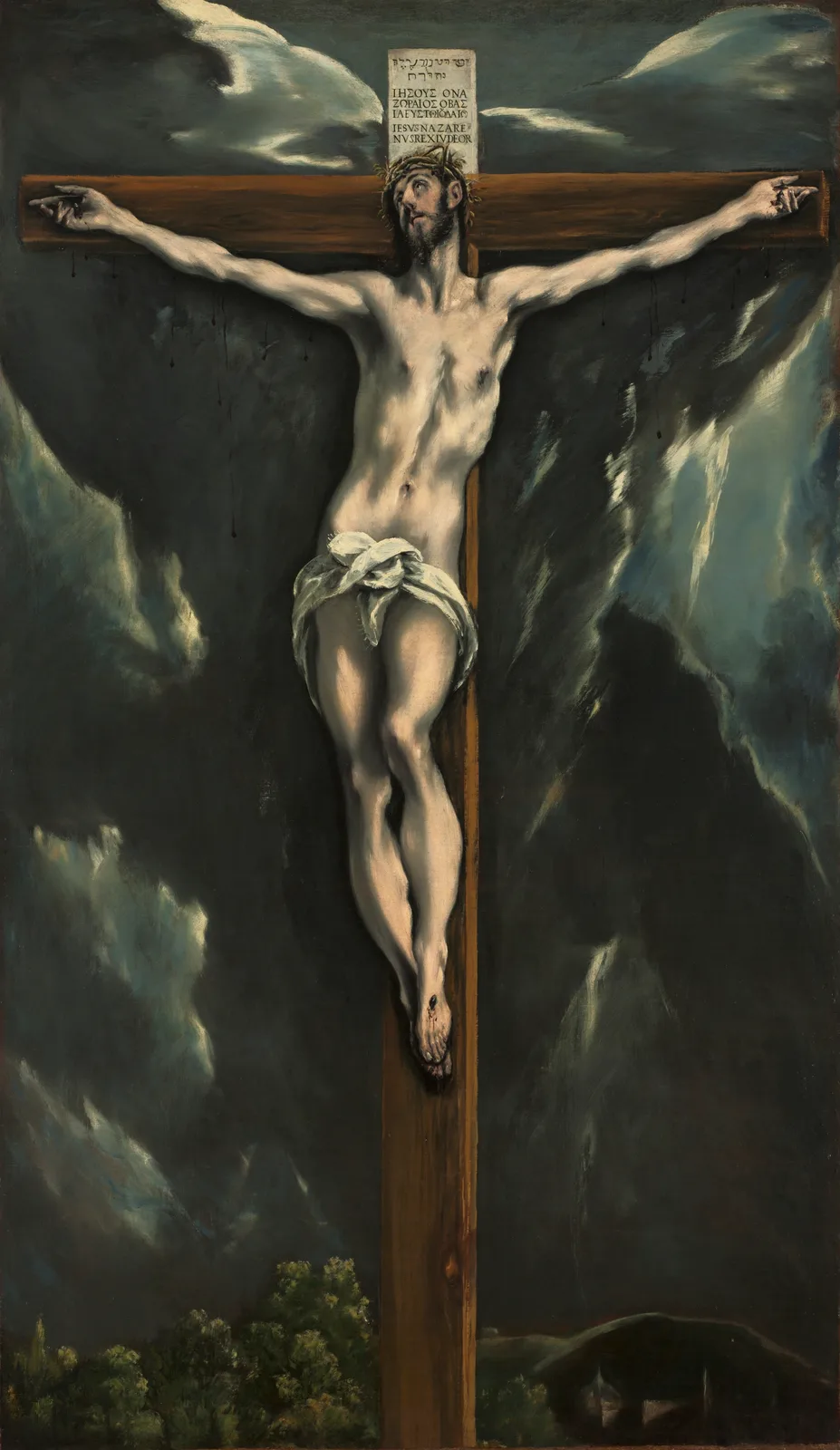
Now a short calculation. Stretch the earlier Christ vertically by 1.25. The head becomes 140 (112 × 1.25) and the height 925 (740 × 1.25). And 925 ÷ 140 is still about 6.6. An even vertical stretch makes a person longer but leaves the height in head lengths unchanged. If that number grows from about 6.5 to between 8 and 9, the body has lengthened more than the head, and an even stretch cannot explain it. This calculation is this note's own, not an argument taken from the literature, and it holds only on the assumption that astigmatism stretches evenly.
Round things and sideways hands
According to The Met, Cardinal Fernando Niño de Guevara was probably painted in the spring of 1600. There is a convenient test object: the spectacles. The Met describes them as the fashionable kind of the time, held on with cords around the ears, and thinks they must have been part of the sitter's real appearance to appear in a formal portrait. On The Met's original file, measured on the outside of the rims, the lens at picture right is 92 pixels wide and 99 tall, about 1.08 times as tall as wide, and the lens at picture left is 79 wide and 91 tall, about 1.15 times. The left lens is on the side the face turns toward, so it may look narrower. The upper rims overlap the eyebrows, so their edge is unclear.
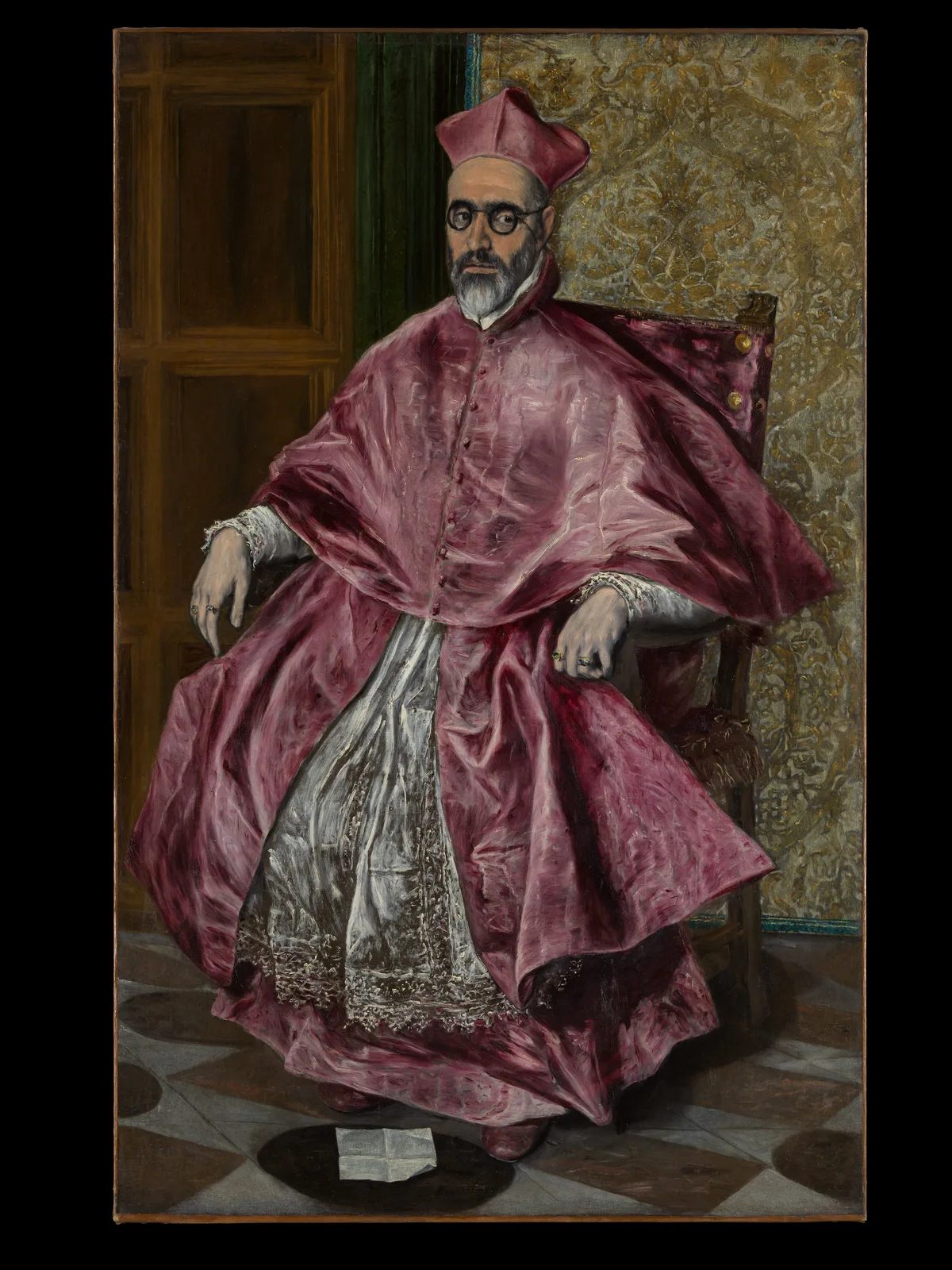
They are close to round. We cannot know that the real lenses were perfect circles, and a slight stretch cannot be ruled out. Still, set beside the hand with its fingers hanging down on the same canvas, what is long here is the body and the hand, not the whole picture. The larger example Katz gave points the same way. In The Burial of the Count of Orgaz the figures in the earthly part below are close to natural proportion and the heavenly figures above are strongly lengthened. An optical system, he argued, does not work two ways within one canvas. There is a reply to that. In a 1933 article the ophthalmologist Strebel countered that the portraits below were painted looking closely at the models and the figures above from memory, and that astigmatism lessens in near vision.
Hands are an old quarrel too. In 1932 Dr Huber pointed to the Saint Jerome in the National Gallery, London, where hands are lengthened horizontally as well. Anderson likewise notes that the sideways hand in the 1610 Saint Jerome as Scholar is long, like the figure. Measured on The Met's picture of that title, the hand lying sideways on the page is about 305 pixels from fingertip to cuff, and the hand pressing down on the book from above is about 225. The sideways hand is about 1.4 times as long (305 ÷ 225 ≈ 1.36). The upright hand has a bent wrist and may look shorter for it, so read this comparison with that in mind.
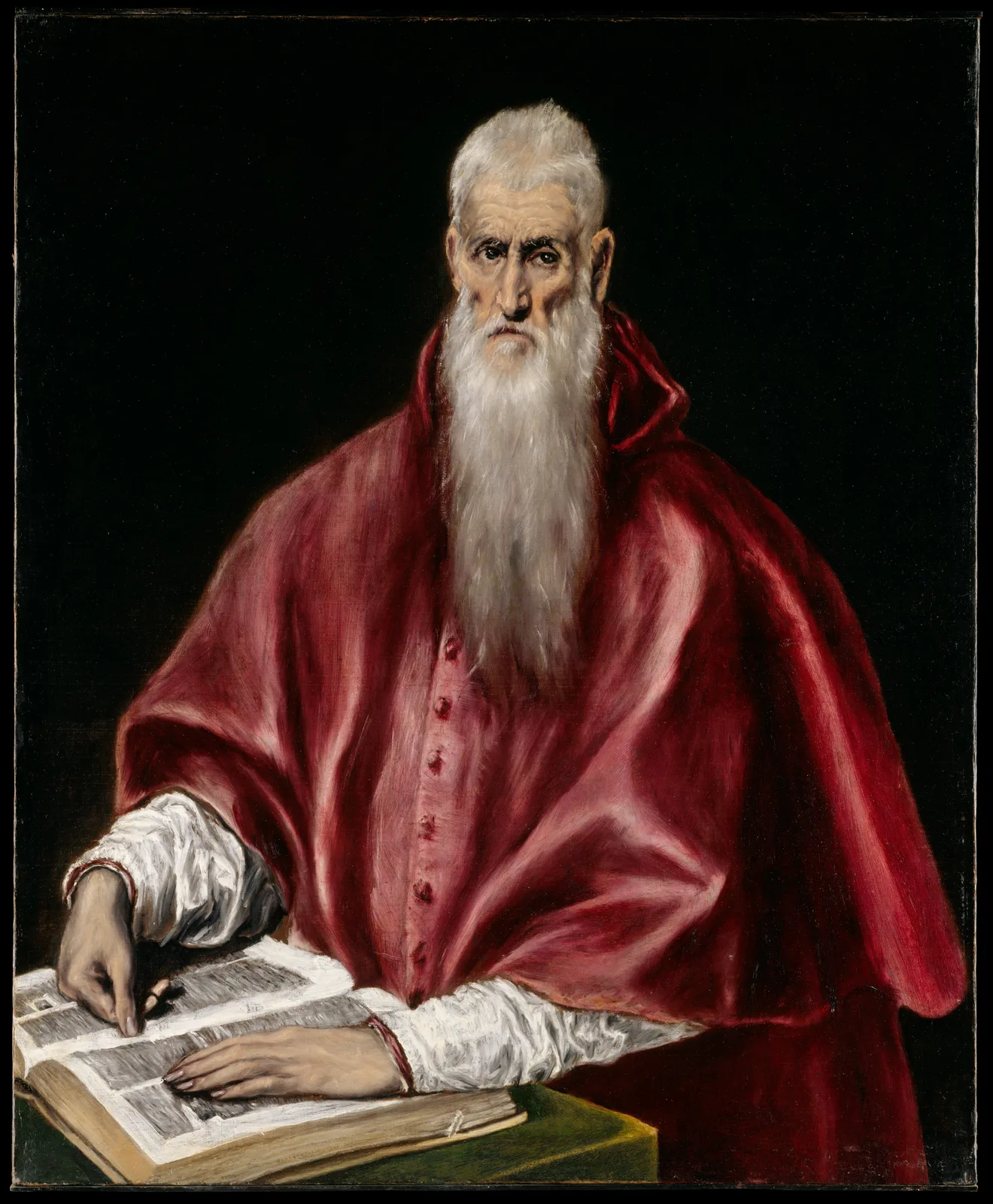
Strebel had an answer on hands as well: the period demanded long hands as a mark of distinction, and the painter could have turned the canvas to paint them. In 1935 Huber replied that the same long hand cannot be put down to period fashion and to a faulty eye at once.
Then why are they long?
Museums look to style rather than to the eye. The National Gallery, London, says it was in Venice, during his training, that he developed his "intense, colourful Mannerist style". Keith Christiansen of The Met sees in his first great Toledo works a Mannerism that pushes elegance to an extreme, and reads The Burial of the Count of Orgaz as aiming at a vision that belongs to the imagination more than to the world in front of us. Anderson too concludes that the evidence suggests a conscious artistic choice. The words "the evidence suggests" should stay. The sources checked for this note hold no record of anyone examining his eyes.
Pinotti goes further and rejects the choice between the condition of the eye and style. Drawing on Merleau-Ponty, he holds that what happens to a painter's body is itself absorbed into style, a "coherent deformation". This can be read as saying that even if something was wrong with his eyes, that alone would not explain these pictures.
So whenever you hear that a painter worked that way because of an eye disease, ask three things. Did the painter not see his own canvas with the same eye? How does the figure's height in head lengths change? Did the round objects and the sideways things on the same canvas change too? With El Greco, start with the cardinal's spectacles.
Add your perspective.
Share a question, another approach, or something you have tried.
Checking sign-in…
Loading comments…