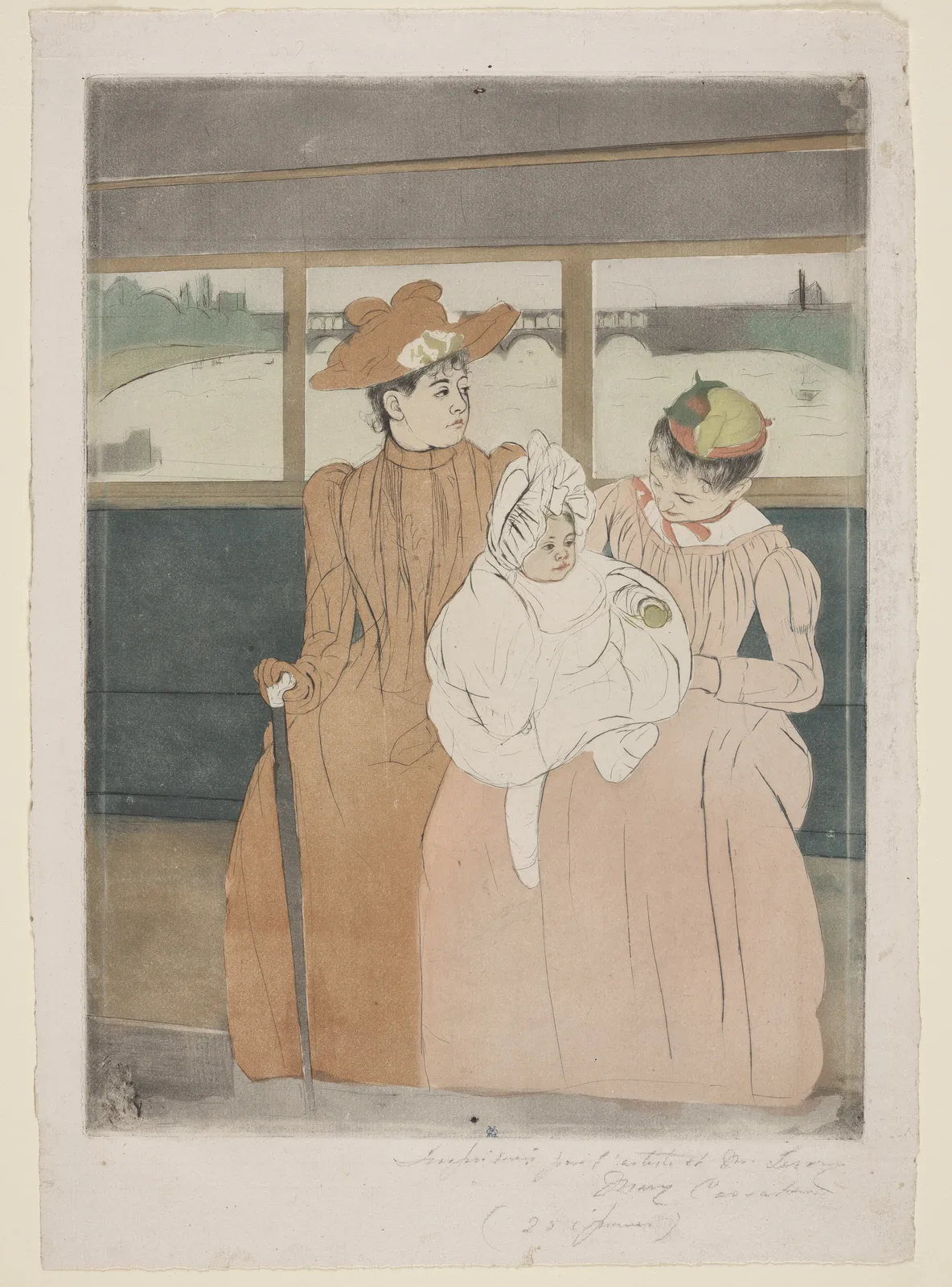
At first sight, Mary Cassatt's In the Omnibus recalls a Japanese woodblock print. Flat areas of colour sit inside thin outlines, and the window frames and seat back divide the picture into horizontal bands. The Cleveland Museum of Art itself says the print was influenced by her study of Japanese woodblock prints. So it is easy to assume this is a woodblock. Was it really printed from wood?
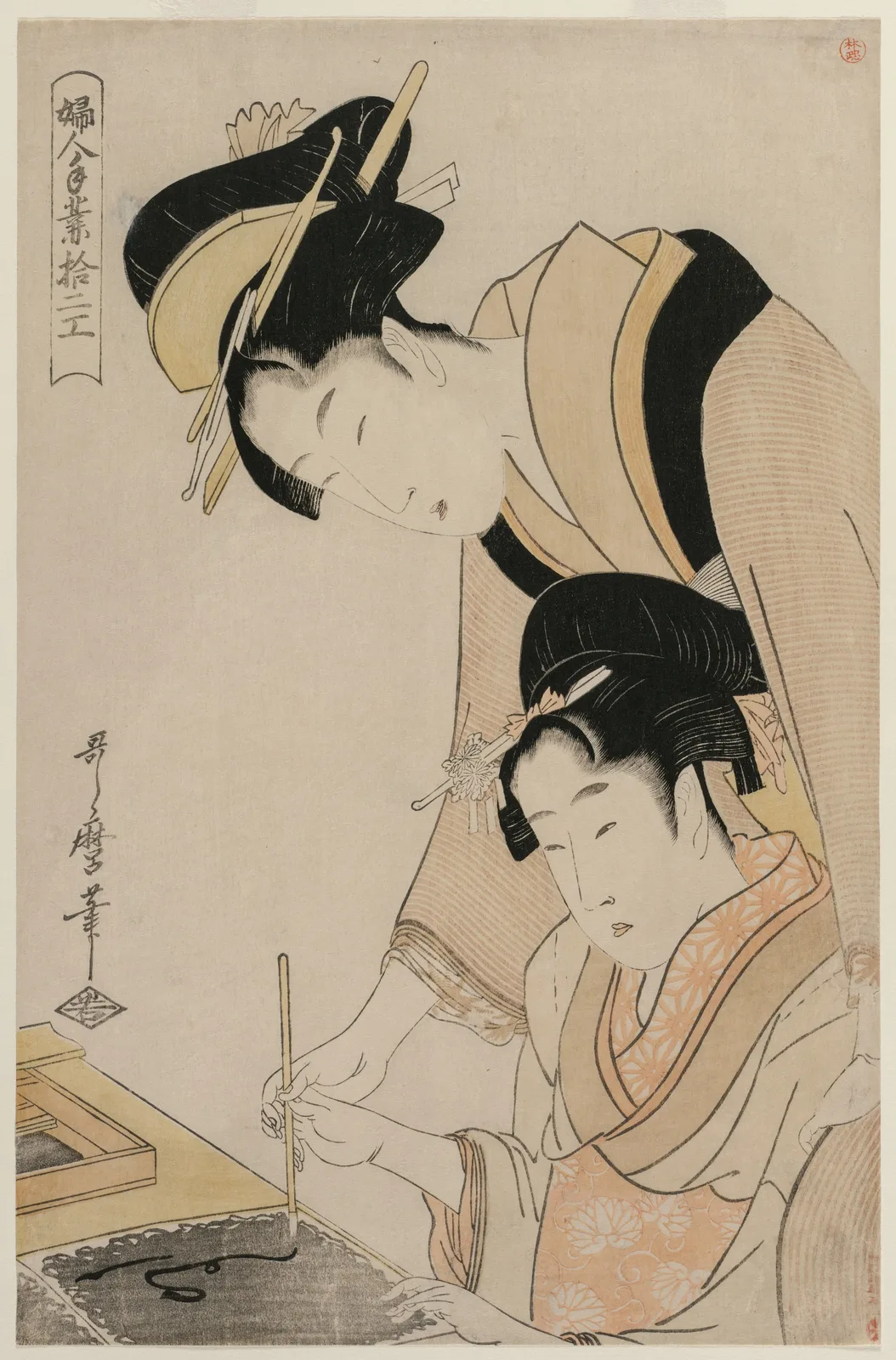
The record says no. Cleveland's medium line reads color drypoint and aquatint, and both are metal-plate techniques. The useful question comes next: how far does it look like a woodblock, and where does the metal plate show? By the end you will be able to stand before a colour print, look at three places, its edge, its colour areas and its lines, and make a reasoned guess whether it was printed from wood or from a metal plate. The comparison is one woodblock print by Kitagawa Utamaro, of about 1798. The observations here come from enlarging the high-resolution photographs Cleveland has released, not from the prints themselves.
Two things that show up close
Look first around the image. A rectangular border is pressed into the paper. A metal-plate print is made by putting ink into the plate's recesses and pressing the paper in a press, so the plate's edge can leave its mark on the sheet. That is why Cleveland gives the size as a platemark, 36.6 × 26.8 cm. Enlarge the upper left corner and a rounded edge line appears, with grey ink spreading inside it.
Next, the colour areas. The brown dress looks flat from a distance, but enlarged it is covered in small light flecks like sand. Aquatint is made by fixing resin powder to the plate and putting it in acid, which bites between the grains. The result is an area with a rough texture rather than a line. That the flecks in the middle panel of the next image result from this technique is this note's judgment, combining the medium record with what can be seen.
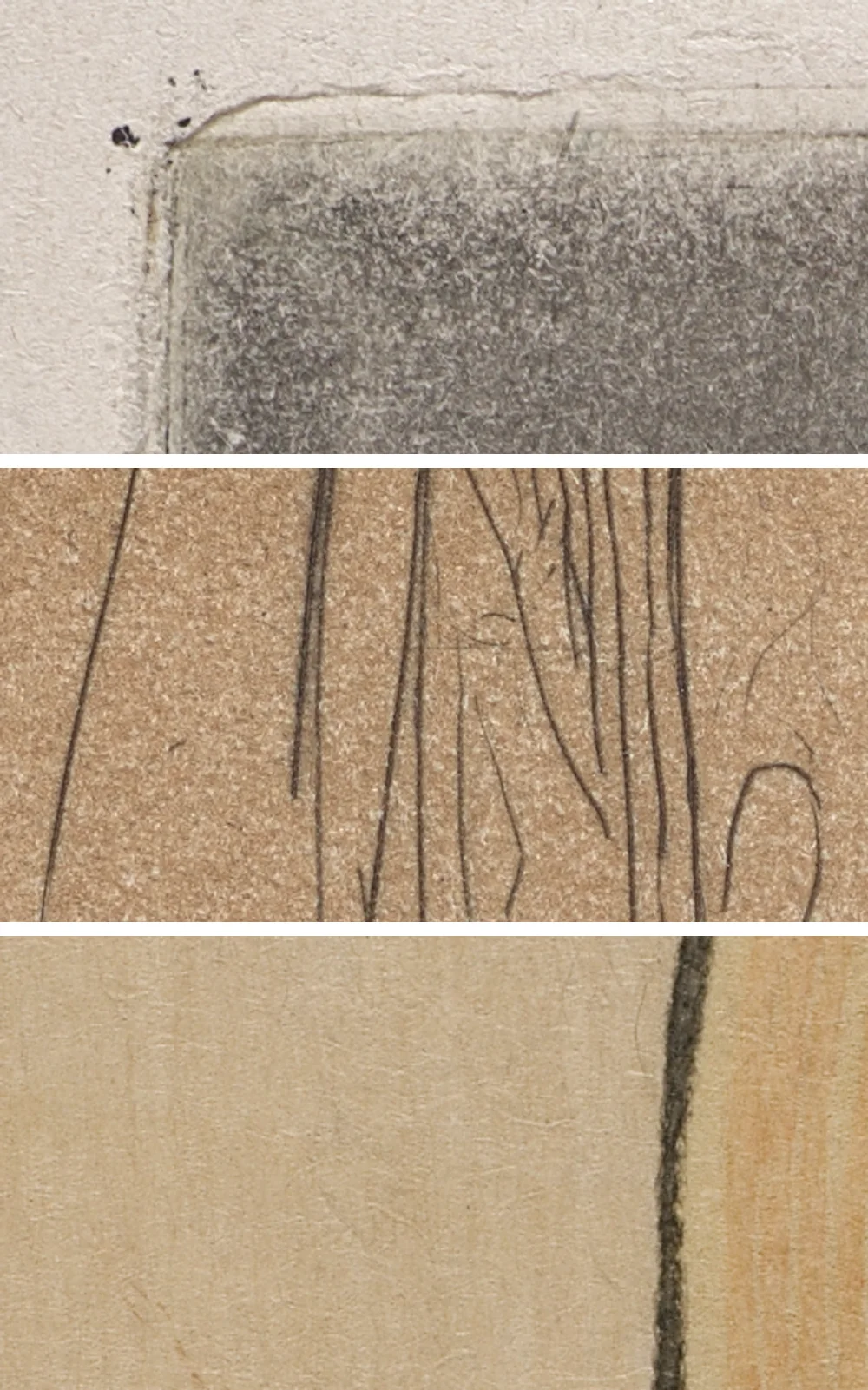
Utamaro's sheet looks different on both counts. No pressed rectangle shows around the image in this photograph. Woodblock printing used no press: a tool called a baren rubbed damp paper against the block. Enlarged to the same degree as Cassatt's (the bottom panel above), a pale colour area in the robe has no sand-like flecks, only paper fibres and faint vertical streaks. Whether those streaks are wood grain cannot be decided from the photograph.
Lines: scratched or left standing?
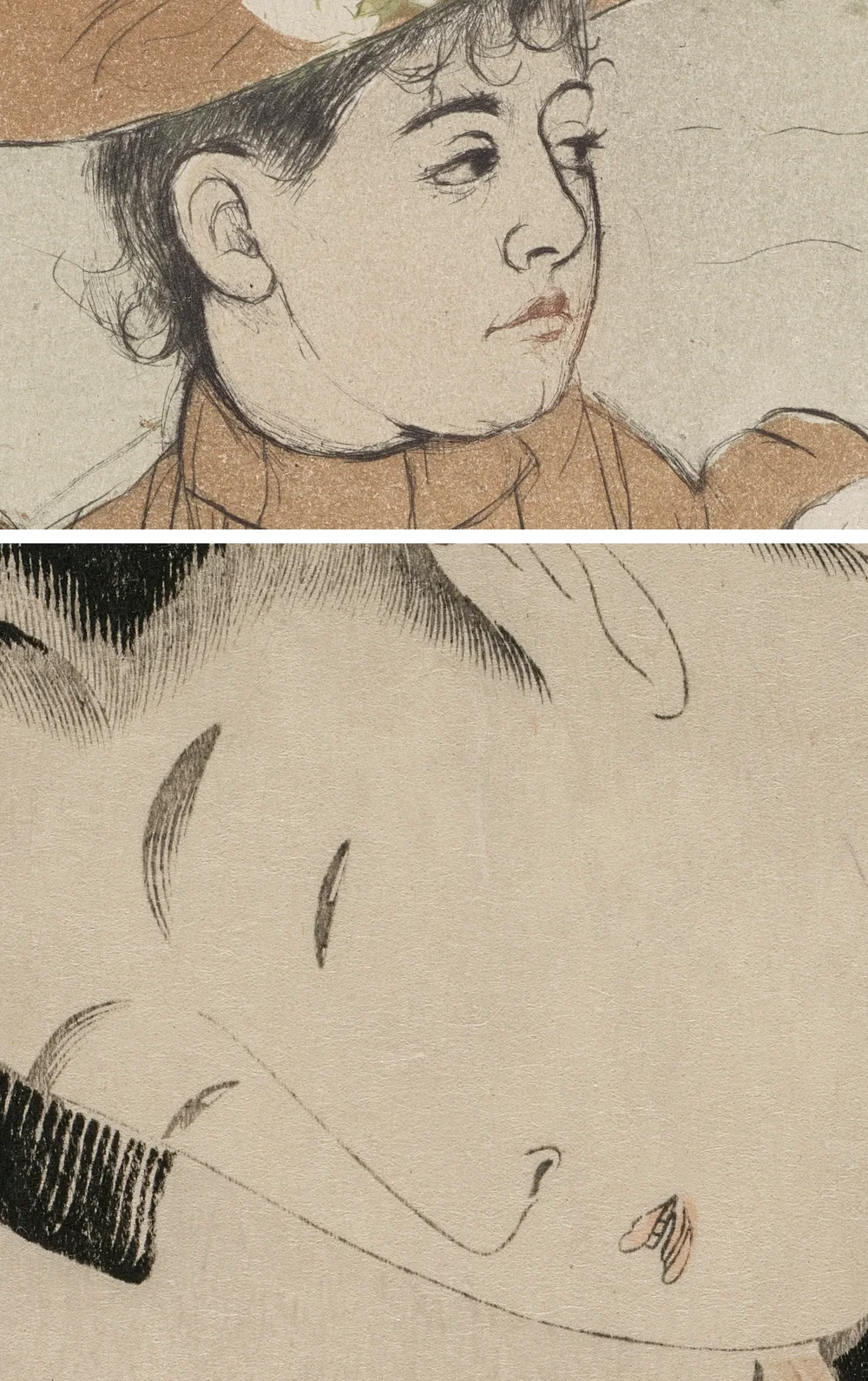
Drypoint is scratched directly into the plate with a sharp needle. Metal burr rises on both sides of the scratch and holds ink, so the line prints soft. A woodblock line is made the opposite way: the carver cuts away the wood around it and leaves the line standing. They may look like the same Japanese outline, but one is a groove in the plate and the other is a ridge left on the block.
Put the two faces in windows about 6 cm wide and the difference shows in the expression too. Cassatt's woman has hair and a jawline built from many fine strands, and some lines fade out towards their ends. More fine lines go in around the eye and under the jaw, modelling the face from within. The inside of Utamaro's mother's face is nearly empty. The eyebrows are bundles of fine parallel lines, and the ridge of the nose is one thin broken line. The black hair is a solid mass, but at the forehead its edge breaks into comb-like strokes that also thin towards their ends. In this note's judgment, Cassatt took the flat outline of Japanese prints but kept modelling the flesh of the face with fine lines. This compares two sheets and says nothing about either artist as a whole.
Three plates on record, more colours
The logic of colour differs too. According to the Asian Art Museum's account of ukiyo-e, a woodblock print used one block for each colour and printed one colour at a time, with at least about ten impressions for an average print. That is a general account; the number of blocks for this Utamaro sheet could not be confirmed from its record.
The Metropolitan Museum's record of another impression says In the Omnibus was printed from three plates. That sheet and Cleveland's are both catalogued as the seventh state. On Cleveland's sheet, counting by eye gives about six colours: orange-brown, pink, grey, dark teal, light green and red. If Cleveland's sheet also came from three plates, then some plate likely carried more than one colour. The Cleveland Museum of Art's magazine points the same way. By its account the lines came from drypoint or soft ground, and the colour was mixed for the job and put straight onto the aquatinted parts of the plate. One impression could therefore differ from the next by a little or by a lot. On the surface both are flat areas, but on this reading one adds colour by adding blocks while the other divides colours across a single plate.
A letter of 1890: colour on copper
The Cleveland Museum of Art's magazine (2012) introduces a letter Cassatt wrote to Berthe Morisot in spring 1890, after seeing an exhibition of 725 Japanese ukiyo-e prints at the École des Beaux-Arts. The magazine dates it 15 April, but the exhibition's poster gives its run as 25 April to 22 May, so the exact day stays open. Urging her friend to come, she described her own dream. In the English translation the magazine prints, she thinks of nothing else but "color on copper". Copper, not wood. Read as it stands, her goal seems to have been less the woodblock itself than getting colour to match Japanese prints from her own plates.
According to the magazine, the result was a suite of ten colour prints. Cassatt printed them herself with help from a professional printer named Leroy, and the edition was 25. The pencil writing in the lower margin of In the Omnibus says the same. Cleveland's record transcribes it as "Imprimé par l'artiste et M. Leroy / Mary Cassatt / (25 épreuves)", printed by the artist and Mr Leroy. The Met's record says the group appeared in her first independent exhibition in 1891.
The tools came before the exhibition
These metal-plate tools did not appear after the Japanese exhibition. According to the Cleveland magazine, she showed her first etchings at the fifth Impressionist exhibition in 1880, and a drawing of 1881 was used for one of her early soft-ground etchings. Cleveland's record for After-Dinner Coffee describes this sheet of about 1889 as a study for a soft-ground etching with aquatint.
Because both sides of this sheet are public, the process can be seen. The front is a graphite drawing, and the record for the back reads transferred soft ground. Soft ground is a plate coating that does not harden; paper laid over it and drawn on picks the coating up wherever it is pressed. The brown grainy lines on the back follow the pencil lines on the front, mirrored, which fits that account. But this study is not the drawing for In the Omnibus, so it does not show that the lines of In the Omnibus were transferred this way.
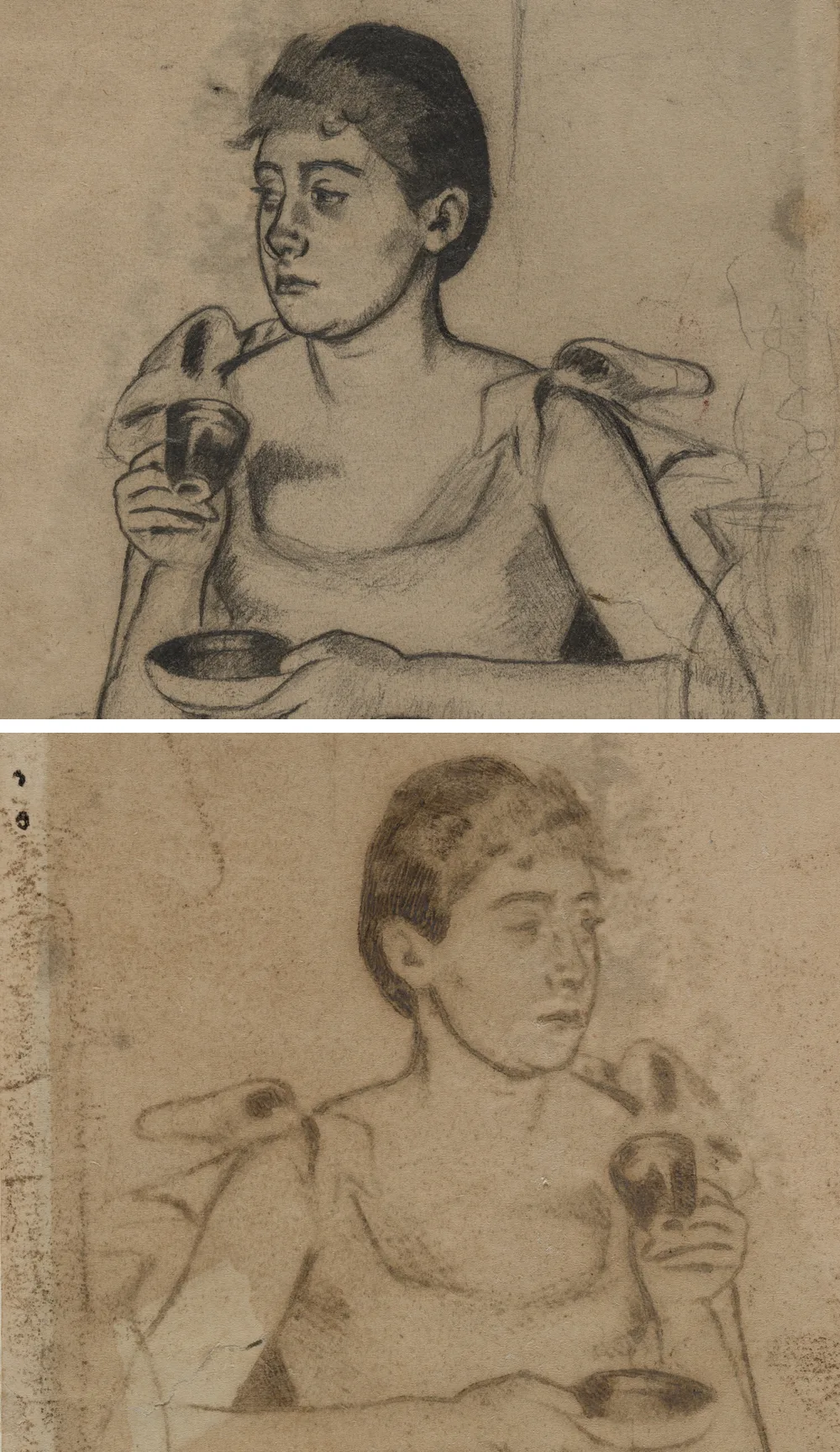
So what changed after the exhibition seems to be how much the picture holds rather than the tools. The magazine credits the exhibition with moving her from the dense surfaces of her paintings to much simpler designs. In the Omnibus can be read as that simplicity tried out on copper.
Three places to look at a colour print
When a colour print looks like a woodblock, look at three places. Is there a pressed rectangle around the image? Are the colour areas covered in sand-like flecks? Do the lines fade thin, as if scratched? If all three hold, a metal plate becomes more likely. The lines alone cannot decide it, though: Utamaro's hair strokes at the forehead thin towards their ends too. This is a rule of thumb drawn from comparing two sheets, not a rule that sorts all prints. A trimmed sheet may have no platemark, and a low-resolution photograph will not show the flecks. In those cases, read the medium line of the museum record first. Once you know the medium, the more interesting question remains: what did this artist take from Japanese prints, and what did she leave behind?
Add your perspective.
Share a question, another approach, or something you have tried.
Checking sign-in…
Loading comments…