Looking at Berthe Morisot's pictures, it is easy to feel that her figures rarely look your way. The Cleveland Museum of Art says as much, setting her against Manet: his women often meet our eyes, while hers are "usually" busy with some task or lost in thought. So when do they look at us? Is there any picture in which they really do?
Four works from about 1870 to 1889 let us follow where the eyes go, one at a time. By the end you will be able to stand before a Morisot figure and tell where the eyes and head go, and who receives that look. The four were released by The Metropolitan Museum of Art and the Cleveland Museum of Art, and they are read here from enlarged public photographs, not from the originals.
About 1870: she looks straight ahead
The first picture already goes against that impression. The woman in The Pink Dress sits on a sofa with body and head forward and both eyes aimed out of the picture. Her mouth is closed and her expression is slight, but those eyes cannot be avoided. The Met's title names the sitter: Albertie-Marguerite Carré, later Madame Ferdinand-Henri Himmes. The Met's audio commentary is a little more careful, saying the sitter "is thought to be" Carré. The dress is painted with a broad brush, while the face keeps eyes and mouth distinct.
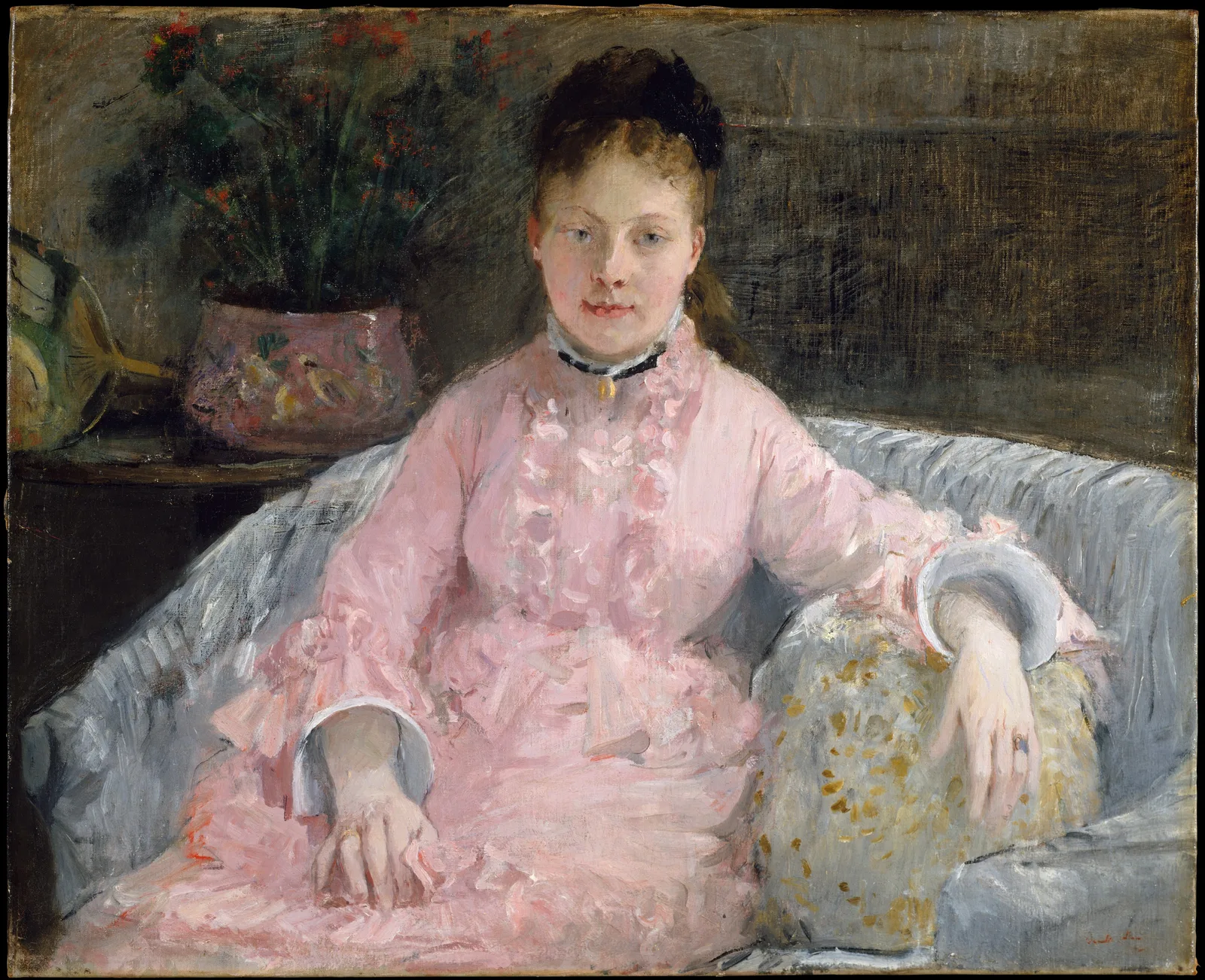
So to say "Morisot's figures do not look at us" is already wrong. In a portrait sitting it is natural for the sitter to look at the painter, and that look then reaches the viewer. The Met's text places this picture in just such a setting: the portraitist Jacques-Emile Blanche watched it being painted at the sitter's family home, over several sessions. Even so, the idea that the gaze comes from this format is only a guess.
1873: the eyes were repainted to look down
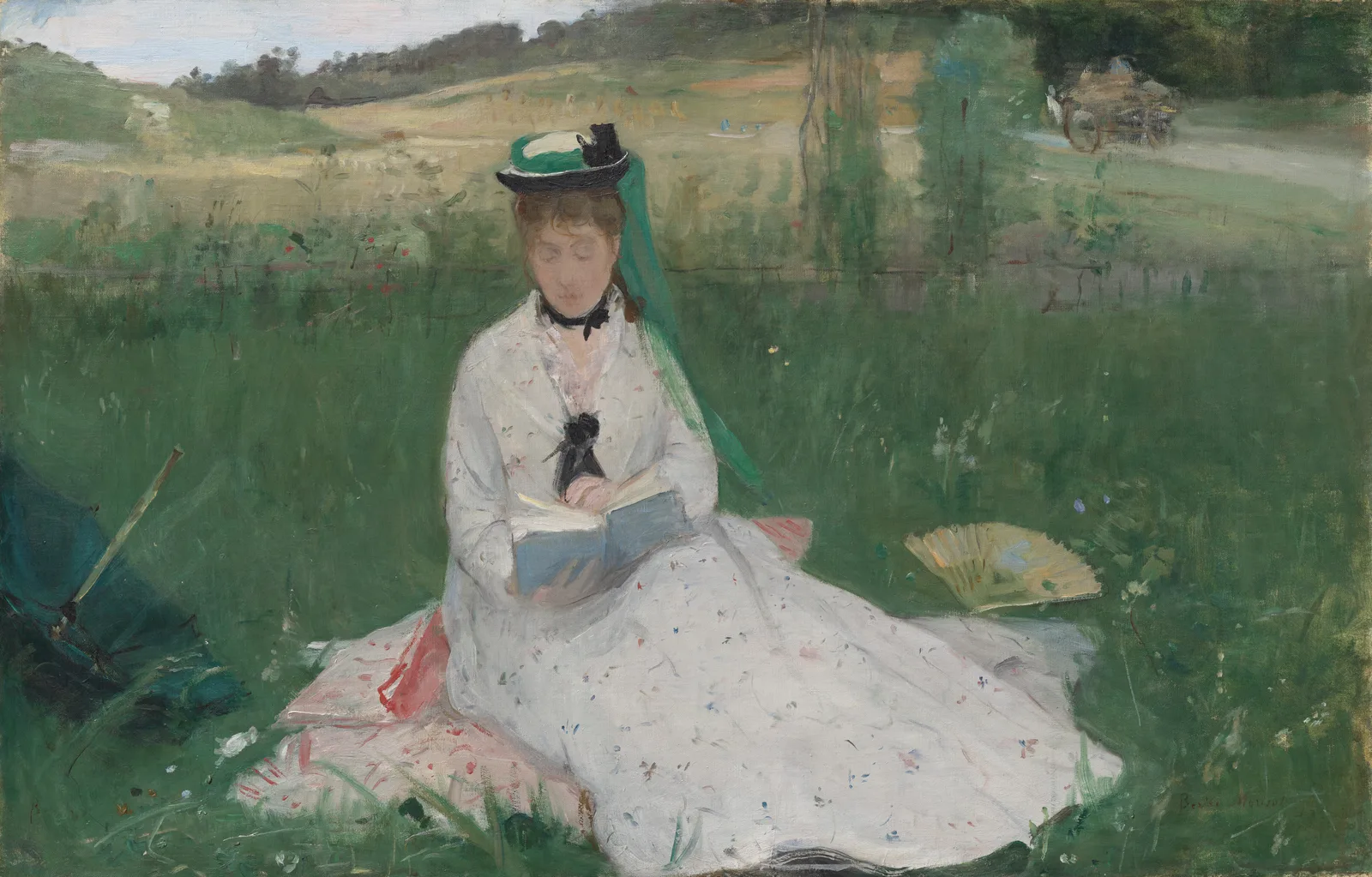
Reading holds an event you cannot see. The sitter is Morisot's sister Edma, seated on her shawl in the grass and looking down at a book. Parasol and fan have been set aside. According to the Cleveland Museum of Art, an X-ray shows a different first version: the eyes met ours, as Manet's figures more often do, and Morisot then repainted them.
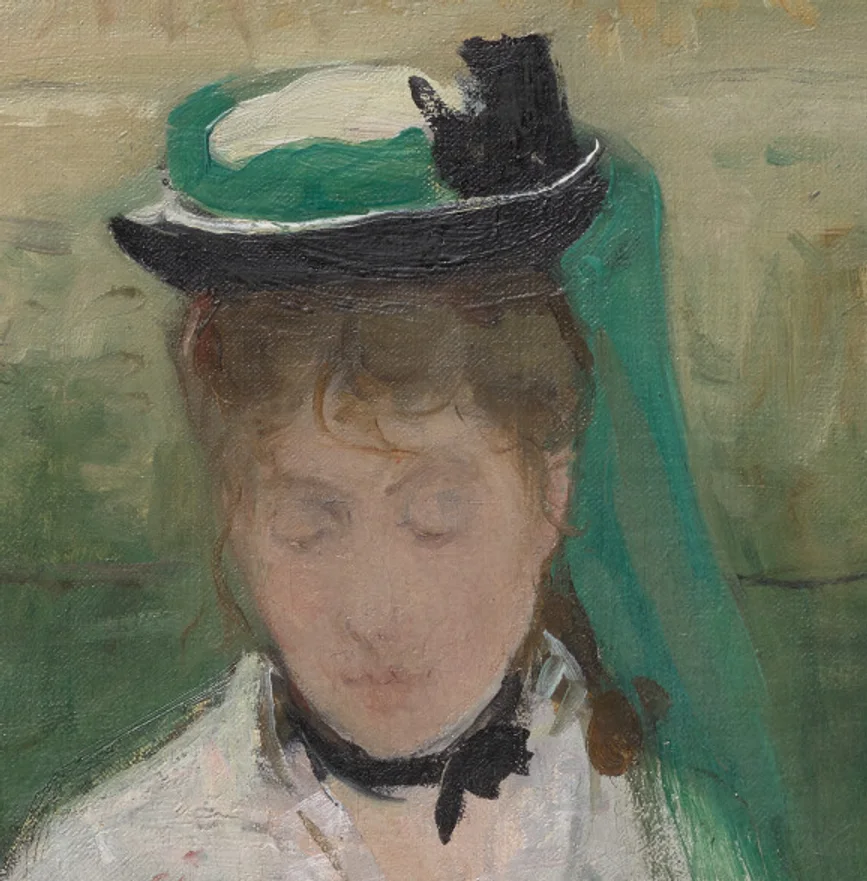
Enlarged, the eyes lie hazily under lowered lids, with greyish paint lingering like a smudge around them. It is tempting to call this a trace of the change, but the photograph alone cannot say. This note has not seen the X-ray and knows of it only through the museum's sentence.
One idea explains why changing a pair of eyes matters. In a 1980 book on French painting in the age of Diderot, Michael Fried set absorption against theatricality: once a painted figure seems aware of being seen, absorption gives way to theatre. Fried was not writing about Morisot, and applying the idea here is this note's reading. An Edma who looked forward would presumably have been someone who knows she is being seen. With her eyes lowered, she becomes someone reading. Going by the eyes alone, the viewer's position changes.
About 1883: the eyes cannot be seen at all
Young Woman Knitting goes a step further. The woman sits on a chair beside a garden path with her head bent toward the lower right of the picture, and only part of a cheek and an ear show below the hat. The eyes are nowhere to be seen. Her hands are set down in a few strokes over the knitting on her lap. At right stands an empty chair. It is tempting to read it as a place that receives us, but the Met's account is plainer: the fine chairs are enough to mark the setting as a backyard. The same text says Morisot passes lightly over the features of the face and drops other description, which fits the missing eyes.
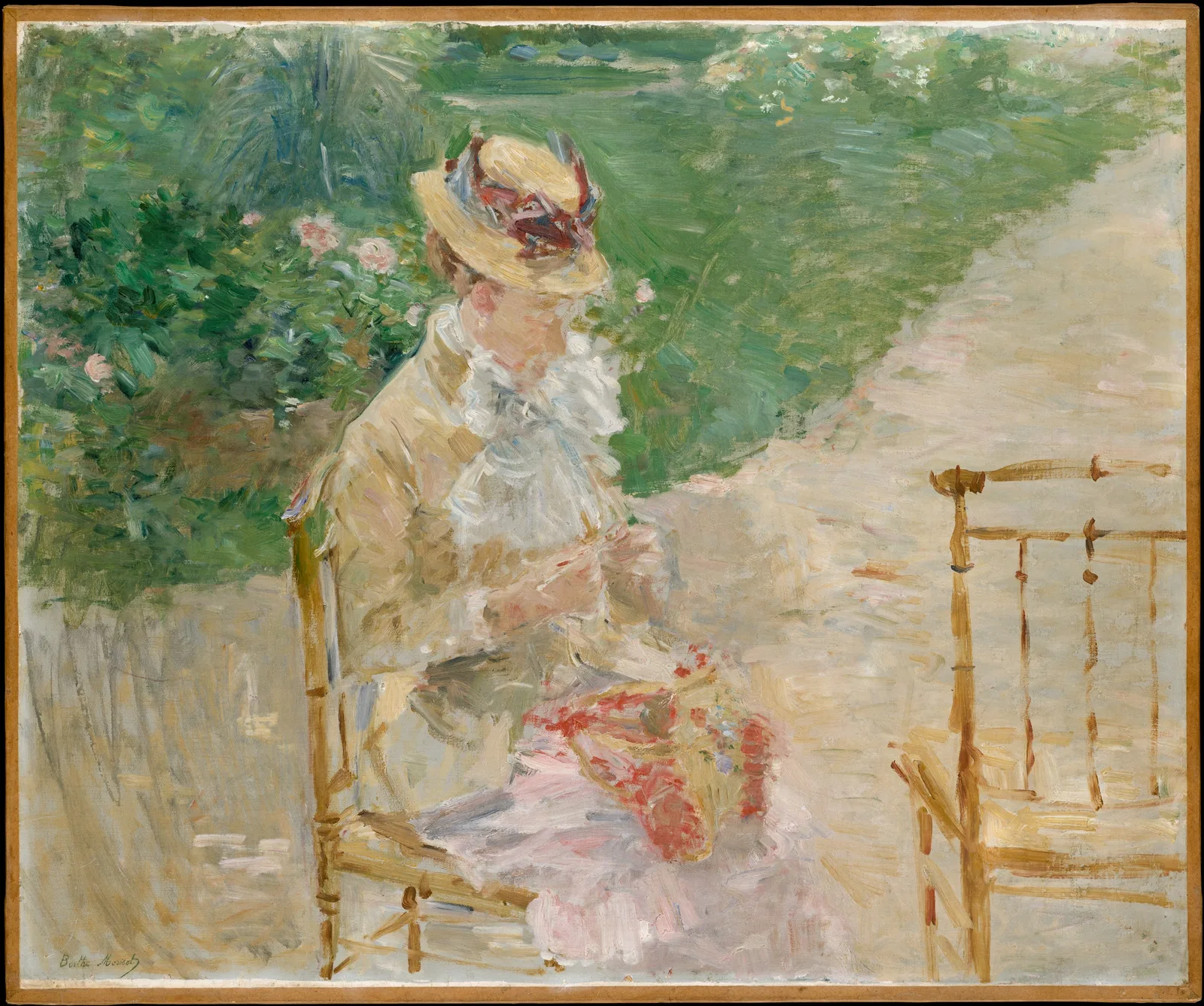
With the head bent and the face hidden, there is no gaze to discuss. One might call this the same absorption as the downward look in Reading, but the picture does not answer whether she is intent on her knitting or looking elsewhere.
1889: the one looking out is the artist
The last is a drypoint. According to the Cleveland Museum of Art, Morisot, encouraged by Mary Cassatt and Stéphane Mallarmé, tried printmaking between 1887 and 1889. In The Drawing Lesson, the museum writes, Morisot faces us as though we were the ones being drawn, while her daughter Julie, then 11, watches her work. In the enlarged print the mother's eyes clearly point this way. The daughter's seem to point down, so to this note's eye she looks more at the board than at her mother.
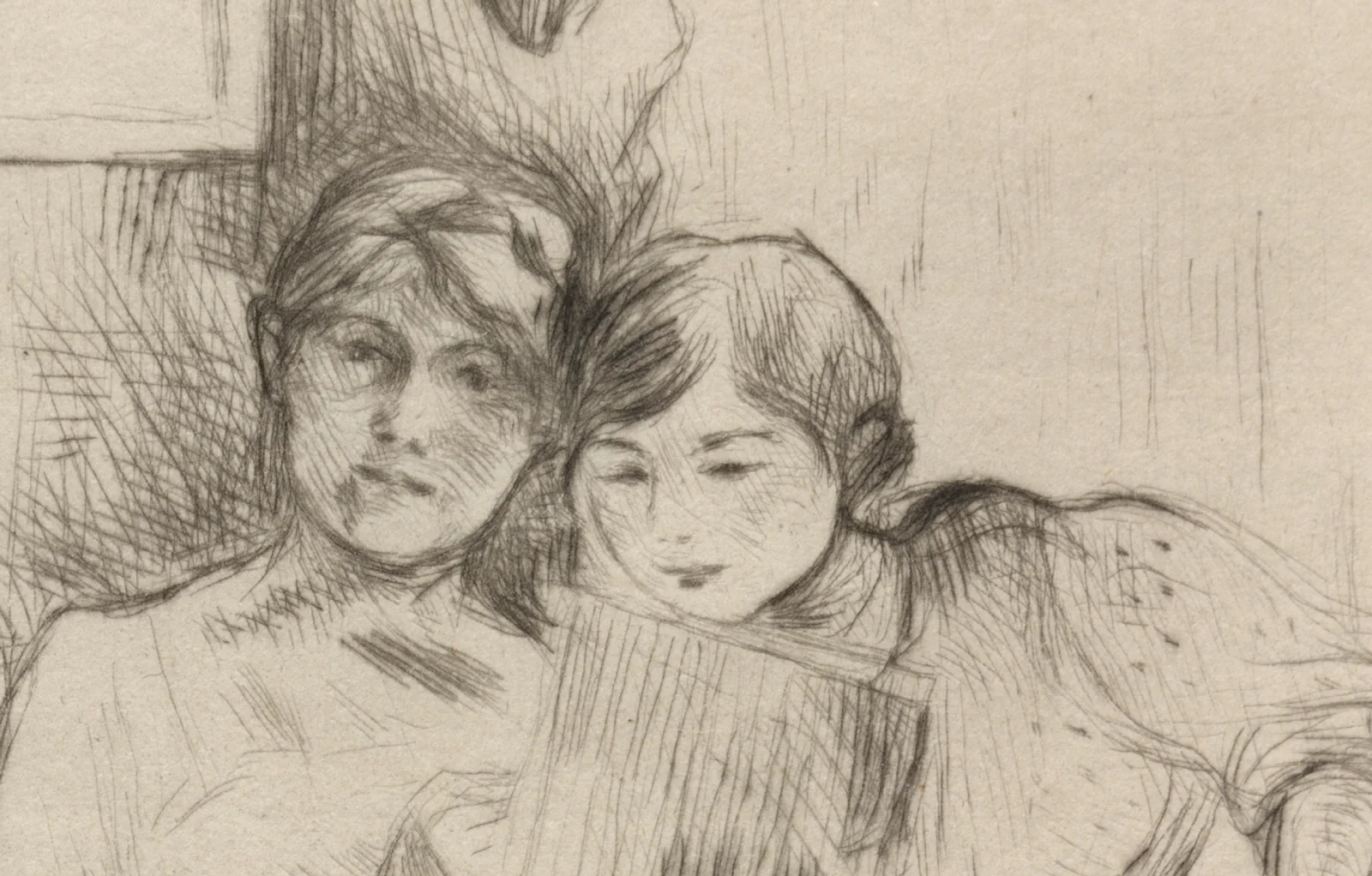
Compared with the first picture, the positions have changed. About 1870 the sitter was presumably looking at the painter, and her eyes reached us. In 1889 the painter is herself the subject, and the person doing the looking still looks out at us. Whether she was really looking in a mirror is unconfirmed.
What the four do and do not say
Set the four together and a small answer appears. The sitter facing us in a portrait and the artist at work look out; the sister reading and the woman knitting do not. Three of Cleveland's other Morisots fall on the side of not looking: the pastel Mademoiselle Louise Riesener in a Hat is in profile, the boy in Young Saint John has his eyes turned aside, and the woman in the watercolour Sewing near the Window looks down at her work. Cleveland's 1889 drypoint Young Woman at Rest is harder to call, with half-lowered eyes that may or may not be on us. None of this confirms the museum's "usually". The sample is small and chosen by this note, and the comparison with Manet is borrowed from the museum and not tested here. Cleveland also sees the marks of Impressionism in her loose brushwork, and says her subjects often reflect the limits placed on her as a woman. These four cannot tell whether the difference in gaze comes from that.
So before a Morisot figure, first look for whether the eyes can be seen. If they can, see where they point, and think about who may have been in the place that receives them. And do not assume that eyes now lowered were always lowered. The eyes in Reading changed once, and that came to light through X-ray examination.
Add your perspective.
Share a question, another approach, or something you have tried.
Checking sign-in…
Loading comments…