The name Frans Hals tends to call up a laughing face, which is fair enough when his most famous picture is called The Laughing Cavalier (1624). Yet according to the press release in which its owner, the Wallace Collection in London, announced a loan, the name is a nickname given only in 1888, and little is known of who the sitter was. The same release says, "He is neither 'laughing' nor a 'cavalier'." Reviewing the 2021 Wallace exhibition built around the picture, Michael Glover is just as flat: "He is not, as we have already pointed out, laughing." So are Hals's people really laughing?
This note enlarges four pictures from the open collections of The Metropolitan Museum of Art and the Cleveland Museum of Art and reads mouth, cheek and eye separately. By the end, in front of a Hals face, you will be able to tell how far the laugh has been painted, and which kinds of picture show a laugh with teeth and which a smile with closed lips. The Laughing Cavalier belongs to neither museum, so it is not shown and not judged here.
First count where teeth show
Laughter is easy to misjudge, so start with the firmest test: do teeth show between the lips? On November 1, 2026, The Met's open records list 13 pictures under Hals's name. Two come out, because The Met classes Malle Babbe as another hand working in his style and one self-portrait as a copy. Add Cleveland's 2 to the remaining 11, enlarge the 13, and teeth show in four pictures: Merrymakers at Shrovetide, Young Man and Woman in an Inn, The Smoker and Boy with a Lute. In the nine portraits of one standing or seated person, no teeth show between the lips. But one of those, The Met's Portrait of a Woman, 91.26.10, had its whole background painted over later, most likely in the 18th century, and The Met calls its surface worn. The Met does not say the mouth was changed, but the fine detail of the face cannot be vouched for as first painted either. This count concerns the 13 pictures in the two museums, not all of Hals.
1623: who is the man with the open mouth?
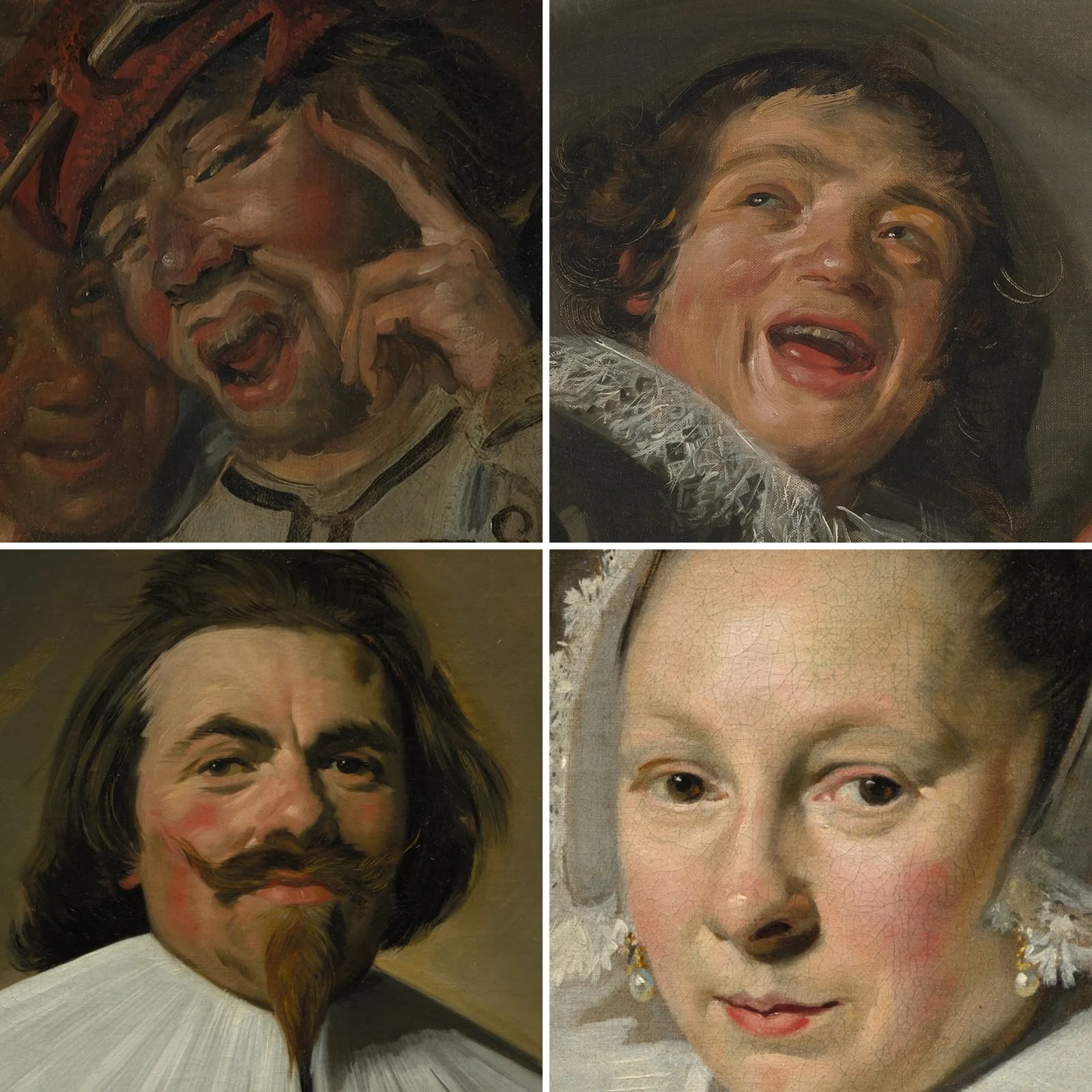
Young Man and Woman in an Inn is the easy case. The man opens his mouth wide, showing upper teeth and tongue, rolls his eyes up and lifts his glass. The woman lays a hand by his shoulder and bares her teeth. The red on the cheeks and the creases by the eyes show the whole face at work.
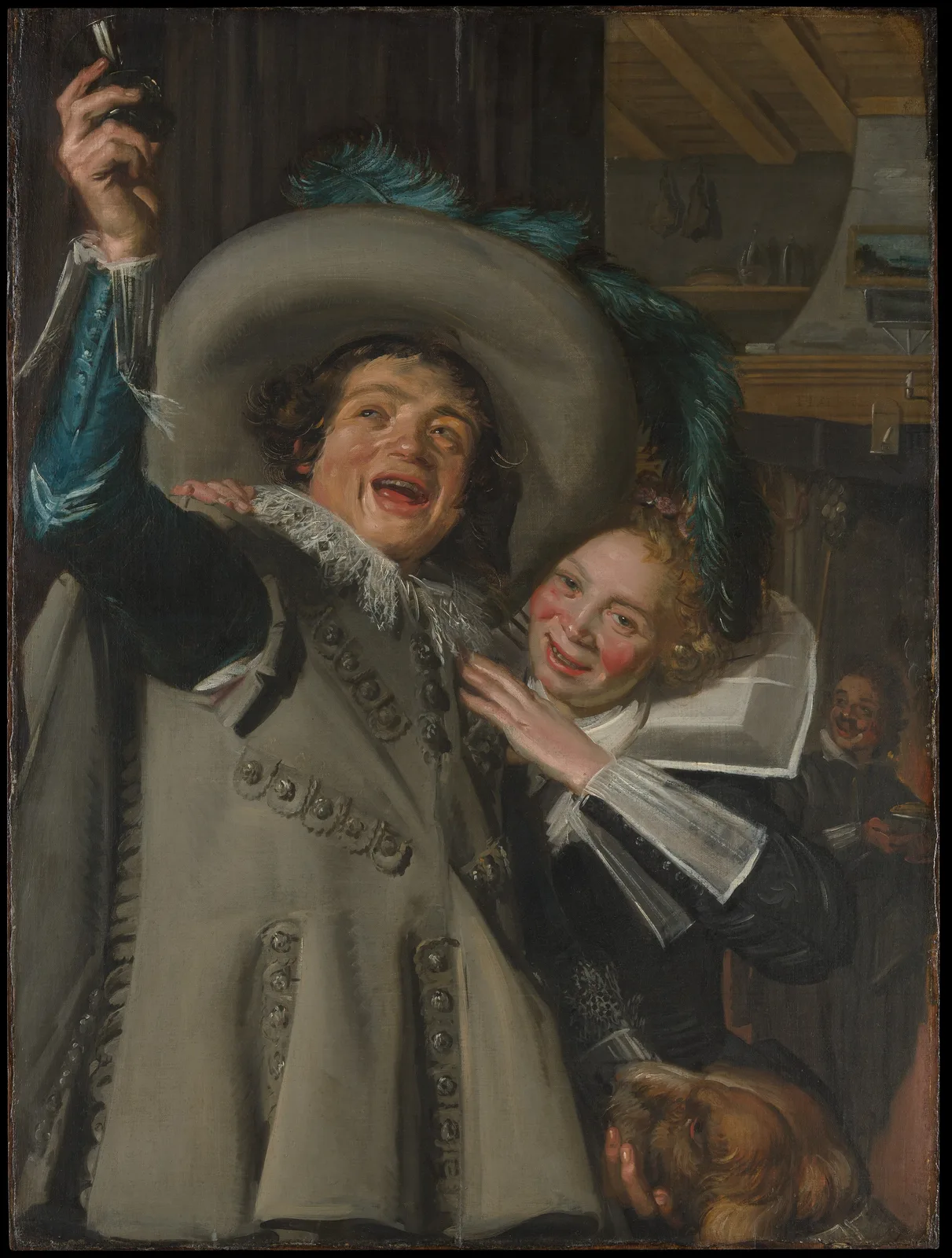
This man has long had a name. According to The Met the picture has been known since the 18th century as Yonker Ramp and His Sweetheart, because he was thought to resemble the ensign Pieter Ramp in one of Hals's group portraits. The Met reads the scene differently: two people who have probably only just met, in a tavern or perhaps a brothel. It also thinks this may well be the Hals "Prodigal Son" mentioned in a 1647 document, and says such present-day prodigal stories were told less to teach a lesson than to get a laugh at a young fool. So this mouth is closer to the expression of a comic type than of an individual.
About 1616–17: even at the party, mouths differ
Merrymakers at Shrovetide is merry by name, yet face by face it is uneven. The man at the left edge holds a finger to his eye with his mouth wide open. The central figure in the laurel wreath looks up, showing a little of the upper teeth. Behind, the man in the black hat looks sideways with his lips slightly parted, and the man in the red cap at right lowers his eyes and the corners of his mouth. Among these three in front, nobody has a wide-open mouth.
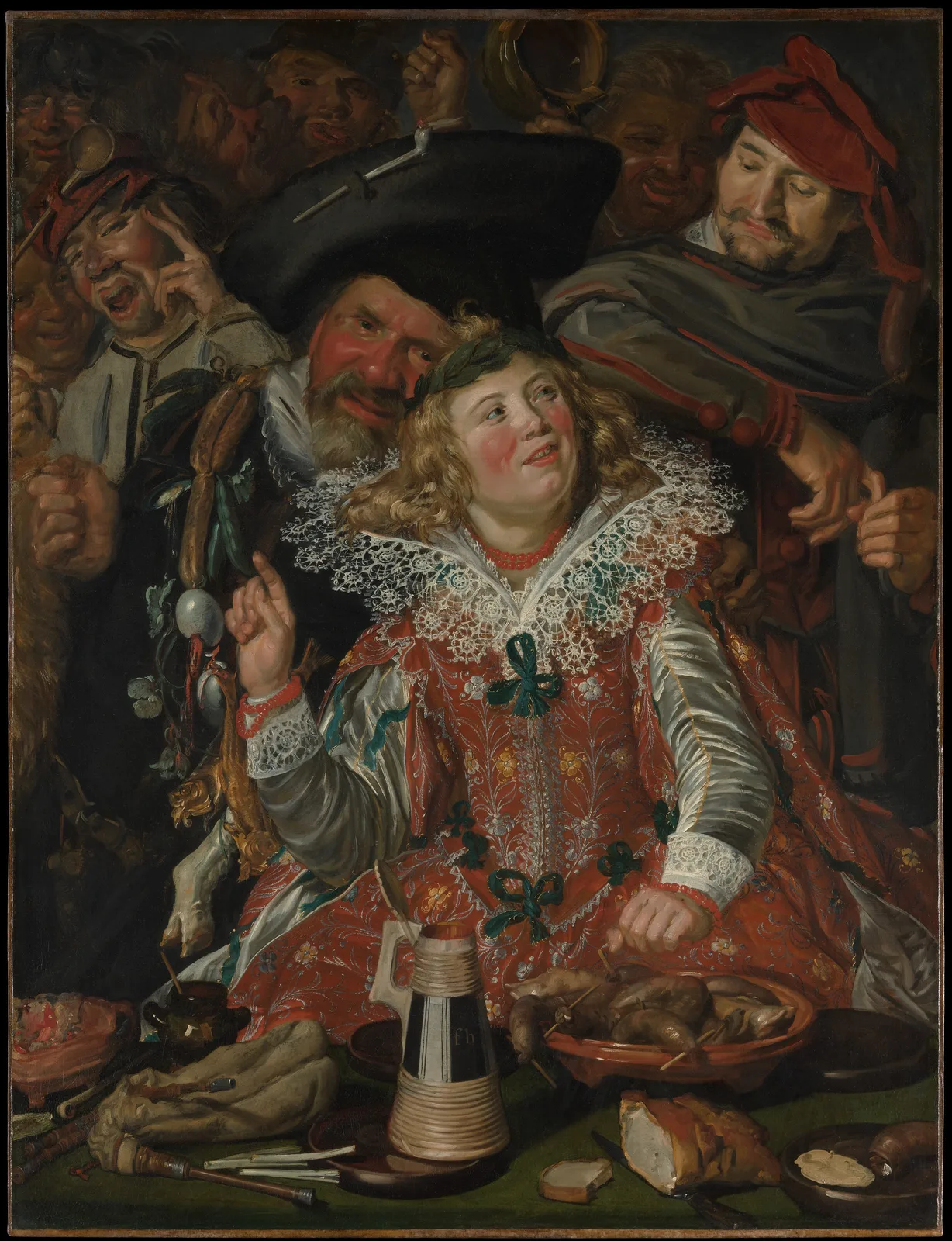
The Met reads these people as stage figures. It follows Slive, pointing to the hair, in seeing the central figure as a boy dressed as a woman, and names the men on either side as Pekelharing and Hans Worst, stock characters of comic theatre. Hals himself had ties to a chamber of rhetoric in Haarlem, and the comedies of such societies could be coarse; The Met thinks the picture grew out of that acquaintance, and the intended owner may have been such a chamber, one of its members or simply someone who enjoyed rough comedy. The six heads at the back were once covered over, no one knows when, and came to light only when the picture was cleaned in 1951; the old painted copies include them too. The Met does not say which heads they are, but counting past the three main figures leaves exactly six faces, so the man at the left edge, the widest mouth in the picture, is probably one of them. One more caveat: The Met keeps the picture as Hals's, but according to its references Claus Grimm called it a copy after Hals in 1972.
1634 and 1638: portraits with closed mouths
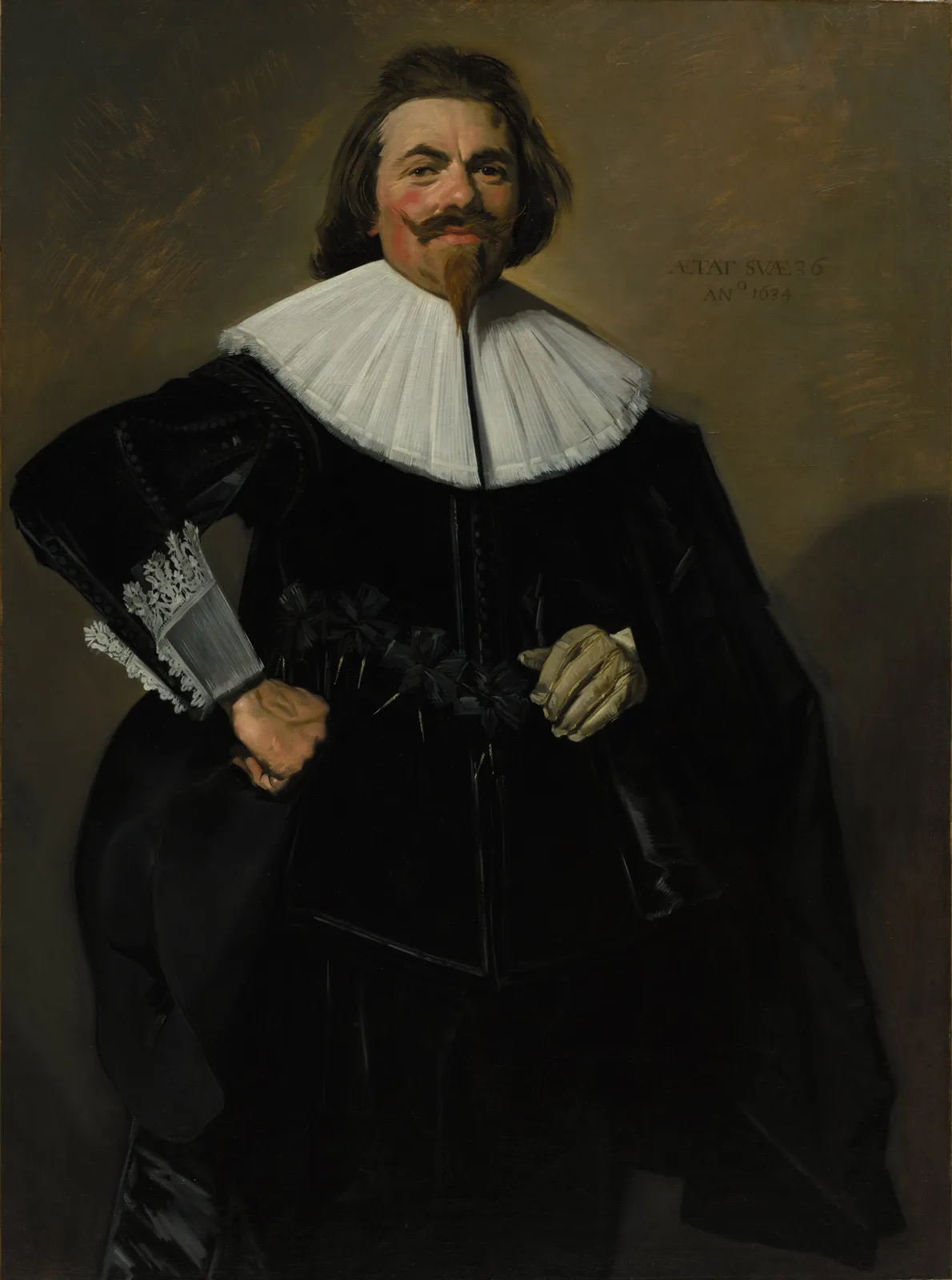
In these two portraits the mouth is shut. According to the Cleveland Museum of Art, Tieleman Roosterman was a very rich Haarlem dealer in linen and silk, and this portrait and a companion of his wife may have been commissioned to mark their 1631 marriage. His face is not blank, though. The lips are closed, but the lower lids push up so that the eyes narrow. The moustache tips rise too, though that may be grooming rather than expression, and the red in the cheeks proves little, since the quiet woman in the next picture has much the same. The evidence is in the eyes. The laugh has moved from the mouth to the eyes, and this note reads that as a smile.
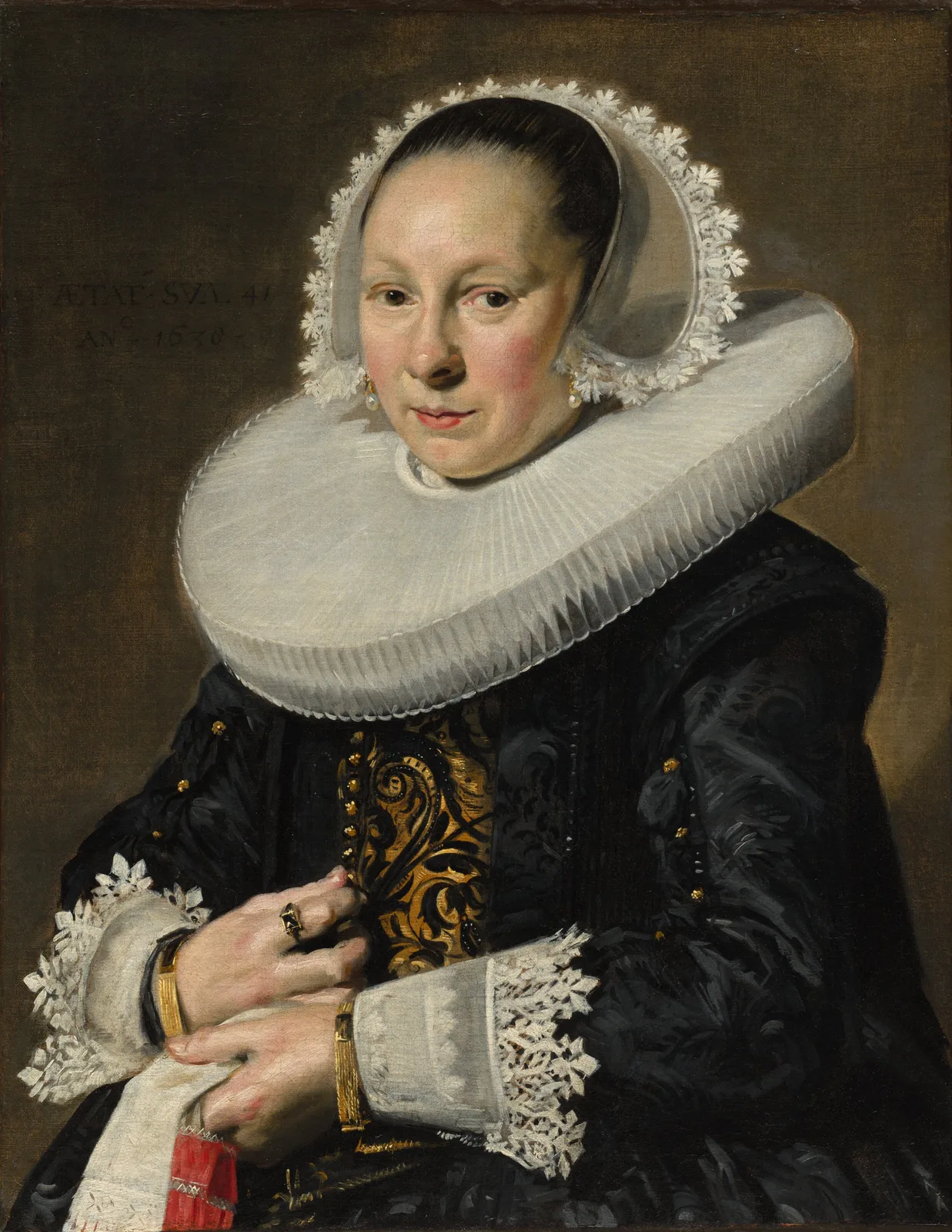
The Portrait of a Woman four years later is different. Cleveland tentatively identifies the sitter as Aeltje Dircksdr. Pater and, following the inscription, gives her age as 41. The lips are closed, the corners barely rise, and the eyes do not narrow. As Cleveland points out, at the hairline there are soft strokes laid into paint that was still wet, and while the brush is lively the expression is quiet. Hals's bold brush and laughter are not the same thing.
Set the four faces side by side and the difference is easier to see. In the upper two the mouth does the work, at lower left the eyes do, and at lower right hardly anything moves much. Both lower faces have much the same red in the cheeks, so the cheeks alone cannot tell them apart.
Why the split?
The four pictures with teeth have no sitter named in their titles, and The Met explains all four as scenes or types: stock comic roles in Merrymakers, a foolish young man in the Inn picture, a joke about human nature rather than a sermon in The Smoker, and, in Boy with a Lute, one of the carefree musicians Hals painted in the mid to late 1620s, taking his cue from Dutch followers of Caravaggio such as Honthorst and Ter Brugghen. Of the Inn picture The Met adds that most scholars count it among his key works on the theme of "everyday life", meaning modern manners drawn to a set pattern. Many of the nine portraits record one person with an age or a year, though three of them also have no name in the title, so the title alone does not make the split. This note's reading goes this far: within the 13, the mouth that shows teeth belongs to the genre scenes and the portraits show no teeth. Only two portraits were read closely here, and in Roosterman, the one read as smiling, the smile sits in the eyes. That does not extend to the other portraits.
This cannot be widened into a rule. Hals's pictures in other museums were not counted. The Met reads the red cheeks and wide grins in Young Man and Woman in an Inn as a sign that the pair have stepped outside the manners of their day, but this note did not itself trace any period document showing that anyone objected to open mouths in portraits. Some scholars have called The Smoker a workshop replica, though The Met keeps it as Hals's, and The Met says the surface of Boy with a Lute is worn and carries old restorations.
So in front of a Hals face, do not ask "is he laughing?" all at once. Look at three places separately: at the mouth, whether teeth show; at the eyes, whether the lower lids have risen and narrowed them; at the cheeks, whether the red comes with any of that. Red cheeks alone are not a laugh. Then look for an age or a year on the canvas. According to The Met the Inn picture is the only dated genre painting by Hals, so lettering of that kind often points to a portrait. The name The Laughing Cavalier was attached in 1888, so the face can come before the name.
Add your perspective.
Share a question, another approach, or something you have tried.
Checking sign-in…
Loading comments…