In the market interest rate table of the Bank of Korea's Economic Statistics System (ECOS), the monthly average yield on 10-year Korea Treasury Bonds (KTBs) was 3.366% in December 2025 and 4.210% in October 2026, a rise of 0.844 percentage points (pp) in ten months. When yields rise, bonds already issued lose value. So how much did 0.844 pp take off the price of a 10-year bond?
After reading this you will be able to turn a change in yield into a percentage change in a bond's price in two ways: by repricing with the price formula, and by estimating with duration. You will also see in numbers why a shorter bond moves less for the same rise in yield. The bonds in the calculations are hypothetical, not actual issues.
The 10-year yield rose 0.844 pp in ten months
In ECOS the series is found under table 721Y001, "1.3.2.2. Market Interest Rates(Monthly, Quarterly, Annually)" → "Yields of Treasury Bonds(10-year)" → monthly; it was read on 9 November 2026. It starts at 3.366% in December 2025, passes 4% in May 2026 at 4.075%, peaks at 4.454% in September and comes back to 4.210% in October. Over the same months the 3-year KTB yield went from 3.010% to 3.861%, up 0.851 pp, almost the same rise as the 10-year.
A month's value is the average of that month's daily yields. Averaging the daily 10-year yields for the 22 business days of December 2025 (ECOS table 817Y002) gives 3.3656%, which rounds to the monthly 3.366%. So 0.844 pp is not a move from one day to another but a comparison of two monthly averages.
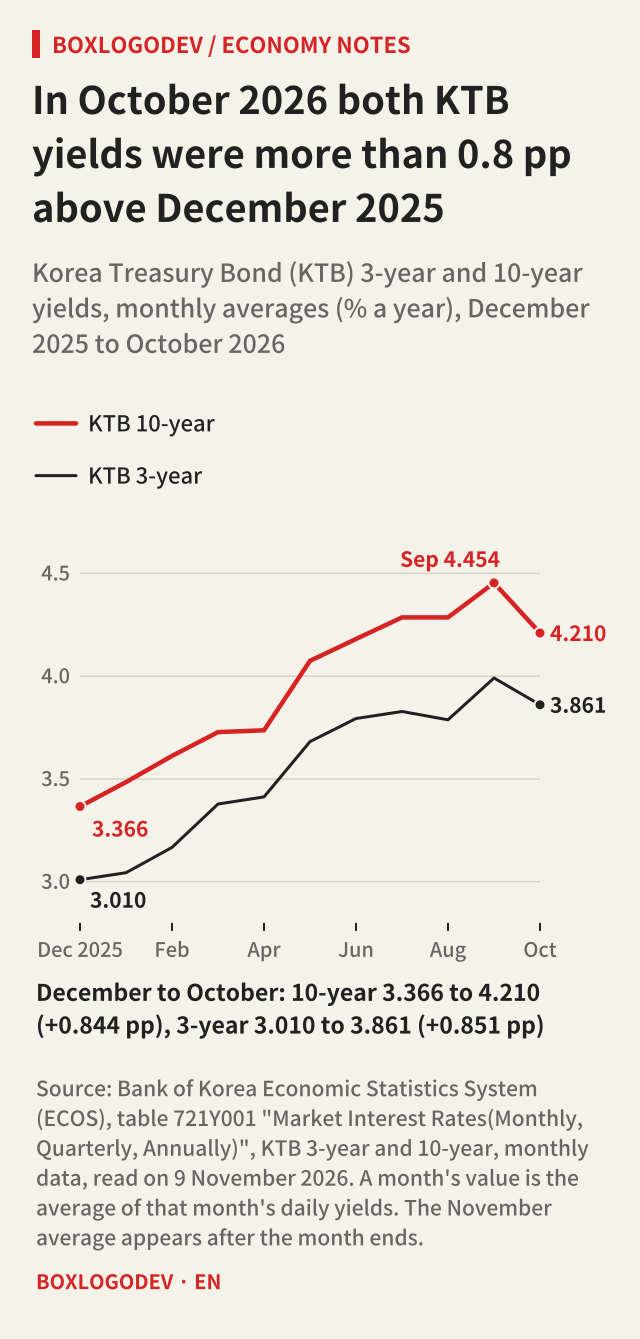
The November average can only appear after Monday 30 November, the last business day of the month. Market rates are not on the Bank of Korea's statistical release calendar; the monthly values are averages of the daily values in ECOS. On 24 November, when this note is published, the latest monthly average is still October's 4.210%.
Why do existing bonds fall when yields rise?
A fixed-rate bond pays the interest set at issue until it matures. When market yields rise, new bonds pay more, so an existing bond with a lower coupon only sells at a lower price. A bond's price is the sum of the payments still to come, each discounted at today's market yield.
The bond types table on the Ministry of Finance and Economy's government bond site (in Korean) says KTB interest is paid every six months, in arrears. The hypothetical bond follows that: face value 100, 10 years to maturity, a coupon of 3.375% a year paid as 1.6875 every six months, 20 payments, and the 100 of principal back at the end. The coupon is set close to the December average yield so that the starting price is near 100.
Discounting is half-yearly too. At 3.366% a year the half-year rate is 1.683%, so the k-th payment is divided by 1.01683 to the power k and all 20 are added up. Both prices use 10 years to maturity and a coupon date, as if only the yield had changed from 3.366% to 4.210% on the same day.
Repricing gives a fall of 6.83%
A short script for this price formula and the duration in the next section was run with Python 3.9.6, standard library only. Below is the first part of its output, unchanged. pp means percentage points.
10-year hypothetical bond: coupon 3.375% paid every 6 months, 20 payments
  price at 3.366%            100.076
  Macaulay duration          8.57 years
  modified duration          8.43  (= 8.57 / (1 + 3.366%/2))
  price at 4.210%             93.242
    yield change           +0.844 pp
    exact price change      -6.83%
    duration estimate       -7.11%  (= -8.429 x 0.844)
    + convexity term        -6.82%  (convexity 82.4)
  price at 4.454%             91.369
    yield change           +1.088 pp
    exact price change      -8.70%
    duration estimate       -9.17%  (= -8.429 x 1.088)
    + convexity term        -8.68%  (convexity 82.4)

3-year hypothetical bond: coupon 3.000% paid every 6 months, 6 payments
  price at 3.010%             99.972
  Macaulay duration          2.89 years
  modified duration          2.85  (= 2.89 / (1 + 3.010%/2))
  price at 3.861%             97.583
    yield change           +0.851 pp
    exact price change      -2.39%
    duration estimate       -2.42%  (= -2.848 x 0.851)
    + convexity term        -2.39%  (convexity 9.7)
At 3.366% the price is 100.076; at 4.210% it is 93.242. 93.242 ÷ 100.076 − 1 = −6.83%. The same calculation at the September peak of 4.454% gives a price of 91.369, a fall of 8.70%. A 1.088 pp rise in yield takes almost 9 off a bond with a face value of 100.
Duration estimates a fall of 7.11%
The Bank of Korea's glossary of 800 economic and financial terms (2026, in Korean), p. 103, describes duration as the weighted average maturity of a bond's cash flows, the average time it takes to get the money back. Each payment time is weighted by that payment's present value as a share of the price. The same entry gives the relation (dp/p) = −[dr/(1+r)] × D between the percentage change in price and duration. Duration divided by 1+r, the modified duration, is the multiplier that turns a change in yield into a percentage change in price.
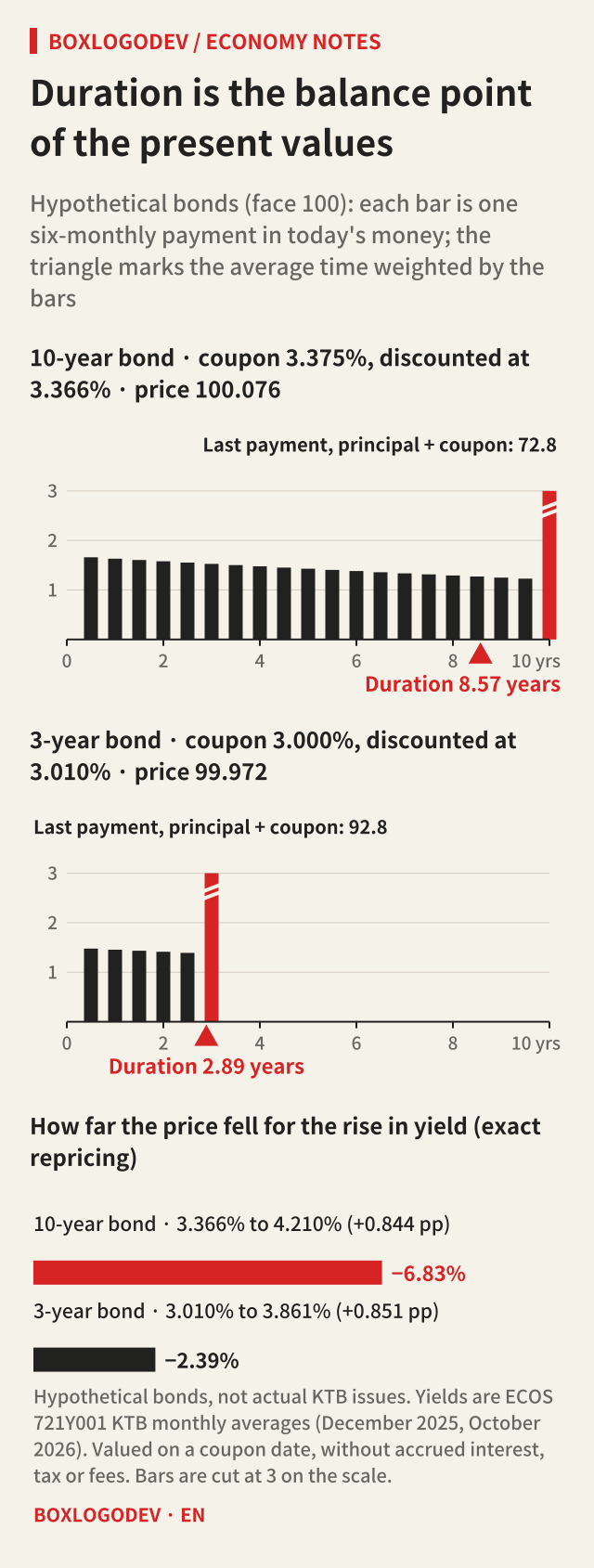
The hypothetical 10-year bond has a Macaulay duration of 8.57 years. As the bars in Figure 2 show, the 19 coupons are each worth 1.2 to 1.7 today, while the principal and last coupon in year 10 are worth 72.8 and make up most of the price, so the average time sits at 8.57 years, a little before maturity. Because discounting is half-yearly, 1+r in the formula becomes 1+0.03366/2. 8.57 ÷ 1.01683 = 8.43 is the modified duration, and −8.43 × 0.844 = −7.11% is the estimate.
The 0.28 pp gap is convexity
The exact −6.83% and the estimated −7.11% differ by 0.28 pp (0.285 pp before rounding). The duration formula replaces the price-yield relation with a straight line drawn at the starting point, a tangent. The real relation is a convex curve that lies above that line, so when yields rise the price falls less than the line says. This curvature is called convexity.
Putting the curvature into numbers almost closes the gap. Convexity takes k(k+1) × CF ÷ 1.01683^(k+2) for each k-th payment CF, adds all 20, and divides by the price of 100.076 and then by 4, the 2² that turns half-years into years. The hypothetical bond's convexity is 82.4, and ½ × 82.4 × 0.00844² ≈ 0.0029, or +0.29 pp; added to the estimate it gives −6.82%, next to the exact −6.83%. The bigger the change in yield, the bigger the gap. At 4.454% in September (+1.088 pp) the exact −8.70% and the duration estimate of −9.17% were 0.47 pp apart.
ECONOMY NOTES
The same 0.844 pp: −6.83% by exact repricing, −7.11% by the duration estimate
Hypothetical 10-year bond: face 100, coupon 3.375% a year, 1.6875 paid every six months, 20 payments
Discount at the December average, 3.366%
- Half-year rate = 3.366% ÷ 2 = 1.683%
- Price = 1.6875 ÷ 1.01683 + 1.6875 ÷ 1.01683^2 + … + 101.6875 ÷ 1.01683^20
- = 100.076
Discount again at the October average, 4.210%
- The same 20 payments at a half-year rate of 2.105% = 93.242
- 93.242 ÷ 100.076 − 1 = −6.83%
Estimate with duration
- Macaulay duration 8.57 years ÷ 1.01683 = modified duration 8.43
- −8.43 × 0.844 = −7.11%
The 0.28 pp gap is convexity
- The duration estimate is a straight tangent line; the price curve is convex and stays above it, so when yields rise the price falls less than the line says
- Adding the second-order term with convexity 82.4, +0.29 pp, gives −6.82%
- At the September peak of 4.454% (+1.088 pp): exactly −8.70%, estimate −9.17%
A hypothetical bond, not an actual KTB issue. Yields are Bank of Korea ECOS 721Y001 KTB 10-year monthly averages (read on 9 November 2026). Valued on a coupon date, without accrued interest, tax or fees. Prices are rounded to three decimal places, percentage changes and durations to two, convexity to one.
The 3-year moved less for the same rise
The same method was applied to a hypothetical 3-year bond with a coupon of 3.000% a year, paying 1.5 every six months, 6 payments. Discounted at the December 3-year average of 3.010% it is worth 99.972; at the October average of 3.861%, 97.583. The yield rose 0.851 pp, almost as much as the 10-year's, but the price fell only 2.39%.
The difference comes from duration. The 3-year bond's Macaulay duration is 2.89 years and its modified duration 2.85, about a third of the 10-year bond's. All its payments arrive within three years, so the higher yield discounts them over a shorter time. That is why, for the same rise in yield, longer bonds move more.
What to keep in mind when reading these numbers
First, both prices assume 10 years to maturity. A bond that existed in December would, by October, have ten months less to run, 9 years and 2 months, and would have paid one six-monthly coupon of 1.6875 in between. The actual gain or loss of someone holding it therefore differs from −6.83%. Second, these are monthly averages; picking particular days would give a different size of move.
Third, coupon income comes on top of the price. The hypothetical 10-year bond pays 3.375 a year, so the price drop of 6.83 (100.076 to 93.242) is about two years of coupons (3.375 × 2 = 6.75). Held to maturity, the promised coupons and the 100 of principal are paid as before; the lower price is what the bond would fetch if sold in the market now. The October price of 93.242 is also the price at which the bond's remaining payments are discounted at 4.210% a year, that is, a yield to maturity of 4.210%.
One rule is worth keeping. A bond's percentage price change is roughly minus its modified duration times the change in yield. When yields rise, the actual fall is a little smaller than this estimate, and the gap grows with the size of the rise; when yields fall, the actual gain is a little larger than the estimate. For this hypothetical 10-year bond, 0.1 pp of yield moves the price by a little over 0.8%; for the 3-year bond, by about 0.3%. As the glossary notes, a higher yield to maturity shortens duration: measured again at 4.210%, the same 10-year bond has a modified duration of 8.33 (the last line of the same script's output). Once November is over and its average is in ECOS, multiplying its difference from October's 4.210% by −8.33 gives a first estimate.
Add your perspective.
Share a question, another approach, or something you have tried.
Checking sign-in…
Loading comments…