The Bank of Korea's September 2026 weighted-average interest rates, released on 29 October, put the fixed-rate share of new mortgages in September at 34.2%. A year earlier it was 91.5%, so it fell 57.3 percentage points. Yet the fixed-rate share of the mortgages already on banks' books went only from 65.6% to 61.0% over the same period, down 4.6 points.
After this note you can gauge with arithmetic why the two move so differently, see where that arithmetic misses, and see that "fixed" in the table is wider than "fixed" in a dictionary. The figures were read from the Bank of Korea's ECOS database and release on 1 November 2026, and September is preliminary. October data are due at 12:00 on 25 November, so September is still the latest when this note goes up on 20 November. The coverage is deposit banks and the shares are by amount. This note does not tell anyone to choose fixed or variable.
Loans made this month and loans on the books
The new-loan share is a share of the amount lent that month; the outstanding share is a share of the amount still on the books at month-end. One is a flow and the other a stock.
The table since January 2013 shows how flow and stock relate. The new-loan share climbed to 96.4% in July 2024, and the stock share peaked at 66.0% in July 2025, though it had already reached 65.7% by September 2024 and moved only within 65.4–66.0% after that. The new-loan share dropped fast, from 94.0% in October 2025 to 60.8% in March 2026 and 31.9% in July. September is 34.2%. The stock share held almost flat through February 2026, at 65.4%, then fell 0.4 to 0.8 point a month from March to reach 61.0% in September. All of these are percentages.
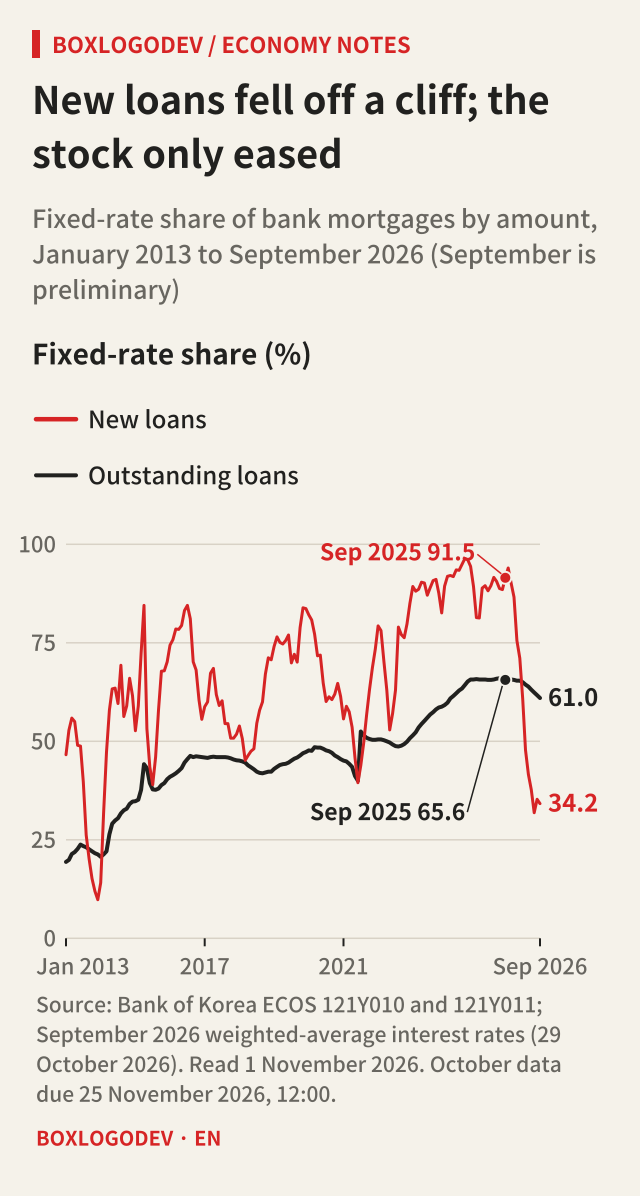
The stock share moves slowly
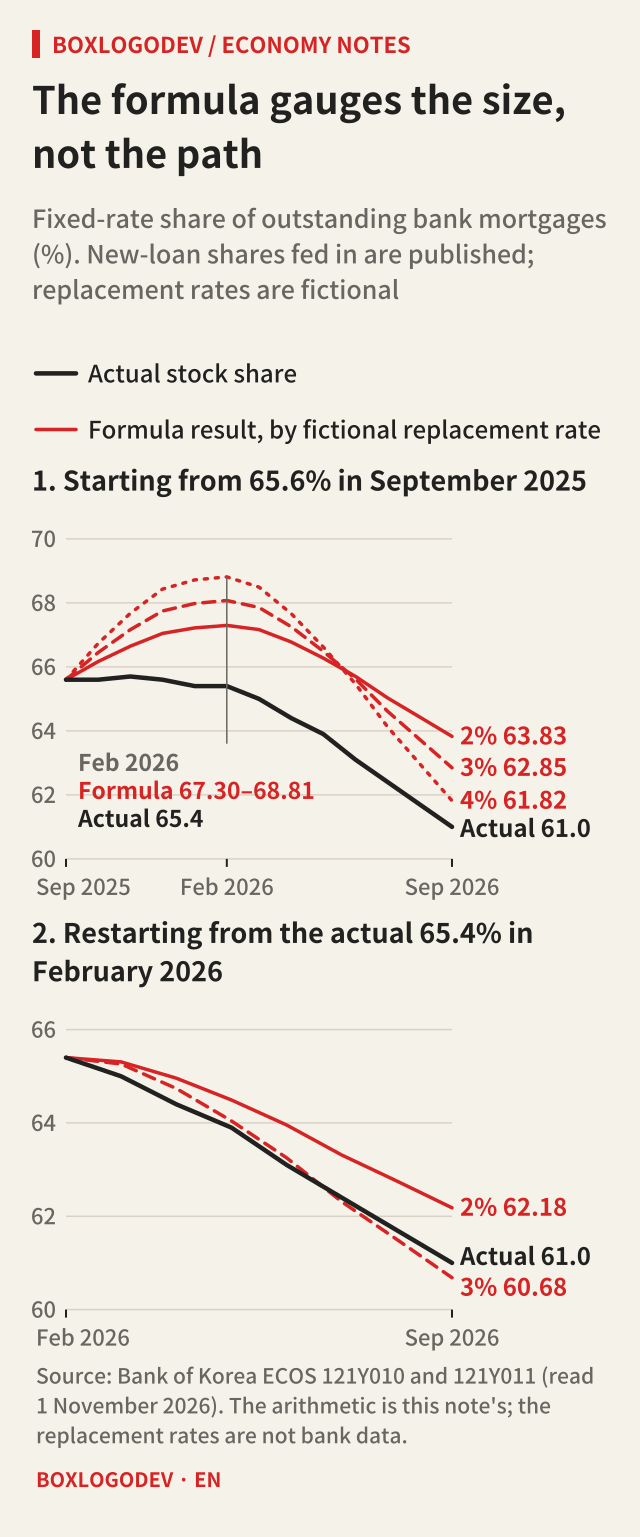
A simple formula shows why. Assume a fixed proportion of the stock is repaid each month and the same amount is lent anew. If repayment falls on fixed and variable loans in proportion, this month's stock share = last month's share × (1 − replacement rate) + new-loan share × replacement rate.
A 2% replacement rate is this note's fictional choice. Starting from 65.6% in September 2025 and feeding in October 2025's new-loan share of 94.0% gives 65.6 × 0.98 + 94.0 × 0.02 = 66.168. Run the twelve published new-loan shares in order to September 2026 (94.0, 90.2, 86.6, 75.6, 71.1, 60.8, 47.8, 41.6, 37.7, 31.9, 35.3, 34.2) and the result is 63.83%. At 3% it is 62.85% and at 4% it is 61.82%. Nothing is rounded along the way; only the final value is cut to two decimals. Even with the new-loan share down 57.3 points, a stock that turns over slowly moves only a few points. The formula gauges the size of the move, though; it does not reproduce the actual path.
ECONOMY NOTES
How the new-loan share moves the outstanding share
New-loan shares are Bank of Korea figures (%); the replacement rate is fictional · starts from 65.6% in September 2025
Inputs · new-loan fixed share, 12 months
- Oct–Dec 2025: 94.0, 90.2, 86.6
- Jan–Mar 2026: 75.6, 71.1, 60.8
- Apr–Jun 2026: 47.8, 41.6, 37.7
- Jul–Sep 2026: 31.9, 35.3, 34.2
If 2% of the stock turns over each month (fictional)
- This month = last month × 0.98 + new share × 0.02
- First month: 65.6 × 0.98 + 94.0 × 0.02 = 66.168
- Assumes repayment in proportion and equal new lending each month
Stock share after 12 months (%)
2% 63.83 · 3% 62.85 · 4% 61.82- Actual September 2026: 61.0
- No rounding along the way; two decimals at the end
The replacement rate is an assumption, not bank data. Repayment mix, the reclassification of hybrid loans and loan sales or securitisation may also move the stock share, but the public tables cannot separate them.
The actual table also has parts this formula does not explain. The actual 61.0% is below even the 4% result. On this formula the stock share should first have climbed to 67.30–68.81% by February 2026, but it was actually 65.4%. Over a longer stretch, from October 2024 to February 2026, the new-loan share ran at 71.1–94.0% for 17 months while the stock share stayed at 65.4–66.0%. Restart from the actual 65.4% in February 2026, on the other hand, and a 2% rate gives 62.18% and a 3% rate gives 60.68%, on either side of the actual 61.0%. The new-loan share went below the stock share in March 2026 (60.8%, against 65.4% the month before) for the first time since August 2021, so on the formula's logic it has been pulling the stock down for only seven months to September.
And in December 2025 and January 2026 the new-loan share (86.6% and 75.6%) was above the stock share, yet the stock share fell 0.1 and 0.2 point. Fixed-rate loans may have been repaid faster, or hybrids, covered next, may have moved to the variable side. The stock counts loans a bank holds at month-end, so loans sold or securitised after origination may also have left it; their size was not checked. These public tables cannot separate the banks' actual replacement rate and its makeup, so this is this note's reading.
"Fixed" in the table is wider than in a dictionary
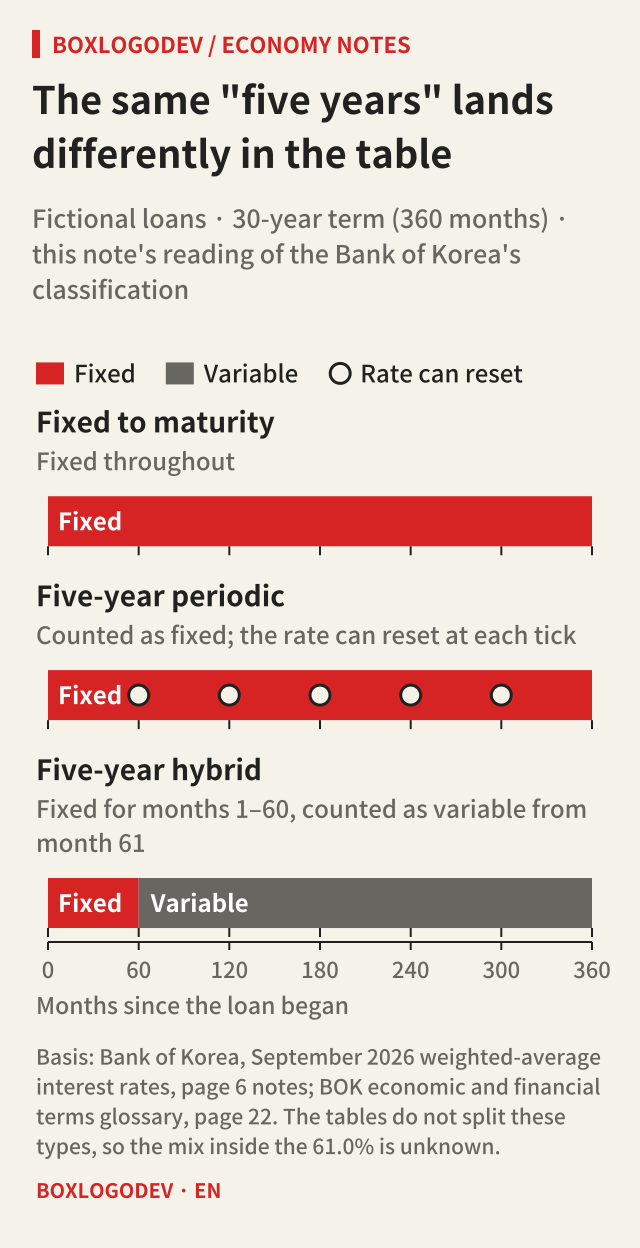
The Bank of Korea's glossary of economic and financial terms describes a fixed rate as one that stays at the first agreed level until maturity. The notes in the weighted-average release likewise describe fixed-rate loans as those whose rate does not change during the contract. But an exception follows in the same passage. Periodic loans with a cycle of five years or more count as fixed, and hybrid loans are classified, in both the new-loan and outstanding tables, by the rate terms at that date.
On fictional 30-year (360-month) loans, it reads like this. A five-year periodic loan can reset every 60 months yet counts as fixed throughout; any one rate holds for 60 ÷ 360 = 16.7% of the term. A five-year hybrid counts as fixed for the first 60 months and variable from month 61, when its rate terms change. It changes place in the outstanding table with no repayment at all.
So reading the stock's 61.0% as "61% will not change until maturity" goes too far. The public tables do not split pure fixed, periodic and hybrid loans, so the mix inside the 61.0% cannot be known from them.
Reading it with the rate tables
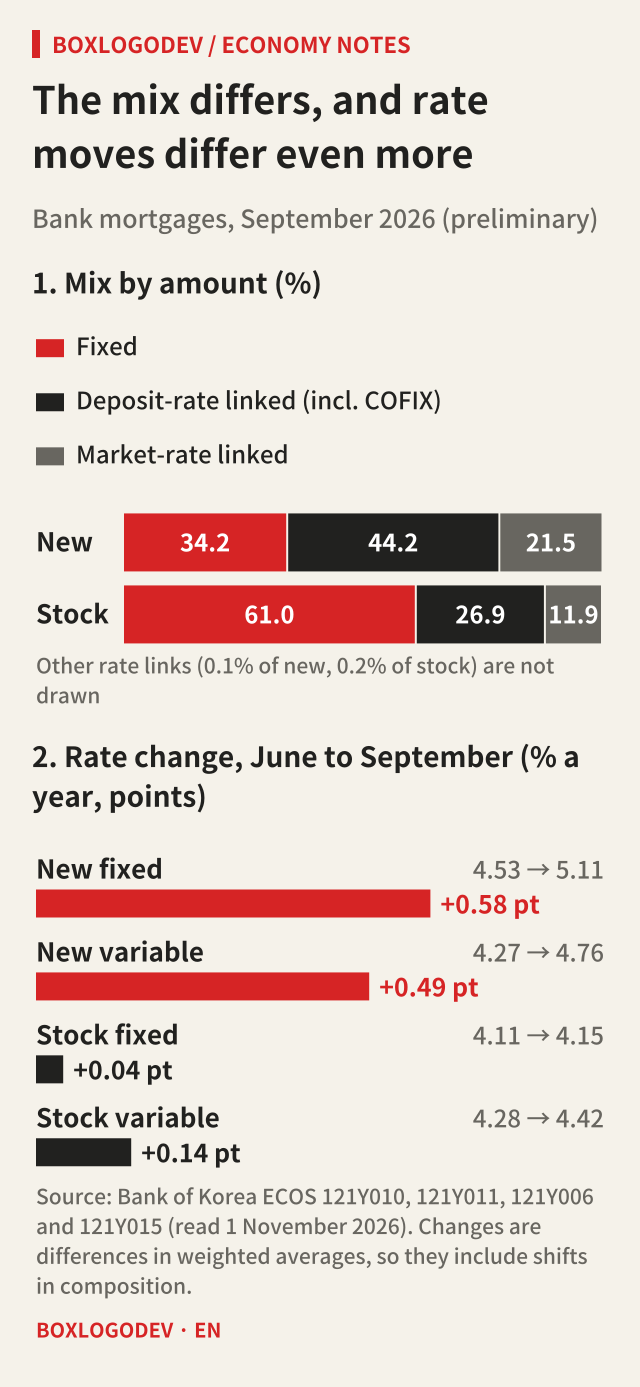
By mix, new loans were 34.2% fixed, 44.2% deposit-rate linked, 21.5% market-rate linked and 0.1% other. The stock was 61.0% fixed, 26.9% deposit-rate linked, 11.9% market-rate linked and 0.2% other. COFIX-linked loans sit inside the deposit-rate group.
Comparing September 2026 with June, the end of the previous quarter, rate changes in % a year diverge even more. New fixed-rate loans rose 0.58 point, from 4.53% to 5.11%, and new variable-rate loans rose 0.49 point, from 4.27% to 4.76%. Fixed-rate loans in the stock rose 0.04 point, from 4.11% to 4.15%, and variable-rate loans in the stock rose 0.14 point, from 4.28% to 4.42%. The September gap between new and outstanding fixed-rate loans is 0.96 point. The gap suggests that how fast a market move reaches existing borrowers depends on the makeup of the stock and on reset dates. These are weighted averages, though, so they also include changes in composition.
The release does not explain why the new-loan share fell so far. Press coverage includes Money Today's "'It's cheaper for now': borrowers flock to variable, fixed-rate mortgage share at a five-year low" (26 June 2026, in Korean), in which the Bank of Korea's financial statistics team head cited rising 5-year bank bond yields and shrinking volumes of Bogeumjari policy loans in judging a rebound in the fixed share unlikely. In the same tables, the new fixed rate was below the variable rate through March 2026 (−0.07 point in March), then moved above it from April, and was 0.35 point higher in September. The rate gap may have played a part, but the new-loan fixed share also fell from 94.0% to 60.8% between October 2025 and March 2026, while fixed loans were the cheaper ones. It cannot be pinned on the rate gap alone, and bank lending practice or policy effects do not appear in this table.
How to read a fixed-rate share
First, check whether it is the new-loan or the outstanding basis; 34.2% and 61.0% answer different questions. Second, remember that a change in the new-loan share takes time to reach the stock; put your own assumptions into the formula above for a rough size, though it will not reproduce the actual path. Third, check in your contract whether your loan is periodic or hybrid, and the date of its next rate change. That date bears on your interest more directly than which column you fall into.
October data are due at 12:00 on 25 November 2026. The data are in the Bank of Korea's September 2026 weighted-average interest rates (in Korean) and in the ECOS tables on the fixed and variable loan shares of deposit banks.
Add your perspective.
Share a question, another approach, or something you have tried.
Checking sign-in…
Loading comments…