The September COFIX posted by the Korea Federation of Banks on 15 October 2026 shows the new-funds basis rising from 3.18% to 3.43% a year, up 0.25 percentage point, and the balance basis rising from 3.05% to 3.15% a year, up 0.10 point. Both come from the same eight banks in the same month, yet one rose more than twice as much as the other.
After this note you can tell exactly what "new" means, check with arithmetic why the balance basis moves slowly, and work out how much your monthly interest changes at a reset. The figures were read on the federation's consumer portal on 1 November 2026. The October figures are due at 15:00 on 16 November, so September is still the latest figure when this note goes up on the morning of 16 November, and a newer number may be out that afternoon. The explanation works with any month's figures.
"New" means money the banks newly raised, not new loans
From the name, the new-funds basis can read like the rate for new borrowers and the balance basis like the rate for existing ones. But COFIX is not a lending rate. It measures what banks pay for funding. Eight banks (NongHyup, Shinhan, Woori, Standard Chartered Bank Korea, Hana, Industrial Bank of Korea, Kookmin and Citibank Korea) report amount-weighted rates on time deposits, instalment savings, mutual instalments, housing instalments, certificates of deposit, repurchase agreements sold, cover bills and bank debentures, excluding subordinated and convertible bonds.
The difference is what gets averaged. The new-funds basis averages the funds taken in during the month. The balance basis averages all the same products a bank holds at month-end, including deposits taken years ago at low rates if they have not matured. Which one your loan follows depends on the reference rate in your contract, not on when you borrowed.
The new balance basis (2.79% a year) adds other deposits, other borrowing and the part of settlement funds estimated to finance loans. Settlement funds such as demand deposits tend to carry low rates, which appears to pull the average down, but that is this note's inference rather than the federation's explanation. The short-term COFIX, posted weekly (the latest when read on 1 November was 3.32% a year, posted 28 October), looks only at newly taken three-month funds.
ECONOMY NOTES
Four COFIX rates, all about the banks' funding
September 2026 (short-term: 17–23 October), % a year, changes in percentage points
New-funds basis
3.43- Amount-weighted rate on funds taken in that month
- Up 0.25 point from 3.18 in August
Balance basis
3.15- Amount-weighted rate on all the same products still held at month-end
- Up 0.10 point from 3.05 in August
New balance basis
2.79- Adds other deposits, other borrowing and the settlement funds estimated to finance loans
- Up 0.08 point from 2.71 in August
Short-term
3.32- Three-month funds newly taken during one week
- Latest when read on 1 November (posted 28 October); posted weekly
Source: Korea Federation of Banks consumer portal, COFIX postings and overview; COFIX operating standard (read 1 November 2026). Eight reporting banks. These are not the rates banks charge borrowers.
Why the balance basis moves slowly
A balance average covers the whole book, so it moves only by the part that changes this month. Take a fictional bank. Its KRW 100 trillion balance averages 3.05% a year, and this month KRW 10 trillion at 2.50% matures and is refinanced at 3.43%.
The month-end average is (100 × 3.05 − 10 × 2.50 + 10 × 3.43) ÷ 100 = 3.143, or 3.14% a year, up 0.09 point. In short, with the total balance unchanged, change = share replaced × (new rate − old rate), and 10% × 0.93 = 0.093. With 20% replaced it would be about 0.19 point. The inputs are fictional, and the federation does not post the banks' actual maturity mix. The result looks close to September's actual 0.10 point only because the inputs were chosen that way; it is not an estimate of the real figure.
ECONOMY NOTES
A balance average moves only by the part replaced
A fictional bank's books · amounts in KRW trillion, rates in % a year
1 · Books at the start of the month (fictional)
100 × 3.05 = 305- Balance KRW 100 trillion, average rate 3.05%
- Sum of balance × rate = 305
2 · KRW 10 trillion matures and is replaced (fictional)
305 − 10 × 2.50 + 10 × 3.43 = 314.3- Funds at the old 2.50% leave
- Funds at the new 3.43% come in
3 · Average at month-end
314.3 ÷ 100 = 3.143- 3.14% to two decimals
- Up 0.09 point from 3.05%
In one line, with the total balance unchanged
10% × (3.43 − 2.50) = 0.093- Change = share replaced × (new rate − old rate)
- With 20% replaced, about +0.19 point
The inputs are fictional. The federation does not post the banks' maturity mix, so this is not an estimate of September's actual +0.10 point.
In the table, some months move in opposite directions
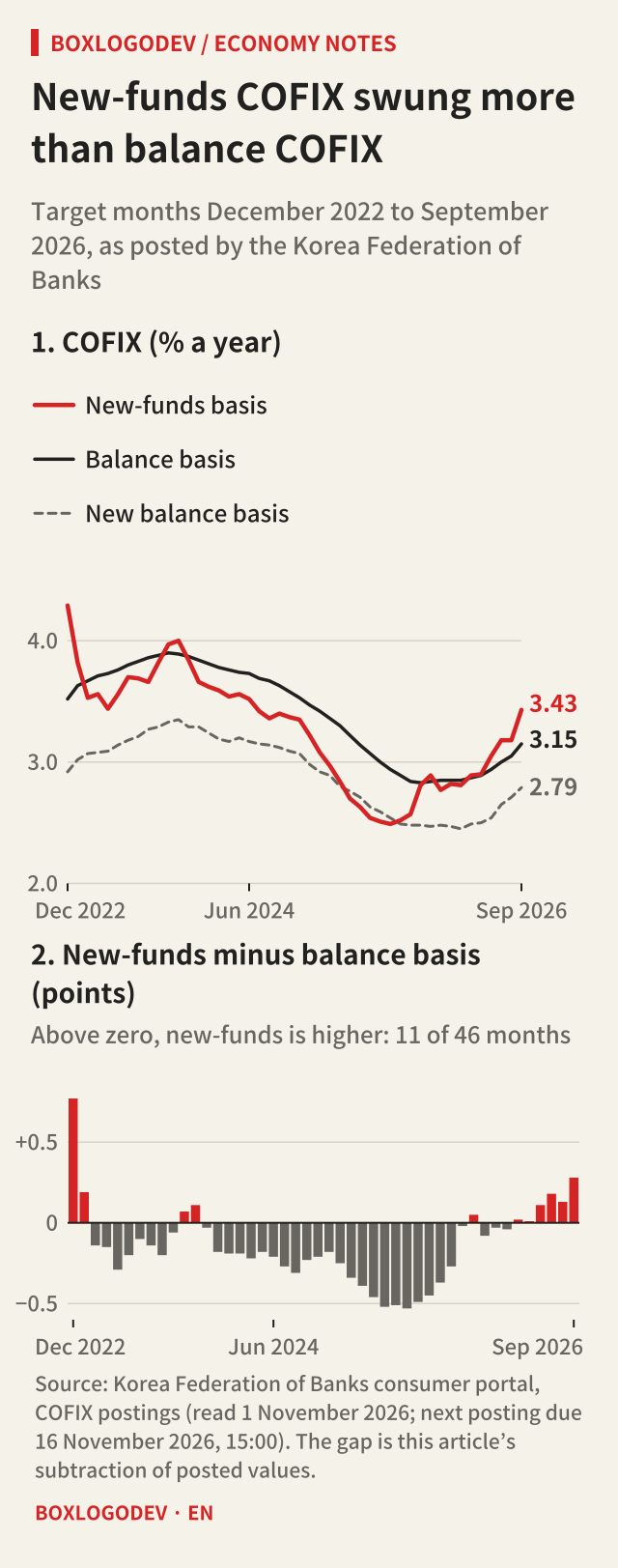
Across the 46 months from December 2022 to September 2026, read from the postings of January 2023 onward, the distance from low to high is 1.80 points for the new-funds basis (2.49% to 4.29% a year), 1.07 points for the balance basis (2.83% to 3.90%) and 0.90 point for the new balance basis (2.45% to 3.35%). These widths hold inside this window only. The new-funds basis for November 2022, the month just before it, was 4.34% a year, so a longer period gives different numbers.
Directions can also split. From August to November 2025 the new-funds basis rose 0.32 point, from 2.49% to 2.81% a year, while the balance basis fell 0.11 point, from 2.94% to 2.83%. Even as new money gets dearer, the average can fall if the funds maturing carried still higher rates. The table cannot confirm the actual mix in those months, so this too is this note's reading in light of the calculation above.
Which one is higher is not fixed either. The new-funds basis was above the balance basis in 11 of the 46 months, including six straight months from April 2026. The September gap is 0.28 point.
What it means for your own interest
Comparing levels side by side misleads. Banks can attach different margins to the two indices, so a balance basis 0.28 point lower does not make a loan that much cheaper. So look only at the change in one loan across a reset.
Here is a fictional loan: KRW 300 million outstanding, a rate reset every six months, a 1.50-point margin, principal repayment ignored. Assuming each reset uses the latest posting, then between the 15 April 2026 posting (March figures) and the 15 October posting (September figures) a new-funds loan goes from 4.31% to 4.93% a year, up 0.62 point, and a balance loan from 4.35% to 4.65%, up 0.30 point. Monthly interest is KRW 300 million × rate ÷ 12, so the new-funds loan goes from KRW 1,077,500 to 1,232,500, up 155,000, and the balance loan from KRW 1,087,500 to 1,162,500, up 75,000.
The reverse holds on the way down. Between the 15 October 2024 posting (September figures) and the 15 April 2025 posting (March figures), the new-funds basis fell 0.56 point, from 3.40% to 2.84% a year, and the balance basis fell 0.33 point, from 3.63% to 3.30%. On the same KRW 300 million that is KRW 140,000 and KRW 82,500 less a month. The two periods show the size of the moves; they do not say which index is the better one to be linked to. That depends on where rates go next, and this note recommends no product. Actual timing and reset terms differ by contract, so check yours.
ECONOMY NOTES
One loan: how much the monthly interest changes at a reset
Fictional KRW 300 million loan · six-month reset · assumed 1.50-point margin · no principal repayment
New-funds link · rising period
4.31% → 4.93%- 2.81 + 1.50 → 3.43 + 1.50 (posted April and October 2026)
- KRW 1,077,500 → 1,232,500 a month
- Up KRW 155,000 a month
Balance link · rising period
4.35% → 4.65%- 2.85 + 1.50 → 3.15 + 1.50 (posted April and October 2026)
- KRW 1,087,500 → 1,162,500 a month
- Up KRW 75,000 a month
The reverse when rates fell
- Monthly change = KRW 300 million × change ÷ 12
- Posted October 2024 → April 2025
- New funds 3.40 → 2.84: −0.56 point, KRW 140,000 less a month
- Balance 3.63 → 3.30: −0.33 point, KRW 82,500 less a month
COFIX values are the federation's postings; the loan is fictional. The equal margin is an assumption for comparison; actual margins and reset terms differ by product and contract.
COFIX is not the whole mortgage rate
COFIX is one reference rate among several. In the Bank of Korea's September 2026 weighted-average interest rates (released 29 October, preliminary; release in Korean), the new mortgage rate at deposit banks was 4.88% a year, up 0.22 point from 4.66% in August, with variable-rate loans at 4.76% and fixed-rate loans at 5.11%. By amount, new mortgages were 34.2% fixed, 44.2% linked to deposit rates, 21.5% linked to market rates and 0.1% other. COFIX-linked loans sit inside the deposit-rate group, and this table cannot separate them.
The federation's operating standard says it does not take responsibility for the accuracy of the banks' data and does not inspect their books, though it also sets a verification step against the Bank of Korea interest-rate survey data. The posted value is best read as a tally of what banks report.
How to read the next COFIX posting
First, find in your contract whether the reference rate is the new-funds, balance or new balance basis. Second, check the reset interval and the next reset date; until then your rate does not change, whatever is posted. Third, take the gap between the value used at your last reset and the value now, and calculate balance × change ÷ 12. If you repay principal in instalments, use the balance at that date.
The October figures are due at 15:00 on 16 November 2026. The data are on the Korea Federation of Banks COFIX page (in Korean), and the coverage and procedure are in the COFIX operating standard (in Korean).
Add your perspective.
Share a question, another approach, or something you have tried.
Checking sign-in…
Loading comments…