The Bank of Korea Base Rate was 2.50% and is now 3.00%. Write that it “rose 0.5%” and you are wrong; write that it “rose 20%” and the arithmetic is right. Yet the Bank's own releases describe moves like this in percentage points or basis points. Unless you know what each of the three measures, the numbers in interest-rate news keep contradicting each other.
After reading this you will be able to restate one rate move in percentage points, basis points and percent change, and you will work out on a fictional loan which of those numbers reaches the interest you pay.
The base rate is 3.00% after two hikes
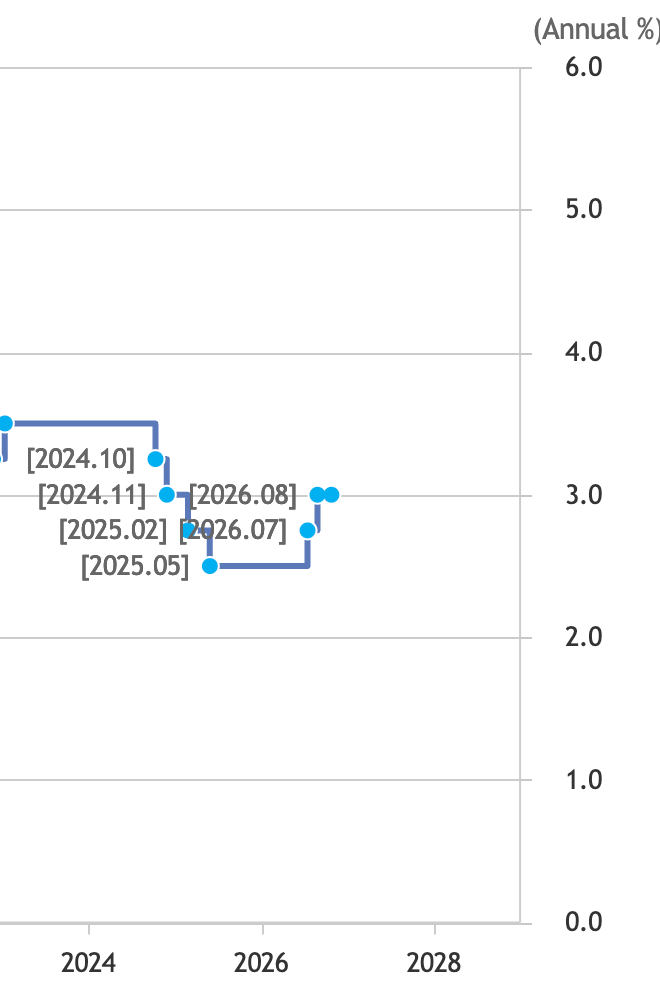
On 22 October 2026 the Bank of Korea's Monetary Policy Board left the Base Rate unchanged at 3.00%. All seven members supported the decision. The two meetings before that both raised the rate. The Base Rate had been 2.50% since 29 May 2025; it went to 2.75% on 16 July 2026 and to 3.00% on 27 August 2026.
In its October monetary policy decision, the Board said it needed to assess domestic and external risks as well as the effects of the two prior hikes. It added that it would decide the timing and pace of further increases while watching inflation, the economy and financial stability. This article does not forecast rates. It only covers how to state a move that has already happened.
The starting point is how the Bank itself wrote those two hikes. The English releases for July and August both say the Board raised the Base Rate “by 25 basis points”, and the Korean releases of the same days say “0.25%p”, the Korean shorthand for percentage points. Neither says the rate rose 0.25%.
Whose interest rate is the base rate?
The Bank of Korea's glossary of 800 economic and financial terms (2026 edition, in Korean, page 76) describes the Base Rate as the policy rate set by the Monetary Policy Board. It is the reference rate for the Bank's dealings with financial institutions, such as repurchase agreements (RPs) and its standing lending and deposit facilities. In March 2008 the policy rate changed from an overnight call rate target to the current Base Rate.
The Bank's page on the Base Rate uses basis points too. The rate on liquidity adjustment deposits is 50 bp below the Base Rate and the rate on liquidity adjustment loans is 50 bp above it. With the Base Rate at 3.00%, that gives 2.50% and 3.50%. The same page says the Base Rate has a prompt impact on the call rate, the overnight inter-bank rate, which then leads to changes in short- and long-term market rates and in deposit and loan rates. In other words, the Base Rate is not the rate a household pays on its loan. That matters again in the last calculation. And as the chart's axis says, it is an annual rate.
Percentage points are a difference, percent is a ratio
The difference between two rates is a subtraction: 3.00 − 2.50 = 0.50, measured in percentage points. It is the unit for the gap between two numbers that are themselves percentages. A basis point is 0.01 percentage point, so 0.50 point is 50 basis points. The glossary's entry on spreads (page 4) also says rate gaps are usually given in basis points, writing a 0.5% gap as 50 bp and 1% as 100 bp.
A percent change is a division: divide the increase by the starting value and multiply by 100. (3.00 − 2.50) ÷ 2.50 × 100 = 20%. The Base Rate as a number grew by a fifth, so “rose 20%” is arithmetically correct. But unless you say what you divided by, a reader can take it for percentage points.
The arithmetic also shows why “rose 0.5%” is wrong. Read as a percent change, it means the rate rose by 0.5% of 2.50%, which gives 2.50 × 1.005 = 2.5125%, not the actual 3.00%. To state the gap, write 0.5 percentage point or 50 bp; to state the ratio, write 20%. Then the two meanings never mix.
Splitting the move into its two hikes makes the difference clearer. July's 2.50% → 2.75% and August's 2.75% → 3.00% are both 0.25 point, or 25 bp. Percentage points simply add: 0.25 + 0.25 = 0.50. The percent changes are 10.0% for July and 9.09% for August, 9.1% rounded to one decimal, because the starting point had risen to 2.75%. Added together they make 19.1%, which does not match the overall 20%. Percent changes chain by multiplication: 1.10 × 1.0909 = 1.20.
ECONOMY NOTES
2.50% to 3.00%: one move, three numbers
Bank of Korea Base Rate · percent changes rounded to one decimal
1 · Inputs
- Before: 2.50%, set on 29 May 2025
- After: 3.00%, set on 27 August 2026
- Two hikes in between: 2.75% on 16 July
2 · Difference: percentage points and bp
3.00 − 2.50 = 0.50- = 0.50 percentage point = 50 bp (1 bp = 0.01 point)
- Each hike was 0.25 point (25 bp): 0.25 + 0.25 = 0.50
3 · Percent change: relative to the start
(3.00 − 2.50) ÷ 2.50 × 100 = 20%- Step by step: 10.0% and 9.1%
- Added: 19.1%. Multiplied: 1.10 × 1.0909 = 1.20
Read “rose 0.5%” literally
2.50 × 1.005 = 2.5125%- Not the actual 3.00%
- Write “0.5 percentage point” or “50 bp”
Source: Bank of Korea base-rate history (checked 25 October 2026). The point, basis-point and percent figures are this article's calculation.
The number that reaches a loan is a different one
A household loan rate is not tied to the Base Rate directly, so a 0.50-point rise in the Base Rate does not by itself lift a loan rate by 0.50 point that day. The glossary's entry on variable rates (pages 135–136) describes a variable rate as one that resets at fixed intervals to reflect market rates, with an example contract of the CD rate plus 0.5% (or 50 bp). It says the reference rate used to be mainly the CD rate, and that COFIX and bank bond yields are now widely used as well.
COFIX (glossary page 261) is an index of the average cost of the funds banks raise. The Korea Federation of Banks publishes it as a weighted average, by amount, of the rates on deposit products such as time deposits, installment savings and certificates of deposit at eight domestic banks. A loan rate is that reference rate plus a spread, and the reference rate follows market rates, so there is no guarantee it moves by the same amount or at the same time as the Base Rate. On a loan that resets every three months, the rate also changes only on those reset dates.
The calculation below therefore makes one assumption. In a fictional variable-rate loan, the reference rate rises by exactly the same 0.50 point as the Base Rate and the spread stays the same, so the loan rate goes from 4.00% to 4.50%. The balance is 100 million won and only interest is paid. Rates are annual, so monthly interest here is yearly interest divided by 12, rounded to the won. A real bank's interest calculation can be more involved.
At 4.00% the yearly interest is 4 million won and the monthly interest is 333,333.33 won, or 333,333 won. At 4.50% the yearly interest is 4.5 million won and the monthly interest is 375,000 won. That is 41,667 won more a month and 500,000 won more a year. The change in interest is 0.50 ÷ 4.00 × 100 = 12.5%, not the 20% of the Base Rate, because the divisor is this loan's rate of 4.00, not 2.50.
ECONOMY NOTES
The same 0.50 point is 12.5% on a fictional loan
Fictional example: 100 million won, interest only, variable rate · monthly interest = yearly ÷ 12, rounded to the won
Assumption
- The loan's reference rate is assumed to rise by the same 0.50 point
- The spread stays the same: loan rate 4.00% → 4.50%
Monthly interest
100,000,000 × r ÷ 12- 4.00%: 333,333 won (333,333.33 rounded)
- 4.50%: 375,000 won
- Difference: 41,667 won a month, 500,000 won a year
Percent change in interest
0.50 ÷ 4.00 × 100 = 12.5%- Not the 20% of the base rate
- The same 0.50 point is 16.7% on 3.00% and 8.3% on 6.00%
Fictional example. Real variable-rate loans follow reference rates such as COFIX or bank bond yields, which can move by a different amount and at a different time.
One step to turn a headline into your interest
When rate news says “up 0.25 percentage point” or “up 25 bp”, divide that number of points by your own loan rate and multiply by 100. If your reference rate moved by the same amount, the result is the percentage by which your interest rises. The same 0.50 point raises interest by 16.7% on a 3.00% loan and by 8.3% on a 6.00% loan. The lower the rate, the larger the percentage the same points make.
Next, check your loan contract for its reference rate (COFIX, a bank bond yield or another) and its reset interval, and you can judge roughly when and how much a Base Rate change will reach your interest. This article does not recommend any loan product or a choice between fixed and variable rates. The decision itself is at Bank of Korea, Monetary Policy Decision (22 October 2026), and the rate history is on the Bank of Korea Base Rate page.
Add your perspective.
Share a question, another approach, or something you have tried.
Checking sign-in…
Loading comments…